
Text resize: A A
Change contrast

Hot Topics

Tracing 700 years of Armenian heritage in Poland

Cemeteries, khachkars, churches and bakeries all point to the Armenian presence in Poland that stretches far back to medieval times. Though often overlooked, Armenian communities once played a vital role in trade, diplomacy and culture, traces of which remain in cities dotted around Poland. A new wave of Armenian migration is mixing with the “Old Polish Armenian” communities, adding a fresh influence to the enduring legacy of Armenian heritage in Poland.

February 28, 2025 - Ottilie Tabberer

Polish language and nation: a rather recent pairing

Standing fast by Poland’s national “master narrative”, the country’s schools teach that the Polish nation, defined as all the speakers of the Polish language, is a millennium old. Yet, this pairing of the Polish nation and language dates back only to the late 19th century.

In Polish popular opinion, the view that the Polish nation consists of all the speakers of the Polish language is not controversial. Hence, the Polish speech community is unreflectively equated with the Polish nation. In turn, all the territories where speakers of Polish reside compactly are deemed to rightfully constitute the Polish nation-state. 

February 28, 2025 - Tomasz Kamusella

Multiculturalism in the Balkans. Prospects and perils

In the Balkans, multiculturalism has come to represent a defining feature and a cause of conflict simultaneously. The region, shaped by centuries of migrations, conquests, political upheavals and civil wars, with its complex mix of cultural diversity and political instability, serves as a global example of the failure of multicultural policies. Consequently, “Balkanism” and “Balkanization” have emerged as technical terms denoting conflict driven by identity-based fragmentation.

Multiculturalism refers to 1) the coexistence of diverse cultural, ethnic and religious communities within a society, and 2) the social and political theory that promotes cultural diversity. It uses legal and administrative logic that seeks to regulate the coexistence of different cultures within a polity, as well as social theory that addresses the plurality of perspectives on society, the state, science, education and culture itself. It is most commonly understood in two primary ways: descriptively, as a characterization of cultural diversity, and normatively, as a theory asserting that culture plays a significant role in politics and as a practice of granting culturally distinct groups (for instance, minorities) certain special rights. Ideally, it seeks to enable their full equality. In this sense, multiculturalism has captivated generations of academic authors, journalists, politicians, NGO workers and human rights advocates. 

February 28, 2025 - Miloš Milenković

From civic-minded, multinational Vojvodina to patriotic, nationalist northern Serbia

Vojvodina and its capital Novi Sad had been a multicultural region that once enjoyed significant autonomy from Belgrade. Sadly, it became the consolation prize that Serbian nationalists received in exchange for an independent Kosovo. Anything that deviates from the narrow framework of Serbian nationalism is now considered separatism in Vojvodina.

The Serbian region of Vojvodina – once a civic, multicultural and economic phenomenon – is rapidly being destroyed politically. In February of last year, the region remembered 50 years since the adoption of the Constitution of the Socialist Autonomous Province of Vojvodina in the former Yugoslavia. At that time, Vojvodina had its own judicial, legislative and executive authorities. It had its own financial revenues. Like Kosovo, Vojvodina had almost all the elements of a republic, but it was still a part of Serbia. During the 1980s, Vojvodina was one of the most developed parts of socialist Yugoslavia in terms of GDP, after Slovenia and Croatia. 

February 28, 2025 - Boris Varga

“We rolled out a red carpet for a war of aggression”

Interview with Gabrielius Landsbergis, the former foreign minister of Lithuania. Interviewer: Robert Finch.

February 14, 2025 - Gabrielius Landsbergis Robert Finch

For your freedom and ours: Georgia at the edge of the abyss

An open letter and call for action and solidarity with the Georgian people

December 20, 2024 - New Eastern Europe

Georgian democracy at risk. How you can support

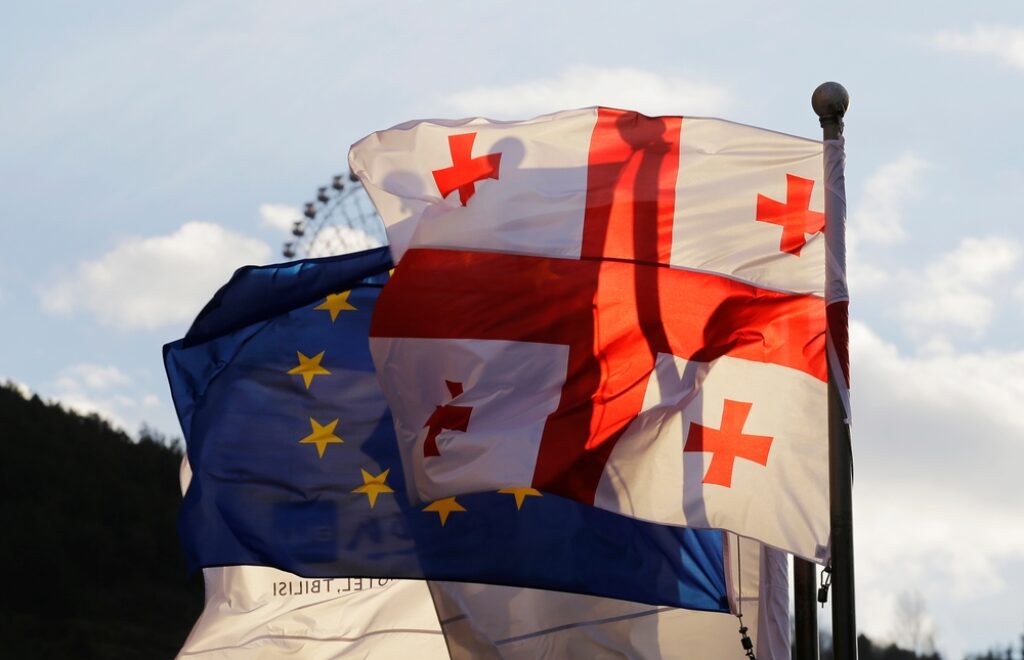
Ever since the October 26th 2024 elections and the subsequent announcement by Georgia’s ruling party that the country will no longer seek EU membership until at least 2028, the Georgia society has taken to the streets to protest. The response from the government has been a crackdown and repressive actions against the protesters, whose numbers are growing.

December 20, 2024 - New Eastern Europe

Georgian Dream turns into Georgian Nightmare: election fraud, escalating protests, and a confrontation with the EU

The unrest that erupted in Georgia following the recent parliamentary elections shows no sign of ending. As the Georgian Dream government comes under increasing pressure, the country now stands at a crossroads regarding not only its democracy but also its place in the world.

December 19, 2024 - Lasha Gamjashvili

An open letter from Georgia

New Eastern Europe received this open letter from one of our contributors based in Georgia. We are republishing it here in support of Georgian society and in an effort to help raise awareness of the situation that is taking place there.

December 7, 2024 - Nino Lezhava

Europe in the age of uncertainty

As long as we have different narratives concerning the real meaning of Russia’s war in Ukraine, the European Union will not be able to act as a coherent and pro-active geopolitical player. The EU should attempt to find a common language to talk about the war and its implications. Only then will we be able to uphold security across the continent, both for ourselves and our partners.

The recent meeting of the UN General Assembly proved to be a focal point for all the uncertainties the world is currently facing: the ineffectiveness of multilateralism; impunity for aggression and violations of international law; and increasing problems related to climate change and sustainable development goals. In short, the international rules-based order as perceived in the West is under threat with major uncertainties as a consequence.

November 22, 2024 - Tony van der Togt

The uncertain conclusion to Russia’s war in Ukraine

As Ukraine continues its resistance against Russian aggression, discussions about the potential end of the war have sparked numerous debates throughout the international community. While many are eager for a swift resolution to the conflict, Ukraine has every right to be concerned about how the war will end.

The dialogue between Ukraine and some western partners was complicated in the early stages of the full-scale war. As President Volodymyr Zelenskyy repeatedly emphasized, Ukraine is unwilling to give up any of its territories to achieve peace. He often referred to the moral aspect of the issue, even if some believed that it was not realistic. He stressed that Ukrainians living in the occupied territories are suffering under Russian occupation and enduring torture and human rights abuses.

November 22, 2024 - Sofia Oliinyk

There will be no peace in Europe with Putin in power

A conversation with Borja Lasheras, advisor on Ukraine to Joseph Borrell, the High Representative of the European Union for Foreign Affairs and Security Policy. Interviewer: Iwona Reichardt

November 22, 2024 - Borja Lasheras Iwona Reichardt

Partners

Terms of Use | Cookie policy | Copyryight 2026 Kolegium Europy Wschodniej im. Jana Nowaka-Jeziorańskiego 31-153 Kraków
Agencja digital: hauerpower studio krakow.
We use cookies to personalise content and ads, to provide social media features and to analyse our traffic. We also share information about your use of our site with our social media, advertising and analytics partners. View more
Cookies settings
Accept
Decline
Privacy & Cookie policy
Privacy & Cookies policy
Cookie name Active
Poniższa Polityka Prywatności – klauzule informacyjne dotyczące przetwarzania danych osobowych w związku z korzystaniem z serwisu internetowego https://neweasterneurope.eu/ lub usług dostępnych za jego pośrednictwem Polityka Prywatności zawiera informacje wymagane przez przepisy Rozporządzenia Parlamentu Europejskiego i Rady 2016/679 w sprawie ochrony osób fizycznych w związku z przetwarzaniem danych osobowych i w sprawie swobodnego przepływu takich danych oraz uchylenia dyrektywy 95/46/WE (RODO). Całość do przeczytania pod tym linkiem
Save settings
Cookies settings