
Text resize: A A
Change contrast

Hot Topics

With a view to the Baltic Sea

Our geopolitical imagination, which until recently was stretched along the East-West axis, has now gained a new dimension – the North. This new perception is becoming the impetus for economic as well as demographic changes that are taking place along the Polish coast.

The city of Gdańsk, one of the largest port cities in Europe, reached the height of its power at the turn of the 17th century. During this period, it held the prestigious status of a royal city, enjoying extensive autonomy and maintaining its own naval fleet. In return for loyalty and financial support, the Polish kings granted the city numerous privileges. Thanks to its location on the Baltic Sea and at the mouth of the Vistula river, Gdańsk controlled the trade in grain, timber and salt.

July 8, 2025 - Piotr Leszczyński

Never before have we been so secure as today

“Two major developments have significantly strengthened Latvia’s security: its own accession to NATO and, more recently, the accession of Finland and Sweden to the Alliance.” This comparison was made by the former commander of the Latvian armed forces, Raimonds Graube (1999–2003, 2010–2017). Similarly, Latvia’s former defence minister, Imants Lieģis (2009–2010), remarked on the anniversary of Latvia’s accession to NATO – and on the eve of Finland and Sweden’s membership – that “never before in Latvia’s history have we been so secure as today”.

July 8, 2025 - Elizabete Vizgunova-Vikmane

Denmark: A small nation rethinking its security

On March 6th 2022, two weeks after Russia’s full-scale invasion of Ukraine had begun, Danish Prime Minister Mette Frederiksen announced a referendum on lifting the opt-out on Denmark’s participation in EU defence cooperation. The vote, held on June 1st, marked the end of one the four opt-outs that Copenhagen negotiated to convince their citizens to accept the Maastricht Treaty.

July 8, 2025 - Miłosz J. Cordes

A Baltic triangle

The dispute over where the geographical centre of Europe lies has been ongoing for centuries. Central European countries such as the Czech Republic, Slovakia and Hungary – as well as Baltic Sea neighbours like Poland, Lithuania, Estonia and Sweden – have all laid claim to this symbolic status. While there are rational arguments behind each of these claims, viewing the region solely through the prism of geographic centrality is insufficient.

July 8, 2025 - Aleksandra Kuczyńska-Zonik

A German perspective on security and stability in the Baltic Sea

As seen from Berlin, Sweden and Finland’s accession to NATO significantly enhances security in the Baltic Sea region and the wider Euro-Atlantic area. This is especially true given the renewed uncertainty and geopolitical tensions in the region as a spillover from Russia’s aggression against Ukraine.

July 8, 2025 - Thomas Michael Linsenmaier

Putin’s gift to NATO: the rise of the “New Nordic Shield”

When former Finnish President Sauli Niinistö said, “You caused this. Look in the mirror” in 2022, he really hit the nail on the head. That simple statement perfectly sums up the massive shake-up in European security. Putin's full-scale invasion of Ukraine was meant to fracture the Alliance and stop NATO from growing.
July 5, 2025 - Inga Samoškaitė

Ukraine’s capital under attack

As the world looks away, Russia’s war creeps back to Kyiv.

July 1, 2025 - Joshua Kroeker

NATO must pivot East – or risk irrelevance

History is littered with alliances that failed to adapt – so NATO must reorient to the East, where threats are real and commitments strongest.

June 23, 2025 - Dan Perry Mihai Razvan Ungureanu

Zelenskyy has a lot of cards

An interview with Major General Mick Ryan. Interview by Robert Finch

June 9, 2025 - Mick Ryan Robert Finch

Collectively, we are losing this war

An interview with Serhiy Sydorenko, editor of European Pravda. Interviewers: Adam Reichardt and Iwona Reichardt, New Eastern Europe

May 6, 2025 - New Eastern Europe Serhiy Sydorenko

Russia’s war is undermining the world order

Since 2014, Moscow has been transforming global affairs in the interests of international revisionism. This has already caused considerable damage to international law and the global rules-based order. In fact, the political implications of Russia’s attack reach far beyond Ukraine and Eastern Europe.

Going into its 11th year of war against Ukraine, the results of Russia’s attack on its alleged “brother nation” are ambiguous for the Kremlin. On the one hand, its image as a supposed military superpower has suffered greatly. Since 2022 the war has become an international embarrassment for the Russian leadership, army and weapons industry. Moscow’s campaign in Ukraine also led to the loss of western partners, markets and investors.

May 6, 2025 - Andreas Umland

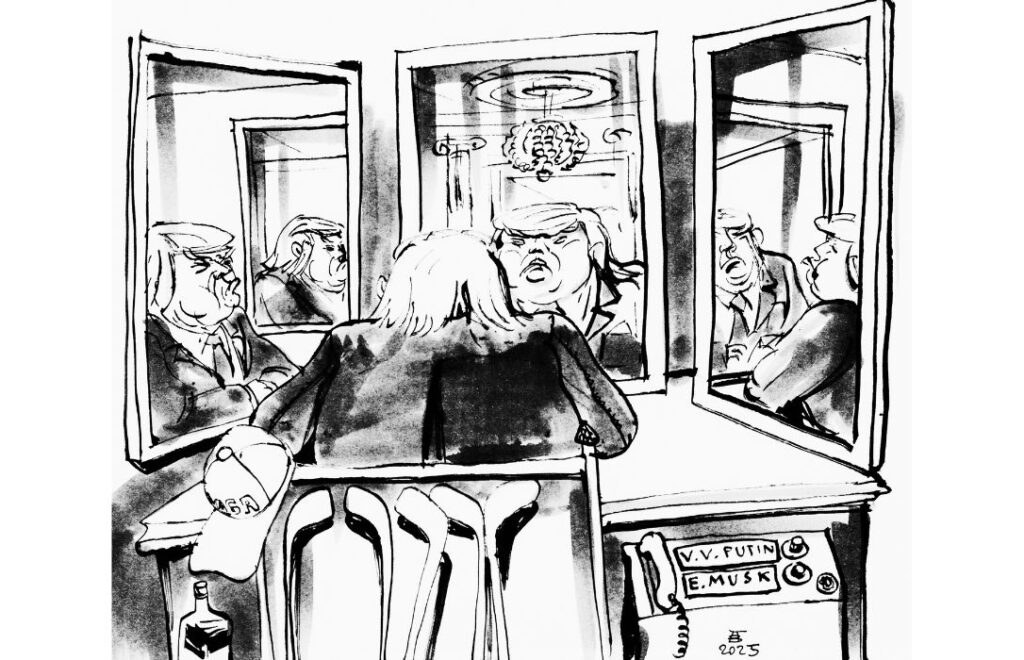
Trump’s new political technology

It’s bad enough that Trump lives, to use Volodymyr Zelenskyy’s words, “in this disinformation space”. Countries like Ukraine have to cope with Trump imposing his virtual reality on the rest of us.

In 2023 I finished my book Political Technology: The Globalisation of Political Manipulation (see: www.politicaltechnology.blog). While the phrase is well known in Russia and throughout the post-Soviet world, which is my area of interest, it is not so much heard in the West. However, when properly defined – and my definition is “the supply-side engineering of the political system for partisan advantage” – plenty of examples can be found in the West. Spin doctors do more than spin the mediatization of politics.

May 6, 2025 - Andrew Wilson

Partners

Terms of Use | Cookie policy | Copyryight 2026 Kolegium Europy Wschodniej im. Jana Nowaka-Jeziorańskiego 31-153 Kraków
Agencja digital: hauerpower studio krakow.
We use cookies to personalise content and ads, to provide social media features and to analyse our traffic. We also share information about your use of our site with our social media, advertising and analytics partners. View more
Cookies settings
Accept
Decline
Privacy & Cookie policy
Privacy & Cookies policy
Cookie name Active
Poniższa Polityka Prywatności – klauzule informacyjne dotyczące przetwarzania danych osobowych w związku z korzystaniem z serwisu internetowego https://neweasterneurope.eu/ lub usług dostępnych za jego pośrednictwem Polityka Prywatności zawiera informacje wymagane przez przepisy Rozporządzenia Parlamentu Europejskiego i Rady 2016/679 w sprawie ochrony osób fizycznych w związku z przetwarzaniem danych osobowych i w sprawie swobodnego przepływu takich danych oraz uchylenia dyrektywy 95/46/WE (RODO). Całość do przeczytania pod tym linkiem
Save settings
Cookies settings