
Is NATO prepared to collectively defend its allies?
NATO wants its member states to spend more on their militaries, but governments need public support. While Russia’s invasion of Ukraine is a pivotal moment for both East and West, threat perceptions continue to differ. For current and future western governments to get public support for increased military spending, they need to explain the new threat environment now.
Russia’s full-scale invasion of Ukraine has brought about a paradigm shift in western security and defence policy. A new kinetic war on the European continent has revived NATO. Its member states are adapting strategies and strengthening the Eastern Flank. We are witnesses to historic changes. Whether allies are willing and able to defend NATO territory depends on capabilities and political willingness. However, preparing for war tomorrow means investing in military capabilities and public awareness today.
July 4, 2023 -
Marta Prochwicz-Jazowska
-
Hot TopicsIssue 3-4 2023Magazine
Photo: Gints Ivuskans / Shutterstock
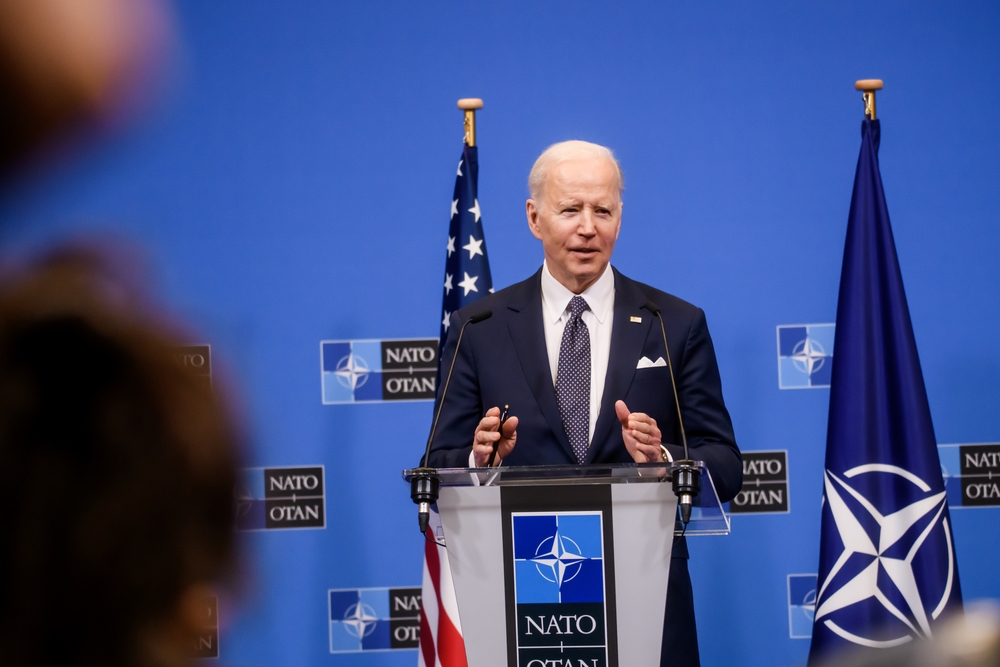
NATO is preparing for large-scale war in Europe
Shock at the scale, intensity and brutality of the Russian invasion has caused a shift in perceptions of Russia. In its new strategic concept adopted in Madrid in 2022, NATO identified Russia as a primary threat. The document states that “We cannot discount the possibility of an attack against Allies’ sovereignty and territorial integrity.” Therefore, the Alliance is now gradually working to re-enable its capabilities to be able to act immediately in response to any aggression. This requires more boots on the ground in sensitive areas in Eastern Europe, an improved command and control system, the storage of equipment and ammunition, and the ability to rapidly reinforce front line troops with additional forces. According to current plans, the NATO Response Force will be increased to 300,000 troops. It will be linked to 800,000 more soldiers in three tiers of combat readiness, capable of defending allied territory against Russia.

NATO and its member states moved fast. Four additional battlegroups were set up in Slovakia, Hungary, Romania and Bulgaria. Existing ones have also been reinforced. Germany sent 350 additional troops to Lithuania. Canada and Spain deployed 200 and 250 troops respectively to Latvia. The United Kingdom increased its presence in Estonia to 1,700 troops and moved an extra 350 on a bilateral basis to Poland. The number of US soldiers in Poland doubled, and in Romania tripled. The US army garrison in Poland is the first military institution of this type set up by the US on NATO’s Eastern Flank.
Aside from manpower, defence spending is going up across the entire continent. Poland is gearing up to spend over four per cent of its GDP on defence and wants to become a “provider of security” that can repel a Russian attack from the very first moments of a conflict without any allied support, which would likely come with a delay. What is more, the Alliance is stronger and better prepared thanks to its newest member, Finland.
Only as strong as the sum of its parts
The Madrid document, however, is only a framework which needs to be filled with more specific actions. We need a bigger boat and member states are not moving fast enough. Eastern Europeans are hoping for further decisions and announcements of more deployments at the upcoming NATO summit in Vilnius. Years of defence cuts have led to lost capabilities. Munition stockpiles and weapons are low. While the United States and the European Union plan to acquire more and produce more, the replenishment process will take time. Getting industry tooled up for wartime production will be a long process that will take years.
In every member state, except the US, the process of producing the necessary forces to deploy on the Eastern Flank will be lengthy and may encounter staff, equipment and financial challenges. Currently, only eight out of 31 NATO countries spend the agreed minimum of two per cent of GDP on defence. Defence budgets will not be pulled out of thin air. With a deteriorating economic situation, societies are more reluctant to make sacrifices after the pandemic. This necessitates two things: governments in Western Europe need to explain to their publics why investing in military capabilities is necessary and those further east need to do a better job at maintaining good bilateral relations with their key NATO allies.
Collective self-defence is enshrined at NATO’s very core. Article Five of the North Atlantic Treaty directly states that “an armed attack against one or more of them in Europe or North America shall be considered an attack against them all.” Declared political willingness to defend “every inch of NATO territory” has gone hand in hand with developments in member state rhetoric vis-à-vis Russia, the strengthening of the Eastern Flank, sanctions and the severing of ties with Russia. The United States has returned as a transatlantic player and guarantor of European security. The new US National Security Strategy, on top of its commitment to Article Five, declares that the United States will “deter and, as necessary, respond to Russian actions that threaten core US interests, including Russian attacks on our infrastructure and our democracy”. Its nuclear deterrence strategy assumes that US nuclear weapons will serve to defend the vital interests of its allies.
The 2024 election in the United States will be a serious test of the country’s resolve for supporting Ukraine and maintaining forces in Europe. Europe needs to be able to defend itself. Germany’s announcement of a Zeitenwende and its delivery of weapons to Ukraine are a fundamental shift in military doctrine and foreign and security policy. Yet, the plan to revive Germany’s military is very ambitious and has yet to materialise. NATO wants its member states to spend more on the military, but governments need public support. While the war in Ukraine is a pivotal moment for both East and West, threat perceptions continue to differ. For current and future western governments to get public support for increased military spending, they need to explain the new threat environment now.
Are NATO member states in danger?
Assessing the threat environment requires looking at the facts on the ground, the enemy’s military doctrine as well as past behaviour. In the short term, NATO member states should mostly be prepared for spill over from Ukraine. Ukraine has managed to push the invader back from part of its territory, but the fight continues and there is potential for escalation. Polish citizens were victims of stray missiles landing in NATO territory late last year. A Russian cruise missile fired at Ukraine in December 2022 landed in Western Poland. Luckily, it contained no explosives.
Ukraine is not the only hot spot in Europe. Thousands of Russian troops are also stationed in Transnistria, Moldova and pose a threat to neighbouring Romania. The leader of Belarus is controlled by the Kremlin. And as soon as Finland joined NATO, Russia reinforced its troops near its Finnish border. Assessing the threat level also means evaluating Vladimir Putin’s intentions. Some experts say he may at some point use an “escalate to de-escalate” strategy, which involves non-conventional warfare tactics. Chemical weapons could either be used in military actions or on civilian targets in Ukraine. Although highly unlikely, Russia could use tactical nuclear weapons.
The study of Russian foreign policy shows us that Russia is trying to establish a European sphere of influence. To achieve its goals, the state wages a hybrid war and has repeatedly invaded its neighbours using kinetic warfare (Georgia 2008, Ukraine 2014 and 2022). Sadly, the threat of direct aggression from the Russian Federation to NATO member states will increase in the long term. If there is a stalemate and some Russian troops remain in Ukraine, over a period of five years or more, Russia will reconstitute its forces and attempt another incursion into Ukraine. In the case of a Ukrainian victory, Russia will be destabilised, perhaps even fragmented, and continue to jeopardise security in the region. Especially if China is supporting it economically and therefore controlling it politically.
On paper and in rhetoric, western countries are committed to NATO and the defence of its territory. The level of preparedness and readiness to engage in war over NATO allies on the Eastern Flank will depend on the scale, timing and type of potential attack. February 22nd 2022 was a wake-up call. Yet at NATO’s upcoming Vilnius summit, NATO’s new strategic concept and model of deterrence and defence needs to turn from plan into action. Member states will only be able to muster resources for defence if people understand Europe’s new threat environment. This is the role of current and future governments.
Marta Prochwicz-Jazowska is an expert with the German Marshall Fund’s Warsaw office.