
Text resize: A A
Change contrast

A common red line? Limits of European engagement in Russia’s war against Ukraine

The Russian war against Ukraine has substantially changed perceptions of conflict and crisis in the European Union. As a recent comparison study shows, the conflict has encouraged fears of war, awareness of developments in Ukraine, questions concerning the broader frame of this war, and the involvement of the respective countries in it.

November 19, 2023 - Christos Katsioulis - AnalysisIssue 6 2023Magazine

Photo: tilialucida /Shutterstock

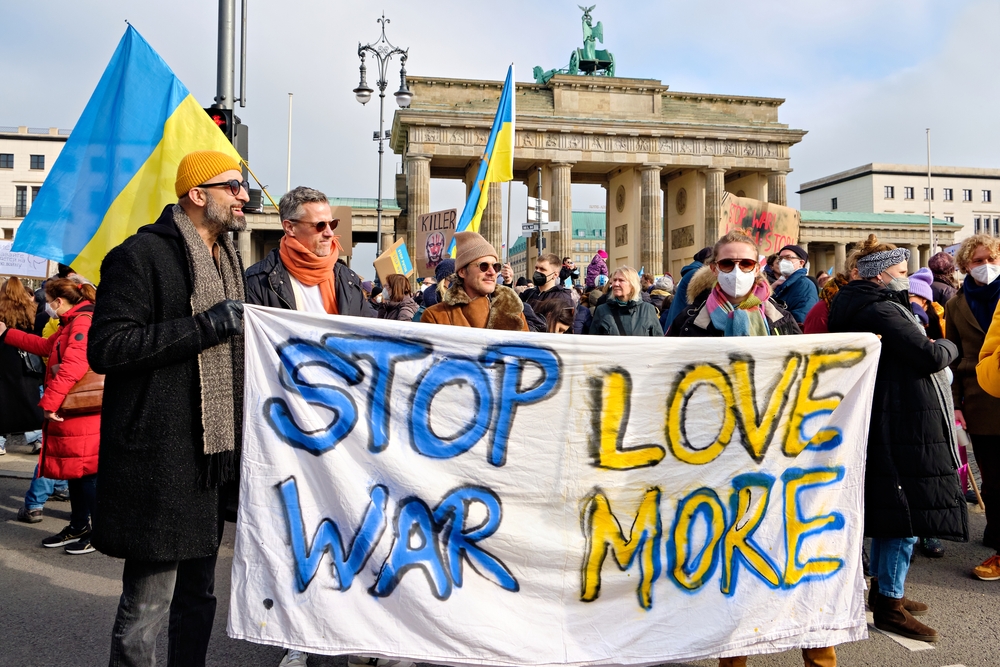
A major war is taking place in Europe. Russia’s unprovoked attack on Ukraine on February 24th 2022 has brought the dangers of war back to the continent. More than a year into this war, questions are now being asked concerning Europeans’ role in it. Currently, they support the Ukrainian defence by sanctioning and isolating Russia, delivering weapons to Ukraine and supporting the country financially. However, the provision of weapons includes the risk of Russian escalation against the supporting states, even by accident, as we were sharply reminded when a missile fell on Polish soil in November 2022. One of the defining factors in the ongoing war will be the sustainability of European support for Ukraine, which rests on popular consent.

Looking at polling numbers in several EU member states can help us understand the potential, but also the limits of this support. This analysis concentrates on German, French, Polish and Latvian perceptions of the Russian war against Ukraine, based on two surveys conducted in September 2021 and September 2022. These show how the war has encouraged a common threat perception and similar awareness of dangers.

New fears and a new awareness

The Russian war has had a considerable effect on citizens’ fears and concerns in the four countries. The probability of new wars in Europe has risen especially in the eyes of EU citizens. This is most significant in France and Germany. In both countries the level of concern about new wars in Europe nearly doubled between the two surveys. The same applies to concerns about a direct military confrontation between Russia and the West. The possibility of a major interstate war has clearly become more salient to the citizens of Europe. This helps us understand the major political changes in German and French foreign policy towards Russia and Ukraine. In Berlin’s case, this has been conducted under the banner of Zeitenwende – a turning point.

Nonetheless, there are differences within Europe. The threat of a direct military confrontation with Russia seems more likely for respondents in Latvia and Poland, where the level of concern reaches approximately 60 per cent. At the same time, in France and Germany it remains a little lower, at around 50 per cent. We also see changing perceptions of Russia and Ukraine after the Russian attack. One key conclusion from comparing 2021 and 2022 is that more people now have an informed opinion on questions surrounding Ukraine. In 2021 the share of respondents answering “don’t know” to questions on the nature of and responsibility for the conflict was around 20 per cent, while in 2022 the share halved to about ten per cent.

What emerges from these observations is a broadly shared conflict perception among the four EU members that holds Russia responsible for the war. In all four states a relative (and sometimes absolute) majority believes that third countries should not stay out of this conflict. This leads to the question of what kind of intervention is deemed acceptable.

Regarding tools of engagement, we examined a series of instruments ranging from widening sanctions, a ban on Russian oil and gas, more weapons deliveries and finally the potential deployment of soldiers in Ukraine. Overall, there is broad support for more sanctions on Russia, with all countries showing absolute majorities agreeing with such a measure. A similar picture emerges on the broader issue of countries’ dependence on Russia after the attack. There is clear majority support for becoming more independent, even if this has effects on living standards.

A different picture is discernible regarding more robust support for Ukraine that goes beyond economic means. The question of providing more weapons to the Ukrainian military finds the four countries rather divided. This instrument of support is thus politically contested. But there is a clear red line when it comes to sending troops to Ukraine. Respondents in all four countries polled overwhelmingly oppose sending troops to the country. Here it becomes clear that citizens seem to be very conscious of the distinction between supporting Ukraine and becoming party to the war.

Convergence and differences

As has already been pointed out, there are considerable differences between the two western and the two eastern EU countries. Poland, however, shows a peculiar picture. It seems to be the country most invested in this war, showing the most pronounced support on all questions regarding Ukraine, as well as housing a considerable number of Ukrainian war refugees. Even this final aspect is not politically contested. The issue of grain imports was not on the agenda during the previous survey.

The strong engagement of the population might also be connected with the perception that Poland has been strengthened by this conflict and that the centre of gravity within European security is moving further eastward. The preparedness to send troops is relatively higher than in the other countries and the opposition lower. It is the only country in which the question of weapons deliveries is not polarising society into two equal camps. Instead, the country shows strong support for more weapons deliveries. The widening of sanctions is also broadly backed by a significantly larger part of society than in the three other cases.

The Russian war against Ukraine has substantially changed perceptions of conflict and crisis in the surveyed countries. It has encouraged fears of war, awareness of developments in Ukraine, questions concerning the broader frame of this war, and the involvement of the respective countries in it. There is a clear convergence towards the view that Russia is responsible for escalation. This might seem obvious in light of the unprovoked attack and full-scale Russian invasion, but behind these numbers lies another development. They ultimately form a part of a deeper change in policies at least in Germany and France. Overall, Europeans show a deeper understanding of the war in Ukraine. This allows them to attribute blame for the conflict more easily than in 2021.

The four countries start from different places and this is visible. A convergent tendency is observable, although national idiosyncrasies remain notable. The concerns about war and conflict in general and Russia more specifically were already rather high in Poland and Latvia, even before the Russian attack, whereas France and Germany were far less concerned, with war seemingly far away and improbable. Ten months into the war, differences are still obvious in the survey, but have become considerably smaller.

When looking at how respondents characterise this war and how their countries are related to it, a clear line is discernible between support and direct involvement. We have seen that a higher number of respondents in all four countries do not agree with the notion that this is a war between Russia and Ukraine in which no third country should intervene. Therefore, it can be concluded that there is a growing sense that because Russia is clearly identified as the aggressor, other countries should also play a role in helping the party that has been attacked. However, in the view of respondents this role is clearly limited. Sanctions and greater national independence from Russian fossil fuels are broadly supported, even if there is a hint of caution when price increases are mentioned.

When it comes to more direct support in the form of weapons, the societies appear to be more polarised and cautious. Even in Poland, where support for Ukraine is most clearly expressed throughout the survey, a sizeable share of respondents rejects the provision of more weapons to Ukraine, whereas the other three countries are split equally. Direct involvement in the war by sending national troops is overwhelmingly opposed and represents a red line. Both issues reveal a sense of the risk of unintended escalation through engagement. This is likely related to the increased awareness of possible direct military conflict between Russia and the West. It remains to be seen how the ongoing Ukrainian offensive of 2023 will affect these perceptions.

Outlook

Summarising our findings from a political perspective, four observations emerge. We can observe a common awareness that Russia is the aggressor against Ukraine, as well as a potential enemy. There is also stable support for Ukraine, but no willingness to become embroiled in the war. The softer measures in support of Ukraine are approved of across the board. These are namely decoupling from Russia’s oil and gas industry, as well as sanctions. The experience of winter 2022-23 shows that despite price increases, support for Ukraine has not significantly diminished and the economic decoupling from Russia remains widely accepted in the four countries.

The provision of weapons is already politically contested and divides societies. The red line, however, is the direct involvement of troops. The threshold between being a support act and the main act that seems to guide respondents is also expressed in the framing of this war, which is not defined in ideological or geopolitical terms. This allows the expression of continued but limited support without the danger of becoming party to the conflict.

However, European citizens seem to be buckling up for a longer conflict. Despite that rather grim outlook, there is a clear wish to support a besieged Ukraine against the Russian aggressor, but to stay out of direct conflict. This allows for a continued sanctions regime, although it might need to be combined with further packages, mitigating the effects on energy prices when these start to hurt personal finances. The ongoing provision of weapons needs to be explained continuously and case by case, as it could become a polarising issue, especially if the Ukrainian offensive is not meeting the (sometimes unrealistic) expectations of the public. Governments need to be aware of the escalatory risks in this conflict, which could be linked to their support for Ukraine. This is especially true given that the key outcome of these surveys has been the red line between helping and participating.

Another conclusion stands out: the responses to the Russian war have been communicated mostly on a national basis. And whereas the Franco-German tandem has tried to work simultaneously on support measures for Ukraine, the PiS-led Polish government sometimes distanced itself from its allies to the west, probably for domestic purposes. The sometimes implicit, sometimes explicit “beauty contest” for the biggest supporter of Ukraine (in Europe) has limited the effects that a more collaborative approach could have had in the long run. Similarly, the election campaign in Poland, where anti-German sentiment was being used, has shown the risks for European solidarity for Ukraine in the long term. It remains to be seen, how a new, less confrontative, government in Warsaw can mend fences in the coming months, since there is enough common ground amongst societies. As the surveys show, citizens in the EU are aware of the challenges the war will pose for their societies. They share an urge to support Ukraine, but similarly fear direct involvement. If there is a common understanding that these challenges will be met in cooperation and not whilst competing with European partners, the task becomes easier to fulfil. European solidarity with Ukraine should be based on a stable foundation of solidarity amongst Europeans.

This text is a revised version of the report titled “Mind the red line. Limits of European engagement in Russia’s war against Ukraine” written by Christos Katsioulis, Alexandra Dienes and Simon Weiss (2022). It is available for download at https://library.fes.de/pdf-files/bueros/wien/19872.pdf

Christos Katsioulis currently heads the Friedrich-Ebert-Stiftung’s regional office for cooperation and peace in Europe, located in Vienna.

, , , ,

Partners

Terms of Use | Cookie policy | Copyryight 2025 Kolegium Europy Wschodniej im. Jana Nowaka-Jeziorańskiego 31-153 Kraków
Agencja digital: hauerpower studio krakow.
We use cookies to personalise content and ads, to provide social media features and to analyse our traffic. We also share information about your use of our site with our social media, advertising and analytics partners. View more
Cookies settings
Accept
Decline
Privacy & Cookie policy
Privacy & Cookies policy
Cookie name Active
Poniższa Polityka Prywatności – klauzule informacyjne dotyczące przetwarzania danych osobowych w związku z korzystaniem z serwisu internetowego https://neweasterneurope.eu/ lub usług dostępnych za jego pośrednictwem Polityka Prywatności zawiera informacje wymagane przez przepisy Rozporządzenia Parlamentu Europejskiego i Rady 2016/679 w sprawie ochrony osób fizycznych w związku z przetwarzaniem danych osobowych i w sprawie swobodnego przepływu takich danych oraz uchylenia dyrektywy 95/46/WE (RODO). Całość do przeczytania pod tym linkiem
Save settings
Cookies settings