
Text resize: A A
Change contrast

Fear of Russian drones creates anxiety in Romanian villages

As Ukraine has been trying to re-route its crucial wheat and corn exports via its ports on the Danube river, Russia has begun targeting them. Their proximity to Romania creates a significant risk to the local residents, who feel their concerns remain unaddressed. Drones or fragment of drones have already crashed on this NATO country’s territory, with little recourse.

“The sky was lighting up from the tracer ammunition fired by the Ukrainians and you could see the outline of the drones. The last one crashed at 00:20 – I can show you on my surveillance cameras how loud the bang was. And I told myself: this is one hundred per cent in Romania,” recalls Neculae Marian, a resident of the city of Tulcea who owns a house in the village of Plauru. Following multiple crashes of Russian drones on Romanian territory around the settlement, confidence is low and frustrations towards the country’s decision-makers are at a high. Neculae becomes visibly irate when talking about the government’s response and argues that the authorities have been consistently disingenuous about the risks faced by the local population.

November 16, 2023 - Vlad Iaviță - Issue 6 2023MagazineStories and ideas

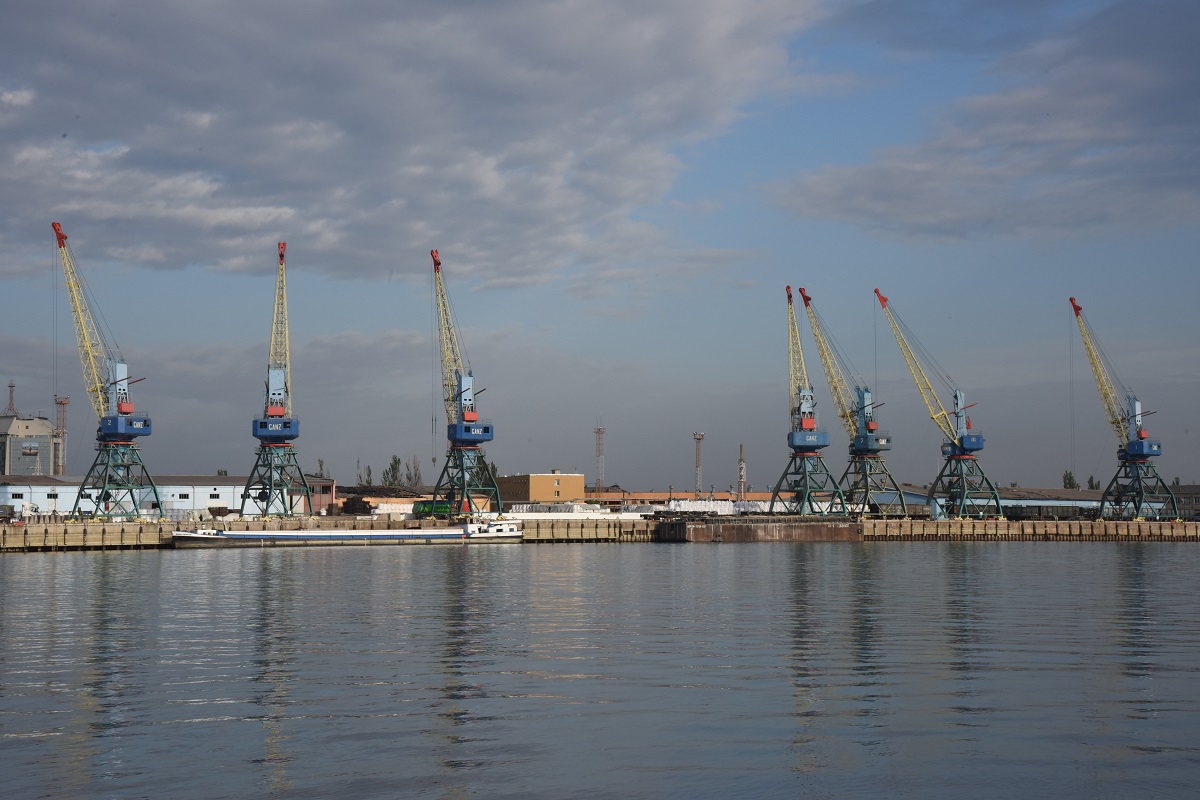
Cranes operating at the port of Izmail.

Escalation at the ports

At first glance, Plauru is an unremarkable village on the banks of the Danube River with a population of only a few dozen people. Yet recently, it has caught the attention of Romanian and international media after several Russian drones crashed in its proximity. The recent explosions on NATO territory have left many concerned about the risks of the war spilling over from Ukraine, while locals continue to feel unprotected by the already distrusted authorities, who have ignored their most basic necessities for decades.

After Russia withdrew from the Turkey-brokered grain deal with Ukraine on July 17th this year, Kyiv found one of its key economic lifelines jeopardised. Overnight, its main way of exporting its enormous agricultural outputs to world markets became virtually unusable, with Moscow stating that any commercial ships disregarding its blockade would be considered “legitimate military targets”.

As a result, Ukraine has been trying to re-route its crucial wheat and corn exports via EU countries, using rail links, and through Reni and Izmail, its two key ports on the Danube. The strategic importance of the two river ports grew even greater as cheap Ukrainian grain exports have become a thorny issue in some EU countries, with Poland, Hungary and Slovakia still enforcing export bans. They claim these are necessary to protect their own agricultural producers from unfair competition.

Russia was quick to ramp up its attacks on Ukraine’s alternative export routes, striking the Danube port of Reni for the first time on July 24th, only one week after exiting the Black Sea Grain Deal. At the time, Romanian President Klaus Iohannis reacted by condemning the attack and calling the strikes at such proximity to the Romanian border an “escalation”.

After the first attack, Russia soon started to regularly target these port cities with night-time drone strikes, using relatively inexpensive Shahed UAVs manufactured in Iran. In August, the mayor of Ceatalchioi and nearby Plauru, a settlement only 300 metres across the Danube from the port of Izmail, warned that locals saw Russian drones violating the country’s airspace and flying over their houses in an attempt to confuse Ukrainian air defences. These statements were at the time dismissed by the country’s defence minister, who attempted to reassure citizens that at no time did any Russian drone cross into Romanian territory.

When a drone finally crashed and exploded on Romanian territory on September 4th, the immediate reaction from both the government and the country’s president was to vehemently deny that any such incident occurred in the first place. Only after evidence emerged that a drone did indeed crash in Romania, and the Ukrainian foreign ministry’s spokesperson Oleg Nikolenko shared an image confirming an explosion on Romanian territory, did the authorities admit that the incident had occurred. Later in September, one drone crashed in the Danube so close to Plauru that the shockwave destroyed the windows in one villager’s house. Since the first incident, two more drones crashed in the surrounding area, the most recent incident taking place in the early hours of October 12th.

Poor communication

Marius Ghincea, a researcher at the European University Institute and a foreign policy expert, points out that this incoherent communication is in line with the general instincts of the Romanian state institutions. Overall, it seems that they are attempting to manage situations in which they have incomplete information. Ghincea states that “In Romanian bureaucratic culture it is problematic to say, “I don’t know.” It is simpler to just deny that something existed.” To him, this sequence of events proves yet again that the Romanian government continues to have limited capacity to monitor the region and even engage in clear, articulate communication regarding security incidents.

The poor communication and engagement from Bucharest are key issues raised by Tudor Cerneagă, the mayor of Ceatalchioi, the settlement that includes the village of Plauru. Leaning in his office chair, Cerneagă notes that it took painstaking persistence for the central authorities to take the otherwise evident security risks seriously.

A Cargo vessel crossing the Sulina Canal, in the Danube Delta.

He insists that the government’s initial denials ended up having a negative effect on local residents’ confidence: “The fact that they have been denying things with indifference only generated more concern amongst locals.” He added that appropriate support did not appear initially, but now, with regular briefing meetings between local authorities and the army taking place, collaboration is moving in the right direction.

Nevertheless, some of the measures taken by the government to reassure people in Plauru have only exposed the chronic underinvestment that has left the village decades behind the rest of the country. In the year 2023, Plauru is a settlement that does not have running water, public transport links with nearby towns, or cellular service. When the army built two bomb shelters for locals to take cover during any future drone incidents, the government intended to show that it is taking its citizens’ safety concerns seriously. However, without being covered by Romania’s cellular network, no warning messages from the country’s emergency signalling service can be delivered.

When asked about the emergency alerts, Gheorghe Puflea, a 70-year-old resident of Plauru, said that they are not getting through to villagers’ phones, and that only one man in his village received the alerts in time. As a result, this man was able to use the shelter during the last drone strike. “To talk on the phone with my wife, I have to go all the way to the back of the garden and behind the shed to catch some signal,” he says.

Ceatalchioi Mayor Tudor Cerneagă expressed his frustration with the government’s apathy regarding this issue. He has raised the problem with the authorities on multiple occasions. At the moment, residents all across the area, within 30 kilometres of Romania’s Danube border with Ukraine, receive “RO-Alert” warning messages on incoming drone attacks. However, the Plauru villagers, who need them the most, do not.

Pessimism and distrust

As the drone strikes persist and local residents continue to be cut off from the rest of the country, all that is left for them to do is wait and hope for the best. Everybody is concerned by the attacks, and about their livelihoods and physical safety if the next UAV happens to crash in the village.

“They keep on insisting that there is no danger, nothing. If that drone fell on my house, who would have paid for it? But even if it killed you on the street, the state would have had no issue with it whatsoever,” concludes Neculae Marian bitterly, before driving off.

Some villagers are so sceptical towards the authorities’ commitment to their well-being that they view the recently erected shelters as little more than a PR exercise with no practical purpose. One villager, who wished to remain anonymous, believes that the shelters were only built for the sake of television cameras: “Can’t you see what it looks like? A real shelter would need to have solid metal doors to protect you from an explosion – if a bomb lands next to this place its shockwave would still crush you inside.”

Plauru and Ceatalchioi mayor Tudor Cerneagă speaking in his office

Despite the overall sense of pessimism and the distrust voiced by locals all around Plauru, nobody plans to leave their home. When asked about the possibility of moving somewhere safer, Gheorghe Puflea is unequivocal in his response: “Here is where my father’s legacy is. Here is the house he left me. After I retired, I tried to raise some animals, I have two cows, two horses. What will I do with all this? Let’s say I move to my flat in the city. Can I take all these with me? Can I take it all to my flat? No, I can’t.”

Following the completion of a government report on the September drone incidents, Romania’s defence minister, Angel Tîlvăr, told the parliament’s Chamber of Deputies that Russia did not target Romania intentionally and that the UAVs crashed in its territory after direct hits from Ukrainian air defences made them uncontrollable. The minister explained that the country’s air monitoring systems did not pick up the drone movements due to “objective reasons” related to their low altitude and erratic flight trajectory.

As long as Ukraine continues to export its grain through its Danube ports, Russia will continue to disrupt the commercial activities taking place there through a variety of means. When asked why the Russian military takes the gamble of sending UAVs right next to NATO territory, knowing this could cause lethal accidents, analyst Marius Ghincea offers an instant assessment: “Because the benefits are higher than the risks and they likely expect based on previous situations that the Romanian government will not react.” According to Ghincea, through its hesitant initial reaction, the Romanian government has already signalled a degree of tolerance towards Russia’s activities in dangerous proximity to its border, which Moscow will likely continue to exploit.

In the coming months, Ukraine will continue to try everything to successfully dispatch its exports and keep money flowing in. Meanwhile, locals in Plauru continue to wait for connectivity improvements in their village, while keeping an ear out for clearer security guarantees from the government. It is certain that Russia will too.

One of the two bomb shelters built in September in Plauru

Vlad Iaviță is a freelance journalist based in Bucharest, Romania. He writes mainly on topics covering Central and Eastern Europe as well as European Union policy. He holds a master’s degree in European and International Public Policy from the London School of Economics.

, , ,

Partners

Terms of Use | Cookie policy | Copyryight 2025 Kolegium Europy Wschodniej im. Jana Nowaka-Jeziorańskiego 31-153 Kraków
Agencja digital: hauerpower studio krakow.
We use cookies to personalise content and ads, to provide social media features and to analyse our traffic. We also share information about your use of our site with our social media, advertising and analytics partners. View more
Cookies settings
Accept
Decline
Privacy & Cookie policy
Privacy & Cookies policy
Cookie name Active
Poniższa Polityka Prywatności – klauzule informacyjne dotyczące przetwarzania danych osobowych w związku z korzystaniem z serwisu internetowego https://neweasterneurope.eu/ lub usług dostępnych za jego pośrednictwem Polityka Prywatności zawiera informacje wymagane przez przepisy Rozporządzenia Parlamentu Europejskiego i Rady 2016/679 w sprawie ochrony osób fizycznych w związku z przetwarzaniem danych osobowych i w sprawie swobodnego przepływu takich danych oraz uchylenia dyrektywy 95/46/WE (RODO). Całość do przeczytania pod tym linkiem
Save settings
Cookies settings