
Text resize: A A
Change contrast

Kosovo-Serbia dialogue: a perpetual state of stagnation

Russia’s full-scale invasion of Ukraine stressed the importance of engaging the Western Balkans more closely. The strategy behind the West’s renewed interest was twofold: bring Kosovo and Serbia closer to a deal to normalise relations and simultaneously move Serbia away from the Russian orbit. Despite initial enthusiasm in early 2023, relations quickly soured once again. What will it take to overcome this impasse?

The Kosovo-Serbia dialogue which has been facilitated by the European Union since 2011 has faced challenges in normalising relations between the two countries. However, Russia’s full-scale war in Ukraine injected a sense of urgency and provided a renewed impetus to address the dialogue. This led to a new diplomatic offensive that culminated in the finalisation of the second Brussels Agreement and its Implementation Annex in February and March 2023, respectively.

September 11, 2023 - Visar Xhambazi - Hot TopicsIssue 5 2023Magazine

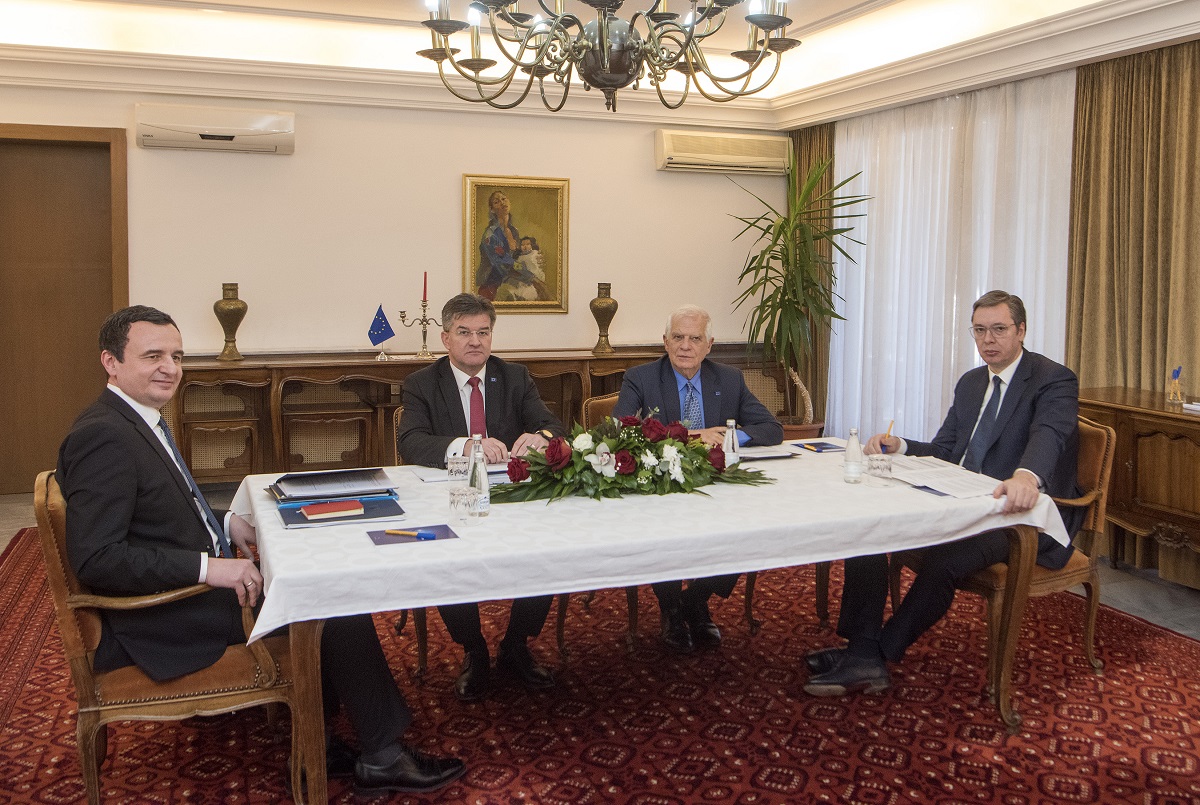
Trilateral meeting between HRVP Borrell, President Vucic, and Prime Minister Kurti in Ohrid on March 18, 2023.

Despite these efforts, the new agreement fell short of achieving its intended outcome as Serbian President Aleksandar Vučić violated its provisions on multiple occasions. However, the EU and the United States remained silent and failed to hold Serbia accountable for its actions. This lack of response by the West undermined the implementation and effectiveness of the new deal and, consequently, there were no significant breakthroughs in the negotiations.

The EU fails to capitalise

The EU launched the Kosovo-Serbia dialogue in 2011 to normalise relations and foster better cooperation between Kosovo and Serbia. The negotiations had initial success, and in 2013 the EU managed to conclude the first deal for the normalisation of relations between Kosovo and Serbia. According to the deal, Kosovo agreed to establish an Association/Community of Serb-Majority Municipalities, granting more autonomy to Kosovo Serbs. In return, Serbia committed to dissolving its parallel structures in the north of Kosovo and integrating them into Kosovo’s security and legal system.

For their constructive approach, the EU rewarded both countries. Kosovo signed its first contractual agreement with the EU, the Stabilisation and Association Agreement, the first important step towards the long road of EU integration, whereas Serbia started its EU accession talks. However, the EU did not build on its success as both Brussels and the member states gradually lost enthusiasm for further enlargement, leading to a phase of enlargement fatigue. This shift had a domino effect on the dialogue. Vučić quickly grasped the implications and became less interested in the normalisation process. Consequently, progress in Kosovo stalled, with the implementation of the Association/Community of Serb-Majority Municipalities being actively avoided.

The prospect of EU membership was instrumental in facilitating the normalisation of relations between Serbia and Kosovo. There was momentum in the dialogue process at the beginning of the 2010s, when the promise of membership was deemed credible. However, the lack of progress made it increasingly more difficult for Kosovo and Serbia to cooperate with one another and fulfil their original promises.

War in Ukraine sparks new momentum

Russia’s full-scale invasion of Ukraine, which started in February 2022, produced shockwaves in Europe and stressed the importance of engaging more closely with the Western Balkans, another vulnerable point in the security and stability of Europe. The strategy behind the West’s renewed interest was twofold: bring Kosovo and Serbia closer to a deal to normalise relations and simultaneously move Serbia away from the Russian orbit. Within a few months, news began to circulate that there was a Franco-German proposal to normalise relations between Kosovo and Serbia. French and German envoys visited Pristina and Belgrade in September 2022 to discuss the proposal. By the end of the year, the EU foreign policy chief, Josep Borrell, confirmed that an updated version had been sent to the representatives of Kosovo and Serbia, building momentum for the new agreement.

After several rounds of meetings and discussions, on February 27th 2023, Vučić and Kosovo Prime Minister Albin Kurti met in Brussels and accepted the EU draft. Borrell stated that further talks were needed to discuss its implementation. However, he stressed that no further discussions were needed on the EU proposal. The EU deal states that Kosovo has agreed to establish some level of self-governance for the Kosovo Serb community, whereas Serbia agreed not to object to Kosovo’s membership in any international organisation (Article 4). Furthermore, both parties agreed to develop good neighbourly relations and recognise each other’s national symbols and documents, and most importantly, they agreed to exchange permanent missions, among other important provisions.

Three weeks later, Josep Borrell tweeted “We have a deal,” announcing that the parties have finally agreed to an implementation annex that constitutes an integral part of the agreement. The annex calls upon Kosovo and Serbia to implement all provisions stemming from the agreement and announces the establishment of a joint committee, chaired by the EU, to supervise the implementation of the agreement.

No real breakthrough

Borrell’s initial excitement quickly waned as the Serbian president immediately undermined the agreement. While Vučić verbally agreed to the deal, he refused to sign it. Two days after the agreement was reached, Vučić vowed to oppose Kosovo’s membership of the United Nations, violating Article Four. Two months later, Serbia voted against Kosovo’s bid for Council of Europe membership, another direct breach of the deal.

Despite these flagrant breaches, the EU and the US remained silent. This caused major disappointment because the EU took the responsibility to chair a joint committee to supervise the implementation of the agreement. The EU and the US failed to keep Serbia accountable for respecting all provisions in the agreement, which created an imbalance in the dialogue and undermined the effectiveness of the new deal. Furthermore, the second Brussels Agreement did not take into account the local elections in four Serb-majority northern municipalities in Kosovo, which were scheduled to take place in April 2023. President Vučić organised an unexpected collective boycott, which resulted in less than four per cent of voter turnout and allowed Albanian political parties to take control of the municipalities. The assumption of office by the new mayors was met with swift resistance by the local Serbs, who attempted to storm the municipal buildings, leading to violent clashes with the police.

Following the escalation, the EU and the US specifically called upon Kosovo to immediately halt violent measures. The NATO-led international peacekeeping force, KFOR, was deployed in the north, but it was not enough to ease tensions. Local mobs attacked dozens of KFOR soldiers using grenades and gunfire, injuring 30, with three of them in critical condition. Simultaneously, Vučić put the army on combat readiness and moved troops close to the Kosovo border. Taking into consideration the heightened tensions, the Kosovo government refused to remove the special police units and arrested dozens of Kosovo Serbs involved in violent attacks. Moreover, in a clear act of aggression, the Serbian gendarmerie kidnapped three Kosovo police border guards and refused to release them for two weeks.

The West issued statements demanding that Kosovo withdraw its special police units, but Pristina held its ground. However, neither the EU nor the US were willing to wait for more than a couple of days for their demands to be met. As a result, the US announced a first round of consequences by excluding Kosovo from “Defender Europe 23” – a US-led military exercise – and threatened that they would consider further action. Furthermore, for the first time, the EU issued sanctions against Kosovo. This sequence of events led to the deterioration of the situation in the north and diminished the chances for the implementation of the new agreement.

Unblocking the impasse

Progress in the Kosovo-Serbia dialogue hinges on the collective efforts of the EU and US to hold both parties equally accountable and ensure the implementation of all the agreements. The initial breach of the agreement by Vučić and the organisation of the boycott of the elections in the north of Kosovo made it difficult for Kosovo to continue with its plans to establish the Association/Community of Serb-Majority Municipalities. Tensions were further exacerbated by the deployment of Serbian troops near the Kosovo border and the kidnapping of three Kosovo border guards.

While both parties are responsible for being cooperative, it is crucial to factor in patterns of behaviour when assessing the situation. Serbia’s unconstructive and aggressive behaviour remains unaddressed. At the same time, Kosovo has been pressured to withdraw from part of its territory for upholding security operations and escorting democratically elected mayors to their posts. This then culminated in sanctions against Kosovo. The EU’s disproportionate response represents a strategic blunder. This approach undermines the effectiveness of implementing the EU deal and hurts the dialogue.

While the renewed impetus in the dialogue was a step in the right direction, the lack of an appropriate response to agreement violations and even progress has caused the dialogue to lose momentum and credibility. To overcome the impasse, the EU and the US must reassess their approach to the dialogue and hold all parties accountable. Without timely action and meaningful commitment, the dialogue risks remaining trapped in a state of perpetual stagnation, further complicating prospects for the full normalisation of relations between Kosovo and Serbia, and threatening regional stability in the Western Balkans.

Visar Xhambazi has worked as a researcher, consultant and project manager for various non-profit organisations in the Western Balkans and across Europe. He currently works as a project manager at Sbunker, a non-profit media organisation in Kosovo covering politics, economics, culture and society. In January 2023, he became a member of the Wilson Center’s Transatlantic Writers’ Group.

, , ,

Partners

Terms of Use | Cookie policy | Copyryight 2025 Kolegium Europy Wschodniej im. Jana Nowaka-Jeziorańskiego 31-153 Kraków
Agencja digital: hauerpower studio krakow.
We use cookies to personalise content and ads, to provide social media features and to analyse our traffic. We also share information about your use of our site with our social media, advertising and analytics partners. View more
Cookies settings
Accept
Decline
Privacy & Cookie policy
Privacy & Cookies policy
Cookie name Active
Poniższa Polityka Prywatności – klauzule informacyjne dotyczące przetwarzania danych osobowych w związku z korzystaniem z serwisu internetowego https://neweasterneurope.eu/ lub usług dostępnych za jego pośrednictwem Polityka Prywatności zawiera informacje wymagane przez przepisy Rozporządzenia Parlamentu Europejskiego i Rady 2016/679 w sprawie ochrony osób fizycznych w związku z przetwarzaniem danych osobowych i w sprawie swobodnego przepływu takich danych oraz uchylenia dyrektywy 95/46/WE (RODO). Całość do przeczytania pod tym linkiem
Save settings
Cookies settings