Hazards to Georgia’s foreign policy: A strategic partnership with China?
The latest shift in Georgia’s foreign policy, marked by the signing of a strategic agreement with China, raises further concerns about the country’s trajectory towards the European Union and NATO. By engaging more with China, Tbilisi is also helping Russia fulfil its aim to decouple Georgia from the West.
In July 2023, the relationship between Georgia and China grabbed the spotlight of global attention – the two countries decided to elevate their bilateral relations to a strategic partnership and signed a subsequent agreement. Although deepening relations between sovereign states is not out of the ordinary in foreign affairs, critical questions about this particular event are looming over the horizon.
November 20, 2023 -
Nino Lezhava
-
Hot TopicsIssue 6 2023Magazine
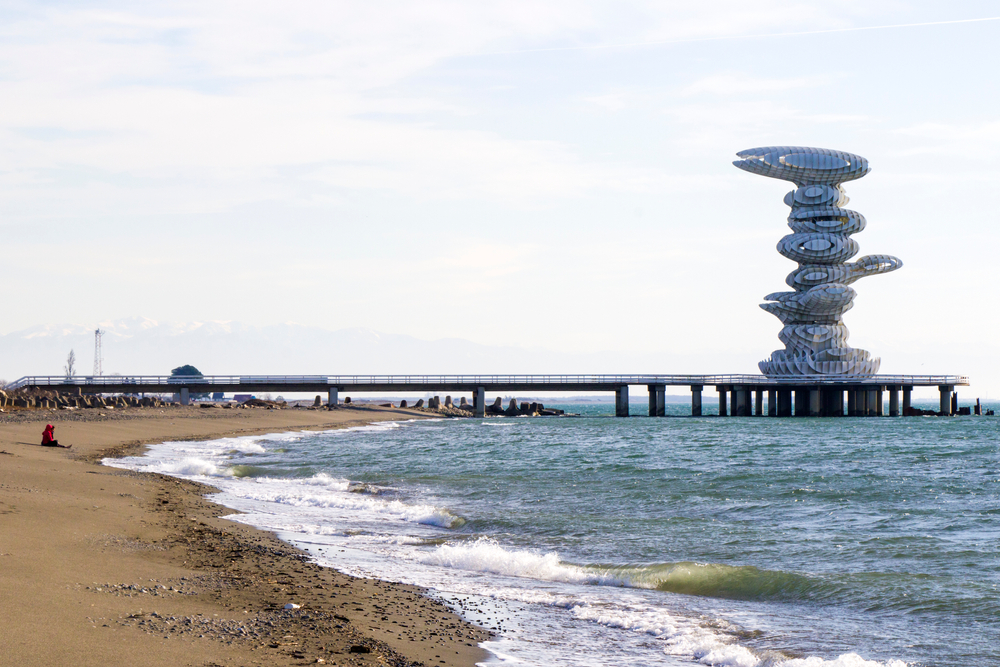
Anaklia, Georgia. The Georgian government has recently revitalised the well-known Anaklia deep sea port project and the Chinese ambassador to Georgia straightforwardly expressed the readiness of Chinese companies to participate. Photo: Tai Dundua/Shutterstock
Since the world order is effectively at stake in Ukraine, the great powers are striving to maintain and enhance their spheres of influence. At the same time, the small states, lacking individual security guarantees, try to find a silver lining based on their national interests. In this particular light, there is a clear controversy regarding Georgia’s ultimate foreign security goal, outlined in the constitution of the state. This obliges governmental bodies to take all measures within the scope of their competencies to ensure the full integration of Georgia into the European Union and NATO. Engaging with a power determined to challenge Euro-Atlantic security and its main competitor, the United States – which is a genuine strategic partner for Georgia – does not align with the priorities stated above. Moreover, the “limitless cooperation” between the People’s Republic of China and Russia, their mutual affection for authoritarian regimes and the temptation to undercut the rules-based international order exclude the option of considering China as a trusted partner for Georgia. There is a tangible risk that the cost of this opportunistic choice will be much more expensive in the long term than any short-term economic gain.
Enhancing cooperation
With a major international crisis at hand, China is making efforts to advance its position in the South Caucasus and beyond. Indeed, the war in Ukraine became a strategic opportunity for Beijing to establish coherent lines of action regarding the EU, transatlantic society and Russia. China’s extensive economic posture became a resource and at the same time, a threat to these actors.
The Trans-Caspian International Transport Route, known as the Middle Corridor, promises the revitalisation of the ancient Silk Road, further expanding Chinese markets and leverage on Central Asia, the Caucasus and Europe as well. More importantly, the trade route bypasses the Northern Corridor, dominated by Russia, and the traditional maritime route through the Indian Ocean, which the United States could hold sway over. In this context, Georgia presents one of the key countries of the Middle Corridor, hoping to capitalise on international interest in an alternative Eurasian Trade route that avoids Russia.
Thirty-one years of bilateral cooperation between Georgia and China has witnessed fruitful results in various fields, especially in trade and economics. The two countries launched discussions regarding the possibility of establishing a free trade regime back in September 2015. In 2018 the agreement came into force and Georgia became the first country in the Caucasus to have this type of deal with Beijing. China is now Georgia’s third largest trading partner. In 2019, Tbilisi and Hong Kong signed another agreement on economic-technical cooperation and the Chinese government provided 15 million US dollars for Georgia with no apparent strings attached.
As mentioned above, the new Strategic Partnership Agreement is the most comprehensive document envisaging future cooperation between China and Georgia. It hopes to foster cooperation between the parties through four main dimensions: political, economic, cultural and international. Since publishing the brief of the document, it has been criticised for the inequality of the states’ positions. Although Chinese officials openly support and reaffirm Georgia’s territorial integrity, the critique was focused on the fact that the document fails to mention Georgia within its internationally recognised borders, which includes two Russian-occupied regions – the Tskhinvali Region, also known as South Ossetia, and Abkhazia – which Russia invaded in 2008 and then declared as independent states.
The opening paragraph of the new agreement reads: “The two sides reaffirm their respect for the sovereignty, independence, and territorial integrity of all countries and Georgia firmly adheres to the One-China principle.” China understands the One-China principle to legitimise its sovereignty over the mainland, Hong Kong, Macau and Taiwan, a position that the United States and most western countries have not endorsed, at least in the case of Taiwan.
The new document has become an impetus for more further actions. Recently the government of Georgia announced the abolishment of the visa regime with China, allowing Chinese tourists one-month visa-free travel. Consequently, flights between China and Georgia will increase and occur once per day. As stated officially, these decisions serve to boost Georgia’s tourism potential and economy. Despite this, the same type of visa-free regime for Georgian citizens in China is allowed only if they are a part of a tour group. Interestingly, the same conditions apply for five more countries, including Azerbaijan, Belarus, Russia, Moldova and Turkmenistan.
Bringing Anaklia back
The joint political will expressed in the strategic document can easily be translated into action. Chinese government companies already take part in Georgia’s infrastructure projects, including the construction of highways, railways and tunnels, mostly in the framework of the Middle Corridor. In this light, the Georgian government has recently revitalised the well-known Anaklia deep sea port project and the Chinese ambassador to Georgia straightforwardly expressed the readiness of Chinese companies to participate. Building the Anaklia deep sea port will be a game changer due to its geostrategic location and long-term outlook. It would allow larger ships to transport increased volumes more efficiently. According to open sources, 51 per cent of the construction consortium will belong to the government of Georgia, thus an international tender has been announced for 49 per cent. The tender proposals have already been received and surprisingly enough, along with Swiss-Luxembourgish companies, a Chinese-Singaporean one has also registered. It is crucial to reiterate that previous efforts by a consortium between Georgia’s private sector and the US-based Conti International to build the deep sea port in Anaklia were cancelled by the government in 2020 after being delayed for years in controversial circumstances.
Considering the full spectrum of advantages, Georgia’s longstanding strategic partner, the United States, expressed disappointment regarding this development. In a letter signed by four US representatives addressed to the Georgian government, it was emphasised that the framing of the Anaklia Development Consortium (ADC), which was backed by the US, “scares and hinders the investments of American companies” in this critical project. Moreover, the then Trump Administration urged Georgia to abstain from enhancing economic ties with Russia and China due to the potential risks. Former US Secretary of State Mike Pompeo called Russia and China “fake friends of Georgia” at a joint press conference with the Georgian prime minister and stated that the Anaklia port would protect the country from the predatory economic influences of these two countries.
As for more recent reactions from Washington, the US State Department commented that “the US respects countries’ sovereign decisions about with whom they want to engage with or do business with. However, they will continue to monitor the next steps of newly established Chinese-Georgian cooperation closely, whilst emphasising the importance of these activities being done transparently, according to the rule of law, and with trusted vendors.”
Friend of a friend
As the turmoil around Anaklia unfolds, it stands as a crucial indicator of whether Georgia will persist on a trajectory of deeper integration with the European Union and other western partners, or if it will pivot towards forging closer relations with China, which is Russia’s main partner. Amid sanctions, Moscow is more dependent than ever on Beijing’s economic, technological and diplomatic assistance. The joint statement which the Chinese and Russian presidents issued in February 2022, less than three weeks before Russia’s invasion of Ukraine, not only declared that the two countries enjoyed a friendship with no limits but also outlined many shared views regarding realigning the world order. Throughout Russia’s war in Ukraine, China maintained a stance of pro-Russian neutrality, offering theoretical support and a boost to Russia’s finances through increased energy purchases. China’s economy is ten times bigger than that of Russia. Thus, Georgia should look back and move forward with the most pragmatic and value-based approach in mind, whilst pursuing foreign security goals.
Since the war in Ukraine, the position of the Black Sea ports has become more dangerous, having witnessed the continuing grain crisis. Diversifying existing transport routes and developing new ones is of critical importance. Despite this, actions speak louder than words and Georgia, which has a strategic partnership with the US, just received EU candidate status whilst striving for NATO membership, should be cautious in its decisions in such global insecurity. Even though the EU is trading and cooperating with Beijing, there are many red flags and even perhaps “wire fences”. The transatlantic community is focused on cooperative security and deterrence, and, unlike Georgia, is strong enough to opt out of cooperation with China if necessary. Georgia’s latest moves carry significant implications especially since the European Commission recommended EU candidate status. Brussels has never hidden its concerns regarding stronger connections between Georgia and China, while Tbilisi has been increasingly reliant on Chinese firms for its extensive infrastructure projects.
Forging cooperation with China only widens the gulf in Tbilisi’s relations with Brussels and Washington. The country seems to be taking a step towards the East and this fully fits in with Russia’s interest to decouple and distance Georgia from the West. International relations theory states that small states should focus on national interests whilst considering great power rivalry. Georgia’s Euro-Atlantic aspirations are backed by an overwhelming majority in Georgian society and are enshrined in its constitution. Thus, establishing strategic cooperation with China should be criticised not only because it offends the EU or the US, but also because it is against the national interests of the country.
Nino Lezhava is a research analyst focusing on international relations, security and defence. She is currently based in Geneva where she is simultaneously pursuing the “Leadership in International Security Course” (LISC) and a Master of Advanced Studies in International and European Security offered jointly by the Geneva Center for Security Studies (GCSP) and the Global Studies Institute at the University of Geneva. She also holds a position at the Georgian Parliamentary Research Center and is the very first Georgian public servant who has successfully conducted an internship at NATO HQ.