
A treatise on guilt
Russia, both as a state and a collective of individuals, is guilty of the many war crimes committed in and against Ukraine under the banner of the Russian flag. However, leaving the argument at “Russia is guilty” is both reductionist and dangerous, as it can absolve individuals of their guilt whilst at the same time trivialising the pain and suffering caused at the hands of individuals and their actions.
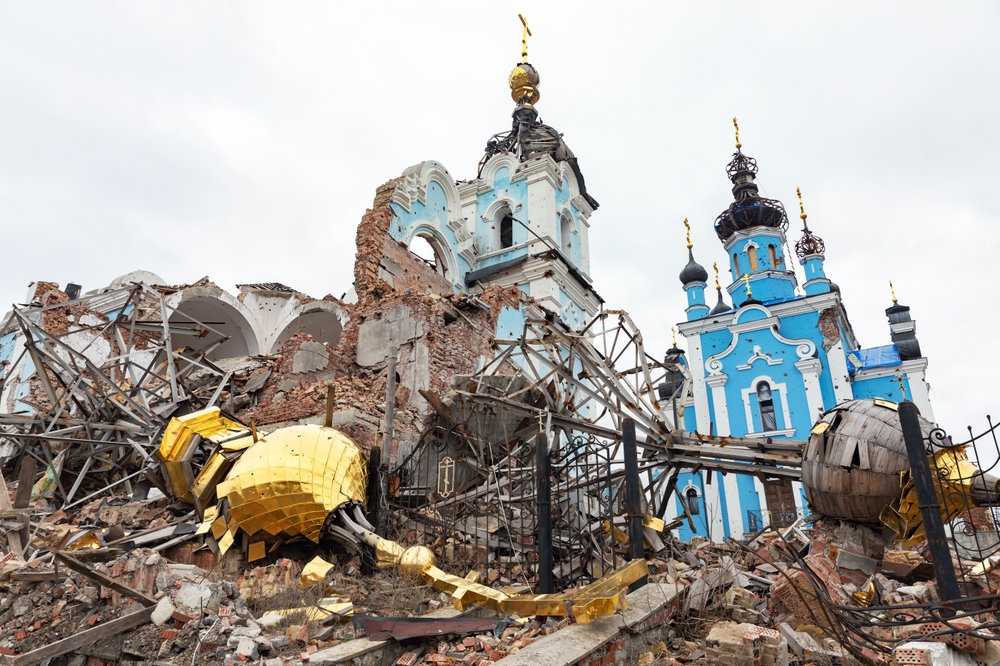
For over 20 months, Russia has been committing war crimes previously unfathomable on the European continent in the 21st century. Murder, rape, the kidnapping of thousands of children and the bombings of schools, hospitals and cultural sites, are only some of the many atrocities the Russian army and affiliated mercenary groups have committed against the Ukrainian nation. Almost more striking than the horrific images that flow out of Ukraine on a near-daily basis is the deafening silence coming from Russia and Russians.
November 20, 2023 -
Joshua Kroeker
-
Hot TopicsIssue 6 2023Magazine
Photo: Drop of Light / Shutterstock
It is almost as if the entire Russian state – and the many different nations that make up the Russian Federation – are guilty of candidly supporting the countless crimes being committed in their name.
Can that be? Are all Russians guilty of what is happening in Ukraine, or are only the Russian state and military responsible for such crimes? In the first weeks and months of the war, western leaders such as Germany’s Olaf Scholz were careful in their rhetoric to refer to the full-scale Russian invasion of Ukraine as “Putin’s War”. For a time, Ukrainians themselves even followed this rhetoric, many of whom deeply hoped their friends and family in Russia would take to the streets and finally put an end to Putin’s regime. This never came to fruition. Bucha then happened: 458 civilians were killed in April 2022 in what the world now knows as the Bucha massacre. It quickly became obvious to Ukrainians – and many in the West – that this was not just Putin’s war.
How to determine guilt?
A year and a half later, Russia’s senseless killing continues, whereas an end to the war does not seem to be in sight. Though their effectiveness is debatable, the West continues to pile sanctions on Russia in hopes of punishing those responsible for the war. The Russian state has been demonised throughout international institutions and organisations. Yet one pertinent question remains: who, exactly, is guilty of the war against – and war crimes committed in – Ukraine?

The answer, unfortunately, is hardly straightforward. Without a doubt, Putin, his generals, and those who pulled the trigger are guilty of war crimes. This assessment quickly runs into problems, however, when considering groups such as the mothers from Bashkiria, whose sons were forcefully sent – or misled – to fight on the front lines. Some of the educated middle class of Moscow and St. Petersburg, who genuinely oppose the war but take no action, offer another convoluted example. Is the entire country, made up of each and every one of its individuals, in what has been termed “collective guilt”, somehow responsible for what is being done in the name of “Russia”? These questions are impossible to answer, as philosophy, history, politics, law and human subjectivity differ too much for objective, positivist answers. Nevertheless, some of the facets of this debate can shed light on the complex discourse of Russia’s war guilt and the responsibility of each and every Russian citizen vis-à-vis Russia’s criminal war against Ukraine.
In recent months, journalists and experts alike have attempted to unravel the question of whether “good” Russians exist in the era of a neo-imperial – even fascist – Russian regime and its war of destruction against Ukraine. Each and every article on the topic has come short of a sufficient conclusion due to the simple fact that concepts like “good” and “bad” cannot be objectively defined, let alone placed on an entire society. The question of good and bad Russians is underpinned by a deeper debate on guilt: the guilt of a nation and the guilt of an individual. This topic was dealt with by the Heidelberg philosopher Karl Jaspers shortly after the Second World War.
In his seminal work, Die Schuldfrage or “The question of German guilt” from 1947, Jaspers dove into the legal, moral and philosophical underpinnings of the concept of guilt in Germany, two years after the end of the Holocaust and Germany’s war against civilisation. Jaspers outlines four different and independent types of guilt that must be considered in any discussion on the topic:
- Political guilt – or collective guilt – is the result of actions of the collective citizens of a country who, in the name of the state, collectively commit a crime;
- Criminal guilt is a sentence pronounced by a court of law;
- Moral guilt, rooted in each and every individual’s conscience, cannot be determined by others but only by the self;
- Metaphysical guilt is one’s guilt before God, a result of not acting to prevent evil and wrongdoing.
As Jaspers explained, whereas war criminals are criminally guilty for the crimes they commit in the name of the state, civilians cannot be criminally guilty of the same. Rather, to different extents, the entire collective as individuals carries within them a political guilt. Jaspers argued that “it makes no sense to accuse a people as a whole of a crime. The criminal is always the individual” and that “[it] is also absurd to morally accuse a people as a whole. There is no character of a people in such a way that every single member of the people has this character. … A people as a whole does not exist. … People and state do not coincide, nor do language and common destinies and culture.” In his theory, a people cannot commit a crime, but rather only the individuals that make up that people. As a result, the people in and of itself cannot be criminally or morally guilty, but they can be politically guilty.
The Russian collective. Who is guilty?
Political guilt, unlike its criminal, moral and metaphysical counterparts, is a material form of guilt that stems from a collective – in the current context, Russia – committing a crime against another nation or state. The horrors of the crime, committed by the state and criminal individuals but enabled by the (oftentimes silent, but in many cases supportive) masses, transfer a dimension of political guilt to each and every individual member of that collective or state. The collective, then, is in and of itself guilty, though each and every individual that makes up that collective may or may not be morally guilty or have committed a crime. Without understanding these differences, it is impossible to commit to discourse on the very real question of Russia’s war guilt – and the limitations thereof. In postulating that Jaspers’ philosophical reasoning is correct, we come to understand that although Russia as a state, its political leaders and the many individuals who commit crimes in Ukraine are all without a doubt guilty, the criminal, moral and metaphysical guilt of much of the Russian collective is far more difficult to prescribe. Considering a number of examples should help to make this problem easier to understand.
There should be no doubt that the majority of Russians support the war in Ukraine and Putin as president. Though war-time polling in an authoritarian state does have its complexities and a margin of error, the numbers, obtained by various independent pollsters, continuously demonstrate support between 70 and 85 per cent and therefore testify to a predominant opinion among Russians. Of the 15 to 30 per cent that do not support the war, silent assent reigns supreme. Protests and anti-war actions seldom take place, given the state’s draconian laws against dissent. Though the vast majority of Russians have not stepped foot into Ukraine or picked up a gun, here they share the political guilt of the country in having allowed – or at the least not prevented – the crimes committed by the state. But is that enough?
Collective (political) guilt remains a controversial, if not ineffective, framework with which to evaluate the guilt of individual Russians. This is for three reasons. Firstly, the concept of collective guilt can absolve individuals from responsibility, as guilt is attributed to the nation as a whole, and foremostly its political leaders, rather than looking at the individual destinies that led to the crimes having been committed. Secondly, it simplifies historical processes and removes individual agency, as it implies a dimension of historical determinism and ignores actions, crimes, bottom-up support for the state, and even the dissent of individuals. Discussions of collective guilt often reduce individual guilt to reasoning involving state propaganda, the army’s actions, and what the people think. Third, it complicates any discussion of individuals who have taken real actions to oppose the state and the crime in question. Considering the individual and his or her actions provides a much better lens through which to view the responsibility and ultimately the guilt of Russians. For this, I will consider four examples that go beyond the clear case of the soldier-murderer and politician-general. Each reader should draw their own conclusions.
Guilty actions?
First, anyone who uses Telegram has likely noticed the thousands upon thousands of brazen Russians who take to this and similar social media in order to “like”, respond with fire emojis, and comment on the bombings of civilians. Comments such as “cooked meat” and “dead pigs” can often be found after the announcement of a Russian bombing on a civilian building in Ukraine. Though such a phenomenon is both repulsive and infuriating – especially for this author – it must also be taken into account that such clicks account for less than one per cent of the entire Russian population, although they are often attributed to the whole. Nevertheless, this is reflective of a terrifying opinion within Russian society that openly supports, although does not commit, war crimes.
Second, a 25-year-old woman from Moscow personally opposes the war but does not wish for Ukraine’s victory. She considers Ukraine to be part of a greater, post-Soviet society and dislikes Volodymyr Zelenskyy. She believes in the Russian propaganda of “Ukraine committing genocide in Donbas”, and frequently travels to Crimea. She opposes the use of violence, does not see the point in the war, and hopes for an immediate end. She has never protested against the state and refuses to be involved in politics.
Third, a 40-year-old woman works for a private corporation in St. Petersburg. She is well travelled, belongs to the upper echelons of Russian society and is the classic portrait of the middle class that has benefitted from decades of hydrocarbon profits. She opposes the war and internally wishes for Russia to withdraw its troops and even leave Crimea, but does not voice this online or publicly. Rather, her Instagram posts complain of the difficulties of obtaining an EU visa and the effects of sanctions. When asked why she does not protest, she responds: “And risk my job for nothing?”
Fourth, and finally, a 30-year-old man living in the Urals primarily reads foreign media and deeply opposes the war. While many of his friends have gone to fight in Ukraine, he does not voice his opinion or attend protests. Instead, he takes matters into his own hands. He has sabotaged train tracks that carry provisions to the front and has burnt down a local conscription office. He is filled with feelings of guilt for all the crimes that his country has committed.
Though each person from the above examples shares in the political guilt as a result of their belonging to the larger Russian collective, they also demonstrate the complexities and ineffectiveness of concentrating only on collective guilt, rather than the individual. Political, criminal, moral and metaphysical guilt will all mean something different in the case of each individual. It is therefore impossible to reduce them to a whole. The only certainty here is that there is no effective framework that allows us to determine which type of guilt, and to what extent, should be attributed to each of these individuals. Although example four secretly fights against the regime, he pays the taxes that fund the war. One of the many Telegram enthusiasts may have emigrated, taking with them their neo-imperial hatred for other post-Soviet nationalities, but effectively harming the state via brain drain and a lack of taxes. On the other hand, none of the above examples share the same level of guilt as the Russian soldiers who perpetrated the massacre of Bucha. Here it is simple to observe that though most Russians share in the political guilt of their country, “collective guilt” as a concept and framework is far too complex, ineffective and reductionist in judging Russians’ guilt.
A paradox of guilt
Similar to the dozens of articles before it, this commentary upholds the conclusion that Russia, both as a state and a collective of individuals, is guilty of the many war crimes committed in and against Ukraine under the banner of the Russian flag. However, leaving the argument at “Russia is guilty” is both reductionist and dangerous, as it can absolve individuals of their guilt whilst at the same time trivialising the pain and suffering caused at the hands of individuals and their actions. Finally, it does not allow for differentiation between various dimensions of guilt.

Without a doubt, the Russian state, its institutions, and its military are politically and criminally guilty of the war crimes, and possibly genocide, committed in Ukraine. Bucha, Irpin, Hostomel, Uman, Odesa, Izium, Bakhmut, Dnipro, Kryvyi Rih and countless other tragedies can be pinned on the Russian government which makes the decisions, the soldiers who commit the crimes and drop the bombs, and the civilians who cheer them on. It remains an open question – for which I have no answer – to what extent the apolitical, the silent and neutral, or even anti-war populations of Russia share in the guilt of the crimes committed in their collective name – the Russian Federation. Axiomatically, the entire country and each of its citizens share in the collective, political guilt resulting from Russia’s war against Ukraine. As Jaspers argues in his work, in a post-war scenario, that realisation may help transform Russia from a totalitarian state committing war crimes into a developed, moral democracy – though that is likely many years away.
In what can be seen as an insurmountable paradox of Russian wartime guilt and responsibility, by attributing guilt to the entire nation, the distinct crimes of the individual become blurred as the crimes pass over to the responsibility of the collective, rather than focusing on the war criminal. Though criminals must be judged and sentenced, it is impossible to do the same to an entire collective made up of millions of individuals. The concept of political guilt is useful in demonising the Russian state, but it is at the same time reductionist in its considerations of individual crimes and horrors. Russia, after all, cannot serve a prison sentence. The never-ending discourse of Russian guilt, though entirely understandable in the current context, serves little purpose beyond philosophical considerations. For societies seeking to support Ukraine – which can be the only true judge of the crimes Russia has been and is now committing – focusing on the tangible criminal guilt of individuals rather than philosophical musings of political and moral guilt will better serve Ukraine’s claims of war reparations and the development of an international tribunal for war crimes. This will also help us to better understand the specific political and historical processes that have occurred over the past three decades within Russia that allowed for the promotion of – and lack of opposition to – the atrocities and war crimes committed in the name of the Russian state.
Joshua R. Kroeker is an independent researcher, founder of the boutique analytic firm Reaktion Group, an analyst at the political analysis project R.Politik, and an editor at RANE. He holds degrees from the University of British Columbia in Canada, Heidelberg University in Germany and St. Petersburg State University, Russia.