
Text resize: A A
Change contrast

Doom and gloom for Georgia’s EU candidacy?

Despite its claims to be willing to implement all the necessary reforms for EU candidacy, the Georgian government’s measures have been slow. Substantial progress has been missing in the areas where strong political will is required. While Georgia is awaiting the European Commission’s recommendation on granting it EU candidate status, much work is yet to be done.

More than a year has passed since Georgia submitted its application to obtain EU candidate status. The announcement followed a similar move by Ukraine in the wake of the Russian aggression, which led to a historic opportunity for other countries which aspired to obtain EU membership. Soon, Moldova demonstrated its interest in applying for candidacy as well.

November 19, 2023 - Ioseb Dzamukashvili Sekhniashvili - Articles and CommentaryIssue 6 2023Magazine
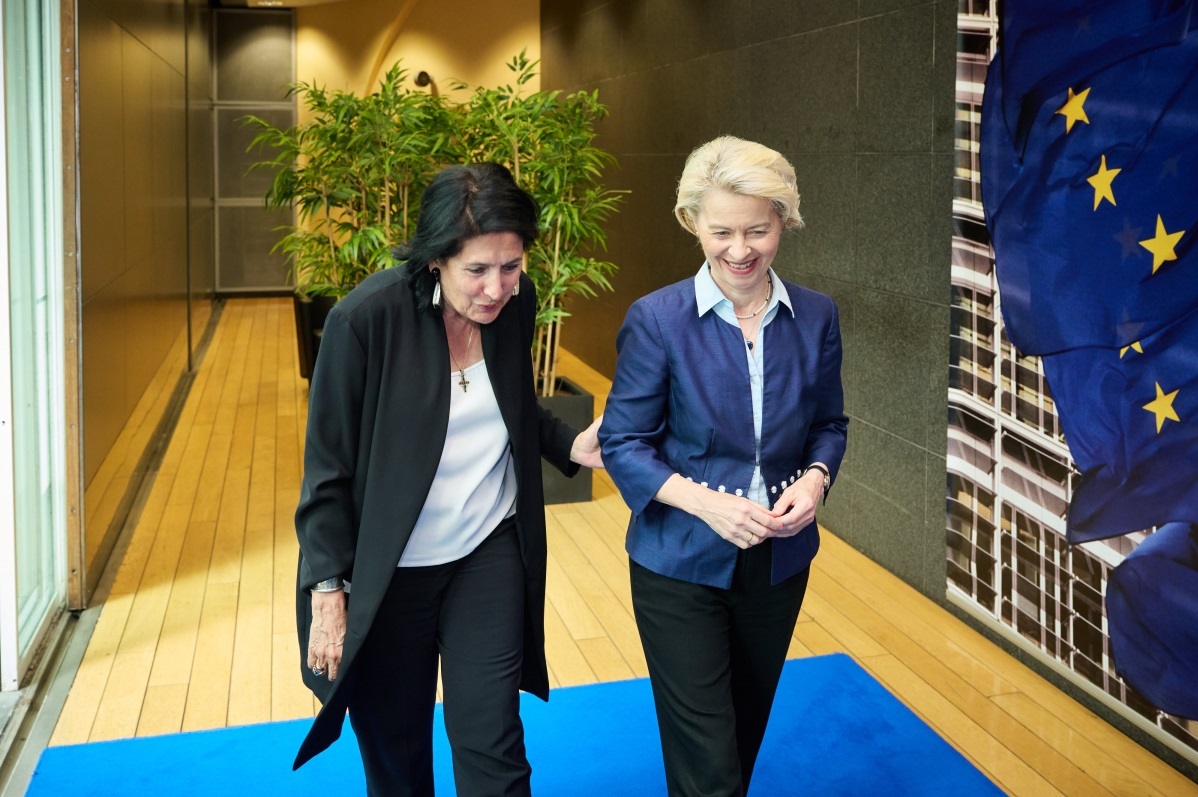
Georgian president, Salome Zourabichvili (left) meets with Ursula von der Leyen, president of the European Commission. As a result of the Zourabichvili’s active diplomacy in the EU, the ruling Georgian Dream party announced impeachment proceedings against her, which ultimately failed. Photo: Courtesy of the European Commission


During a crucial summit in Brussels, the 27 leaders of the European Union decided to grant Ukraine and Moldova their much sought-after status as candidate countries. Georgia, on the other hand, was given only a “European perspective”, meaning that candidate status will be granted only after the country meets 12 key priorities outlined by the European Commission. Implementing these recommendations would then allow Georgia to move ahead regarding its European integration efforts.

The European Commission is set to prepare an assessment report on the implementation of these recommendations by Georgia for obtaining candidate status – and for Ukraine and Moldova to start accession talks – by the end of October 2023. The EU will make a final decision in December. Initially, this was meant to occur in December 2022, however, the EU postponed the assessment in order to give “enough time” to the government “to carefully work out its priorities”. Despite that, the Georgian government’s efforts to implement the reforms recommended by the European Commission have been rather slow. Thus far, the ruling party has fully implemented only three out of 12 recommendations and some reforms are still in progress. The Georgian government’s reluctance, as well as its controversial diplomatic moves and statements, significantly undermine the country’s chances of obtaining candidacy. However, there are some possible hopeful scenarios that might help Georgia obtain its sought-after status.
The government’s reluctance

Georgia used to be seen as the leader of the three countries known as the “Association Trio” along with Moldova and Ukraine. These countries signed Association Agreements with Brussels in 2014. Yet in recent years, Georgia’s steady democratic shift has dramatically slowed. While Ukraine has, for understandable reasons, suspended normal democratic practices, Moldova has made a strong case for inclusion due to its pro-western government led by President Maia Sandu.

Georgia meanwhile has been struggling with democratic backsliding. The ruling party has displayed authoritarian tendencies by harassing independent media and politicising the country’s judiciary system. A crisis erupted when opposition parties claimed the parliamentary election was rigged and refused to concede defeat, sparking polarisation and police arrests. Opposition members consequently boycotted the legislature by refusing to take their seats, while the leading party, Georgian Dream, formed a new government. As the crisis hit a deadlock, European Council President Charles Michel personally emerged as a mediator and brokered an agreement to bring all parties back to the table. The deal also proposed a series of electoral and judicial reforms. However, Georgian Dream eventually withdrew, leaving most of the lingering issues unaddressed. This ever-deepening instability was reflected in the Commission’s opinion on Georgia’s EU bid, which did not recommend candidate status for Tbilisi. Hence, the EU put forward a list of issues that Georgia needs to address, including political polarisation, the proper functioning of all state institutions, judiciary issues, money laundering, media freedom, gender equality, civil society participation and organised crime.    

Despite its claims to be willing to implement all the necessary reforms, the Georgian government’s measures have been slow. Substantial progress has been missing in the areas where strong political will is required, such as “de-oligarchisation” – one of the most important recommendations for this country struggling with democracy. Initially, the Georgian parliament introduced an anti-oligarch bill which was so weak that it even failed to clearly define the term “oligarch”. Many have considered this deliberate as Georgian Dream’s founder, Bidzina Ivanishvili, who is domestically and internationally regarded as an oligarch, is widely seen as the behind-the-scenes ruler of the country. Ultimately, the bill was dropped as per the recommendations of the Venice Commission and Council of Europe. On September 14th this year the government adopted a so-called “de-oligarchisation action plan” more in line with the recommendations. This should serve to put a stop to excessive influence in political, economic and public life interests.

While Georgia is awaiting the European Commission’s recommendation on granting it EU candidate status, much work is yet to be done. This was reiterated by the EU’s top diplomat Josep Borrell during his visit to Tbilisi in September. According to Borrell, even though Georgia fully implemented three recommendations, work on the remaining nine has to continue. Georgia still has some time to obtain EU candidacy, but the current regime’s reluctance to deliver on reforms threatens this historic opportunity. Thus, the window for implementing comprehensive reforms is quickly shrinking.

Ill-timed diplomacy

Since 2012, the Georgian Dream ruling party has been formally pursuing EU integration. However, it has also steadily deepened Georgia’s ties with Russia. After coming to power, Georgian Dream followed a so-called “non-irritation” policy towards Russia in order to avoid future conflicts, which resulted in substantial growth in trade relations between the two countries. According to Transparency International, in the first half of 2023, Georgia received two billion US dollars of income from Russia through remittances, tourism and export of goods, which is almost twice as high as the figure for the first half of the previous year. Notably, Georgia has maintained no diplomatic relations with Russia since the 2008 war, which has led to 20 per cent of Georgia’s territory being occupied by Moscow. There has been an opening of Russian checkpoints on Georgian-controlled territory, illegal “borderisation”, as well as continuous kidnappings of Georgian citizens.

While it would be logical for Georgia to express its full support for Ukraine and condemn Russian aggression, the Georgian government’s desire to toe the Russian line is ever more apparent. The ruling party has also abstained from joining sanctions against Russia and emphasised the importance of both sides coming to the table for negotiations to end the war in Ukraine. In the meantime, anti-western propaganda has reached new highs as some members of the ruling coalition have blamed the West for meddling in Georgia’s domestic affairs. Ruling party officials, such as the prime minister and ruling party chairman, Irakli Kobakhidze, have been indirectly accusing the West of dragging Georgia into the war and opening a “second front”.

The government also decided to renew direct air links between the two countries on May 19th after a four-year break. Amid a sharp warming in relations between Moscow and Tbilisi, Russia even restored visa-free travel for citizens of Georgia and lifted a ban on direct flights between the two countries that was imposed in 2019.

In the meantime, the government also decided to elevate bilateral ties to a strategic partnership level with China. In the official document adopted on July 31st, Tbilisi pledged to deepen policy coordination, align development plans, and expand cooperation in the political, economic and cultural domains with Beijing. The pledge to intensify bilateral cooperation could be seen as a logical progression of the relationship, as the ties between Beijing and Tbilisi have been rapidly evolving throughout the past decade within the framework of the Belt and Road Initiative. Nevertheless, the timing of the new strategic partnership has been controversial. Georgia has been trying to meet key conditions required to obtain EU candidacy but the apprehension about closer linkage with China, from which the EU has been trying to distance itself, has been a diplomatic signal that Tbilisi might be distancing itself from the EU and revisiting its foreign policy. The domestic and international critics of the Georgian Dream party have raised questions regarding the political aspect of the strategic partnership and, more importantly, how it can impact the country’s democratic processes in the long run. As Chinese economic engagement with smaller economies often leads to spillover regarding Beijing’s political influence, Georgia’s willingness to expand cooperation at the political level is concerning.

While Prime Minister Gharibashvili was touring China to conclude the strategic partnership, the government denied President Salome Zourabichvili her plans to tour European capitals to promote Georgia’s EU candidacy. The Georgian constitution requires the president to get permission from the government before conducting any foreign policy activities. However, according to the government, Zourabichvili asked for permission for the trip but was refused. On the same day that Zourabichvili was warmly greeted in Brussels by European Council President Charles Michel, who praised her “personal commitment to advancing the European perspective of Georgia”, the ruling Georgian Dream party announced on September 1st that it intended to launch impeachment proceedings against her. On October 16th Georgia’s constitutional court, which is believed to be under government influence, stated that the president had violated the constitution, authorising the parliament to hold the vote. However, due to a lack of parliamentary support, the impeachment effort failed. The ruling party needed 100 votes but received only 86. Despite that, the government’s hostile attitude towards the president amid her visit to Brussels has been a significant diplomatic signal that, in the whole context of recent developments, further hinders Georgia’s bid for EU candidacy.

Possibility of positive scenarios

Even though there are a number of recommendations that the Georgian government needs to readdress, Georgia has made some progress in implementing the 12 priorities. According to the latest report from the Open Society Foundation, one priority is “fully fulfilled” (proactive consideration of ECHR judgments), while two priorities are “mostly fulfilled” (an independent ombudsman and institutional independence of the prosecutor’s office, alongside gender equality and violence against women). At the same time, seven are “partially fulfilled” (electoral and institutional reforms, an independent judiciary, anti-corruption measures, media environment, the protection of the human rights of vulnerable groups, the involvement of CSOs in the decision-making process, and the fight against organised crime), and two priorities (de-oligarchisation and political de-polarisation) are “yet to be fulfilled”.

Zourabichvili took some bold moves as well. She has openly criticised the government’s “foreign agent” law, which she said would bring Georgia “closer to the flawed Russian model and not to the European model”, before huge street rallies forced Georgian Dream to abandon the draft law. Moreover, in June, Zourabichvili pardoned Nika Gvaramia, the director of an opposition media outlet who had spent more than a year in jail. This occurred amid pressure from western diplomats and international NGOs seeking to secure his release. This move has been seen as a step forward for media freedom and was greatly welcomed by Georgia’s western partners. Meanwhile, there have been signals coming from Brussels that Georgia might have a real opportunity to gain candidacy at least as far as it concerns the European Commission’s recommendation (the final decision will be made by the Council in December). European Council President Michel has recently voiced his opinions about the need to speed up the enlargement process and has pointedly included Georgia in his remarks.

Georgia may find it easier to get EU candidacy for another reason: the status has been somewhat “devalued” after Bosnia and Herzegovina obtained it at the end of 2022. Candidacy      status was given despite Sarajevo hardly meeting the 14 conditions that Brussels outlined in 2019. The case of Bosnia and Herzegovina demonstrates that the bar has been lowered. All European countries that have aspired to join the EU are candidates except Georgia (with the exception of Kosovo, which is not recognised as an independent state by five EU member states). Considering that EU enlargement is back on the discussion table again and EU officials are actively discussing the future of an enlarged bloc, Tbilisi could obtain candidacy as long as it keeps implementing reforms.

Both Moldova and Ukraine have only met several conditions outlined by the European Commission, three and two respectively. If this progress allows both Ukraine and Moldova to open accession talks, it would be logical and fair for Georgia to obtain candidate status. Since the three countries applied for membership, the EU has been addressing them together as a group. Similarly, it can be expected that Tbilisi will not be isolated from Kyiv and Chișinău within the Associated Trio. In another possible scenario, Georgia could advance with its candidacy but with certain conditions, meaning that opening accession talks would require meeting them. This, however, does not mean that the Georgian government should stop moving forward with the reforms outlined in the Commission’s key priorities. In this situation, it is crucial for the country to send positive signals similar to the release of opposition journalist Nika Gvaramia. Georgia cannot afford to be denied candidacy, as it could be a big frustration for a society that overwhelmingly supports EU integration.


Ioseb Dzamukashvili Sekhniashvili is a policy analyst focusing on political developments in Central and Eastern Europe. He is a contributing policy analyst for the Georgian Foundation for Strategic and International Studies and previously worked as a columnist at Forbes Georgia. He holds an MA degree from the University of Glasgow.

, , ,

Partners

Terms of Use | Cookie policy | Copyryight 2025 Kolegium Europy Wschodniej im. Jana Nowaka-Jeziorańskiego 31-153 Kraków
Agencja digital: hauerpower studio krakow.
We use cookies to personalise content and ads, to provide social media features and to analyse our traffic. We also share information about your use of our site with our social media, advertising and analytics partners. View more
Cookies settings
Accept
Decline
Privacy & Cookie policy
Privacy & Cookies policy
Cookie name Active
Poniższa Polityka Prywatności – klauzule informacyjne dotyczące przetwarzania danych osobowych w związku z korzystaniem z serwisu internetowego https://neweasterneurope.eu/ lub usług dostępnych za jego pośrednictwem Polityka Prywatności zawiera informacje wymagane przez przepisy Rozporządzenia Parlamentu Europejskiego i Rady 2016/679 w sprawie ochrony osób fizycznych w związku z przetwarzaniem danych osobowych i w sprawie swobodnego przepływu takich danych oraz uchylenia dyrektywy 95/46/WE (RODO). Całość do przeczytania pod tym linkiem
Save settings
Cookies settings