
Migrants on the border (of the Polish imagination)
What makes Poles help Ukrainian refugees yet indifferent to the fate of migrants on the Belarusian border? Is this determined solely by the right-wing propaganda, which portrays the Ukrainians in good terms and those in Belarus in essentially bad ones?
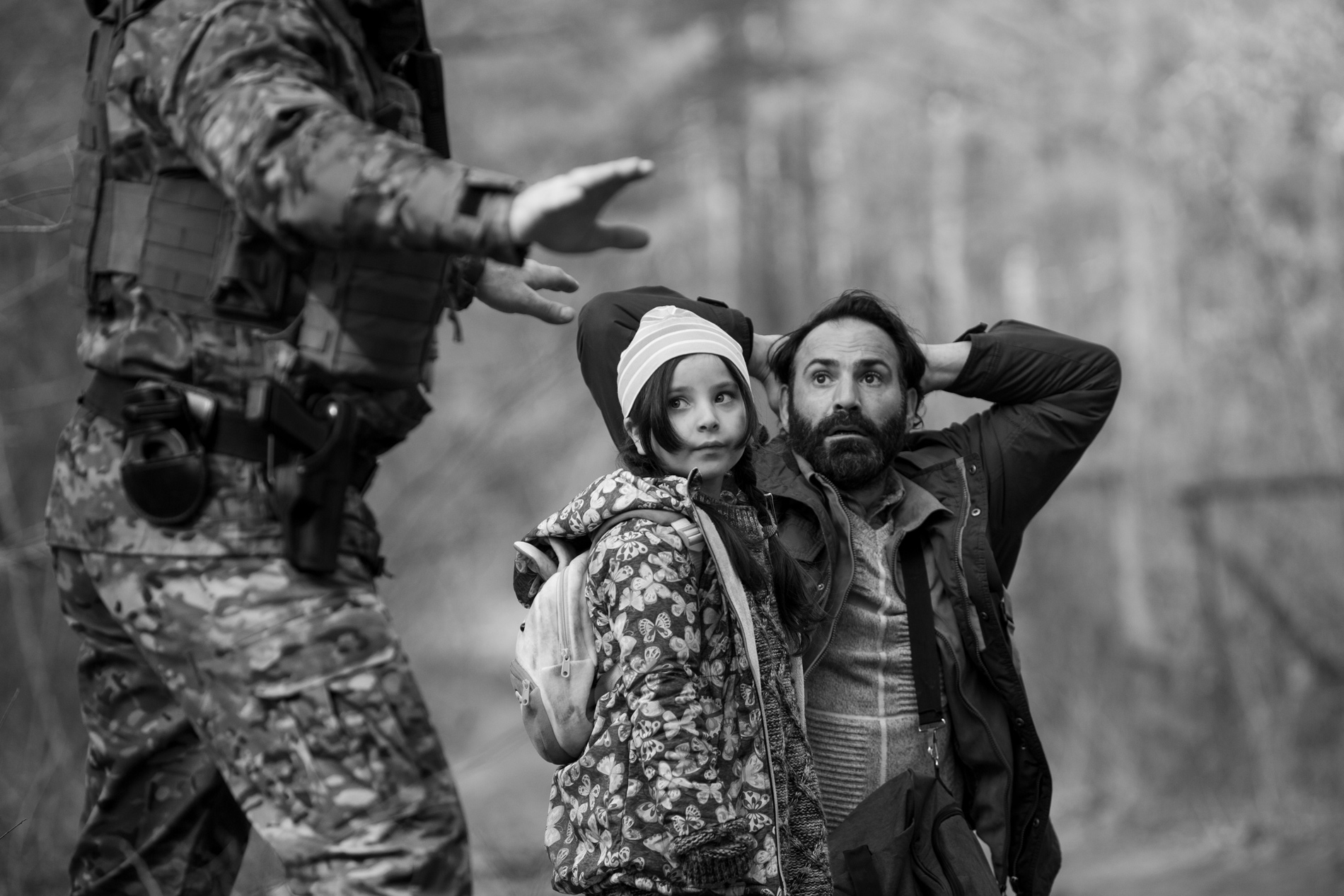
The release of Agnieszka Holland’s film The Green Border (Zielona Granica), which depicts the human drama of people pushed across the Polish-Belarusian border and the helplessness of activists willing to help them – helplessness resulting from the specific political decisions of the Polish authorities – has been met with unprecedented heckling and brutal attacks in Poland. The outrage of the country’s highest-ranking politicians from the United Right coalition was clear.
November 16, 2023 -
Piotr Augustyniak
-
Hot TopicsIssue 6 2023Magazine
A scene from Agnieszka Holland’s film “The Green Border” which depicts the multi-layered reality that is unfolding at the Polish-Belarusian border. Photo: Promotional material courtesy of Films Boutique
It is indeed difficult to tell whether their reactions were a planned action as part of the then ongoing election campaign, or rather the hysteria of people lacking control of both the situation and themselves. Equating Holland with the chief propagandist of the Third Reich, while stigmatising the film’s viewers with the famous slogan of the Polish resistance during the Nazi occupation (“Only pigs sit in the cinema”), is something unheard of even in Poland’s extremely brutalised and irresponsible public debate. All this raises the highest level of concern and poses very difficult questions. That is why, I would suggest restraining emotions, as much as possible, and taking a look at this situation from a critical distance. For it is a unique opportunity to dig deeper into what is actually happening in Poland today.

Neither simply “good” nor simply “bad”
The indifference of most of us to the tragic fate of migrants reaching the Polish-Belarusian border, the excitement of supporters of the Law and Justice party about the wall erected along it, their horror at the influx of alleged terrorists and rapists (a significant number of whom are women and children) and pride in Polish border guards making illegal push-backs – what else can this testify to, if not to the xenophobia and extreme selfish cynicism of Polish society?
Such a conclusion seems obvious, and yet it is not so easy to maintain, bearing in mind the hundreds of thousands, and perhaps millions, of Poles who, in the first days, weeks and months of Russia’s invasion of Ukraine, took in and provided assistance to several million refugees from Ukraine. Does this not prove the opposite: hospitality, openness and willingness to sacrifice in order to provide aid?
So what is the truth about Poland and Poles? Is the state of our spirit schizophrenic, with contradiction taking over our thinking? Or is it somehow possible to combine these two incompatible perspectives? To see them in a broader context as two sides of one social phenomenon?
In their own way, right-wing politicians and columnists are doing just that. Here, they claim, when Poles are confronted with real misfortune, they are willing to help and prove to be extremely sensitive to human misfortune. However, they are unwilling to help intruders who try to force their way in, or are to be forcibly relocated from other EU countries. This kind of political dictum assumes that the problems of migrants from countries of the Global South do not concern Poland. And if this is the case, then Poles are reacting appropriately to their influx.
One does not have to be particularly insightful to see the one-sidedness of such a perspective. Perhaps, then, those who claim that the true nature of Polish society is evidenced solely by an aversion to migrants from the Global South are right? They explain the attitude expressed toward Ukrainians through an incomprehensible compulsive reflex. They see it as an exception that confirms the sad rule.
In my opinion, such a way of thinking is equally simplistic. To understand and properly assess the state of the Polish condition and cultural identity, one must not depreciate either of the two attitudes towards migrants. Both should be recognised, even though they contradict each other. We are neither simply “good” nor simply “bad”; neither completely hospitable and open, nor completely closed and xenophobic. But – like all people – both at the same time, oscillating somewhere in between, leaning one way or the other. This is, of course, a simplified explanation. However, for our consideration, what is the rule of this oscillation in the case of Poland?
Unreal conflicts and hopes
What makes us help Ukrainian refugees and yet indifferent to the fate of migrants on the Belarusian border? Is this determined solely by the right-wing propaganda, which portrays the Ukrainians in good terms and those coming from Belarus in essentially bad ones? I suggest not to overestimate the role of propaganda. If it were the key issue, we could imagine the opposite situation: propagandistic dislike of Ukrainians versus openness to migrants from the Global South. We realise that no amount of media manipulation would be able to convince Poles of this. At most, propaganda reinforces deeply entrenched reflexes in the social imagination. It is not able to create them at will.
Andrzej Leder, a Polish philosopher who has consistently applied the tools of Lacanian psychoanalysis and post-structuralism to the reading of socio-cultural reality in western societies, draws attention to the deepening of the incompatibility of the social “imaginarium” with the dynamisms and their conflicts that really drive our world. The culturally defined structures of our imagination and our thinking, created in the past to describe the world of the time, are slipping away from the contemporary status quo. They continue to function, but being, as Leder says, detached from the “real”, they plunge us into the unreality of collective delusions. They make us live with unreal conflicts and hopes. Ignoring or misreading what is actually taking place.
This situation, according to Leder, applies not only to Poland, but the entire western world. However, in countries like Poland, peripheral and marked by a traumatic, unreconstructed history, the unravelling of the collective phantasm is more far-reaching and acute.
Today’s “Real” is first and foremost global capitalism, which, operating on a scale that exceeds the framework of the modern state, has escaped social control and entered a “turbo” phase. The consequences are far-reaching. These include growing social inequality, dividing the world into a rich North and a poor South, and the climate catastrophe.
Turbo-capitalism, combined with the extraordinary development of technology, exploits resources, emits carbon dioxide on an unimaginable scale and produces waste that exceeds storage and disposal capacity. In social terms, it produces a whole lot of “unnecessary people” who have no chance for a normal life in the warming climate of the South. So they besiege the countries of the rich North.
All this means that the model of the liberal welfare state and the middle class that was previously in force in Western Europe has entered a path of decay and end. The hitherto prevailing phantasm, accommodating the notion of lasting global peace and universal security, endless human development and the possibility of self-realisation for everyone, is tottering along with it and unsticking.
The Other is knocking at Europe’s doors (or rather, the entanglement-like borders), making it clear that these demands do not include everyone, but are only the privilege of the rich and dominant part of the globe. Here comes the multitude of those to whose exploitation the North owes its prosperity, and who pay the ultimate price in a lack of prospects and elementary security.
Their presence at our borders gives rise to increasing anxiety. The reaction to it is a vicious circle-like oscillation between limited admission and internment, repatriation and expulsion. The process practiced on the Polish-Belarusian border, in defiance of law and ethics, bears a striking resemblance to the psychological mechanism of displacement. Alongside it is denial, rationalisation and ad hoc attempts to remedy the multiplying and recurring “migration crises”. The unglued phantasm prevents one from seeing the true source of the problem and its scale. And graciously allows one not to see one’s own perversion – a pleasant life at the expense of others’ misery and pain.
Peripheral Polish phantasm
In Poland – as a European peripheral country – it is even worse. This is because the Western European imaginarium is combined here with the native phantasm, formed at the turn of the 20th century. While Western European societies are able to relate to the world in its globality (albeit an incomplete and perverse reference), in Poland the global context is completely – to use the language of psychoanalysis – cut off. We enjoy economic development and (hyper)consume, and our collective psyche accepts this as something basically natural. It is as if the consumed goods grow on trees in Polish orchards, and economic growth falls like manna from heaven. The other, in the form of the Global South, does not fit at all into the space of our collective perceptions, identifications and reactions.
This is how our peripheral Polish phantasm, based on historical trauma, works. It locks our psyche into the space of a local conflict, where Poland was the victim, while the oppressors were the competing, but also cooperating, powers in the destruction of our homeland: Russia and Germany.
Only such a perspective allows us to explain the schizophrenia of the Polish reference to the two migration waves. The Ukrainian one arouses sympathy, solidarity and involvement, because it is the result of an imperial onslaught by Russia, our eternal enemy. Our unstuck phantasm here turns out to be still relevant and “adjacent”. It allows us to understand Russia’s aggression and respond to it appropriately. This is because today’s Russia is living its own superpower past and by its actions is trying to bring it back to life. It is playing for its imperial position in a world where it has long had no place. Waging a war native to the early 20th century, it remains fully legible to the Polish collective imagination, born in the same era. Meanwhile, in the orbit of the contemporary “real”, this war appears as an anomaly and blandly unexplained. That is why its reasons remain unclear to the societies of Western Europe. This is also why countries such as China and India have an obvious problem with it, only secondarily trying to give it real meaning and use it for their own purposes.
Not much time left
The migratory surge on the Belarusian border is quite different. Although politically provoked by Vladimir Putin and Alyaksandr Lukashenka, in its essence it is the result of a conflict and crisis that is entirely contemporary. However, since the Polish phantasm is detached from the contemporary “real”, it sees the migrants, wandering through the Białowieża Forest, as spectres and wraiths, as a simulacrum. They are something that produces the appearance of its own existence, while in its essence it is nothing. Unfortunately, the consequences of this recognition are dramatic for many migrants. For the Polish phantasm pushes them to the brink of the real loss of existence.
The conclusions are not optimistic. This is true not only when it comes to the fate of migrants on the Polish-Belarusian border but also when it comes to the Polish future.
Let us not condemn Poles for their particular immorality, nor praise them for the heights of nobility to which they have reached. We need to look at Poland as an unfortunate sliver of the European periphery that has become stuck in its traumatic memory, out-of-date perceptions and identifications. As such, Poland is an example of a global problem, only that it has been magnified to its limits. To change it, one would have to modify the Polish phantasm, that is, de facto tear it down and replace it with a new one. So far there is no idea how to do this. This is because its unglued inadequacy is combined with a complete congealment in itself, a complete impregnation with national traumas and catastrophes.
Who is to bring us out of them, when the political mainstream lives by its persistence and fuelling it (the right wing) or, for fear of another electoral defeat, did not dare to violate it (the democratic opposition)? In this near hopeless situation, I nevertheless hope that Holland’s film will be an impulse, contributing to the activation of slow change. We must muster the courage to put the Polish imagination on the edge in defiance of politicians. Perhaps by violating the boundaries of our imaginations, we will finally face the chance to transcend them, that is, to build new perspectives on how we perceive and react to the world? There is not much time left.
This article first appeared on Forum Dialogu – an online portal in Polish and German dealing with issues related to the political and cultural dimensions of Europe
Piotr Augustyniak is a Polish philosopher, essayist, journalist and academic lecturer. He specialises in issues at the borders of human philosophy, metaphysics, philosophy of religion and the theory of modernity.