
The (in)famous Dovbush. A robber of trust?
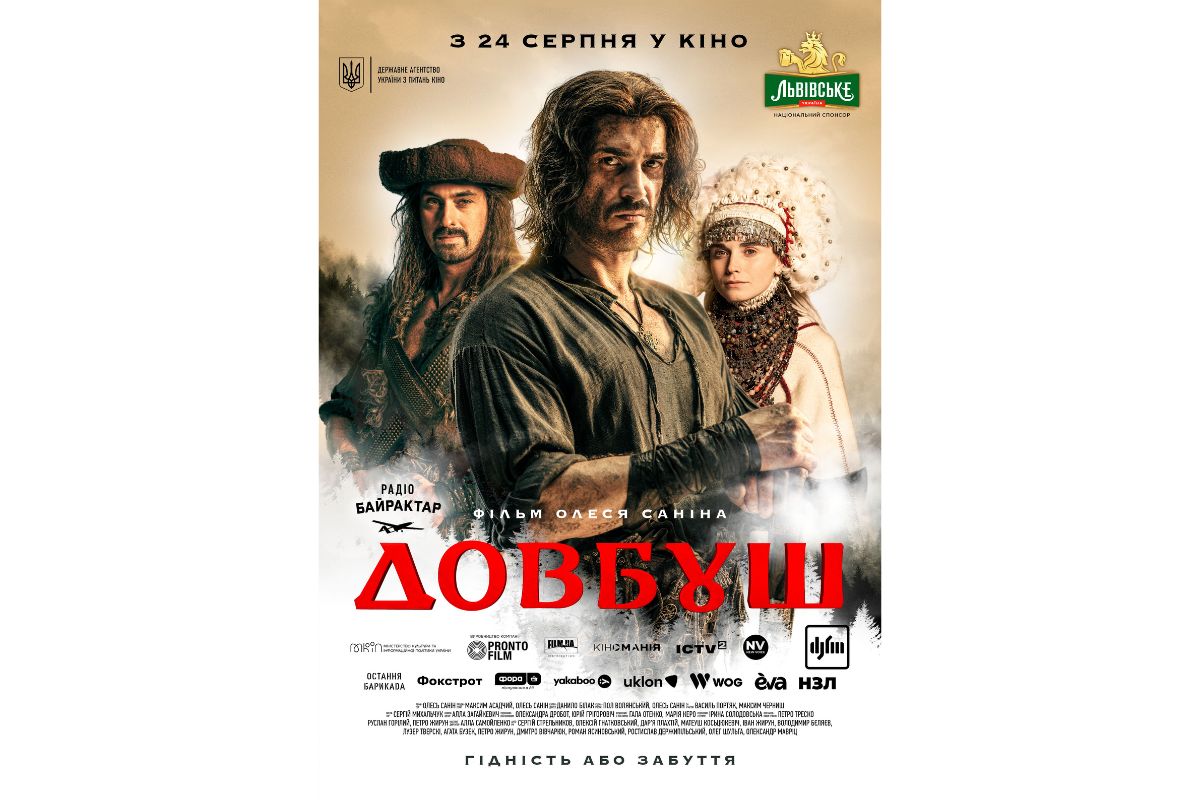
A review of Dovbush. A film directed by Oles Sanin. Distributed by Film.Ua Distribution Kinomania, Ukraine (2023).
February 7, 2024 -
Grzegorz Szymborski
-
Books and ReviewsIssue 1-2 2024Magazine
When I first learned of a Ukrainian film set in the mid-18th century Polish-Lithuanian Commonwealth, I was full of hope and joy. As a historical re-enactor of that era, I could only envy Ukrainians. This is because they explore various timelines in their cinema, while Polish contemporary productions get bogged down almost entirely in the 20th century. Yet already with the first trailers of Dovbush, my hope was replaced by doubts.
The production is worthy of recognition. It is the most expensive cinema project in the Ukrainian film industry. It came to a successful end amidst the uncertainty of the Russian invasion. Yet, although it premiered on Ukraine’s independence day, surprisingly it tells the story of the Polish nobility’s oppression that forced Hutsuls (Carpathians of Ruthenian and Romanian origin) to rise against their feudal lords. The iconic hero of the folklore – the mountain robber Oleksa Dovbush (played by Sergey Strelnikov) – serves as the symbol of this struggle and encourages contemporary Ukrainians to defend their homeland.
Whilst being an actual historical figure, research shows that the plot of the film is far from authentic. And while the historical sources on Oleksa Dovbush himself leave room for interpretation, the director Oles Sanin ignored those facts that are indeed out of the question. He did so for the sake of his narrative, which challenges, to say politely, today’s often tense Polish-Ukrainian relations.
“Get a life!”
The reason why I take a harsh stance on the historical background is only partially connected to my personal interest and field of expertise. No historian should ever expect a film to be entirely correct. Ridley Scott’s viral reply to the professor accusing his latest Napoleon of inaccuracies reminds us that motion capture will always serve other purposes such as entertainment, with history simply a tool to achieve it. At the same time, a disregard for reality may outrage people as Napoleon truly did, being widely accused of creating a simplistic view of the French dictator and 19th century European history.
Yet, at the very beginning of Dovbush, the director, through the narrator, pledged himself to tell the true story behind the mountain robber’s infamous career and the multiple legends that arose concerning him over centuries. That is where the expectations start skyrocketing. If one claims to reveal the truth, they invite critics to test them. If the production was declared to be an adaptation, that would result in acceptable licentia poetica. Another reason for a watchful eye is the tone. Unlike the 1974 Polish comedy series Janosik by Jerzy Passendorf, which also depicts the story of the highland robber, yet, fully fictional, the mood of the Ukrainian film requires the audience to stay serious. And the spectator soon realises that this is more of an action, rather than a historical, production. But whatever genre it would be, it always conveys a specific message to the audience. After the screening I was deeply worried about what idea spectators may be left with. Surprisingly enough, Ukraine is never mentioned. Still, it is a truly patriotic film for Ukrainians, conveying somehow a universal value – personal freedom. At the same time, it praises – in a far more vague and historically questionable way – the equally important message of defending your surroundings and the local community.

Simplicity
Overall, the film is more about the story of people being oppressed by a cartoonish nobility. While some national diversity is hinted on the side of the robbers, with a Polish fellow among the outlaws, the noblemen are only Poles. Had the director used well-known connotations to make sure that the Ukrainian audience would associate antagonists with Poles only, even if this is historically inaccurate? After all, many noblemen in the area were of Ruthenian origin. The presence and overuse of broadly recognised but historically absent winged hussars, the contemporary Polish flag as a military banner, and infantry officers commanding in Polish instead of in German, serve a simple and disappointing purpose. That being said, after watching Dovbush it is unlikely for the spectator not to perceive Poles as the enemies. Whilst making them the main antagonists is fully understandable, they are depicted as one dimensional characters. While the image is truly simplistic, one must also mention that character development is generally missing in the film, and not only in the case of the antagonists.

The most impactful yet irrelevant part of the movie’s plot is actually the true flaw of the Polish nobility as presented by Oles Sanin – the readiness of the 18th century magnates to collaborate with the Russian court in pursuit of personal interests. Several scenes hinting at this cooperation could easily be removed without affecting the story itself. This is why this whole sequence may be questioned as poetically pointless. Historically, it is more than possible, yet potentially damaging to the current view of Polish-Ukrainian relations.
The same may be said about the historically inaccurate prologue, which presents the short-lasting cooperation between the Polish noblemen and Hutsul infantrymen as ending with the Poles turning their backs on their Ruthenian comrades once the fight against Russia is over. Taking into account the context of the film’s release, this message is particularly painful and leaves room for speculation.
Adjustments to the history
I had already mentioned that historical facts are neglected by the director for the sake of the narrative. While little is known about Oleksa’s life – that is why serving in the Polish-Lithuanian army is not unlikely – the death of the protagonist’s father Vasyl at the hands of noblemen is pivotal proof that the director meant to make Poles personal and sanguinary enemies. This was used to give the main protagonist a reason to unleash his need for vengeance. Meanwhile, according to the 19th-century Ukrainian historian Julian Celewycz, Vasyl Dovbush denounced his sons Oleksa and Ivan (played by Oleksiy Hnatkovskyy) and forbade them to return home after repeated pleas from his Jewish neighbours. These people were victims of the mountain robbers’ raids and other illegal activity. Colonel Przełuski (played by Mateusz Kościukiewicz), presented as the protagonist’s nemesis, was tracking his successors many years after Dovbush’s death in 1745. Taking into account the known historical facts, so many changes and interpretations of the story led to the depiction of Poles as treasonous enemies fully responsible for Oleksa’s tragic fate.
On the other hand, little is said in the film about Dovbush’s raids and his “professional” career. Celewycz claimed that Dovbush and his mountain robbers were feared by the Poles, Armenians and Jews that were targeted, with Hutsuls being spared. The film limits the story of the fearsome robber for the sake of the tale about the liberator who challenges Colonel Przełuski and Duchess Teofila Jabłonowska (played by Agata Buzek). She is ultimately presented as the hidden antagonist for Dovbush. While a real historical figure, she was incorrectly called a “grand duchess of the Crown” who rules over the peasants with an iron fist against the alleged will of her father. If the production was to deliver the message of the exploitation of the peasantry by the nobility, it was poorly executed with the depiction of Jabłonowska.
Fiction justifying the narrative and, therefore, the message conveyed by the film, in fact minimises the idea that should stay with the audience. I can understand that the question of feudal exploitation may be an important issue for Ukrainians with regard to our common history. But to make this clear and representative, the true story should support the director’s idea. Otherwise, some Polish circles could sadly disregard any need for debate connected to the tale.
A new approach in the film industry?
Strikingly, Sanin’s adaptation has a lot in common with the Soviet depiction from 1959 by Victor Ivanov. Just like in the 1950s, the Poles are again cartoonish and cruel. Oleksa first attempts to trust the nobility and learns harshly from his mistake. In the Soviet version, Polish magnates pursue him in the form of Jabłoński’s spouses, instead of Jabłonowska. In both films, the mountain robber outsmarts his enemies. Captured and brought to justice, he escapes. The first battle sequence takes place in the market square, with the second clash focusing on a classic trap in the wilderness. The outnumbered mountain robbers eventually overcome their pursuers. In both productions there is also one Polish fellow loyal to Dovbush, who then suffers grave consequences at the hands of his compatriots. The Commonwealth soldiers wear inaccurate blue uniforms, and lastly, the finale and fate of Dovbush are very much the same, strikingly opposite to the reality. Both adaptations make a nod to the alleged mountain robber’s mercy – sparing both Polish soldiers and children. The links between the Soviet and contemporary versions are somehow noticeable.
It is worth pointing out some similarities with Janosik: A True Story – the 2009 reboot by Agnieszka Holland. While her attempt was definitely not as successful as the Polish communist TV series, by comparing Sanin’s picture to the 1959 adaptation, it is clear that there are similarities between the contemporary images of the mountain robber. At this point the modern films essentially constitute a cliché. The leader of the robbers suffers from the scars of war, perceives authority as a source of oppression, cherishes freedom and accidentally becomes a leader while facing opposition within his ranks. The legend relies on people who tell stories about immortality and spells protecting the robber from bullets. The commitment of the robbers to the land and soil is seen as giving them spiritual strength and is highlighted in both contemporary movies about the mountain robbers. Yet, Holland does not try to immortalize her hero, concluding Janosik’s journey with his true end as it was without any sparks of romanticism. And this is where the undoubtful commercial success of Dovbush may be found. While Janosik is vague, presented neither as a criminal nor a hero, he does not become immortalized or even memorable in Holland’s depiction. While historically inaccurate, the Ukrainian spectator can truly get along with the predominantly fictional superhero-like figure, resembling Mel Gibson’s Patriot protagonist.
Lessons to be learned
The comments around Napoleon remind us that historical authenticity still plays an important role in film. Whilst Scott’s image generates broader debate due to the scale of his work and its subject matter, the issue triggered by Dovbush may affect the world at a smaller, more Polish-Ukrainian scale. For some reason, the director decided to delay screening in Poland until late autumn 2023. Many possible reasons for that are presented above.
All that being said, considering the circumstances and the tone of Dovbush, the dedication made to Poles in the opening seems unfitting and rather for a completely different film or political timeline. While Sanin’s need to release already postponed work of his own is commercially and creatively understandable, doing it after receiving so much support from Poland is very questionable. While the film is truly entertaining, it follows the Soviet narrative. The depiction of the robber as the hero and liberator may only postpone a necessary and serious Polish-Ukrainian debate about the exploitation of people by the nobility. From the Polish perspective, the release date of the movie was very inconvenient. To be fair, I guess that for some far-right Polish circles, any time would be unfitting. Yet doing so on Ukraine’s independence day, while the country continues to fight for its life against the Russians, could not have been worse from the Polish point of view.
There is something about this film that reminds us of the past in Polish-Ukrainian relations, before the time of the solidarity honeymoon. But it may also be the plain truth that as a Pole I may never fully understand the Ukrainian narrative – just like it may be difficult for Englishmen to accept the tale of William Wallace, with whom Sanin compared Oleksa Dovbush. I hope a time will come when Poles and Ukrainians combine their forces in directing a film of heroes that we can be mutually proud of, and antagonists we can mutually condemn for the sake of a common and undoubtful moral message. And, of course, do it in an equally entertaining way.
Grzegorz Szymborski is a graduate of the College of Europe in Natolin (Poland). He is also the author of the books Wolność niejedno ma imię (2013), Wyprawa Fryderyka Augusta I do Inflant w latach 1700 – 1701 w świetle wojny domowej na Litwie (2015), and Działania zbrojne w Rzeczypospolitej podczas interwencji rosyjskiej 1764 roku (2020). He is an avid historical re-enactor.