
Text resize: A A
Change contrast

The anatomy of betrayal

The story of local Belarusians who collaborated with Nazi Germany is often a forgotten page of history. Yet, their brutal tactics and participation in the extermination of Jews and other populations are a sad reminder of life under occupation, as was the case of the Barysau police officers.

I remember when I was a small boy, I used to ride my bike with my grandfather. In one village near Babruisk, my grandfather would start a conversation with a local resident. The villager would ask, “Are you interested in the history of the war?” “Do you see the house on the left? A policeman lived there. So there was a lot of blood on the hands of this policeman. He shot Jews and Soviet POWs. He didn’t run away with the Germans; he was hiding here. Caught, and tried. Got a quarter, 25 years. No one else had seen him here.”

September 11, 2023 - Ihar Melnikau - History and MemoryIssue 5 2023Magazine
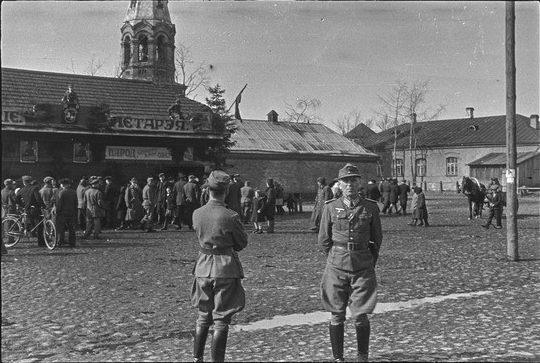
An image from Barysau during the Second World War. Photo: Public Domain (CC) https://garystockbridge617.getarchive.net/amp/media/barysa-rynak-barysa-rynak-1941-44-3-07e6a7

I listened to that story and imagined that “traitor” who served the Nazis. What motivated these people to turn to the Nazis? Some fiercely hated the Soviet government, others longed to rise above their fellow villagers and realise their paltry ambitions. Others were led to the police by fear of the occupiers and possibly sent to work in Germany.

 Establishing a “new order”

On July 25th 1941, SS Reichsführer Heinrich Himmler issued an order “on the tasks of the police in the occupied territories”, which, in particular, emphasised that “it is necessary to create additional security formations from a suitable part of the population of the occupied regions for us.” The main task of the auxiliary police, which the Nazis began to create in the occupied territory of Belarus in the autumn of 1941, was to assist the German military and civilian authorities in maintaining order and implementing occupation policy. The Nazis divided the territory of Belarus between various administrative districts. Thus, fragments of our country were part of the General District of Volyn-Podillya, the Reichskommissariat “Ukraine”, the district “Białystok” (part of East Prussia), the Reichskommissariat “Ostland”, as well as the rear areas of the army group “Centre”. In this regard, there were “Belarusian”, “Ukrainian”, “Lithuanian”, “Latvian” and “Russian” police on the Belarusian lands, whose occupier was the Nazis.

In July 1941, the commander of the army group “Centre” General Max von Schenckendorff issued an order in Baranovichy to create a local government and police. In the ranks of the police it was originally planned to accept reliable Belarusians and persons of German nationality, the so-called Volksdeutsche. If we talk about the composition of the police, it should be noted that at the end of 1941 about 3,700 policemen served on the territory of the General District “Belarus”, and by 1943 there were already about 50,000 people in various police structures (such as the “Order Service” or Schutzmannschaft). A network of special police posts was created in occupied Belarus and police forces were consolidated into special battalions. Initially, the formation of police units was on a voluntary basis.

The cadres were selected for the police after checking the reliability of the candidates. Here is how one of the inhabitants of the Belarusian village Mir described this process: “These policemen were not mobilised, they were all volunteers. They were between 25 and 35 years old. They usually did not enjoy special respect among the locals. Some were prone to alcoholism. At that time, about 25 local policemen and 12 gendarmes were responsible for the territory, which had 20 to 25 villages. The Germans did not know the area or the language, and therefore relied on the local police.”

The Belarusian policemen were commanded by German officers. One of them, Captain Max Eibner, described the process of forming the local police in the Baranavichy district as follows: “The Belarusian Schutzmannschaft obeyed me. I took it from the former local commandant. At that moment, there were 250 local volunteers in the Schutzmannschaft. They were distributed throughout the territory.” By forming local police, the Nazis sought (especially in western Belarus) to weaken the influence of Poles in this structure. To find out the national composition of the police, the occupation authorities in December 1941 conducted a survey on the subject of nationality. Shortly after which all those who called themselves “Poles” were fired.

Starting around the summer of 1942, the German occupation authorities began  forcible recruitment into the police. One of the policemen described this as follows: “The mayor sent letters to some men from our town and ordered them to come to the police station. There they were forced to join the police. Then they were examined by a doctor, and then sent to the barracks, where they were given rifles and ammunition.” Due to the shortage of officers and sub-officers, the Nazis created schools for police training. On the territory of Belarus such schools existed in Malaryta, Vileyka, Stolin and other cities. Cadets of these schools had drill and fire training, study of the German regulation of the guard service, and combat tactics. There were, of course, political lessons. It all ended with them taking the oath of allegiance “to the Führer and the Reich”.

Keeping tabs for the occupiers

The local police were armed mainly with weapons seized from the Soviets. The uniform, initially, consisted of an armband, on which, in addition to the inscriptions Schutzmann” and Polizei”, the personal number and place of service were indicated. Then the police began to receive special uniforms. One of the Baranavichy policemen described his uniform as follows: “Our uniform was black: a soldier’s overcoat with grey cuffs, two rows of buttons made of white metal. A black belt with a white, metal buckle.”

The main task of the police was to protect public buildings from partisan attacks. Policemen were also used to guard the ghetto, escort Jews to their place of work and “special actions”, which, most often, meant the destruction of various groups of the local population: Jews, Gypsies, Soviet activists, prisoners of war of the Red Army, or the Polish intelligentsia. At the same time, the so-called unauthorised shootings were often noted in German documents, when the police killed people guided by a banal thirst for profit. In addition, the policemen had to monitor the collection of taxes, confiscation of warm clothes for the needs of the German army, the timely implementation of agricultural supplies and the registration of residents.

Local Belarusian police prepared three lists concerning the population. The first concerned those who lived on the territory before the German attack on the USSR, while the second was made up of those who came to this area after June 22nd 1941. The third concerned Jews, communists, and employees of the Soviet state organizations, party authorities and NKVD. These lists also included family members. All citizens over the age of 16, who were included in the first two lists, had to have an ausweis”, the role of which, most often, was performed by a pre-war Soviet passport with the seal of the occupation administration.

In addition, the Secret Field Police (GFP), as well as the “Order Service” had investigative departments. Their staff most often consisted of “local” residents (including former Soviet militia officers, or captured officers of the Red Army who decided to serve the occupiers). It should be noted, however, that there were some differences between those who voluntarily joined the police in 1941 and those who began to be conscripted by coercion already in 1942. Many of the second category had to choose between police service, work in Germany or escape to the forest to join Soviet, Polish or Ukrainian partisans. Among these people there were fewer stubborn anti-Soviets, antisemites and pro-Nazi individuals.

In 1942, the creation of the “Belarusian Self-Defence Corps” began in the occupied territory of Belarus, units that, according to the plan of the German command, were also to be used for anti-partisan actions. There were up to 15,000 residents of Belarus in the ranks of this formation. In January 1943, the 13th Belarusian Police Battalion was formed under the Security Service of the German SS, which was later actively used in the camps and ghettos, as well as bloody actions against Soviet partisans and the destruction of civilians. In 1944, after the beginning of the Soviet Operation Bagration, a significant number of policemen left for the West.

 The “bloody” mayor

The German authorities actively used policemen and civilian Belarusian collaborators in carrying out the policy of the Holocaust and repressions against civilians of occupied Belarus. As the Israeli researcher Leonid Rein noted: “The Germans depended on local collaborationist structures, first of all, on the so-called ‘local administration’ and auxiliary police. These bodies were created at the very beginning of the German invasion. Local burgomeisters were often key figures at various stages of the genocide.”

One of the most terrible examples of police participation in the extermination of the Jewish population of Belarus occurred in the autumn of 1941 in Barysau – about 8,000 Jews were killed there. The “action” of the destruction of the Barysau ghetto took place with the active participation of the mayor of this city, the Belarusian Stanislau Stankevich. In 1939-41, this man worked as a teacher in Navahrudak. After the German attack on the USSR, he began to cooperate with the Germans. He was the mayor of Barysau and the district and in 1944, he served as deputy president of the Belarusian Central Council in Baranavichy.

On the eve of the destruction of the Barysau ghetto on October 19th 1941, Stankevich participated in a banquet for policemen (future murderers of the Jewish population of Barysau) and “inspired them to serve the Nazis”. “Doctor” Stankevich (the collaborator always emphasised his academic degree) personally supervised the census of the population of the Barysau district and the compilation of lists of Soviet citizens of Jewish nationality.

“In order to identify representatives of the Jewish population, on behalf of the German commandant and the mayor of the Barysau district, the well-known nationalist emigrant Stanislau Stankevich conducted a census of the entire population on the territory of the district in July 1941, as a result of which 400 Jewish families were identified. I provided the lists of all these persons to the Barysau district administration,” noted David Egof, former head of the Barysau district security department, during interrogation by the KGB. The mayor was personally responsible for the arrest of representatives of the Soviet local authorities and made great efforts to create a police force.

In 1946, Soviet special authorities arrested former policeman Mikhail Stuk. During the interrogation, he admitted that it was Stankevich who offered him to go to the police, and he also appointed policemen who participated in the shootings of civilians. “Mayor Stankevich, after preliminary indoctrination in the anti-Soviet spirit, said that the German army would soon end the Soviet Union and there would never be Soviet power again,” Stuk noted during his interrogation.

Numerous archival documents, which are kept in Belarusian archives today, testify to the antisemitic activities of the Barysau police officers. In August 1941, the head of the Security Service of Novo-Barysau, Timofey Bakhanovich, in a letter to Mayor Stankevich wrote: “According to available data, Jews secretly sell their various property to Russian neighbours, such as cows and other livestock, equipment and other contractual things. I ask you to inform me if they have the right to do this and what to do with those Jews who sell and with those citizens who receive property from Jews.” Without waiting long, Stankevich issued an order “to take cows and any cattle from Jews”. At the same time, the terms “Jewish things”, “Jewish cow” and “Jewish goat” appeared in Barysau. The police began to “hunt” Jewish things, and the victims of this hunt were often ordinary Belarusians and representatives of other nationalities who lived in Barysau.

Passion for killing

When the assistant chief of the Barysau police demanded that the chief of the Novo-Barysau police, Bakhanovich, allocate 15 policemen to organise the resettlement of Jews to the Barysau ghetto, 17 policemen signed up for service. They had hoped to receive additional “bonuses” in the form of things seized from Jews. The American researcher Martin Dean noted: “The police could shoot anyone for every reason. It was enough to say about the future victim that they were a partisan or a communist to justify themselves in the eyes of the gendarmerie. They killed people to convince the German authorities of their commitment. This group had a great passion for killing.”

“In August 1941, it is unknown for what reasons the Germans captured a group of 50 Jews and shot them. Following this execution, the German military commandant, Colonel Rosenfeld, ordered all Jews to wear yellow distinctive signs on their chests and backs. The police were ordered to follow this order through the mayor of the city Stankevich. At the end of August 1941, a special camp was organised for the Jewish population, the so-called ghetto, in the area of Krasnoarmeyskaya and Slabodka streets, where the entire Jewish population of Barysaw was settled. The camp was surrounded by barbed wire and a police guard was set up. The execution took place as follows: police officers broke into apartments, grabbed men and women and dragged them to the fields along Krasnoarmeyskaya Street, and from there they were driven by cars to the place of execution. Separate parties of Jews were driven on foot. People were overwhelmed by fear and few of them resisted, and those who resisted were beaten and forced to go. They took whole families and the children went along with the adults.”

“The convicts were brought in cars and brought to the prepared pits, given the order to undress. Those who could, undressed themselves, those who could not, the police undressed. They stripped them naked, some children screamed and were thrown into the pits dressed. Egof, the head of the Security Service, beat people with a whip. Before the shooting, drunken policemen raped women. In total, about 7,000 people were shot these days. The organisers and participants of the execution of the Jews of the city of Barysaw included Colonel Rosenfeld, Captain Max Eibner, Police Chief Kavaleuski, Egof David Davidovich (a German from the Volga region), and the policemen Mikhail Hrinkevich, Pipin, Kislyak, Maitak, Budnik, Nikitin and Klimkovich.”

“When examining the place of execution and interviewing residents, it was found that in October 1943, the Germans burned the corpses of the executed people. The fire was visible and the unbearable stench of burning corpses was felt. They smoked at night. The burning was done for four to five nights, and then the pits were buried, filled in and cars drove over them in order to hide the crime committed.” This was all noted in the Act of the Barysau City Commission of the Extraordinary State Commission on the murder of the Jewish population by the German occupiers in the city, drawn up on September 12th 1944. It should be noted that between October 20th and 21st 1941, there was a mass shooting of Barysau Jews. Thousands of ordinary people became victims of the Nazis and their accomplices from among local collaborators.

Black page

After the destruction of the ghetto and its residents, it was Stankevich who was responsible for the sale and distribution of things left behind by the Soviet citizens and Jews. However, the first to gain access to the belongings of the dead were the policemen. During interrogation after the war, the former headman of the village of Korsakovichy noted that “The policemen who participated in the destruction of the Barysau Jews returned with watches and other items that they received as a reward from among the property of the murdered Jews.” As for Stankevich, according to some sources, already as a representative of the president of the Belarusian Central Council in Baranavichy, he also joined the activities of one of the most terrible places of extermination in Nazi-occupied Belarus – the Kaldycheva concentration camp near Baranavichy. In 1944, Stankevich retreated to Germany together with German troops, and after the war he escaped to the West.

Belarusians are one of those European nations that suffered greatly during the Second World War. Today, studying the events of the past, it is necessary to consider each historical plot in a multidimensional perspective. Archival documents and eyewitness memoirs prove that in 1941-44 on the territory of Belarus even Germans were amazed by their cruelty of the local people who became collaborators. The participation of the policemen from among the residents of Belarus in the extermination of the Belarusian, Jewish and Polish populations of Belarus is a black page in the country’s history. We have to remember it.

Ihar Melnikau is a Belarusian historian, essayist, journalist, blogger and editor of the history portal Historia Pobach. He is the author of various academic and journalistic articles and 18 books, including The border was near Minsk 1921-1941 and Forgotten Corps. The Polish Army in the Bobruisk Area 1918-1920, in which he addresses little-known aspects of Belarusian history and Belarusian-Polish relations during the Second World War.

, , , , ,

Partners

Terms of Use | Cookie policy | Copyryight 2026 Kolegium Europy Wschodniej im. Jana Nowaka-Jeziorańskiego 31-153 Kraków
Agencja digital: hauerpower studio krakow.
We use cookies to personalise content and ads, to provide social media features and to analyse our traffic. We also share information about your use of our site with our social media, advertising and analytics partners. View more
Cookies settings
Accept
Decline
Privacy & Cookie policy
Privacy & Cookies policy
Cookie name Active
Poniższa Polityka Prywatności – klauzule informacyjne dotyczące przetwarzania danych osobowych w związku z korzystaniem z serwisu internetowego https://neweasterneurope.eu/ lub usług dostępnych za jego pośrednictwem Polityka Prywatności zawiera informacje wymagane przez przepisy Rozporządzenia Parlamentu Europejskiego i Rady 2016/679 w sprawie ochrony osób fizycznych w związku z przetwarzaniem danych osobowych i w sprawie swobodnego przepływu takich danych oraz uchylenia dyrektywy 95/46/WE (RODO). Całość do przeczytania pod tym linkiem
Save settings
Cookies settings