
The dream of sanctions stopping wars
Despite various sanctions put in place against Russia for its invasion of Ukraine, the Russian economy is surprisingly doing much better than expected. It appears for now that at least in the short term, the Russian economy is able to bypass sanctions as long as other countries are willing to pursue business as usual with Russia. Whether or not the sanctions will have a longer-term effect and have any impact on Russian aggression remains to be seen.
When western countries adopted sanctions against Russia in response to Putin’s war of aggression against Ukraine, western politicians promised nothing less than the complete breakdown of the Russian economy. The French Finance Minister Bruno Le Maire spoke of the “collapse” of the Russian economy, while US President Joe Biden said that “We will keep raising the economic cost and ratchet up the pain for [Vladimir] Putin and further increase Russia’s economic isolation.”
July 4, 2023 -
Svenja Petersen
-
AnalysisIssue 3-4 2023Magazine
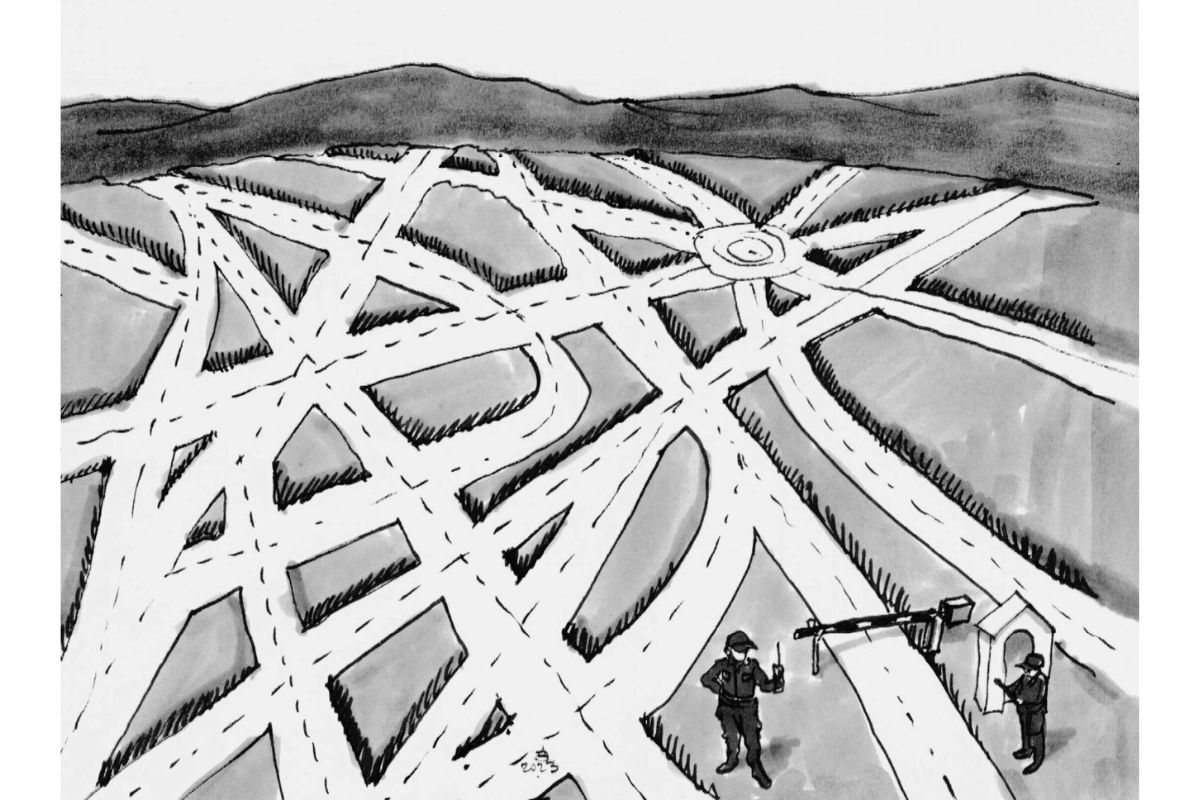
Illustration by Andrzej Zaręba
After more than a year of comprehensive sanctions against Russia, this collapse is still yet to come. On the contrary, Russia’s economy recently grew by 1.2 per cent in April 2023, which is higher than the current economic growth rate of the European Union. The Russian rouble, which was massively devalued in the meantime, is now even stronger than it was before the Russian invasion of Ukraine, which began at the end of February 2022. The key interest rate, which was raised to 20 per cent by the Russian central bank to ward off the consequences of the sanctions, is now at its February 2022 level of 7.5 per cent. At the same time, Russia’s financial cushion is growing. Therefore, one should not be under any illusions: sanctions will not win wars. Yet, the right conclusions must be drawn from this realisation.
The state of research on the success of sanctions
The research on the success of sanctions is extensive and almost always comes to the same conclusion: the closer the relationship between the sanctioning state and the sanctioned state, the more likely it is that sanctions will achieve their goal. But more crucially, the smaller the target of a sanctions policy, the higher the probability that the sanctions policy will achieve its goal. In practical terms, this means that sanctions are more successful when they involve, for example, simpler offenses such as violations of trade treaties on a smaller scale, or the internment of a country’s citizens in a second state. In these example cases, the probability is relatively high that an agreement will be reached to resume compliance with the applicable trade treaties, or to release interned prisoners.
However, when the target of sanctions is of existential importance, such as issues like rearmament, wars or military conflicts, sanctions almost never fulfil their objective. Therefore, they are a difficult tool to use when it comes to serious issues of international security policy. For example, there are extensive western sanctions regimes against North Korea and Iran, as both states are accused of pursuing their own nuclear weapons programmes. Coupled with the anti-western sentiment and threatening gestures of these two states, the western community of states sees itself existentially threatened by this scenario. These two examples confirm the aforementioned theories derived from research: the worse relations between two states and the more relevant the target of sanctions is to security policy, the lower the chances that sanctions will be successful. As a result, the regimes in North Korea and Iran have withstood sanctions for decades.
This suggests that a similar scenario for sanctions against Russia is unfolding. Relations between Russia and the West have been strained since the Russo-Georgian War in 2008 and openly belligerent at least since the war in Eastern Ukraine in 2014. The goal of stopping the full-scale war in Ukraine through sanctions is certainly not an unambitious goal of security policy. Of course, according to sanctions literature, the chances of stopping the war are extremely slim. So, just how does Russia manage to generate economic growth despite the sanctions?
The reasons for the apparent stability of the Russian economy
Deliberations on the EU’s 11th sanctions package against Russia have recently begun, but the consequences of the sanctions are far less visible than initially expected. One of the main reasons for this is sanctions evasion. This means that goods that are no longer allowed to be delivered to Russia are re-exported to Russia via third countries. These new supply chains for sanctions evasion have helped quite a few countries to achieve a recent economic boom. This evasion can be most clearly seen in the non-sanctioned states of the Eurasian Economic Union. These countries are in a free trade zone with Russia and are namely Armenia, Kazakhstan and Kyrgyzstan. Other states whose trade with Russia has increased conspicuously in 2022-23 include Turkey, Georgia, China and the United Arab Emirates. A clear indication of sanctions evasion is a sharp increase in trade balance with Russia, as well as the export of previously unseen goods to the country.
A closer look reveals that the Central Asian republic of Kyrgyzstan exported two and a half times more to Russia in 2022 than in previous years. This does not necessarily indicate sanctions circumvention, as Russia is now naturally looking for new supply chains and increased trade with different partners than before, as trading with western states is no longer possible. For example, more textiles are now exported to Russia than before. More relevant in the context of sanctions, however, is the fact that in 2022 Kyrgyzstan started to export car parts to Russia – a commodity that was never exported from Kyrgyzstan before. Why is this relevant? It is likely that these car parts, which may now no longer be exported from the EU to Russia, found their way to Russia via car manufacturers exporting from Europe to Kyrgyzstan. This is also indicated by the fact that trade between Kyrgyzstan and the largest car manufacturing country in Europe, Germany, has recently grown by as much as 561 per cent. Moreover, last year Kyrgyzstan became Russia’s number one trading partner.
The example of car parts is not accidental, as car parts are especially relevant for Russian warfare in Ukraine and can be used as spare parts for war machinery. However, this can also be the case with less obvious commodities. Refrigerators or washing machines, for example, which are imported from the West to Russia via Kazakhstan (a threefold increase in imports) and Armenia (more imports than in the two previous years combined), may also be indicative. The fear is that these will then be further exported to Russia and the inner workings of the home appliance imports will be used for Russia’s war equipment. In this way, microchips from Texas Instruments or Ethernet cable connections from the German manufacturer Harting have already made their way into Russian Iskander missiles.
Another interesting example is Georgia, which 15 years ago was still fighting a war with Russia and whose state territory has since been partially occupied by the country. At the same time, and to the surprise and criticism of the West, Georgia has not joined the sanctions regime against Russia. On the contrary, it seems that Georgia is benefitting significantly from the sanctions. Trade between Russia and Georgia grew by 46 per cent in 2022; and this includes goods such as food products which even find their way from Ukraine to Russia via Georgia. Above all, however, Georgia appears to be benefitting from Russia’s reduced export goods prices, as imports from Russia in particular grew by a full 74 per cent in the first ten months of 2022. Natural resources from Russia in particular, which are being purchased less and less by the EU, are now seemingly being bought up by Georgia. Georgian imports of oil and petroleum products from Russia increased by a full 179 per cent year-on-year. Increased purchases of Russian natural resources, which are now no longer being taken by the West, naturally continue to boost the Russian economy.
This brings us to the next factor in Moscow’s economy remaining relatively stable despite extensive sanctions. Russia is one of the most resource-rich countries in the world. The reality is that if the West stops buying natural resources from Russia, other countries will. Even though Russian commodity prices have fallen in the face of sanctions, causing a deficit for the Russian state budget, it is true that Russia will always find new buyers, thus keeping the Russian economy at a certain level. The main buyers of Russian crude oil now include China and India, which now buy 91 per cent of Russian crude oil. Turkey also bought twice as much crude oil from Russia in March 2023 as it did a year earlier. In addition, mainly North African, Middle Eastern and Latin American countries increased their imports of Russian crude oil.
Despite the sanctions, many of these Russian natural resources make it back to the European market. India, for example, processes Russian crude oil into diesel fuel, which is then further exported to the EU. Even more unpleasant for the EU should be the suspicion that Russian gas is being exported to the EU via Azerbaijan. Brussels proudly announced a new gas deal with the Azerbaijani regime in 2022 to become less dependent on Russian gas. At about the same time, however, Baku concluded a gas deal with Moscow, indicating that Russian gas is likely to find its way to the EU via Azerbaijan.
The Russian autarky
Even when it comes to Russia’s basic supplies, there should be no illusions. Russia remains the largest country in the world in terms of territory with a variety of natural resources and climatic zones. Due to its natural resources and the territorial vastness of the country, Russia’s basic supply is secure. Rather, the potential is not yet exhausted. Already in 2014 when the first sanctions were imposed on Russia due to the annexation of Crimea, some economists commented that the sanctions may be “in the long run, the best thing that can happen to Russia”. This is because they strengthened domestic production and thus the domestic market. Indeed, prior to 2014 the Russian economy relied heavily on imports coming from the West. Since the sanctions on western food, Russia has significantly expanded its potential and become more self-sufficient. Food production sprouted like mushrooms in Russia after 2014.
However, the sanctions that have now been imposed in 2022 affect other areas, such as the IT sector or financial markets. Russia will not find comparable substitutes here as quickly, and yet these sanctions do not hit Russia as hard as expected. On the one hand, Russia has once again made itself relatively self-sufficient with the Mir payment system. On the other hand, Russia has made itself independent from the influence of western currencies by basing its National Wealth Fund on gold and the Chinese yuan. With this step, Russia has clearly contributed to the appreciation of the yuan and de-dollarisation in an increasingly multipolar world order.
Last but not least, not all western companies have disappeared from the Russian market, as originally announced. The Ivy League University Yale maintains a list of companies that are still active in the Russian market and their number is not insignificant. Even those that have left Russia have often been rebranded by Russian entrepreneurs. The most famous examples are probably a large number of McDonald’s branches, now rebranded Vkusno i Tochka (Tasty and That’s It), and the new Russian soft drink brands Cool Cola, Fancy and Street, which come packaged in a very similar way to the US originals Coca Cola, Fanta and Sprite. Both the foreign companies that are still active in Russia, and the Russian copies of western brands, naturally boost consumption and thus Russia’s economy.
Sanctions and Russia’s war in Ukraine
Declarations about imminent state bankruptcy in Russia therefore have more to do with western wishful thinking than with reality. Especially because of its many natural resources, Russia will always find buyers on the international markets who are not as concerned about the war in Ukraine as their counterparts in Europe. But how to deal with these facts in the future without deluding ourselves?
The stated goal of the sanctions is to end Russia’s war in Ukraine. In the short term, this will probably not meet with success. Yet, as long as the western sanctions do not harm the West more than they harm Russia, according to economists such as Alexander Libman, they can be expected to limit Russia’s financial sources to wage this war in the medium to long term. In addition, the EU’s 11th sanctions package will seek to close various loopholes in sanctions evasion, so that no war-related IT technology can be used in Russian war equipment. After all, what will ultimately decide the outcome of the war is not the sanctions, but the weapons on the battlefield.
Svenja Petersen graduated from the London School of Economics and works in international development cooperation.