
Text resize: A A
Change contrast

Russia’s golden thousand and the last days

Russia’s propaganda, which is largely aimed at the so-called “global south”, denigrates the West as degenerate, poor, and being in “satan’s power”; while Vladimir Putin is portrayed as their representative and saviour. Never mind the fact that the Russian onslaught on Ukraine triggered a worldwide food crisis and made automobile transport and education once again unavailable for hundreds of millions in the global south.

Walking directly into the defunct Soviet Union’s ideological worn-out shoes, neo-imperial Russia of today poses itself as a friend of the poor and oppressed masses outside the West. The Kremlin’s top rashists criticise the “golden billion” (золотой миллиард zolotoi milliard), or the West’s inhabitants who enjoy peace and prosperity across the rich global north. On this platform, the Russian government usurps for Moscow the right to speak on behalf of the world’s poor and huddling seven billion, living the so-called global south. But who is Russia’s golden thousand (золотая тысяча zolotaia tysiacha) whom this rhetoric benefits and who literally own Russia?

July 4, 2023 - Tomasz Kamusella - Hot TopicsIssue 3-4 2023Magazine

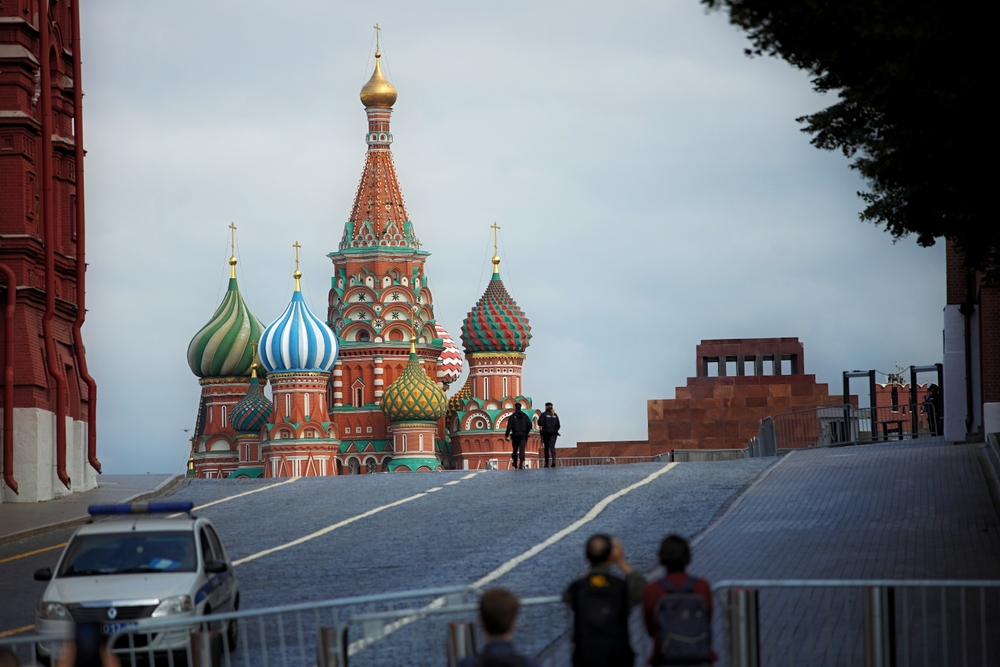
Photo: demm28 / Shutterstock

Moscow: abusing the global south

It is comforting for the Kremlin to propose that seven billion people support the unjustified Russian war on peaceful Ukraine. It does not matter that the claim is unsubstantiated and hardly believable. The rashist propaganda is for domestic consumption in Russia. All is fine, as long as the leading countries of the global south do not confront the Kremlin on this mendacious opinion and usurpation rolled in one. Even better, leaders of the global south have not been asking any uncomfortable questions about how much the war costs Russia and their own people. After all, the Russian onslaught on Ukraine triggered a worldwide food crisis, which made automobile transport and education once again unavailable for hundreds of millions in the global south, while spelling certain death through the starvation for millions.

In such a situation, should non-western leaders continue to fawn over Moscow at the expense of their own populations? Who cares? Dictators do. In the wake of the devastating pandemic, the war and alimentation crisis have contributed to the worldwide plunge in democratic accountability and to the strengthening of autocracies and dictatorial tendencies across the global south. Autocrats of all stripes have the time of their lives. The fellow Russian dictator aspires to become the world’s leader of the global south’s autocrats, and militarily comes to the aid of his colleagues endangered by democracy. Thankful dictators kowtow to Moscow and pay extra premiums on Russian mercenaries and their bloody services, further impoverishing and endangering their countries’ inhabitants.

Staying in power is worth it, until death parts the dictators from the throne. In this approach they closely emulate the Russian president-de facto-for-life who behaves like a tsar, and whom many Russians would like to see crowned as tsar. Absolute power corrupts absolutely. It often wins high approval ratings for dictators, all and sundry being hopeful that “he” – always, an alpha male (no women among dictators) – would give them richer alms than to others. The life is even better for a given dictatorship’s governing elite, who in practice own the state and rob the inhabitants both of their work’s fruits and prospects for a better future. It is the main political and economic mechanism that prevents the poor of the global south from joining the West’s “golden billion”. Democracy breaks this vicious circle of autocracy, and offers a perspective of stability and prosperity, which, for instance, came true in the case of South Korea.

Despite Russia’s propaganda that denigrates the West as degenerate, poor, being in “satan’s power” or without any future, refugees and economic migrants from the global south head for Europe and North America, not Russia. Actually, with Belarus’s complicity and willing assistance, the Kremlin profits from mostly Middle Eastern migrants, who seek better life in Europe. Russia enables and weaponises these migrants for not so hybrid rashist attacks against the European Union and NATO. The goal is to destabilise Europe and undermine democracy by turning voters to far-right populists and autocrats on the Kremlin’s bankroll.

Until the Russian invasion of Ukraine, every year 100,000 to 400,000 migrants came annually to Russia. But almost exclusively all of them stemmed from the poorest post-Soviet (CIS, Commonwealth of Independent States) countries, from Moldova and Armenia to Tajikistan and Kyrgyzstan. The number of all migrants from non-post-Soviet (non-CIS) countries to Russia is paltry. It varies between 10,000 to 50,000 each year. Any substantial flow of non-CIS migrants to the tune of a couple of thousands, arrived only from the two fellow and still communist states of China and Vietnam. Neither do refugees from friendly Syria nor nearby Afghanistan consider Russia (or Belarus) as attractive destinations. They realise that it would be swapping a known autocracy for a foreign one, meaning even worse prospects of achieving a normal (that is, western-like) standard of living. In contrast, after Russia’s invasion of Ukraine, a million (and counting) Russians have fled their country, fearing instability, poverty and draft.

Let’s talk money

Russia is spending around one billion US dollars per day on the ongoing war which causes damages of half a billion dollars in Ukraine daily. During the initial months of the Russian invasion, despite the sanctions, each day the Kremlin continued receiving from Europe $1billion in payments for oil and gas. Hence, the rashist regime could easily afford to wage the destructive war on Ukraine. However, by mid-2023, the daily stream of petrodollars had shrunk by two-thirds to $0.3 billion. For a while it will not matter, as the Kremlin still has at its disposal the piggy bank of the Russian National Wealth Fund with the holdings of $200 billion (as of August 2022) to fall back on.

Had the Russian president decided to spend this financial spree on his own people, each Russian citizen could be handed a cheque of $150 every second day, or $2,200 monthly, meaning $27,000 per year. A family of four, with two children, on top of their salaries, would receive $108,000 per year! Meanwhile, the average monthly salary just skirts $800 in present-day Russia. Taking the aforementioned family of four as a point reference, the Kremlin spends on the war three times more than the median income per family member in a relatively well-to-do Russian household. At the same time, a fifth of Russians (28 million) have no access to indoor toilets or running water. What is more, 3,400 Russian schools do not enjoy toilets on the premises. The construction expense of a good quality public toilet in Russia amounts to $14,000. Hence, the paltry 50 million dollars would be sufficient to ameliorate the dire sanitary situation across the glubinka (глубинка, or provincial Russia) by providing each Russian school with a state-of-the-art indoor toilet. The financial outlay needed for this not so monumental a task equates what Moscow now spends on a mere one hour of waging the war in Ukraine.

Yet, maybe by skimping on its own population Russia provides more development aid to the poor and friendly countries across the global south? Prior to the Russian attack on Ukraine, the Kremlin earmarked around one billion dollars for this purpose yearly. Hence, per day Russia spends as much on the war as it would spend on helping poor countries per year. Moscow’s war price tag for the whole year is as much as Russia would be ready to spend on its non-Western friends for three centuries and a half. At the same time, the West – or the OECD countries – distribute $186 billion in development aid annually. With 28 times fewer inhabitants than Russia, Finland contributes for this purpose $1.5 billion, or 50 per cent more than the mighty Russian Federation of 11 time zones. Russia likes criticising Britain and the United States as the “rotten core” of the world’s selfish “golden billion”. Yet, the two countries alone spend, respectively, 15 and 50 times more than Russia development aid for the global south.

Russia’s own divisions

If, in reality, Moscow does so little for the world’s seven billion poor living outside the West, who then profits from all the largesse? The answer is the “new Russians” or Russia’s new rich. Who are they? Russian society is a steep pyramid. The basic ethno-racialised division is between ethnic Russians (Russkie) and ethnically non-Russian citizens (Rossiiane). Those who live in the European section of the country see themselves as better than those “exiled” to the inhospitable but much larger Asian part that accounts for more than three-quarters of the country’s entire territory. The cleavage between urbanites and the countryside is complicated by towns that are village-like. On paper three-quarters of Russians live in towns and cities. But in the Russian view of things, only Moscow and St Petersburg are deemed to be “real cities”. With 21 million and six million inhabitants, respectively, in their urban areas, both the current and former capital account for a quarter of the country’s population. The Muscovians and Petersburgians lumped together almost equate Asian Russia’s populace of 37 million.

Living in one of the two cities, enjoying well-paid jobs, being fully literate in Russian and at best praying to the Orthodox god is the first indispensable step towards becoming part of the Russian elite. Then what follows is a daunting vertical socioeconomic climb through an almost impossible to navigate maze of power, fraught with criminal and political dangers. The pyramid’s top is pointy and tiny. In the times of tsarist Russia, the elite of nobles amounted to 1.2 million people, or a full one per cent of the inhabitants in the then Russian Empire. Present-day Russia’s political-cum-economic elite, including their immediate family members, count not more than 4,000 members, or a mere 0.003 per cent of Russia’s population of 145 million. But the genuine movers and shakers are the group’s 1,000 paterfamilias. Women need not apply. “Traditional values”, that is the patriarchy which underpins the system and rules supreme, is an “example” to be emulated by the entire world.

These alpha males of business, politics and the military constitute neo-imperialist Russia’s “golden thousand”. The convinced rasishsts govern and own the country. These individuals, their services and companies run Russia and enable the Russian president to conduct his pet war against Ukraine. Real competition for power and influence, becomingly red in claw and tooth, takes place only among the golden thousand’s members. A single top dog at the head of the pack, or the Russian president, keeps all the golden thousand under control, tamed. Stop toeing the line and you are dead, alongside your whole family. Each member of the pack is at the ready to tear at another’s throat. Everyone is waiting and pines for this moment when he may get a rare chance to replace the current top dog. No hostages are taken in this continuous battle for the throne. Expect no mercy. It is a world of stratospheric riches and lavish living on the monies stolen from the rest of the Russians. To live it you need to gamble your own life and your kin’s. With this war on Ukraine the dice has been thrown again. Expect the unexpected in Russia, but not more than a reshuffle at the top.

The world’s sole future?

After the Kremlin-ordered attack on Ukraine, the West almost immediately sanctioned all of Russia’s golden thousand. Their names have been conveniently gathered and made known in numerous online reference databases. They emulate nobility catalogues of yesteryear. Yet, then nobility obliged, while now notoriety does. At present, the lists of sanctioned individuals increasingly cover the golden thousand’s family members and consiglieri to the tune of 10,000 individuals. Further, 17,000 of the rashist golden thousand’s other enablers and collaborators of secondary importance are now under investigation to decide whether their activities and crimes require sanctioning.

With the war against Ukraine, the golden thousand, led by the Russian president, have taken on the ‘‘golden billion” with little thought spared for the sad fate dealt to Russia’s population at large or the poor seven billion across the global south. According to the Kremlin’s ruler, life is overrated. Nuclear war and the entailed destruction of the world is fine with him, because in this line of thinking all (Orthodox) Russians will go to heaven, while others (non-Orthodox infidels) will die like animals. The Russian Orthodox Church fully agrees and supports the Kremlin’s rashist civilisation of death. According to the Patriarch of Moscow, whoever opposes the Russian president and his war belongs to the “forces of evil”.

Hopefully, unthinking friends of Russia (aka useful idiots) in the global south may take note. The Kremlin does not care about them – these seven billion poor who hope for a better life (at best in the global north). With nonchalant abandon, Russia’s golden thousand abuse the global south for Russian propaganda’s needs, as a mere pawn in this self-perceived eschatological in scale stand-off with the West and its supposed “golden billion”. Meanwhile, Russia’s golden thousand fully agree with the Russian president that Russia has a natural right to be a superpower and that the world does not deserve to exist, if it does not feature a great Russian empire. Eventually, all of the globe must see light and join Holy Mother Russia, this worldwide country, whose borders are limitless, as once upon a time Lenin planned. That is the crux of what the not so novel neo-imperial ideology of rashism is about, a new all-Russian world.

Tomasz Kamusella is Reader (Professor Extraordinarius) in Modern Central and Eastern European History at the University of St Andrews in Scotland. His recent monographs include Ethnic Cleansing during the Cold War (Routledge 2018), Politics and Slavic Languages (Routledge 2021) and Eurasian Empires as Blueprints for Ethiopia (Routledge 2021). His reference Words in Space and Time: A Historical Atlas of Language Politics in Modern Central Europe is available as an open access publication.

, ,

Partners

Terms of Use | Cookie policy | Copyryight 2025 Kolegium Europy Wschodniej im. Jana Nowaka-Jeziorańskiego 31-153 Kraków
Agencja digital: hauerpower studio krakow.
We use cookies to personalise content and ads, to provide social media features and to analyse our traffic. We also share information about your use of our site with our social media, advertising and analytics partners. View more
Cookies settings
Accept
Decline
Privacy & Cookie policy
Privacy & Cookies policy
Cookie name Active
Poniższa Polityka Prywatności – klauzule informacyjne dotyczące przetwarzania danych osobowych w związku z korzystaniem z serwisu internetowego https://neweasterneurope.eu/ lub usług dostępnych za jego pośrednictwem Polityka Prywatności zawiera informacje wymagane przez przepisy Rozporządzenia Parlamentu Europejskiego i Rady 2016/679 w sprawie ochrony osób fizycznych w związku z przetwarzaniem danych osobowych i w sprawie swobodnego przepływu takich danych oraz uchylenia dyrektywy 95/46/WE (RODO). Całość do przeczytania pod tym linkiem
Save settings
Cookies settings