
Shame and a disintegrated society. The curious case of Russian intelligentsia
Since the outbreak of the war in February 2022, the Kremlin has abandoned any illusions of cultural freedom in Russia. Its cynical mask has been taken off completely and now we can finally see the real and purely aggressive faces of those who wield power in the state. It is clear that Russia’s priority remains maintaining national unity rallied around the flag.
“We were getting ready, but never fully believed in the war,” said Andrii Yermak, the head of Volodymyr Zelenskyy’s presidential administration in an interview with Ukrain-ska Pravda. This conversation took place just days after the full-scale Russian invasion of Ukraine in February. From today’s perspective, which includes our knowledge of the hide-ous atrocities committed by the Russian army against the Ukrainian people in places such as Bucha or Irpin, we can say that Yermak’s confession was an illustration of the huge naiveté of the Ukrainian political elite. This naiveté seems even more striking when it is contrasted with the other side (Russia), where steadfast cynics spoke through propagandists and official spokespersons such as Dmitry Peskov or Maria Zakharova. The Russian side was also get-ting ready. Except, it believed in the outbreak of the war.
September 30, 2022 -
Wojciech Siegień
-
Hot TopicsIssue 5 2022Magazine
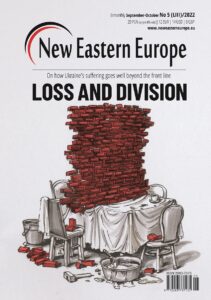
illustration by Andrzej Zaręba
A spectrum where one end marks Ukrainian naiveté and the other Russian cynicism can also be used to show the different degrees of political realism observed in these two states. Before February 24th, the Kremlin evidently had an advantage in this regard as well. Another area where Russia was unquestionably stronger was cultural production. Since the annexation of Crimea and parts of Donbas in 2014, Russia has effectively managed to maintain its channels of cultural influence in Ukraine. At the same time, it convinced everybody that Russian artists and Russian-language products were apolitical. They were presented as belonging to the sphere of beauty and truth.
Propaganda fog
The Ukrainian authorities naturally tried to counteract Russia’s orchestrated cultural influence aimed at their population. One of the initiatives undertaken by Kyiv was to deny entry to Russian artists who had illegally travelled to Crimea after 2014 and performed concerts there. However, in these endeavours, it turned out that the Zelenskyy administration was not always consistent and the restrictions were not always enforced. For example, Vasiliy Vakulenko or Basta, a Russian rapper, had performed concerts in Crimea. This showed his role in the Kremlin’s propaganda machine, which is ultimately aimed at promoting the “Crimea is ours” narrative. Despite this, the Ukrainian authorities let him enter their state and perform in Ukraine. As expected, this decision was criticised by patriotic activists.
Other examples include situations when cynical illusion and manipulation won over reality among Russian cultural figures. Consider the Russian film actor Mikhail Porechenkov’s visit to Donetsk in 2014. He was wearing a helmet with the word PRESS on it and shot at Ukrainian positions with a Soviet-style NSV heavy machine gun. When asked why he had done it, he explained that he wanted to express support for the separatists, adding that he had done enough of his own shooting in Georgia in 2008. Thus, we can believe in the honesty of his surprise when, first, he was attacked in Russia and accusations were made against him for having put journalists working in Donbas in danger and, second, when Ukraine issued a warrant for his arrest, treating him as a terrorist. It is thus the so-called propaganda fog that affects thinking among the majority of Russian society. This also explains how Porechenkov effectively mixed up reality with a war movie, which he was essentially promoting back then in Donbas. In other words, he did not even notice the moment when he transformed from being an actor to a potential murderer.
Already in 2014 Russia was promoting a false illusion that there is no connection between politics and cultural production. The second phenomenon, in today’s Russian reality, is reduced to mass staged productions. However, Russia’s aggression against Ukraine on February 24th changed everything. It should indeed be seen as a breakthrough moment for both states with regards to the promotion of culture. Ukraine almost straight away banned any public performance of Russian music and cultural productions. Russia, in turn, has put a halt to its false policy that culture and politics belong to two different spheres. Everything has become crystal clear: in a country where there is no such thing as politics (Putin is the only politician), everything is political. This, in turn, has led to extreme polarisation and a zero-sum game: you either stand with us or with our enemies.
Keeping up appearances no more
Neutrality is no longer possible and especially in the cultural sphere. The old-time excuse expressed in the popular saying “Мая хата з краю, я нiчога не знаю” (my house is on the periphery, I know nothing), is no longer applicable. As a result, the decisions of artists to not support the “special operation” in Ukraine or show the “Z” or “V” signs at their concerts are interpreted as hostile acts towards the state and its authorities. At least this is what the band Bi-2 learnt in April after it refused to perform a concert in a facility which possessed a “за президента” (for the president) sign and a large letter “Z” above the stage. This letter has indeed become the most recognisable symbol of Russia’s attack against Ukraine. The authorities reacted quickly. Bi-2 concerts were cancelled in different Russian cities, one by one, like a perfectly aligned row of dominos. The musicians were said to be under the influence of the “State Department” or “fat Afro-Americans from the CIA”. In today’s Russia such accusations suffice when officially calling someone an agent of foreign influence.
Evidently, the strong politicisation of culture was noticeable in Russia even before the start of the current stage of the war. Until then, this cynical phenomenon remained somewhat restrained. A kind of consensus between the Kremlin and the “creative intelligentsia”, as artists are commonly called in Russia, still survived during this time. Ivan Urgant, Russia’s answer to Jimmy Fallon, could still make some subtle jokes about the authorities. Simultaneously, the seemingly liberal Echo of Moscow radio station, with Alexei Venediktov (linked with the Kremlin) as its editor in chief, allowed Alexander Nevzorov to trash talk the authorities every Wednesday. An unwritten hierarchical show-business arrangement was also in place and remained pretty influential. Performers such as Alla Pugacheva, as well as her comedian husband Maxim Galkin or former husband Philipp Kirkorov, could thrive in this environment.
Since the outbreak of the war in February 2022, the Kremlin has abandoned any illusions of cultural freedom in Russia. Its cynical mask has been taken off completely and now we can finally see the real and purely aggressive faces of those who wield power in the state. It is clear that Russia’s priority remains maintaining national unity rallied around the flag, which is now often decorated with the “Z” or “V”. The war, which was started but never declared by Russia, has also eliminated a decades-old pantheon of Russian stars and invalidated their hierarchy in a matter of a few days. Within a day of becoming an enemy of the homeland, Pugacheva fled to Israel with her husband. Lead Kremlin propagandist Margarita Simonyan even accused Pugacheva’s husband of being a secret homosexual.
The invasion has also significantly changed the language of state media, removing any forms of politeness. Thus, when you listen to Russian television programmes, do not be surprised when you hear various inflammatory names used to describe the state’s enemies. These include scum, beasts, bastards, sons of bitches, gays, fags, shit, urine, penises and pindos (this is a popular Russian derogatory term used to describe strangers, especially Americans). In the same vein, TV presenters or their guests recommend that these people “are taken from the back” or enter into history’s “asshole”.
What is striking in this language is the number of sexual references and homophobic vocabulary, which can be read as a sign that Russia has indeed become a fascist state. Perhaps the last trace of the country’s cynical discourse upholding a dichotomy between politics and culture, but now targeted at the external audience, is its own version of the American cancel culture debate. However, according to Moscow’s discourse it is Russian culture that is being cancelled in the West. Sticking to such talking points, the hosts of Russian television shows scare their audiences in western states with stories about hypersonic Zircon missiles and nuclear weapons.
A third way?
Within this ongoing process of increasing totalitarian control of culture in Russia, it is interesting to take note of the artists who have chosen what we can call “a third way”. As stated above, since February 24th the choice faced by many Russian artists has been basically limited to either support Putin unconditionally or pack up and leave. Yet, once the shock of the first days of the war was over and the ideological fog began to clear, it became possible to say who was who. It turned out that there were some artists who did not opt for any of these aforementioned choices. Among them were bloggers, essayists, writers and musicians, who despite not supporting the war decided not to leave Russia. Instead, they chose to stay and fight for the truth.
I would argue that the feature that distinguishes these artists from the other two groups is their attitude to shame and guilt regarding Russia’s aggression against Ukraine. It can thus be said that they refuse the moral reactions of those who have left Russia, thereby manifesting their discontent.
The most illustrative example of this third way of artists can be seen in the alternative music band Shortparis. Originally from St Petersburg, this group, which has long skilfully balanced between experimental music and pop, is indeed very popular both in and outside Russia. A few weeks after the invasion of Ukraine its frontman, Nikolai Komyagin, was interviewed by the Russian journalist Nikolay Solodnikov on the popular Yeshchonepozner (eщёнепознер) YouTube channel. I will use this conversation to show this unique way of thinking among some of the “creative intelligentsia” who decided to stay in Russia.
Indicatively, the word “war” is not used in the interview, rather the two refer to it with a series of euphemisms. From the beginning, it seems that both interlocutors are testing each other’s view on that matter, thus talking about an “event”, “a world change” or “inhuman transformation taking place in the streets”. Yet, at a certain point Solodnikov states that the members of Shortparis, just like him, have not left Russia and decided to stay. In the meantime, they have released new songs and even some new music videos. He then adds that after the start of the aggression, he himself reached out to his own mentor, the director Alexander Sokurov, and asked him an existential Russian question: what to do? Sokurov answered that he should “keep working and strengthen his faith”.
Solodnikov and Komyagin quickly agreed that they felt disrespect towards those who believe leaving Russia was the only ethically possible reaction. In their view, emigration is the way towards self-denial. This declaration then led them to what they see as the core of the whole problem: the sense of shame and guilt among the Russian people ever since their state’s aggression against Ukraine. Komyagin admits that once the war started, he indeed felt ashamed.
This feeling, however, quickly turned into frustration once he understood that shame is unproductive. In his view, shame is also a distinctive feature of the Russian intelligentsia, which is always embarrassed about something. This is especially true when it comes to the actions of the Russian nation. At the same time, both Solodnikov and Komyagin admit that the (simple) Russian nation is not known for tackling difficult matters or experiencing a collective sense of guilt. So much for a diagnosis!
The solution that Komyagin, who is quite familiar with post-structural theories, comes up with is not a rebuttal of Russian identity. Instead, he opts for national unity. To achieve this, he suggests a “change in the level of linguistic cooperation”, which could help create horizontal social structures. In a way, this suggests an antithesis to Putin’s vertical system. Referring to the theory of post-structuralism, Komyagin complains that in Russia there is a game between the “signified” and the “signifier” and that this has been visible even to the “philistines” (this word is actually used in the interview). Such post-modern new-speech means that that the Russian authorities are lying to their people and that the people know this.
Solodnikov, who is on the same page as Komyagin, states that not only Russia but the whole world is now taking part in an anthropological catastrophe – where it is no longer clear what makes a human being. In this world, there is also a shortage of grand ideas which, as a rule, are more important than human beings. Without them, no beautiful churches in Milan or St Petersburg would ever have been built. These assumptions are yet only one step away from the neo-Putinist concept of Russkiy mir (or Russian world). Indeed, for Komyagin Russia is a kind of metaphysical country. Russians absorb grand ideas, which later turn into a sacrifice paid by the whole nation. This metaphor seems to refer to the current war. Yet, in his view, the national trauma that haunts society is closely connected to the fact that Russians are removed from the “civilised world”. This means that there is hope that one day they will build a new reality, one that goes beyond globalisation and capitalism. For this to happen, a new generation needs to come to an understanding that a different (Russian) world is possible.
The fictional politics-culture dichotomy
All told, it is quite clear that Komyagin and Solodnikov do not fully grasp that all these linguistic games and ambiguities in Russia ended on February 24th. This is probably why, without even knowing it, they use the language of the Kremlin when talking about Russia’s distinct civilisation; or Russians being victims of collective responsibility imposed on them by the hostile West; or when saying that Russians should not feel ashamed or guilty for starting the war against Ukraine. In the end, they even state that national unity is what Russia needs the most right now.
Their blaming of the “intelligentsia” for the wrongdoings of the “nation” is nothing more than an imitation of Sergey Lavrov’s words. Specifically, when the atrocities committed by the Russian army in Bucha were revealed to the world, the Russian foreign minister reportedly said to a western journalist that his state was what it was and that he was not going to be embarrassed about it. All in all, the politics-culture dichotomy is a fiction in today’s Russia. Thus, Solodnikov’s aforementioned question to his mentor Sokurov was a political question. As such, it calls for more details as it is not enough to just ask “what to do?” Instead, the artists who have stayed in Russia and want to continue working there should rather ask a political question: how to oppose the authorities in a situation where they are part of the very same authorities that they are acting against? Noticeably, none of the participants in the interview used the word “Ukraine” or “Ukrainians” when describing the victims of Russia’s aggression. And yet, there was much discussion about shame and guilt.
The American philosopher Judith Butler discusses the collective sense of guilt in her book The psychic life of power. In its pages, Butler claims that guilt is a remedy against the sadistic need to destroy an object that we would like to see die. In other words, without the feeling of guilt, societies are faced with their own destructive violence. It is difficult to imagine a more adequate example of this reality than the aforementioned interview.
The interview ends with two moments of confusion. First, when Solodnikov attempts to say what he feels about the war and starts struggling with his words. As he does not know what to say, he starts holding his head and groans. Komyagin helps out by stating that the current situation needs to be handled in a way reminiscent of Wittgenstein. This probably means that when something cannot be talked about, it should be silenced. After this statement, the interviewer – unexpectedly both to his guest and himself – suggests that they should round off this intellectual feast with, of all things, some arm wrestling. Surprised by the proposal, Komyagin nonetheless agrees to it and both gentlemen start wresting and groaning. At the end, speaking through his teeth, Solodnikov says: “and look, in this way we get closer to the people, for fuck’s sake!”
Wojciech Siegień works in the department of social sciences at the University of Gdańsk. His main interests include educational ideologies and the different processes of militarisation in post-Soviet countries.