
Forced into exile, young Russian activists continue the fight against the regime
The story of Liuba and Anzhela, two young Russian activists, shows that causes mobilising young people in Germany, Italy or Finland are just as much a concern to some young Russians. Yet as Russians, they are also fighting on several other fronts. The most important is the imperialism that their country is forcing on the world.
On a sunny May 8th in Berlin, the day before a highly contested Victory Day march, pro-Ukrainian activists set up stands and a small stage opposite the city’s Soviet war memorial. There is Ukrainian music playing and people walk around dressed in yellow and blue. A political activist speaks in Russian before the assembled crowd and a woman next to her translates into German.
September 29, 2022 -
Cristina Coellen
-
Issue 5 2022MagazineStories and ideas
Photo: Cristina Coellen
Liuba and Anzhela are behind one of the little stalls with posters, where in big letters the words “REAL PRICE OF ANTIWAR FEMINIST ACTIVISM IN RUSSIA – 10 YEARS” are written. The word “RUSSIA” is surrounded by drawings of small black drops, whether they are meant to represent tears or blood is unclear. Both would be fitting. The two young Russian activists, who are originally from St. Petersburg and Volgograd, invite passers-by to write some kind words to female political prisoners in Russia. They will send these words translated into Russian to the women whose names they have also marked in big black letters on cardboard next to their first poster: Maria Ponomarenko, Anastasia Levashova and Alexandra Skochilenko.
Maria Ponomarenko published information about the bombing of the drama theatre in occupied Mariupol in March, which Russia continues to deny. Anastasia Levashova threw a Molotov cocktail at police officers during an anti-war rally on February 24th. Alexandra Skochilenko replaced price tags in a grocery store with information about Russian crimes in Mariupol. While Levashova has already been sentenced to two years in prison, a ten-year prison sentence could await Skochilenko and Ponomarenko.
Warning sign
Liuba and Anzhela, both still students, have not shared the same fate as these women, who are now faced with an unfair trial and a prison sentence. This is thanks to their decision to leave Russia in April. Their flat was searched by the authorities a few days earlier. “It was a red line,” Liuba says calmly. House searches are a warning sign for activists that they have been noticed. The system of political repression in Russia is complicated and a house search does not mean that the next day will bring a sentence to a penal colony, where Alexei Navalny is currently imprisoned. Nevertheless, with the daily rise of repressive measures in Vladimir Putin’s Russia, an eventual arrest becomes more and more likely. This could be justified by new laws, such as those prohibiting criticism of the Russian armed forces.
During our third meeting, in their flat somewhere in the south of Berlin, they tell me about the details of their last days in Russia. While we sit in the kitchen of the almost stereotypical Berlin flat – high ceilings, large windows through which the sun warms the floor, a slightly chaotic mix of furniture and decoration – Liuba and Anzhela talk about their experiences for two hours with long periods of silence between their words. In the hallway behind them, a poster from their last protest against Moscow’s aggression in Ukraine leans against the wall: “STOP SPONSORING GENOCIDE”. They regularly go on anti-war protests in Berlin. While in the German capital, they can do so without constraints. However, in Russia this was ultimately the reason why they had to leave the country.
In March, the young couple had been to anti-war protests in Volgograd, getting arrested and then held for six days in a police station before being released again. It seemed like the worst was over. “I thought we were too small,” Anzhela tells me, referring to their status as activists. Yet in Putin’s Russia, nobody is too small and too unimportant anymore when it comes to criticising the regime. Anzhela starts by saying that “They came to our flat early in the morning. We pretended to not be there at first and did not open the door. It was not even my official address; I had given my grandmother’s address. They were watching us to find us there.”
“I was only afraid when they were breaking down the door,” Liuba adds. After taking all their electronic devices – Anzhela was lucky to have her phone in a repair shop that day – and leaving the flat in a mess, the police took them back to the station. Liuba says, “It was to scare us.” They were not instantly charged with a crime, but they both knew that a criminal case would be inevitable sooner or later. They came to Berlin, purely because they had some friends there who could make their escape possible.
Activism in the face of hopelessness
Neither of these two women grew up in a particularly progressive or anti-government environment. They are too young to have consciously experienced the brief interlude that the 1990s provided after the fall of the USSR. At this time, Russia glimpsed the path towards democracy and human rights. How does one then become a political activist in a country that has descended into autocracy with every year that Vladimir Putin has added to his reign?
“It started when I realised my sexuality,” Anzhela says. The discrimination that the LGBTQ+ community experiences in Russia has grown rapidly in recent years. While female homosexuality might stir up slightly less hatred in the public sphere than male homosexuality, walking down the street while holding hands as they are doing now in Berlin would be impossible. In a recent move in July, Russian lawmakers proposed an extension of the “LGBT propaganda” law, already in place since 2013, which restricts information on non-heterosexual relationships for children. The extension of the law would include all age groups, likening the spreading of information on LGBTQ+ topics to other “dangers to society” such as drugs, suicide and extremism.
Anzhela explains how she once tried to organise a pride parade in Volgograd. “Of course, it was immediately shut down,” she adds. Her brief smile oscillates between bitterness and resignation, as if to say that it would never be any different in Russia. What especially furthered their activism and brought them together, however, was protesting climate change. In Russia, movements like “Fridays for Future” remain small and are restrained by the excessive reactions of the authorities to anything that resembles protest or political assemblies in the public space. There is also another problem, as Anzhela believes that “People really don’t know how to unite.” Even if protest movements are formed, the process takes a lot of time. Given the comparably feeble attention placed on environmental issues in Russian society, such activism results in little success. “We were not heard – it is a general problem in Russia,” says Liuba, looking tired.
There is indeed a lot of hopelessness in the air of the small kitchen during the interview. Nevertheless, giving up is not an option either. After protesting climate change, the build-up of Russian troops on the Ukrainian border in winter 2021 made activism an even more urgent issue. Liuba and Anzhela continued, starting their project focused on writing to imprisoned female activists. Then, the invasion started.
Quest for decolonisation
Liuba and Anzhela show that the fight for causes that mobilise young people in Germany, Italy or Finland – LGBTQ+, climate change, equality – are just as much a concern to young Russians. Yet as Russians, they are also fighting on several other fronts. The most important is the imperialism that their country is forcing on the world. This imperialism manifests itself most brutally in the invasion of Ukraine, but has many, many layers, both inside and outside of Russia.
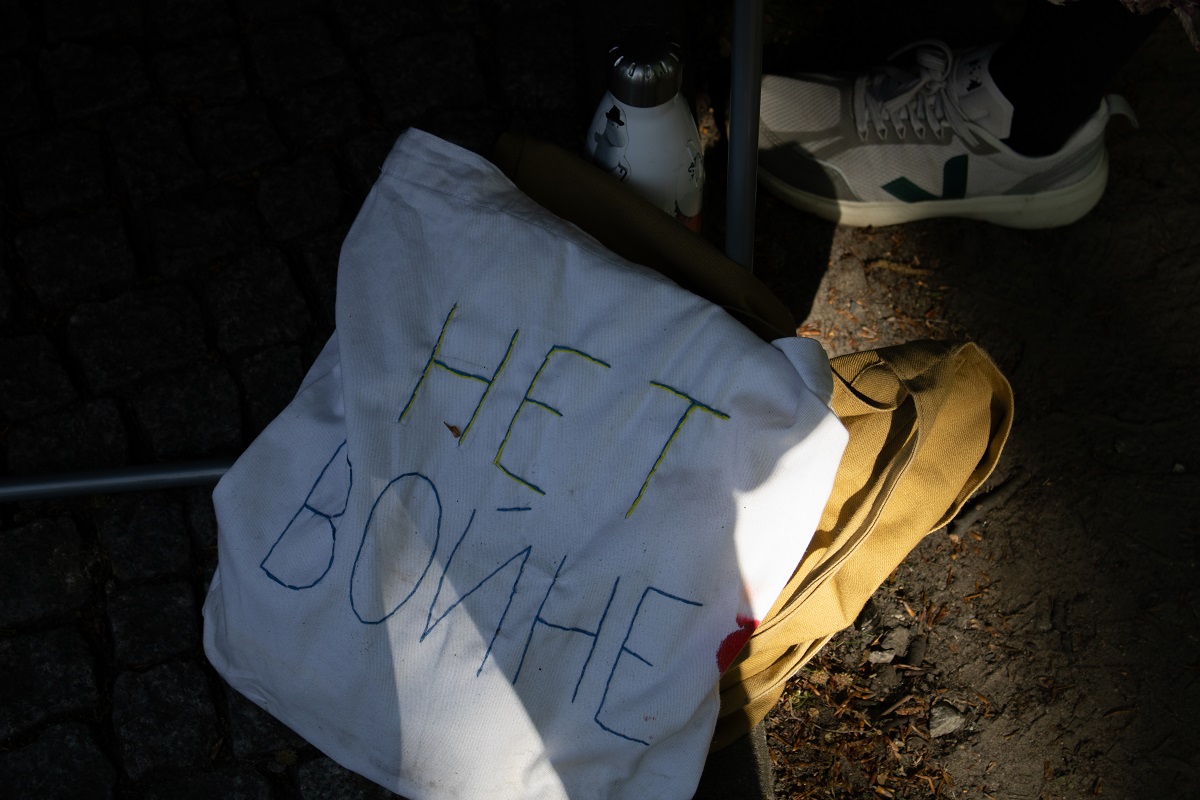
On her Instagram, Anzhela has pinned a photo of herself standing alone in the street, holding a poster with the well-known words “Net voine” or “No to war”. Below the picture, she appeals to the citizens of Russia to “acknowledge” that “we are an imperialist aggressor state.” On Liuba’s page, there are similar photos and similar appeals.
The imperialism that is exhibited by Moscow in its war against Ukraine – and its other neighbours at various other moments in recent history – has an important implication: decolonisation. The quest for decolonisation is what separates these young activists from the “older” generation of regime critics in Russia. The political opposition and opposition movements in the country are a complicated matter, and there are few clear-cut categories. Yet while the generation around Alexei Navalny, arguably Putin’s most well-known opponent, likewise condemns the invasion of Ukraine and seeks to fight the regime, it is often accused of repeating certain nationalist and even imperialist narratives.
For Liuba and Anzhela, it is not enough to say “no to war”. They want more radical change, a complete overhaul of the Russian mentality regarding its neighbours and the world. When asked on the subject of Navalny, they both agree in their criticism of him. “It’s terrible that he is a political prisoner now, but that doesn’t mean that we shouldn’t criticise him,” Anzhela explains, adding that he still has an “imperialist mentality”. For them, Russia needs to move away from its centuries-old imperialism.
“We have started to learn Ukrainian,” Liuba already told me when we met on May 8th. In all their actions, they attempt as much as possible to do the opposite of what their home country does. They are in fact driven by an enormous feeling of guilt and responsibility. “It is the most toxic relationship in my life,” says Anzhela about her country. It is impossible to shake off the fact that both of them are Russian citizens; but their hatred and shame for their country is palpable. She adds that “I want to do everything to destroy Russia in this way.”
The fight within
When talking about Russian imperialism, there is also another cause aside from Moscow’s aggression against its neighbours: it is the imperialism within the country itself. Russia is in no way a homogenous nation. Instead, it contains an estimated 193 different ethnicities, all with their own languages, cultures and traditions. These minorities, sometimes living in semi-autonomous regions like Tatarstan or Buryatia, are however overshadowed and repressed by the imposed “Russianness” of Moscow and St. Petersburg. This does not take place on a merely cultural and linguistic level. “Moscow is eating all of their resources,” explains Anzhela. This exploitation has also made the regions dependent on Moscow as the economic centre of Russia.
Liuba and Anzhela also campaign for more autonomy for groups such as the Tatars, fighting for the preservation of languages and identities within the regions. Neither of them currently has much hope for Russia’s future, although they bring up the idea of the regions becoming autonomous countries once – if – Putin’s Russia is destroyed.
While Russia’s future is uncertain, what about their own? An EU visa for Russian citizens lasts just three months. After that, the options dwindle. The two are hoping to stay in Berlin, where they have friends, freedom and some possibility of rebuilding their lives. What remains clear to them is that, as long as Russia remains as it is now, there is no going back. Anzhela says calmly at the end of the interview that “To love Russia right now… it is something I don’t understand.”
Cristina Coellen is a young freelance journalist from Austria specialising in Eastern European affairs and international conflicts. She is currently studying for a Master’s degree in Journalism and International Security at SciencesPo Paris. Besides her freelance work, she is an analyst for the Geneva-based geopolitical information project Confluences Internationales, for which she covers Eastern Europe and Central Asia.