Women will shake and reverse public opinion about this war
An interview with Liliya Vezhevatova, a coordinator of the Feminist Anti-War Resistance in Russia. Interviewer: Anna Efimova
ANNA EFIMOVA: According to recent research by the Russian human rights project OVD-Info, more than half of Russian protesters are women. How have feminists, who have never been a leading public and social force in Russia, managed to unite against the war in Ukraine?
LILIYA VEZHEVATOVA: Feminist organisations have been burgeoning in Russia over the last two decades. Activists have been deeply involved in internal and external discussions. However, we were not treated seriously during this time. We subsequently remained intact as the war started, while prominent Russian political activists were either in prison or in exile. We mobilised fast at the right time – our movement started on February 25th.
September 29, 2022 -
Anna Efimova
Liliya Vezhevatova
-
InterviewsIssue 5 2022Magazine
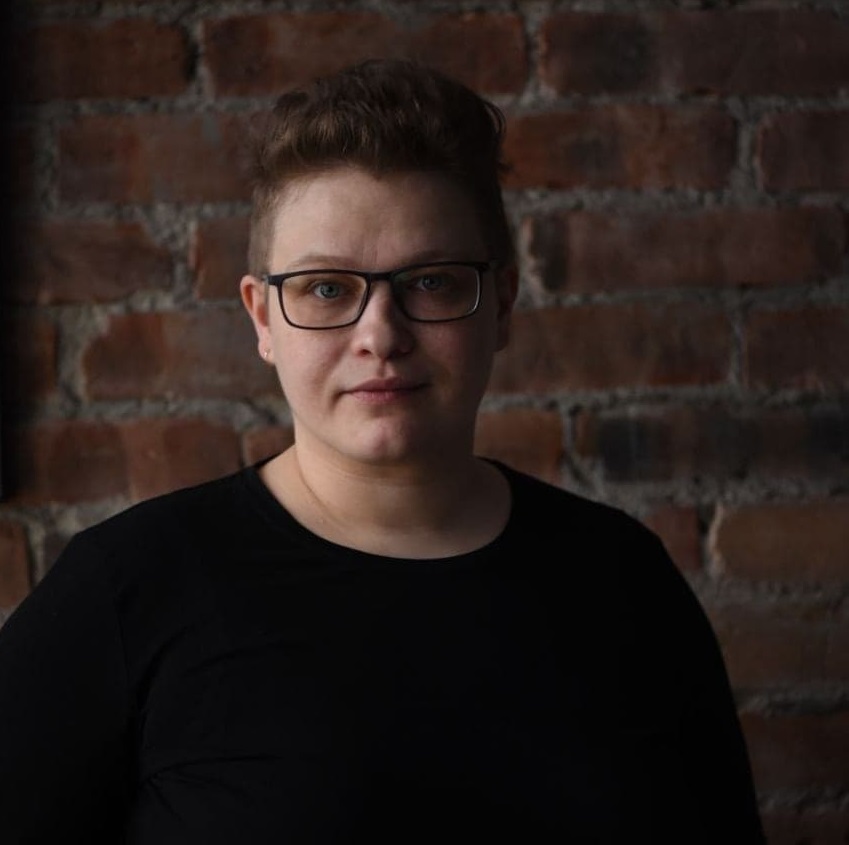
Photo courtesy of Liliya Vezhevatova
Through gender optics, we see that women from both sides of the conflict suffer the most from wars. They lose their sons or have to seek refuge in another country. Because the men are either at war or absent, they have to set up households in the occupied territories. There is an understanding of the horrendous implications that war has for women and that united us, despite the theoretical disagreements between the feminists who belong to different wings.
Your movement started on the second day of the war in Ukraine. When we are having this conversation, it has been almost six months. What do you think about the opinion among some in Europe that anti-war activism in Russia is pointless?
We are fully aware of the fact that we cannot put an end to this war, but we can push for it. We need to make passive opponents active and embolden our communities. Breaking through the information blockade is our primary goal now. We have around 50,000 people following the anti-war publications that we produce on social media. The activists distribute our samizdat (self-publishing), a newspaper for women over 45 called Female Truth, in 20 Russian cities and towns. Russian authorities can hide data on the Russian army’s losses as much as they wish but they will not be able to hide cemeteries. The more coffins return to Russia, the more attitudes to the war will change. When they do, we will be ready, and we will have people who already know what to do next.
Do you cooperate with Ukrainian activists and feminists?
We do interact with Ukrainian activists. For instance, we consulted with Ukrainian feminists and received their approval for the organisation of our most well-known action called “Mariupol-5000”. In commemoration of the war victims from Mariupol, our activists erected improvised graves and memorials around Russia. We joined the Ukrainian Feminist Initiative group’s manifesto, entitled “A Right to Resistance”, and invited our supporters to sign it. As feminists from Russia, we know that the “Russian world” brings domestic and sexualised violence, femicide, torture, homophobia and transphobia along with “traditional values”. That is why we do not agree to fight for “peace” as seen by Putin’s Russia. Together with Ukrainian feminists, we stand for the peace that would come with Putin’s army laying down its arms and a right to self-determination for the entire Ukraine. At the 50th session of the UN Human Rights Council, I spoke about the scale of anti-war resistance in Russia and suggested ways the international community could support it to bring about an immediate end to the war. Furthermore, we called for the arming of Ukraine to better defend it against the aggression. We also called for a halt to energy trade with Russia, as its income permits Putin and his entourage to stay in power and continue the war.
More than two million Ukrainian refugees found themselves in Russia as the war unfolded, making it the country that has received the largest number of displaced people from Ukraine. Can your organisation offer them some help too?
We work with Ukrainian refugees who were forcibly relocated to Russia from the occupied territories. Since our activists are convinced that they are in danger here, we are helping them leave for other countries. For that, they volunteer at the temporary refugee reception points for Ukrainians in Russia. Of course, they cannot register there as activists of the Feminist Anti-War Resistance due to their own safety concerns. These refugee points are well guarded. So, the activists go there with other volunteer groups, earn credibility and distribute information. To some extent, this is partisanship. We also support other similar Russian anti-war initiatives that help Ukrainian refugees leave Russia by spreading information about them.
Someone said that spreading objective information about this war in Russia is like asking Soviet people to protest the invasion of Finland in 1939. Your revived partisan samizdat in the form of a female newspaper serves to circumvent censorship and repressions, as in Soviet times. But why then do you target women over 45, who are statistically more passive or loyal to the government?
In Russia, women that age make up a large part of the population. Theoretically, they should have proportional representation in the government and be in charge, but this does not happen. In fact, they are excluded from the information space and rely solely on Russian television. In the long run, however, we believe this group will become a force that shakes and reverses public opinion about this war. They are our elderly relatives, mothers of the officers, of the Chechen war participants. We consider them victims of the current situation. By believing in the succession of the war in Ukraine to the 1941-45 war, they were tricked and lied to. We face the complicated task of shifting them away from this narrative of fighting Nazis in Ukraine, of this war not being a crime and genocide. We transfer the war from the ideological battlefield to their fridges, wallets and families, making it real and close as if it was happening on their doorstep. We approach them with universal human-interest topics that are interesting for this audience, talking about increased prices, their favourite celebrities who disapprove of the war, and the compensations that [have been promised by the Russian government but] have not been paid out to the families of the Russian military who died in Ukraine.
The newspaper has received very positive reviews. People tell us that after palming off the newspaper to their elderly female relatives, they were able to have a conversation about the war. They did this without blaming each other for being traitors for the first time since the war started. By choosing a non-radical tone and responding to the interests and worries of its audience, our newspaper achieved these results. Visually, it mimics ordinary free district newspapers that are widely distributed to mailboxes before the elections in Russia. Postmen and cleaning services do not throw them away because they do not realise these are anti-war publications, or, according to new Russian legislation, extremist materials.
Some of your activists were prosecuted in Russia and had to leave. How did this happen?
At the beginning of the war, many of us participated in street protests in different Russian cities, from Moscow and St. Petersburg to Novosibirsk and Yekaterinburg. As a result, criminal and administrative cases were opened against us. We faced a choice – either stay in Russia as political prisoners or emigrate and continue to work from abroad. I had to leave Russia myself. Now I reside in Armenia. I coordinate the entire movement from here, help to edit our newspaper, and participate in the activities of the Yerevan unit of the Feminist Anti-War Resistance.
In what ways have Russian feminists who left the country continued their anti-war activism?
The possibilities for anti-war activism depend on the character of the country. When we walked in the streets of Yerevan, protesting the war in Ukraine, we were told: “Where were you in 2020, when we were killed?” Armenia is a small country, and the war it experienced two years ago brought losses to almost every family. Ukraine supported the Azerbaijani side in the 2020 war in Nagorno-Karabakh. The local population does not understand why they should worry about Ukraine now if no one was worried about them two years ago. With this in mind, we cannot just go into the street with pro-Ukrainian slogans here, but develop a decolonial aspect to our activism. To study contemporary Russian imperialism, questions of colonialism and decolonisation, we host events with Armenian civic, feminist and LGBTQ+ activists. A public reading of the letters of Ukrainian mothers that were collected by our friends among Russian bloggers was organised. This event was not considered to be a large-scale gathering, but it was emotional and was covered not just in activists’ social media but by local journalists.
How does it affect the movement that its activists are residing in different countries?
Those remaining in Russia are working anonymously. We do not even gather them in one group chat because this is unsafe. They communicate with us via Telegram and Instagram. Feminist Anti-War Resistance has a horizontal and decentralised structure. Should some activists be arrested or forced to flee Russia, the movement does not stop. Prominent coordinators of the movement are in exile now. We constantly update and distribute the safety protocols among activists. We do not wish to be split by the regime and do our best so our activists stay alright physically and mentally.
Activism is a very demanding job. How are you getting ready to endure the long march before the end of the war?
The problem is that when you manage the refugees’ needs with transportation and clothes, you see the results of your everyday efforts. However, it is completely the opposite with civic activism. You will meticulously do your part of the job without an opportunity to see the picture in its entirety or even the result of our work. Russia only has grassroots anti-war movements – we may be less visible than old men with dual citizenship in Europe who organise conferences for “good Russians”; but we work very hard. Our editors, journalists, interpreters, therapists and volunteers all work for free. Therefore, people involved in activism burn out. For that, we teamed up with professional therapists and psychiatrists who conduct several hundred free consultations for our activists voluntarily. Thus we help those who do anti-war campaigning in Russia and those who recently emigrated, so they do not feel alone and are reminded that we are many.
Liliya Vezhevatova is a coordinator of the Feminist Anti-War Resistance, a grassroots organisation that works in 13 cities in and beyond Russia.
Anna Efimova is a contributing editor with New Eastern Europe and a Russian journalist. As a PhD candidate at Jagiellonian University in Kraków, she focuses on social movements in post-Soviet space. She also holds an MA from the University of Glasgow, UK.