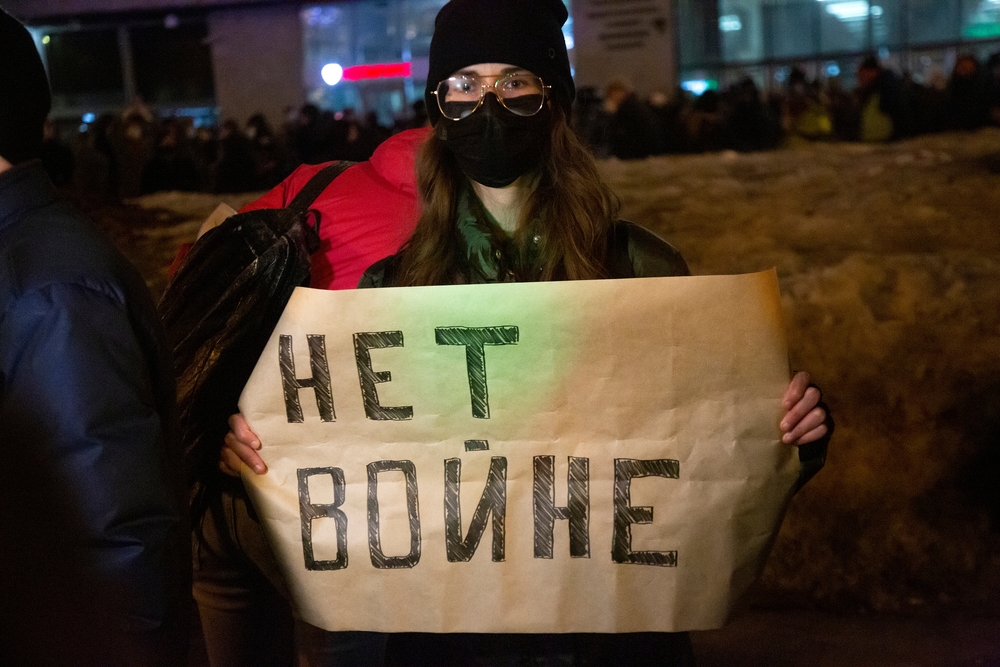
Bearing witness. Despite repressions and state propaganda, the anti-war movement in Russia continues
As the war in Ukraine continues, questions have been asked as to the internal situation in Russia. Whilst the country’s burgeoning anti-war movement may not live up to outside expectations, its attempts to work around the Kremlin’s restrictions are inspiring new and unique forms of protest.
International critics often view the Russian domestic anti-war movement as helpless and doomed to fail. This might seem true as it does not comply with the West and Ukraine’s main expectation that it will start large-scale street protests capable of overthrowing Vladimir Putin’s regime. What often escapes the world’s attention is that there are no such opportunities for the Russian anti-war movement in the country’s political structure. It must first evolve in more sophisticated, symbolic ways to reach a point of numerical strength over time.
April 25, 2022 -
Anna Efimova
-
Issue 3 2022MagazineStories and ideas
Photo: NickolayV / Shutterstock
So far, the Russian anti-war resistance can be characterised as a movement that relies on the logic of “bearing witness”. Lacking political opportunities to influence decision-makers, the movement aims to develop, test and maintain forms of collective action that successfully promote the values and positions of the anti-war activists. The more accepted their framework and the more accessible their actions for people under state repression, the more numerical strength the movement may gain to pursue change.
Depersonalised and decentralised resistance
There is a huge difference between the forms of actions and opportunities available to the activists of the anti-war movement abroad and those who stay inside Russia. Those who manage to flee or fled a long time ago, promote a new, white-blue-white state flag, free of the red line now often associated with the blood of Putin’s regime. Russian activists abroad help Ukrainians to evacuate from the conflict zones and offer free online tutorship and classes to Ukrainian schoolchildren deprived of an education due to internal displacement and war. Their activity implies certain consequences for their security but, as many do not intend to come back to Russia while Putin is in power, they can live publicly without hiding their names.
But most of the anti-war grassroots initiatives based in Russia are decentralised and depersonalised for security reasons. Spreading information and being visible online and offline exposes activists to threats from Kremlin intelligence and informants. Thanks to its new legislation introduced in the first days of the war, the state is now much faster in pursuing its enemies and other disgruntled groups and individuals. This encourages collective action and organisational structures that can comply with the demanding security protocols that most activists must follow. In the new Feminist Anti-War Resistance movement that unites more than 40 feminist groups across Russia, most activists do not know each other or even each other’s names. This is done to make sure that no groups or individuals are endangered if some activists are prosecuted. On the day of the large anti-war rally in Moscow, Feminist Anti-War Resistance had to publish instructions on how to behave at a rally point so that no one would get arrested before the start of the protest. They stated that attendees should “Walk in circles around the [railway station] square, pretending to be a passenger, if there are still not a lot of people”. When producing informational leaflets about the war, activists are mimicking the designs of the signs Russians usually pay attention to in the streets or in public places. These look like leaflets seeking the whereabouts of lost people and pets, announcements of public utilities and telecommunications networks, and price or sale tags in stores. The only difference is that they contain information about Russia’s intervention in Ukraine, civilian victims, and the devastating losses it has brought to the Russian economy. This allows information to reach the mass of the population while enabling activists to stay anonymous and free from arrest and police prosecution.
Logic of numbers
The Russian anti-war movement has pursued tactics of collective action, from street protests and marches to more conventional petitioning, in order to demonstrate its numerical strength. On the one hand, it empowers new and old movement members to get involved or maintain their activity despite the risks and constraints. On the other hand, large demonstrations have a better chance of gaining international media coverage. During the very first week of the war, international media published momentous photos of Russian protesters, creating a sense of solidarity with them across the globe. More than 1,200,000 people signed an anti-war declaration that aimed to demonstrate the numerical strength of the anti-war attitude in the country. Professional unions and communities, NGOs and charitable foundations, and students at Russian universities also published petitions to stop hostilities in Ukraine.
Ekaterina Shulman, a prominent Russian political scientist, suggested that people send official requests to national, regional and municipal deputies. She argued that “deputies are the most sensitive to the volatility of people’s public opinion… Unlike others, they are reachable. Our task is… to create an impression of how people think about this disaster… They [the deputies] will remember that nationwide approval did not happen. This impression will prove important later.” Guided by this call, 450 letters to all the deputies of the Russian Duma were sent out by volunteers. Russian and Belarusian activists are now using this tactic to reach regional and local deputies too.
These actions, however, are costly. According to OVD-Info, a human rights NGO, around 15,000 people had been detained at anti-war rallies in 155 cities across Russia by the end of March. Detention for wearing clothes in a blue and yellow colour scheme (blue boots with yellow shoelaces or a yellow coat with a blue backpack), carrying anti-war posters (even if it is just a white paper list), and shouting anti-war slogans were reported. “No war”, “No fascism”, “Stop the war”, “Freedom to Russia, peace to Ukraine”, “Maidan”, “Ukraine, you are right”, “Russia, do not touch Ukraine”, “Enough of zinc coffins”, “Schools and hospitals instead of bombs”. These are real anti-war slogans that got protesters detained and indicted for “discreditation” of the Russian army or violating the rules of conduct regarding public arrangements. Authorities claim that the rallies “hinder the functioning of city infrastructure”. Some have found themselves in an avtozak (Russian for a prisoner transport vehicle) for silently marching in a dispersed crowd of people. There are even cases of lawyers and defence counsels being denied entry to police stations and courts.
Forty-four per cent of participants detained during the anti-war protests are women and the police exercise pressure and violence on vulnerable female groups. In Moscow, two women and their five children of seven to 11 years old were detained on their way to the Ukrainian embassy, where they wanted to lay some flowers. Police officers threatened to deprive these women of their parental rights and were going to detain them for the night. This is illegal regarding mothers of underaged children in Russia. More than 20 young women were beaten and tortured for refusing to let officers examine their smartphones. They also used their constitutional right not to answer the questions of interrogators. After a large anti-war protest on March 6th, at the Brateevo police station in Moscow, many women were detained. Later, journalists collected their testimonies.
Nineteen-year-old Tatiana stated, “He… was angry, why are we so dumb, why do we not reveal why we do this [participate in the protest] and be repentant about it. Then they tried to take a picture of me, but I was hanging onto the wall – then they kicked me with their legs from the back… They… decided that “the air” would help me to talk. They took a good, tight plastic bag from the wardrobe… The main interrogator in black started to strangle me, but I had access to air because I put my hands on my neck. Then they made me sit on a chair and two people started to strangle me. The man in a white shirt was holding my hands and pressing the bag to my nose and mouth. Another man in black was standing behind and squeezing. This was repeated several times. Once I nearly fainted but they did not notice that I managed to make a few holes in that bag.”
Repressions and prosecutions have also been used against more conventional petitions. Lev Ponomarev, an 80-year-old human rights activist who started an anti-war petition, was detained on February 24th for “calls for illegal public action” after the large protest in Moscow. OVD-info reported that NGOs and charitable organisations that publicly disapproved of the war “were disconnected from the charity programme on the website of the Moscow mayor mos.ru”. This system previously allowed them to receive donations. Later, Olga Zanko, the deputy chair of the State Duma Committee for the Development of Civil Society, suggested depriving such NGOs of state support if they oppose the interests of the state.
In April, a coalition made up of the Vesna youth movement, Feminist Anti-War Resistance, Eighth Initiative Group and Students Against the War presented five demands to the Russian government on behalf of the domestic anti-war movement. These demands include a stop to the war and a return of Russian troops to their bases; the public release of information about Russian military and intelligence losses; an exchange of prisoners and dead with Ukraine; an end to the law concerning the inherently “fake” nature of any information that contradicts the Russian defence ministry; and the cancellation of all criminal and administrative cases concerning the anti-war protests.
Every movement should pose demands. The more numerical strength it shows, the more likely it will influence decision-makers. Yet the logic of numbers does not serve Russian protesters. Decision-makers have been deaf to their demands. There is no sign that this will change when specific demands are made. However, in the current circumstances, protesters are not so much focused on influencing the authorities but on encouraging more people to join the anti-war cause. Saving and disseminating knowledge about past protests also grants activists a feeling of not being alone in this fight. This is exemplified by the “Chronicles of protests in Russia”, an online map that collects data on anti-war street protests. The movement’s core is becoming more aware of the needs of ordinary protesters. Activists of the Vesna youth movement from Saint Petersburg say there is a demand for alternative forms of street protest that would make participants less vulnerable to police violence. On April 2nd, this group organised a sit-in protest in major Russian cities. The idea is that if people sit on the ground holding each other’s hands and legs, police will have more trouble separating and arresting them.
Logic of damage
American sociologist Sidney Tarrow argued that any actions that threaten the normal course of events are “inherently disruptive”. In the eyes of the “silent majority” in Russia, the entire anti-war movement appears to cause disorder in relation to the “natural” order of things. Russian families, with their strong intergenerational connections, are now often split over the war. Overall, the elderly and young generations tend to have different attitudes regarding events in Russia and Ukraine. One female activist shared how a harmless expression of her anti-war attitude, such as wearing a handmade pin in a form of a Ukrainian flag, caused emotional violence on the part of her mother.
“When she realised that it was the Ukrainian flag… she started to shout at me, call me a fascist, a traitor to the Motherland, two-faced, zombified… In the end, she said that she cannot provide for me anymore, that I have to collect my clothes, search for a job and a dwelling and move out of the flat that they bought me when I was enrolled in the university.”
A lack of resources usually leads movements to violence. In the case of the peaceful anti-war movement, it has focused on disrupting state institutions in a less direct manner. Antivoenniy bolnichny (Russian for “Anti-war sick leave”), a depersonalised online initiative, urges Russians to get involved in boycotts and strikes. “Imagine that one morning a tram driver who drives workers to the defence industries would not come to work. A schoolteacher would not come to work, and a child of a defence industry worker will stay at home. Maybe even this worker would have to”, their press release states. Those behind the initiative believe that these forms of protest are not typical for Russian society. To put it at the forefront and support striking employees, they provide legal advice on better ways to organise a strike and have recently started a fundraising campaign.
Activists also target the subjects of Russian propaganda. For instance, they tear down any propaganda material in the streets and public places. Age and television news consumption are the main factors dividing Russian society’s understandings of the war. As a result, the actions of Marina Ovsyannikova, a long-time editor at the Russian state TV Channel One, were particularly impressive. Ovsyannikova burst onto a live evening news broadcast holding an anti-war poster and shouting “They are lying to you here”. This protest certainly increased pressure on her employer. After the incident, Channel One has started to broadcast evening news with a delay of 30 to 60 seconds. As Marina disrupted the work of the state propaganda machine and refuses to leave Russia, she inspired the entire Russian anti-war movement. Her action presented an alternative culture in a thoroughly hostile environment.
The logic of bearing witness
Seventy-seven-year-old Elena Osipova is a painter and a survivor of the Leningrad siege during the Second World War. Having publicly protested against the war in Ukraine and being detained twice, she has become a symbol of the anti-war movement. Her activism does not pose a threat to decision-makers but comes with personal costs and risks. However, it does demonstrate a commitment to the values of human life, peace, rule of law and solidarity. These actions are conducted in line with the logic of bearing witness, which argues that defending these values outweighs the risks.
Russian anti-war activists promote the idea of challenging attitudes and values through civil disobedience and symbolic provocations. They spark an emotional response, shift perspectives, and eventually nurture a sense of individual responsibility among their audiences. Ne vojna (No war), an anonymous art group from Samara, dressed up in black trash bags and laid in a line on the ice of the frozen Volga river, calling their performance “Word to the dead”.
Artist Yevgenia Isayeva splattered herself with red paint while wearing a white dress as a part of her “Breaking my heart” anti-war performance in St Petersburg. She received a fine of 45,000 roubles and was then detained for eight days. Feminist Anti-War Resistance has organised nationwide campaigns in commemoration of the Ukrainians who have died since the start of the war. On International Women’s Day, which has often become a celebration of essentialist stances on women in today’s Russia, feminists in 103 cities in Russia and abroad brought flowers to monuments that commemorate the victory in the Second World War. In April, they led the “Mariupol 5000” protest in commemoration of the dead residents of Mariupol. Activists across Russia installed thousands of improvised crosses in the courtyards of residential buildings. The crosses included plates that provided information about the loss of civilian life in this Ukrainian city because of the war.
The movement is increasingly embracing routine practices of resistance. Feminist resistance also revived the “quiet picket”, a protest initiative first tried in 2016 by Darya Serenko, a Russian poet and feminist activist. Then, passengers of Moscow’s public transport could see Darya either carrying a poster or displaying a piece of paper with a slogan on her bag. Now protesters put anti-war posters, stickers and pins on their clothes, bags and backpacks. Since March 1st, Save Russia 2022, a partisan resistance initiative, has urged Russians to tie green ribbons around fixtures in public places. This is a symbolic gesture meant as a sign of solidarity with others who condemn the war. The green colour symbolises spring, life and nature.
The logic of bearing witness helps activists to break through the informational blockade of Russian society by spreading and discussing trustworthy information about the war. Feminist resistance has urged activists to write anti-war slogans on Russian money. This initiative has become increasingly popular. “It will be much harder for the state to fight against what is written on bank notes than on the social media posts and leaflets,” activists argue. As prices have skyrocketed in Russia since the start of the war, activists have started to put anti-war stickers next to price tags in stores. This is done because “there are still people who do not understand the reason behind the increase in prices.”
Another provocative tactic of Feminist Anti-War Resistance is to send out a scam-like “Unfortunate letter” on WhatsApp. Scam messages asking a user to send a message to several others for good luck are not a rare thing in the world of Russian messaging. Activists decided to use this to their advantage and created a scam letter about the Russian intervention in Ukraine and civilians dying as a result of shelling. The difference here, however, is that the user has to send this scam message further if they want to avoid more “trouble”. Activists say that this message has gone viral as some of them received it from random contacts: “We were told that one woman who supported Putin participated in a street protest, having read the letter.” A “safe repost” initiative urges those who are based outside of Russia to repost safety instructions about participation in street protests for their network in Russia. Spreading this information is illegal under current legislation. Anna Filimonova, a Ukrainian journalist, and Alexii Ponomarev, an independent Russian journalist, together run a podcast called “Kavachai”, where they discuss ongoing events in Ukraine and Russia. Doxa, a renowned student publication, regularly discusses war crimes committed by the Russian army in Ukraine and the conflict’s negative economic and social consequences for Russia. This all started with the “Anti-war newsletter” for those who cannot use a VPN to access blocked social media. Many media and activist platforms publish stories about Ukrainian refugees.
Through their Telegram channels, a range of art and design initiatives, such as the Stop the war/Not alone project, produce, accumulate, and share layouts of anti-war leaflets. While some share posters on social media, others print them out and put them up in public places. The project’s campaign states that “Protests are the final stage of resistance, and a good protest requires a lot of campaigning… Each of us can put up ten leaflets per day… thousands of people will have the impression that at least one person is standing up behind one leaflet, we will show them that we are not alone.” “Graphic intervention”, a Telegram anti-war initiative for designers, has also accumulated more than 100 stickers and poster layouts that Muscovites put up in city streets. At the same time, the Students Against The War initiative collects evidence of resistance in Russian academia, such as putting up anti-war stickers and posters and painting graffiti at universities. The group’s programme statement declares that “Even though many of us did not elect Putin and did not want this war, it has already started. This is why it is our duty to fight against the war out of solidarity with Ukrainian men and women.”
Anna Efimova is a Russian journalist and contributing editor of New Eastern Europe. She is also a PhD candidate at the Jagiellonian University in Kraków and holds a MA degree from the University of Glasgow, UK and the University of Tartu, Estonia.