
Text resize: A A
Change contrast

The unfin(n)ished story of the Baltic alliance

From the region’s perspective, the 1922 Warsaw Accord between Estonia, Finland, Latvia and Poland was a significant step in strengthening geopolitical interests and safeguarding against Russian aggression. Unfortunately, the agreement ultimately failed. This year’s ratification by Finland’s parliament of its application to join NATO can be seen as a final step in this process that began over 100 years ago.

The most promising and – to a certain degree – surprising declaration made by Finland on its interest in joining the NATO Alliance immediately reminded me of the so-called Warsaw Accord. This treaty was drafted 100 years ago on March 17th 1922 and embodied the initiative of a Baltic alliance between Estonia, Finland, Latvia and Poland. Anti-Soviet in nature, cooperation ultimately failed due to reservations expressed by Helsinki. In the summer of 1922 the Finnish parliament – Eduskunta – decided not to ratify the pact. A century later, on May 17th 2022, 188 out of 200 Finnish MPs voted on accession to NATO. The story has come full circle. A story which deserves to be told.

September 29, 2022 - Grzegorz Szymborski - History and MemoryIssue 5 2022Magazine
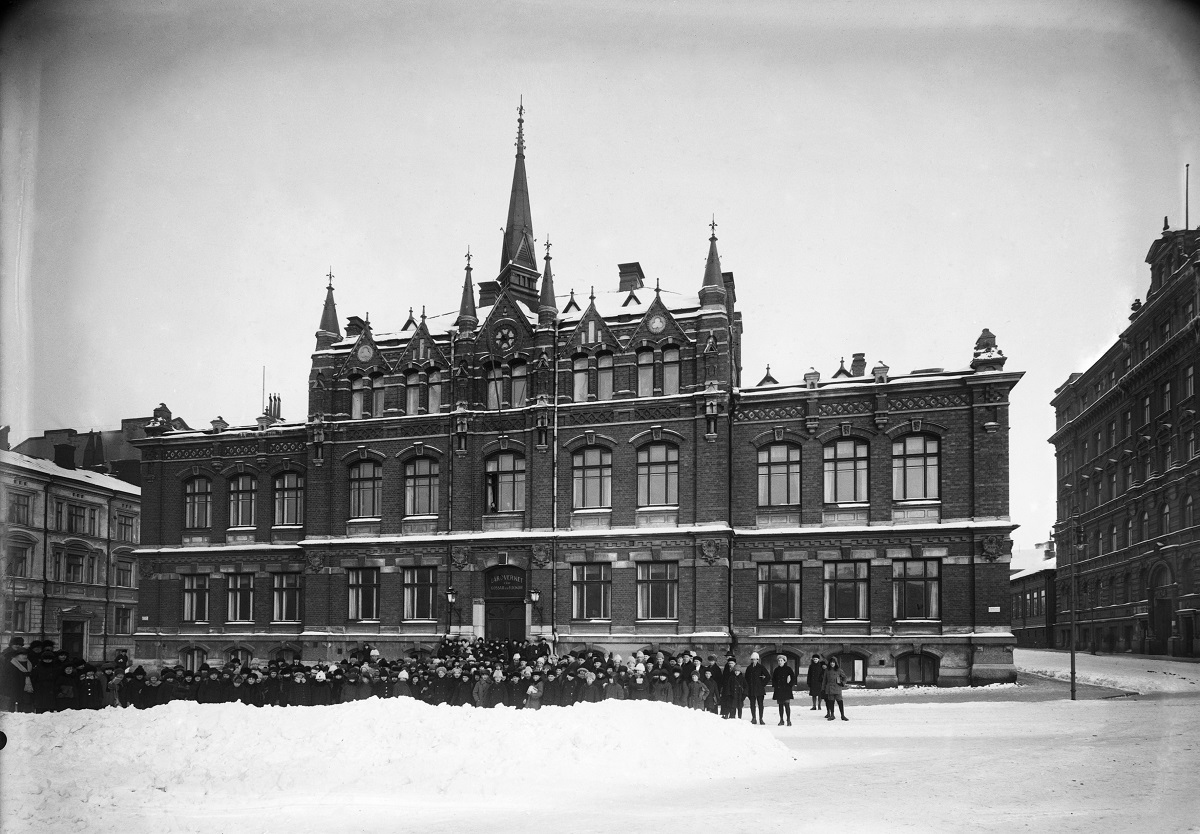
Photo source: Helsinki city museum (CC) commons.wikimedia.org

Roots of the alliance

When speaking of the Baltic alliance, one may think of the Baltic Entente, originally forged by the three Baltic states of Lithuania, Latvia and Estonia in 1934. Although to some extent it expressed the idea of a covenant in the Baltic Sea region, it was far less spectacular than the concepts that were put on the table shortly after the First World War. It was actually the remains of a once ambitious project. The Baltic alliance was meant to unite the newly established states of Eastern Europe.

The question of cooperation arose around the struggles for independence undertaken by the former subjects to the tsars, now fighting back the Bolsheviks. Obviously enough, it was Warsaw which advocated for the anti-Bolshevik entente at the time these states were still at war with Soviet Russia throughout 1920. Poland counted on Finland’s support which was provided by its foreign minister – Rudolf Holsti. At the time of his term, Helsinki was at war with Moscow and faced a threat of a new conflict in early 1922. According to Estonian historian Raimo Pullat, Holsti was reluctant to pursue cooperation with Germany, which was surprising considering the general pro-German attitude of his countrymen.

At the same time, Finland’s relations with Sweden deteriorated in the early 1920s due to a dispute over the Aland Islands. This was finally resolved, but not forgotten, in early 1922. Harsh feelings towards Sweden made Finland temporarily look eastwards to cooperation with the Baltic states and Poland in particular.

It was in September and October 1919 that the three Baltic states’ representatives met at several initial working conferences in Riga, Tallinn and Tartu. Finland joined the consultations and agreed on organising the summit in its capital city. It was also in late 1919 that Helsinki was ready to open negotiations with Warsaw. At that time, Warsaw remained not so focused on such an idea. Poland’s leader Marshal Józef Piłsudski hoped to create a federated bloc with Belarus and Ukraine, not necessarily an alliance with small states such as Latvia and Estonia.

Finland hosted the first big conference between January 15th and 22nd 1920 with Estonian, Latvian, Lithuanian and Polish representations. Latvian historian Alberts Varslavans claimed that the summit in Helsinki in January 1920 was “the first practical step in the formation of a Baltic Alliance”. The Polish delegate was instructed to call for a joint peace of all states against the Soviets. Estonia did not wish to do so, as it was at that time close to reaching its own agreement with Moscow.

The agenda was composed of the idea of a political and military covenant, along with a joint outlook towards Soviet Russia. According to Raimo Pullat, Finland and Estonia advocated for peaceful coexistence, while Poland still pushed for confrontation with Moscow. Helsiniki did not share Warsaw’s scepticism towards Berlin and did not wish to take part in any projects oriented on expansion. According to the first Finnish President Kaarlo Ståhlberg, except for Eastern Karelia, Finland was satisfied with its territorial status. Helsinki did not wish to join any strict military alliance but to think of development, whilst Warsaw dreamed of greatness and a self-declared, bold approach towards both Berlin and the Moscow. At the same time, Lithuanians accused Poles of aggression as it claimed its rights over Vilnius. As the result of bilateral tensions, only some of the future summits could take place with both representatives of Lithuania and Poland on board. The Helsinki conference turned out to be fruitless but not pointless. The idea of the Baltic alliance was not left behind.

Too many obstacles

In March 1920, several meetings with Latvian and Finnish delegates took place in Warsaw. A Romanian representation was also invited as Poland still focused mainly on its war with Soviet Russia and the military effort was the main driver for Warsaw’s interest in the Baltic area. However, all efforts for joint action, or a military convention, failed. The number of meetings organised throughout 1920-24 was substantial, although only two of them concluded with some drafts or alleged results worthy of recognition. The first was a conference of the Baltic states, which took place in August and September 1920 in Bulduri, Latvia. As the result of Poland’s regional policy goals, representatives of the Ukrainian People’s Republic also attended that summit. However, this was more symbolic than anything else.

Polish historian and diplomat Jarosław Suchoples claimed “that the most important event during the month-long Bulduri conference was the conclusion (August 31st 1920) of a political agreement. The contracting parties agreed that it would be necessary to sign a military alliance in the future.” Unfortunately, too many obstacles between the states prevented them from tied cooperation and ratification of the treaty. The main difficulty was the Polish seizure of Vilnius on October 9th 1920. According to Suchoples, the Bulduri agreement’s fate was sealed with this event. This disappointing outcome was also noted by other historians. For Alberts Varslavans, “the first stage of the attempt to create a Baltic Alliance ended with the Bulduri conference. The goal of uniting the five countries – Finland, Estonia, Latvia, Lithuania and Poland – into an anti-Soviet bloc was doomed to failure.” Latvian historian Edgar Anderson claimed that the meeting “provided the greatest opportunity for forming a regional diplomatic, economic, and military Alliance, [but] was destroyed by Poland’s subsequent seizure of Vilnius”.

Throughout 1921 conferences were again convened on multiple occasions. These occurred at a time when Poland was interested in cooperation after the Treaty of Riga on March 18th 1921 and the failure of the federation concept. Warsaw subsequently sought other paths to security. This is why cooperation with the northern countries seemed promising. Yet, all of the summits resulted in very little. The whole concept of the Baltic alliance was not only discussed between the negotiating parties, but also closely observed in European capitals. The involvement of the United Kingdom and France should be noted to embrace a wider view. According to Varslavans, London’s aim was to preserve the balance of power in Europe. In order to achieve this, it wished to unite the Baltic states under the British economic banner. Paris, on the other hand, used Warsaw as its agent to strengthen French influence in the north. The original Helsinki meeting in January 1920 attracted British attention, while the French were afraid of creating any sort of anti-Soviet bloc, meaning de facto recognition of the Bolshevik state. Following the failure of the first conference and the Polish fixation on war with the Soviets, the UK no longer included Warsaw in its plans. It was now willing to create a bloc of the Baltic states excluding Poland.

Great Britain focused on an alliance of the three Baltic states and its economic goals shared by Latvia and Estonia – both dependent on the UK due to their debts. London and Moscow looked for economic rapprochement and the Baltic states were pleased to serve as a bridge between these countries. Riga and Tallinn’s economies had to rely on this transfer role in the 1920s. In order to achieve this goal, London and Moscow signed a trade agreement on March 16th 1921. With Latvia increasingly falling into the British sphere of influence throughout 1921, Riga’s attitude towards Warsaw also deteriorated. Prime Minister Zigfrīds Meierovics acted harshly towards Poland, fearing that after the seizure of Vilnius it could go after six disputed counties in Latgale. As the result of the deterioration of Latvian-Polish relations in the second half of 1921, some summits took place without Poland.

Meanwhile, Soviet Russia was obviously alarmed about any treaties which were even indirectly turned against Moscow. It was interested in the same goals as the UK, primarily international trade. The Soviets also expressed wishes for a future league of the three Baltic states. Maxim Litvinov, the Soviet envoy to Estonia, declared in the summer of 1921 that Moscow had no concerns regarding the Baltic entente as long as Poland is excluded from the project. Between October 28th and 31st 1921 a special trade conference in Helsinki took place with Russia and the Baltic states. Economic interest prevailed over political goals. For obvious reasons, the Polish delegation was absent. Such initiatives proved that Polish influence was beginning to decrease. For Warsaw, the league of the three Baltic states without Poland would mean a bridge between Germany and Soviet Russia and an increase of a threat from the north.

A new opening

International turmoil arising from the Eastern Karelian uprising in the autumn of 1921 resurrected the idea of a Baltic alliance turned against Moscow. This borderland of Soviet Russia, even though throughout history never within the Grand Duchy of Finland, revolted against Moscow and looked for Helsinki’s support. The possibility of a new Finnish-Soviet war led to rapprochement between Riga and Warsaw.

The last British-oriented conference – excluding Poland – took place on December 16th 1921 in Tallinn. Thanks to Holsti, this economic forum was forced to deal with political issues. Two topics were discussed among the participants: the Baltic alliance and the Vilnius question. According to Polish historian Andrzej Skrzypek, Finland’s interest in Eastern Karelia was recognised by the Baltic states. Estonia and Finland wished to cooperate with Poland on this matter. After an initial setback caused by the Latvian delegation, it agreed to invite Polish representatives for future summits. Tallinn and Helsinki called for military cooperation. In late January 1922 Finnish President Kaarlo Ståhlberg entrusted Rudolf Holsti with opening negotiations with Poland, willing also to expand the format by including the Baltic states.

Early 1922 resulted in other important factors that shed light on the international situation. On January 9th parliamentary elections for the local Vilnius parliament took place. As the result of a boycott by Lithuanians, the vast majority of MPs elected soon called Poland to incorporate the Republic of Central Lithuania. Approved or not, the final word of Poland on the Vilnius question made the situation clearer than ever before. At the same time, the western powers intended to organise a summit on economic issues with Soviet Russia. Now threatened with a rapprochement between Western Europe and Moscow, the smaller states of Eastern Europe had to act quickly. Under these circumstances Poland called for a meeting in Warsaw. The Polish General Staff saw the Baltic states as potential key allies, with Estonia, Finland and Latvia maintaining as much as half of all Polish troops mobilised in time of war.

The Warsaw conference held between March 13th and 17th 1922 resulted in the signing of the Warsaw Accord between Estonia, Finland, Latvia and Poland and indicated a surprising turn of events that disappeared just as quickly. The question of a military pact was not officially put on the agenda. No one expected such an agreement to be the outcome of the summit. Only Estonia counted on some political understanding. Nevertheless, the treaty was signed on March 17th 1922. In fact, the direct course of events leading to the signing of the treaty remains a mystery. It is only known that the conference participants were hosted at some point by Józef Piłsudski. The many issues discussed included banning the signing of treaties threatening the contracting parties, the protection of national minorities and the willingness to sign consular and trade agreements. A vague formula related to a collective security mechanism was also hidden within Article 7. This stipulated that in the case of an unexpected attack on an allied state, the other countries would adopt a benevolent attitude towards the victim of such aggression and discuss further steps.

Estonian historian Magnus Ilmjärv wrote that “this agreement clearly meant the political readiness for cooperation in case of a threat.” However, even Article 7 was not what Helsinki and Tallinn expected – a military pact. The Warsaw Accord was ratified by Latvia (March 31st), Estonia (April 6th) and Poland (May 10th). Meanwhile, Finland procrastinated, having the dispute over Eastern Karelia resolved only four days after signing the Warsaw Accord.

Ultimate failure

The Soviets were by no means impressed by the Warsaw Accord. It put in jeopardy the peace achieved after the uprising in Karelia and the subsequent agreement with Finland. The peace was Helsinki’s ultimate goal, far more valuable than the treaty signed prior to the Moscow agreement. Apart from the Finnish question, Moscow continued its attempts of rapprochement with the Baltic states, inviting them, as well as Poland, to a joint conference that took place in Riga. As a result, Estonia, Latvia and Poland promised to lobby for de jure recognition of Soviet Russia in return for the confirmation of peace treaties. On June 12th Moscow called for a conference with the Baltic states and Poland on demilitarisation.

But it was not in Moscow or secret cabinets where the fate of the alliance was ultimately doomed, but the Finnish parliament. After reaching agreement over Eastern Karelia, Helsinki lost its vigorous spirit. Both the Finnish right-wing parties and social democrats thought that the alliance would function not only against the Soviets, but Germans as well. According to Magnus Ilmjärv, the Finns were afraid that in the case of a German-Polish war, they would be forced to support Warsaw. Finland’s reluctance and the Polish-Lithuanian dispute were the main obstacles to the bloc.

Rudolf Holsti was forced to leave his post on May 13th, and the whole cabinet was changed on June 2nd 1922. The parliament actually never voted on the ratification of the treaty. It postponed relevant discussions until autumn 1922 but the topic was never again put on the agenda. After new parliamentary elections, Helsinki diplomatically informed its counterparts on August 18th 1922 that it will refrain from ratification. Considering the international context, we also have to bear in mind the specific issues facing Finland’s parliaments in the 1920s, which suffered from the same disadvantages faced by others including Poland. According to Finnish historian Seppo Hentilä, only two out of the country’s thirteen governments were majority-based.

Competition rather than collaboration

Alberts Varslavans admitted that “the Warsaw conference of four states in March 1922 once again proved the impossibility of creating an overt military anti-Soviet bloc of the Baltic states. The divergence of interests between France and Poland on the one hand, and the smaller states on the other, undermined the effectiveness of the military agreement signed at the conference, which was composed in vague and general terms … the failure of this second stage in the Baltic region signified a setback for France’s policy in the Baltic region and, consequently, a further increase of Britain’s influence.” Historian Magnus Ilmjärv argued that this event turned out to be the climax of the Baltic alliance dream even though the conferences continued. The British approach prevailed and following the failure of the Warsaw Accord various economic forums were called – one took place in Helsinki in March 5th 1923 and another between July 9th and 11th in Riga. Further unsuccessful attempts at cooperation continued until 1924. With the Treaty of Locarno signed, the new international situation changed the optics of the cordon sanitaire. Germany became the main anti-Soviet power for Britain to the extent that it did not want to offer any guarantees to the Eastern European states.

The young states, competitive in many ways, could not reach rapprochement in the first years after their creation. Too many contradicting elements ultimately doomed the ambitious and far-reaching project. The only visible result of the talks was the Latvian-Estonian agreement reached on November 1st 1923, which was signed against the newly formed Soviet Union. The fact that the only outcome of this great dream was a mere bilateral treaty of two neighbours only proves how difficult it was to reach any sort of consent and approval.

“One should also add”, claimed Edgar Anderson, “the fierce nationalism and pride in undulated independence too, were formidable obstacles to meaningful cooperation of the Baltic states. Economically they were competitors rather than collaborators. Still, largely strangers to one another, the Baltic states had no close cultural contacts.” British and French rivalry, Lithuania and Poland’s dispute over Vilnius, the unwillingness of Estonia and Latvia to be dominated by Poland, the potential German-Lithuanian dispute over Memel, Tallinn and Riga’s indebtedness to the UK and Finland’s aversion to conflict – this international net of unresolved and obstructive issues led to the failure of the Baltic alliance. The more this failure is disappointing, however, the more welcome and encouraging the current turn of events should be in this region. All three Baltic states, Poland and Ukraine are now praising Finland for finishing what was once initiated in Helsinki a century ago.

Grzegorz Szymborski is a diplomatic trainee at the Diplomatic Academy of the MFA of the Republic of Poland, graduate of the College of Europe in Natolin (Poland) and the Faculty of Law and Administration at the University of Warsaw. He is also the author of books: Wolność niejedno ma imię (2013), Wyprawa Fryderyka Augusta I do Inflant w latach 1700 – 1701 w świetle wojny domowej na Litwie (2015) and Działania zbrojne w Rzeczypospolitej podczas interwencji rosyjskiej 1764 roku (2020).

, , , , , , ,

Partners

Terms of Use | Cookie policy | Copyryight 2026 Kolegium Europy Wschodniej im. Jana Nowaka-Jeziorańskiego 31-153 Kraków
Agencja digital: hauerpower studio krakow.
We use cookies to personalise content and ads, to provide social media features and to analyse our traffic. We also share information about your use of our site with our social media, advertising and analytics partners. View more
Cookies settings
Accept
Decline
Privacy & Cookie policy
Privacy & Cookies policy
Cookie name Active
Poniższa Polityka Prywatności – klauzule informacyjne dotyczące przetwarzania danych osobowych w związku z korzystaniem z serwisu internetowego https://neweasterneurope.eu/ lub usług dostępnych za jego pośrednictwem Polityka Prywatności zawiera informacje wymagane przez przepisy Rozporządzenia Parlamentu Europejskiego i Rady 2016/679 w sprawie ochrony osób fizycznych w związku z przetwarzaniem danych osobowych i w sprawie swobodnego przepływu takich danych oraz uchylenia dyrektywy 95/46/WE (RODO). Całość do przeczytania pod tym linkiem
Save settings
Cookies settings