
The Baltic phoenix
The dissolution of the Soviet Union resulted in defragmenting of the world map into fifteen pieces – most of which were new entities. However, three of them somehow seemed particularly familiar – Lithuania, Latvia and Estonia, jointly known as the Baltic states. Their re-emergence in Europe created many legal questions as they all began to claim renewal of their previous statehoods existing in 1918-1940.
Anti-Soviet tendencies on the Baltic coast exploded at the time of Mikhail Gorbachev’s perestroika. The desire for independence and the struggle for historical truth in the Baltic republics spawned social movements which emphasised the statehoods of the Baltic states, deprived as the result of the USSR’s invasion in 1940.
April 11, 2021 -
Grzegorz Szymborski
-
Hot TopicsIssue 3 2021Magazine
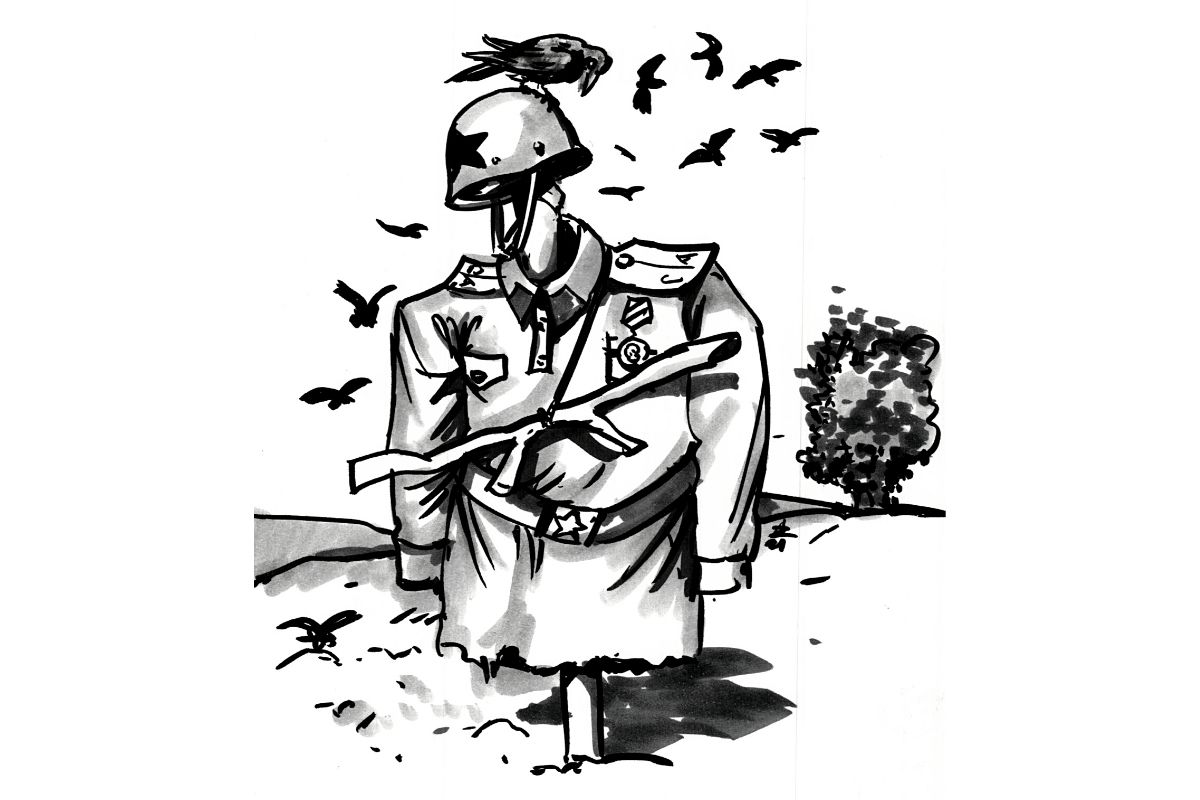
Illustration by Andrzej Zaręba
With Soviet military bases already present in the suppressed countries since the autumn of 1939, any resistance against an impending conquest was pointless. The states were obliged to make concessions to the overwhelming protector, leading to their forced inclusion into the Soviet Union. Some states, such as Germany and Sweden, accepted that incorporation. The subjugation was nonetheless disregarded by many countries, including the United States which strongly opposed the invasion, claiming they accept this new situation de facto but not de jure.
On March 11th 1990 Lithuania declared independence through a newly elected Supreme Council of Soviet Lithuania; it was the first Soviet republic to do so. On March 30th the Supreme Council of Estonia passed a decree which called for the restoration of an independent Estonian republic. On May 4th the Supreme Council of Latvia did the same. The Baltic states had entered a transition period. After a series of manifestos, Soviet threats and sanctions, the peoples of the Baltic states took advantage of the unsuccessful August 1991 coup, led by Gennady Yanayev in Moscow. On August 20th and 21st Estonia and Latvia declared full independence from the Soviet Union. Boris Yeltsin’s Russia recognised them in September. Although the sovereignty of the Baltic states was secured, their struggle for identity and status within the international community was more complex.
The world’s reaction
Throughout 1991 the majority of countries recognised the Baltic states. Iceland was the first to recognise Lithuania in February. In order to honour their pre-war continuity and meet the expectations of Lithuania, Latvia and Estonia, gold reserves stored in France and the United Kingdom during the Second World War were transferred back to the respective countries in 1992 and 1993. Many countries restored their pre-war embassies’ abroad.
The European Community recognised the Baltic states’ continuity as early as in 1991. On August 27th the ministers of foreign affairs of the European Community declared its support for the Baltic states. The European Parliament released them from Soviet debts as they were not recognised as Soviet successors. According to Peter Van Elsuwege, current professor of EU law at Ghent University, the European Union decided to accept the historic continuity to differentiate the Lithuania, Latvia and Estonia with the other post-Soviet countries in order to pave their smooth path towards European integration. In autumn 1991 they entered the United Nations and the OECD, and later NATO and the EU. The position of the Baltic states was really exceptional and their recognition was not conditional at all. The International Labour Organisation seems to be the one exception – attempts to reactive membership failed. They had to reapply.
The legal case of the Baltic states re-emerging after a period of time is a topic that can be found in ancient Roman law, adopted in modern and international law. Professor Karol Karski, current Quaestor of the European Parliament, refers to jus postliminium. This rule concerns the civil death of a Roman citizen captured by the enemy, who could possibly reclaim his rights and liberties after termination of captivity. Yet, this ancient concept was reinterpreted for the purpose of the law of nations in the 16th century. Lawyer Balthazar Ayala claimed that a restored state may consider itself the same entity as formerly. It suggests that regaining lost status used to be taken seriously by lawyers through the ages, so the Baltic attempt was something more than just a whim.
With respect to the dispute between the Baltic states and Russia, Van Elsuwege refers to another Roman rule: ex injuria non oritur jus – no legal benefit can be derived from an illegal act. According to him the Soviet Union had no sovereign power over the territories of the Baltic states. He argues that there was an occupation of the three states throughout the communist period and as such they were subjects of international law. Karski agrees with this assumption, arguing that there were just two possible outcomes of the Soviet invasion of 1940 – a fall of the states, or their occupation. As for him, the fall through incorporation was not possible due to the so-called Stimson doctrine, originally introduced in 1932 by the American Secretary of State Henry Lewis Stimson and subsequently adopted by the League of Nations. Stimson advocated for non-recognition of any attempts leading to the overrun of the Briand-Kellogg treaty banning aggression in interstate relations. Karski claims incorporation did not comply with the principles of international law.
It must be noted that from a legal point of view, the time gap is not so relevant – international law lacks the notion of a statute of limitation. The claim ceases to exist once all parties to the cause agree that it does not exist anymore. Nonetheless international lawyers are aware that sometimes it is inevitable to legalise originally invalid actions, otherwise international law would have become the system of idealistic norms. Professor Van Elsuwege supports the point of view of a Polish lawyer Krystyna Marek, that violation of international law remains legal only in cases of its permanence without the possibility of restitutio ad integrum (literally: restoration to original condition). More importantly, already in 1954, Marek claimed that the Baltic states still have a chance, sometime in the future, to reclaim their pre-war identities.
Resuming relations
The Supreme Council of the Estonian Soviet Republic announced that the authority of the USSR over Estonia was null and void ex tunc (from the very beginning); therefore the body restored the Republic of Estonia. All the states proclaimed restitutio ad integrum, but it was not truly possible to unconditionally fulfil such a wish. While negotiating the restoration of interstate relations, Tallinn and Helsinki agreed on the temporary use of the Soviet-Finnish treaties in relation to Estonia. It was an exception while all the Baltic states tried to avoid Moscow-made law and declare its non-applicability. But still, the provisional usage of the Finnish-Soviet agreements was settled voluntarily and was not based on Estonian succession of the USSR. At the same time, some of the Soviet treaties were too important to be ignored in relation to the new states, so they also remained in force.
In fact, the majority of pre-war agreements were not easily resumed. In 1991 Estonia and Finland agreed that the only former treaty that could prevail is one on cultural exchange. The remaining bilateral settlements had to be rewritten in order to adjust to the new reality. In the case of its relations with the United Kingdom, Estonia managed to resume a deal, adopted before 1940, on visa-free travel. In 1994 Poland and Latvia agreed that all pre-war treaties were still in force, but simultaneously decided to review the contents of a number of agreements excluded from “continuity”. In 1997, 14 pre-war treaties expired.
Claiming the continuity of previous statehoods resulted in the question of constitutional order. In March 1990, Lithuania partially reinstated its former authoritarian one. The fundamental principles of the sovereignty of Lithuania remained in force. Shortly afterwards the constitution was suspended until a new one was drafted. Estonia, on the other hand, avoided explicit reference to its authoritarian legacy. On May 8th 1990 the Supreme Council adopted a law on national symbols. The most basic principles of the Estonian constitution of 1937 were reinstated, including the official state language. One may say the adoption of constitutional heritage was conducted indirectly. The legislative body drafted a completely new act in 1992. Its preamble resembled the first provision of the 1937 constitution.
On the contrary to Lithuania and Estonia, the Latvian constitution was suspended and not amended nor changed, so that, despite the authoritarian episode, its democratic core remained untouched. Yet, in 1990 the idea of readopting the act met many obstacles – society was not familiar with its content, and moreover no legal research of it was undertaken during the Soviet period. Yet, there was reason in favour of such a solution – according to Egils Levits, the current president of Latvia, the 1922 constitution was “free of Soviet legal and political thinking”. That was truly valuable. The Supreme Council left four provisions in force – including the one concerning parliamentary elections. Although the Latvian declaration called for the drafting of a new constitution, it never happened. On August 21st 1991 the laws and regulations of the USSR, on Latvian territory, were announced as null and void. Once a new parliament was established in 1993, it proclaimed that the pre-war constitution remains in force. According to the legal scholar Jānis Pleps: “No other country has conducted a similar constitutional experiment.”
Another element of state continuity that has been pestering the Baltic states was the question of citizenship. In 1992 Estonia restored its 1938 citizenship law. As a result, only the children of an Estonian father could be considered an Estonian citizen in 1992. The questions that arose afterwards, also in regards to human rights, caused the Estonian Supreme Council not to decide on resuming any other laws prior to 1940. Yet, according to Van Elsuwege, Latvia and Estonia in 1991 were not obliged to automatically grant citizenship to whoever was present on their territories. He introduced the Alsace-Lorraine case. The territory was exchanged twice between France and Germany in 1871 and 1919, respectively. After the First World War, France did not decide to grant French citizenship to German settlers who arrived on the land under German rule. According to Van Elsuwege, “even after 50 years an application of the principle of legal continuity does not imply a right of citizenship for the immigrant population”.
What else is at stake?
State continuity and the narrative of occupation allowed the Baltic states to maintain their claims concerning potential compensation for 50 years of illegal occupation and of the atrocities committed during the Soviet era. Thanks to state continuity Lithuania, Latvia and Estonia did not become the successors of the USSR, therefore they are not responsible for international obligations and cannot claim any Soviet assets and belongings. State continuity foredooms the applicability of the treaties signed by Bolshevik Russia and Estonia and Latvia in 1920. Moscow rejected this argument. Estonia strongly insists upon the letter of the Treaty of Tartu and its statehood continuity.
Joint actions and statements were a necessity for the Baltic states, but their decisions in some cases still differed from one another. Latvia and Estonia called for the restoration of their pre-war territories, pockets of which were transferred to the Soviet Union after 1940. Meanwhile Lithuania did not advocate for the restoration of its pre-war boundaries as it excluded Vilnius and Klaipeda. Lithuanian territory under Soviet rule extended and till now remains secured by reference to the 1975 Helsinki Act that acknowledged territorial integrity at the time of the Cold War. In return, in order to trigger its neighbour, Russia raised the question of Lithuanian sovereignty over Klaipeda.
In 2007 Latvia gave up its claims on the city of Abrene, while Estonia and Russia still have not officially reconciled border disputes. Although we can see different approaches, territorial claims are clear under the Viennese Convention on State Succession (signed only by Estonia) that the boundaries inherited resemble an objective reality, no matter if the border treaty in force claims differently. For Rein Müllerson, a professor of international law at King’s College in London, it provides “a definitive question of the boundaries of the Baltic states”.
In some cases, the three Baltic states’ actions did not really follow their own narrative. For instance, all of them acknowledged the twelve-mile-long territorial sea, even if they did not possess this much before 1940. According to Van Elsuwege, the Baltic states sometimes tried to benefit from Soviet agreements with third parties, contradicting their statement on the non-applicability of the treaties signed by USSR. Finally, in 1990, the Baltic states constituted a new intergovernmental co-operation, known as the Baltic Assembly, instead of the pre-war Baltic Entente. Nevertheless, all of those questions were not able to undermine the general direction and understanding of the Baltic states’ continuity as republics before the Soviet occupation.
Another point of view
Today, the continuity of the Baltic states is broadly accepted. Russia, for obvious reasons promotes a different view, namely the so-called “1939-1940 myth”. While not accepting the Baltic statements and interpretation of international law, Moscow often refers to an argument based on the time gap. V.N. Trofimov, a Russian lawyer, has claimed that a time lapse leads to doubts whether the states of the 1990s are legal successors of their pre-war entities. Russian sociologists Renald Simonian and Tamara Kochegarova maintain the Baltic narrative is based on a “myth of the occupation”. They claim that the occupation, as regulated by the Fourth Hague Convention of 1907, refers to an occupation under a war regime. The Russians argue that there were no hostilities between the Baltic states and the USSR at that time, and that the Soviet ultimatum for inclusion was accepted. For those reasons, they accuse Latvian scholar Ineta Ziemele of reinterpreting pre-war international law. She maintains the 1907 provisions apply to the Baltic case, noting that the distinction between military actions and the threat of such actions proves a narrow and inaccurate perception of international law. Simonian and Kochegarova, in contrast, perceive the wide interpretation of military actions as exceeding legal boundaries. For them, the Baltic states were incorporated. They also refer to many non-legal reasons – arguing, for instance, that the Baltic states could have defended themselves in the same way Finland did.
It must be noted that even if some scholars are against the term “occupation,” they still acknowledge Soviet responsibility for the massive scale of executions, deportations and deprivation of property that occurred. In fact, some international lawyers have doubts about whether the Baltics were really occupied. Legal scholar Bart Driessen says the Stimson Doctrine was based upon the Kellogg–Briand Pact and could not have been considered as customary law in the 1930s, not only because “it is difficult to maintain that state practice in the period up to the Second World War conformed to the Stimson doctrine”, but the wording of the doctrine specifically referred to the status of belligerents if both were parties to the pact.
Austria’s Anschluss and Abyssinia’s conquest, approved by the international community, suggest that the Stimson Doctrine was invalid until the signing of the UN Charter. Driessen acknowledges the fact that the US and many other countries did not recognise the Baltic’s incorporation. Nevertheless, he gives some credit to the Helsinki Act of 1975, in which principle four provides the recognition and granting of territorial integrity of other participating states. This act, according to Driessen, resembles recognition of the Soviet western borders. In that case, 1975 marked the Baltic states’ loss of their international personality. Henceforth they had become a constituent part of the USSR.
A predictable conclusion
It is somehow intriguing that international law may let us interpret the same principle or a treaty in a completely different way. The Helsinki Act of 1975 may be invoked by Lithuania trying to justify its territorial gains, while declaring state continuity, by Russia, in order to challenge the Baltic narrative, finally and by the independent scholar who raises the question about the moment when the Baltic states potentially became Soviet republics. The same doubts appear in regards to the Stimson doctrine.
Whenever a topic concerns international law and the politics overlapping one another, the general conclusion appears to be quite obvious as politically determined. It is the specific elements and opinions to the main story that make it more peculiar. All the authors mentioned above agree that restitutio ad integrum claimed by the Baltic states was wishful thinking, impossible to be forced without serious adjustments and exceptions from their own narrative. According to Professor Van Elsuwege: “The principle of state continuity served as a basis for negotiations in order to clarify the situation with regard to international law.” Contradicting deeds could not have stopped the international community from granting support once given to them.It appears that in order to overcome the 50-year heritage, it was – and still is – necessary to stay united and support one’s own narrative at all cost.
Grzegorz Szymborski is a graduate of the College of Europe in Natolin (Poland), a graduate from the Faculty of Law and Administration at the University of Warsaw, and author of the books Wolność niejedno ma imię (2013), Wyprawa Fryderyka Augusta I do Inflant w latach 1700-1701 w świetle wojny domowej na Litwie (2015) and Działania zbrojne w Rzeczypospolitej podczas intwerwencji rosyjskiej 1764 roku (2020).