
A prayer for peace in Belarus
On December 13th 2020 an ecumenical service was held in Berlin Cathedral to pay tribute to the protesters in Belarus. It was followed by a political debate, which focused on a new European Eastern policy, a new Ostpolitik. Through the organisation of these two events, the churches showed, once again, their eagerness to engage in building bridges for the way to peace and democracy.
February 3, 2021 -
Iris Kempe
-
Issue 1-2 2021MagazineStories and ideas
Image by A_Matskevich from Pixabay (CC)
Since the elections in Belarus on August 9th 2020, both the image of this country once portrayed as “the most severe dictatorship in Europe” and its people have significantly changed. International audiences can now see that every weekend – sometimes even on weekdays – large crowds come to the streets of Belarusian cities to express their discontent with the forged election results. The people have been demanding freedom and fair elections, thereby showing their attachment to common European values. Citizens in Belarus have finally awakened and are working towards change.
This awakening has implications for Europe’s eastern policy, or as we say in German its Ostpolitik. In its modern sense, Ostpolitik was first formulated at the Protestant Academy in Tutzing (Germany) during a meeting, which on July 5th 1963, was organised upon the initiative of Willy Brandt and Egon Bahr. Their policy recognised the realities of Europe’s eastern half and proposed ways towards their improvement. The seeds planted by Brandt and Bahr back then later bloomed during the peaceful changes which started in the region in 1989. They continue to bear fruit whenever the people of Central and Eastern Europe assert their freedom to choose their own governments and their countries’ alliances.
Following many different paths of national reform in the 1990s and early 2000s, the societies in eastern parts of Europe made their governments more responsible to the people. In nearly every case, this was accompanied by a desire to join the institutions that had brought peace and prosperity to Europe’s western parts. From 2004-2013, 13 states from Central and Eastern Europe joined the European Union, and practically every eastern neighbour was engaged in a process of deepening relations with the EU.
Desire to live in a common European house
All these changes have been built on the foundation of the desires of people across Europe to live in a common house, one that is whole and free. Since August 2020 the same desires are being expressed with great courage by the people who are protesting on the streets of Minsk and other towns and cities in Belarus. To pay respect to their struggle, on December 13th 2020, the Berlin Cathedral hosted an ecumenical service. This religious gathering allowed people living outside of Belarus to safely gather and express solidarity with the protesters, and to hear from political leaders and sympathizers on what can be done to bring about change.
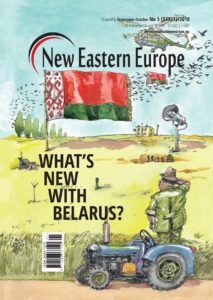
Within Belarus, the population has shown that they can draw from the talent and creativity of its Nobel Prize winner in literature, Svetlana Alexievich, as well as the burgeoning IT industry. At the same time, it is clear that the people are living in economic hardship and fear, which has been more felt amid the mismanaged pandemic. People still remember the infamous words of Alyaksandr Lukashenka when he suggested, as absurd as it was, that the best remedy for COVID-19 was to drink vodka, go to the sauna and drive a tractor. The fear also increased after the government started introducing violent measures to stop demonstrations. Beatings and arrests became common and systematically applied against the protestors for months now.
The spirit of protesters
The experience of 1989 and the period of democratisation that followed, teaches us that regime changes in Eastern Europe took place thanks to the work of organisations and individual actors. However, contrary to East Germany or Poland, civil society in Belarus lacked influential church congregations, trade unions or youth organisations to provide it with a path to democracy. It is the ordinary people of Belarus who are persisting in resistance.
Filled with fear and anxiety, these people have been venturing out, week by week, paving their country on the road to democracy. They have been marching, demonstrating, and sharing leaflets on the streets and squares still named after old Soviet heroes and victories. Meanwhile, Lukashenka’s autocratic regime remains in its palaces. Those in power do not communicate with the people.
The 26 years of Lukashenka’s time in office have been a long time. The damage it has made is deep and has long-term consequences. It also explains why neither the churches nor independent trade unions have been able to become bearers of change. Consequently, for too long Belarus operated as if they still lived in the old Soviet world. The language the majority of the population speaks is Russian, which is also the official language of the state. Because of that, the Belarusian language was not allowed to develop as it naturally would. However, this phenomenon is also rooted in the Soviet period. During that time, when the libraries of other former Soviet republics always had a copy of Bolshaya Sovetskaya Entsiklopediya (Great Soviet Encyclopedia) in their national language, Belarus only had Russian editions. With factors like that playing a role, the national identity of the Belarusian people remained underdeveloped, and it holds true even a quarter of a century after the fall of the USSR.
The spirit of protest, which is ongoing since election day in August 2020, has its reflection in the national flags. The protesters have been using the white-red-white flag, which comes from Belarusian independence in 1918 and the first years of its post-Soviet statehood. Also, given the nature of the protests, which are mainly led by women and creative artists, it is not surprising that once there was a shortage of the fabric to make flags for demonstrations, people started improvising and made ones out of clothing they had at home. They made sure that the colours of independent Belarus were widely present in the public space.
In a similar way, once the regime banned the white-red-white flag, seeing it as a symbol of historical Belarusian statehood and now the democratic protest, people started hanging clothes in white-red-white patterns on their balconies, while students were wearing clothes and pins in such colours at schools and universities. These gestures of protest show how the symbols of democratic statehood can arise from popular actions, and how civil society has been strengthening its position in recent months.
A contested election and its aftermath
The independent female trio in last year’s Belarusian presidential election – Sviatlana Tsikhanouskaya, as the candidate running, supported by Maria Kalesnikava and Veranika Tsapkala – gave hope to the Belarusian people. Belarusians, in turn, supported the democratic candidate. Lukashenka, meanwhile, did not see any threat coming from these women, after the initial arrest of the male opposition candidates allowed them to run in the elections. He underestimated their power, which was most evident during a public debate he had with Tsikhanouskaya. He then said she should concentrate on frying cutlets and feeding children.
As expected, the regime did not allow independent election observers to do their job. Instead, the results were established based on official government-issued data. It stated that 80.2 per cent of the vote went to Lukashenka. Based on the same count, Tsikhanouskaya received 9.9 per cent, while other democratic candidates, together, got around 10 per cent. The forged results could not be recognised by citizens or the international community. Thus, the people of Belarus and most of the international community reacted accordingly. Lukashenka celebrated the election victory he claimed, but popular protests began soon afterwards. They rapidly grew to more than 100,00 citizens in Minsk, as well as insubstantial numbers in regional centres such as Grodna, Brest, Pinsk and dozens of other small towns. There were strikes in key businesses and dismissals in state and cultural institutions.
The next steps
The problem for the democratic opposition, from the very beginning, was that it lacked concepts and strategies to shape democratic development. To improve the situation, the Coordinating Council was established. Its members include Svetlana Alexievich, who holds a leadership position. The members of the council, just like the protesters, came under increasing pressure in late summer and autumn. It included arrests and some other violent measures. Thus, for some, the only way out was to flee the country and relocate to Lithuania and Poland. Unfortunately, with this flee Belarus is now losing important actors who could steer its path towards democracy.
International players such as the EU and its member states have reacted with sanctions. In practice, the sanctions mean that the regime’s decision-makers are not recognised in their position. Visits by members of the regime to the European Union and its member states are no longer possible because of the sanctions. This approach, however, is reaching the limits of effectiveness. Because of the special interests in co-operation with Russia, there have been delays on behalf of Germany, France, Italy and Cyprus to impose sanctions against the regime. Therefore, it seems that dialogue with representatives of a renewed and expanded civil society is much more important than sanctions.
For the Protestant Church in Germany, this brings back the memory of the peace prayers that were held in 1989. However, these experiences cannot be simply transferred to Belarus today. Nevertheless, the spirit of dialogue and co-operation in and with Belarus should continue, anchoring democracy and peace in the long term.
In a recorded message, played following the service in Berlin’s Cathedral, former president of Poland and Nobel Peace laureate, Lech Wałęsa, said the following words about his experience on the path to democracy and Europe: “I have great admiration for the women of Belarus. I am watching your struggle very closely. We had the will to fight. We were numerous. You need people who can negotiate. I will ask that the Nobel Peace Prize be awarded to the women of Belarus.” The church was filled with applause.
Beyond the cathedral walls
As I am writing this, the weather is getting colder, but the protests have not stopped, despite increasing pressure from the regime. However, it is getting more and more difficult for people to gather around with white-red-white flags and keep the movement going. Nevertheless, Belarusians are showing that they do not want to abandon their road to freedom and self-determination.
In this plight, they need Western support. With this goal in mind, the service that was organised in Berlin Cathedral on December 13th 2020 was followed by a political debate. It focused on a new European Eastern policy, a new Ostpolitik. Through the organisation of these two events, the churches wanted to once again engage in building bridges as the way to bring about peace and democracy.
An active role of bridge building has been taken by civil society of Lithuania. The most illustrative gesture of solidarity it showed was the human chain it organised on August 23rd 2020. In this way, the people and the government of Lithuania continued the tradition of the Baltic Way. Namely, the human chain that 1.2 million Lithuanians, Estonians and Lithuanians, still under Soviet rule, formed in 1989 to mark the 50th anniversary of the Hitler-Stalin Pact.
The event at the Berlin Cathedral brought together actors from churches and organisations in their role as architects of bridge building. In 1989, supported by the weekly Monday prayers, Christians in East Germany sparked a large movement that succeeded in overcoming walls and borders. With prayer and peace, European unity was extended. In the same year, the citizens of the three Baltic republics were awakened by church bells to follow a path toward a common Europe. The service in Berlin mixed external and internal support, ideals and practice, veterans, and newcomers. More than almost any other actor, the women of Belarus are currently showing us lessons in social protest. Although they lack social role models and strategic goals, for months they have been following a path that will lead to a peaceful and democratic future.
In this century, Ostpolitik has been characterised by different social paths to peace and co-operation. The elephant in the room, namely Russia, could also be an important partner in this process. However, its political elite favours dominance and, in its interest, restricts social dialogue and tries to assert control over democratic developments in neighbouring states. One goal of a European Ostpolitik should therefore be to get Russia to start respecting international norms. The churches could continue to develop as contributors to the European Ostpolitik. To this end, the event in Berlin was the basis for building bridges based on dialogue between democracy and peace in Europe as a whole. With the ecumenical project “Reconciliation in Eastern Europe”, there is a promising structure that can create a network of partners from civil society and politics.
The worship service and the debate that followed should be seen as pieces of a democratic bridge. One that is based on European values, the rule of law, and resistance to international threats. In this spirit, Petra Bosse-Huber, Bishop and Vice President of the Church Office, underlined that the churches should continue their support to the people of Belarus. A positive change that can come from this engagement can be dialogue and co-operation, which will hopefully go beyond the cathedral’s walls. On the building site of conflict and concern, the churches collectively are an important buttress.
It is crucial to fill the questions of remembrance and reconciliation with answers. These can be only European and ecumenical. The event in the Berlin Cathedral, once again, presented the spirit of dialogue for the new Ostpolitik.
Iris Kempe is a non-resident fellow of the American Institute for Contemporary German Studies. Previously she was a senior advisor at the Council of the Baltic Sea States and regional director at the Heinrich-Böll-Foundation South Caucasus.