
Text resize: A A
Change contrast

Our common heritage

The region of today’s Central and Eastern Europe was mostly part of the eastern half of the Roman Empire. Its religion, writings, customs and traditions came from Byzantium rather than Rome. One exception is Poland, which was baptised in the western style and not by Cyril and Methodius. This fact, however, could be interpreted as the main cause of Poland’s great tragedy.

The world we came to live in today should not have come to us as a big surprise. Neither should the internal problems of the European Union, which, the late Polish science fiction writer, Stanisław Lem, even predicted some time ago. Earlier events such as the Arab Spring, or the weakening position of the United States, and Russia’s imperial aspirations should not have shocked us either.

November 17, 2020 - Jacek Hajduk - Issue 6 2020MagazineStories and ideas

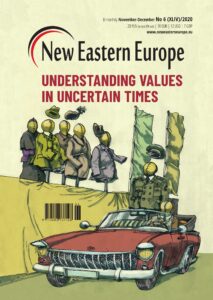
Illustration by Andrzej Zaręba

And neither should have the emergence of centres of wealth influence in Asia: China, which is soon to be followed by India and Vietnam, and perhaps Japan and South Korea. Indeed, these and other countries may not be the subjects of our dinner conversations, but the truth is they are getting richer, more powerful and populous.

 Naturally, all these changes were predicted and foretold in the previous century. They were expressed in the language of social sciences, fictional prose and film. Just as predicted and foretold were such things as the development of technology, digitalisation and global pandemics.

The borders of antiquity

The world has expanded. That is why, when we reduce our thinking to local matters, without paying attention to what is happening in other regions and different cultures, we learn little, if anything, about the current situation in world affairs. Like the fact that Europe, which now resembles scattered and hardly matching jigsaw puzzle pieces, has lost its prior importance.

This, however, does not mean that the dear old continent has lost all its value and has no future in sight. Yet taking on a new role requires some re-evaluation. Thus, if Europe still wants to have a role to play in the next chapter of the opus called “world history”, it can do so only as a consolidated and unified community. One that is well aware of its heritage, which cannot be limited to one nation or group, but common to all. This heritage clearly does not only derive from Christianity but is also of ancient Greek and Roman provenance. Being aware of this can help Europe simultaneously face the old and new world powers as well as cope with the challenges of the 21st century. If it misses that opportunity, there might not be another one.

The ancient world of the Greeks and the Romans is our shared heritage. This fact is well known in China, for example, where extensive translation projects from ancient languages into Mandarin Chinese are now taking place. These works are a combined effort of brilliant minds and teams of distinguished scholars, who happen to be classical philologists. As a result of their co-operation, all available Greek and Roman written records, one author after another, one era after another, are being translated into Chinese successively. These include the works of Homer, the tragic poets and historians, Ovid, Virgil and others. Indicatively, the Chinese are well aware of the significance of the old traditions and hence presume, rightly so, that if one wishes to learn more about us (i.e. westerners), they must first learn about the things that made us and shaped us.

Here, let us ask ourselves if we even know to whom this Greek and Roman heritage really belongs? And what is the actual meaning behind these two terms – Greece and Rome?

The truth is that culture, which we tend to call “ours”, came to us from the East. Even more, it did not take place through one single act, but through a process and numerous events. One of them was the so-called Dorian invasion, which is depicted in Greek mythology as “the return of the Heracleidae” (this is how the descendants of Heracles were named). This invasion apparently took place less than a century after the Trojan war, which was one of the stages of our never-ending internal conflict. The fact that it was, and still remains, an internal conflict for us is evidenced by Homer and his Greek and Trojan genealogy which shows that both in Europe and the Middle East, we are descendants from the same ancestors. Consequently, centuries before Troy, and centuries after it, the culture which we have named western, was in fact shaped by fires and clashes which took place on the territory of today’s Turkey, Iran and Syria.

Evidently, early Greek philosophy is the philosophy of the East. This is true not only because of the organic connections (still probably not researched enough) that the Greeks had with the Persian, Hindu or Buddhist thinkers, but also because of the more literal, geographic ties. Illustratively, such Greek thinkers as Tales, Pythagoras, Heraclitus, Anaximander, Anaximenes and Democritus were all born, lived and worked, east of Athens. The latter became the centre of philosophy only thanks to Socrates, Plato and Aristotle.

Historical Ionia, which is the birthplace of Greek and consequently European philosophy, is also located on the west coast of Turkey. Troy, known as Ilion, which was the most famous battlefield in the history of our armed conflicts and the place where Achilles fought with Hector, is located in Turkey, too. Things were no different at the later stage of antiquity which also saw both Greek and Roman ideas travel to the Far East. They reached this region first with the warriors of the Persian wars, then with Alexander the Great and Roman conquers. All these facts are recorded both in the scarce literary records and archaeological studies that are now being carried out in China.

Thanks to them, it is now certain that the concepts of Greek and Roman civilisations reached beyond the borders of India, getting into China. Some artefacts that were found near Xi’an, the country’s historical capital, clearly certify the presence of Christian communes of the Nestorian “rite”. We can only hope that the numerous Chinese chronicles, even though still mostly in traditional Chinese, and hence accessible to few, will one day provide also us, Europeans, with answers to questions regarding these early encounters and the intermingling of cultures.

A Greek Europe

The Greek and Roman world has always been composed of two distinct forms. This was even the case at the time of the mighty Roman Empire, whose mantra of Rome being the eternal city clearly aimed at the unification of thewhole“West”. Simply attributing the heritage of ancient Greece to today’s country of the same name (which was, to a great degree, also shaped by centuries of Turkish presence) not only imposes an unbearable burden on its shoulders, but also does not speak the truth. The latter is that the ancient Hellas (at a later stage powered by Roman influences) radiated like the sun in all directions, and that radiation was indeed powerful. It affected not only present-day Greece and the Balkans, but also the Middle East, North Africa, Western Europe (and indirectly North America) as well as Russia and Central and Eastern Europe.

When the Roman Empire grew to a point that it could no longer be managed by one person stationed in Rome, an administrative and formal division of its territory was introduced. As a result, the state, once thought to be everlasting, broke into two halves: eastern and western. After their centres, Rome and Constantinople (called the Second Rome), ceased to have common interests or even common enemies, a drift began and both the West and the East first started looking and then moving in different directions. A dispute between them over the right to ancient heritage, that is, who has a greater mandate to call itself the heir to the Greeks and Romans, lasted for a long time – until the Middle Ages. This explains why the Carolingian state was still officially called the Holy Roman Empire of the German Nation while the Byzantine Empire was named the Eastern Roman Empire.

Evidently, the region of today’s Central and Eastern Europe was part of the eastern half of the Roman Empire. Its religion, writings, customs and traditions came from Byzantium rather than Rome. And it took the form of the Greek, rather than Roman, rite. One exception is Poland which was baptised in the western style and not by Cyril and Methodius. This fact, however, could be interpreted as the main cause of Poland’s great tragedy. Being ethnically eastern and culturally western, Poland remains at a crossroads. It feels that it belongs to both worlds but does not feel at home in either.

To experience this dilemma, you should go on a trip along the south-eastern border of Poland. There, when you get off the beaten track and venture to small villages to follow the wooden architecture trails, you will understand how deeply the Hellas and the Byzantine Christianity echo sounds. It carries through the old woodlands, regardless of the state administrative borders. This experience may also help you realise that the current process of the coming together of the post-Roman West and the post-Greek East, and the next stage of Europe’s unification in the face of rapid globalisation, Poland could (and should) take the lead.

The wind from Colchis

There are many stories in Greek mythology which point to the eastern origins of what we call – albeit little roughly – western culture. A good example of the above is the Argonauts’ quest for the Golden Fleece in Colchis, which is present-day Georgia. The story of this expedition is, culturally speaking, very important. It is almost certain that a now lost poem, depicting the adventures of Jason and his companions, inspired Homer in his writing of The Iliad and The Odyssey.

This remote land also inspired the imagination of the late Polish poet and writer, Czesław Miłosz. As a historian of Polish literature, Miłosz argued that it was “the wind from Colchis” that influenced the works of two prominent Polish essayists – Stanisław Vincenz and Jerzy Stempowski – who were known for combining Greek and Roman traditions with Slavic influences.  

The former came from the border area between Ukraine and Poland, the so-called Hutsul region. This mythical land was said to have been home to old Greek culture, traditions, music and myths which had reached there through oral testimonies. Thus, the school and university education Vincenz received as a young man, while Latin in spirit, were already the second layer of the so-called lining of this area’s ancient heritage.

Vincenz wanted to do for his region what Homer did for Greece. He wanted to present it in an epic story and turn it into myth. When working on his collection titled In the high mountain pasture he dressed up as a wondering folk bard, an ancient aoidos, who sang songs, not as much about heroes and their heroic deeds but rather about the memory of a certain community.

Matter-of-factly, “the wind from Colchis” were childhood night stories not only for Vincenz and Stempowski, but also many other prominent translators who, in the 20th century, translated Homer into Polish. Among them were Jan Parandowski, who translated The Odyssey, and Ignacy Wieniewski who translated The Iliad. These two gentlemen were classmates in a gymnasium they attended in Kolomyia, a city located on the Prut river, in today’s western Ukraine. A third translator was Józef Wittlin who spent his whole life translating The Odyssey, which was published in his translations three times. There were also many other researchers of antiquity and writers who were born beyond today’s eastern borders of Poland, in cities such as Lviv or Vilnius. And many who had their first encounters with Greek and Roman culture in Kolomyia! Would any of them ever daresay that they belonged to either Eastern or Western Europe? Isn’t Europe just one?

The tombs of Ovid

The Polish romantic poet Cyprian Kamil Norwid named Ovid, the Roman poet known for such works as Transformations and Sorrows, “the first Sarmatian poet”, which assumed his relation with the legendary invaders of Slavic lands in antiquity.  

Indeed, Ovid’s adventure with today’s Eastern Europe started with a song and a mistake. It happened overnight that Publius Ovidius Naso, who was at the time the most prominent Roman poet, fell out of favour with Caesar Augustus. Yet, while his life was spared, he was banished from the Eternal City. His culpability was a poem that Augustus, “the restorer of the fatherland”, did not like, and perhaps some sort of carelessness on Ovid’s behalf – maybe he saw something he wasn’t supposed to see, or his possible engagement in flirtations with the wrong person. This is unknown and may remain so forever. In any case, Ovid, a celebrity writer, became a persona non gratain Rome. There was nothing left for him there. He packed his few belongings and set off east to the remote corners of the empire.

Ovid arrived in Tomis, which is present-day Constanța in Romania. There he wrote his sad elegies in which he both cursed his enemies and begged for forgiveness to return home. Yet, the Caesar remained indifferent to those pleas and Ovid died far from his beloved Rome. Little is known about the poet’s last years as even the researchers who study his last days in Rome do not know the length of his life and his whereabouts in exile. Did Ovid, as the Romanian legend has it, pass away in Tomis at the Black Sea? Or maybe in some other Central or Eastern European country, like Hungary, Ukraine or Poland?

Jerzy Stempowski spent many years of his life working on a book about Ovid and the Sarmatian legend that was built for centuries around his life in exile, which apparently ended in an even more remote location than Tomis. Although the book was never completed, Stempowski’s scattered papers show the remnants of this fascinating project. It is quite clear that he succeeded in shelling out some Ovidian traces which had been hidden in history.

Stempowski was not the only 20th century writer to enthusiastically undertake this non-academic topic. In 1920 Professor Gustaw Przychocki, a serious Polish scholar and classical philologist, published an important piece of work entitled The Tomb of Ovid in Poland. In a similar way, Professor Jan Zieliński is currently working on a publication about Ovid’s alleged tomb in the area of Pinsk, which is today’s Belarus. Thus, seemingly, another country can be added to the list of the last homelands of this Roman poet.

Regardless of the real facts, the old Sarmatian legend of Ovid’s last journey can stimulate everyone’s imagination. Just think about a great Roman poet who abandons his exile in Tomis, a place which was clearly under ancient Greek and Roman influence, to ask a Slavic king for asylum. He then leaves for the unknown and becomes a poetry tutor.

The third Rome

In 1510 Philotheus of Pskov, a Russian monk, wrote the following words to Vasili III of Russia, the Grand Prince of Moscow: “Listen and remember, your Orthodox majesty, two Romes have fallen, the third one is standing and there will be no fourth one since your Christian kingdom shall not be replaced with any other.” This letter gave rise to the ideology of the first Muskovy and then the Russian empire. Today it is probably well known to the ideologists of new Russian imperialism. The Italian Rome fell in 476 AD whereas the Second Rome, Constantinople, fell a thousand years later, in 1453. The third Rome is obviously Moscow.

Russia has inherited, or perhaps wishes to be perceived this way, both the Greek essence (directly) and the Roman imperial structure (indirectly). Theoretically speaking, its mandate to ancient heritage is stronger than that of any other state. This of course is just a theory because neither the Roman element nor (or perhaps especially) the Greek one, with its strong freedom-oriented component, takes a prominent place in Kremlin’s domestic or foreign policy.

At the same time, however, we may wonder whether the almost legendary chase for freedom of the residents of other post-Soviet states, isn’t Greek in nature. Unfortunately, because of Russia’s position with its earlier described legitimacy and roots, it puts them in the role of provinces, whether near or far, peaceful or rebellious, but always under Moscow’s sphere of influence. This division of roles is still reflected in literature – especially what was written in the 19th century – which identifies the tsar with the Roman emperor, while Poles fighting for their right to self-determination with the first Christians.

Yet today we need to find a new way to decipher the old code and to leave behind the vicious circle of thinking through allegories. Neither Russia is the heir to the Roman empire nor are the smaller states of the former Soviet bloc its conquered and forever transformed territories. Only the ancient Greek and Roman heritage, although subject to numerous transformations, is omnipresent. It can be found in the forgotten world of post-Lemko settlements in south-east Poland and huge metropolises in many parts of the world, regardless of political borders. It is alive in languages and literature, in customs and traditions, in architecture and urban structure, in music and the sound of the wind “from Colchis”. It is present in all other elements that make up our common traditions, which we are all entitled to cherish – no matter whether we live in the East or in the West. Antiquity is our common heritage.

Translated by Justyna Chada

Jacek Hajduk is a Polish writer and associate professor at the Institute of Classical Philology at the Jagiellonian University in Kraków.

, , , , , ,

Partners

Terms of Use | Cookie policy | Copyryight 2025 Kolegium Europy Wschodniej im. Jana Nowaka-Jeziorańskiego 31-153 Kraków
Agencja digital: hauerpower studio krakow.
We use cookies to personalise content and ads, to provide social media features and to analyse our traffic. We also share information about your use of our site with our social media, advertising and analytics partners. View more
Cookies settings
Accept
Decline
Privacy & Cookie policy
Privacy & Cookies policy
Cookie name Active
Poniższa Polityka Prywatności – klauzule informacyjne dotyczące przetwarzania danych osobowych w związku z korzystaniem z serwisu internetowego https://neweasterneurope.eu/ lub usług dostępnych za jego pośrednictwem Polityka Prywatności zawiera informacje wymagane przez przepisy Rozporządzenia Parlamentu Europejskiego i Rady 2016/679 w sprawie ochrony osób fizycznych w związku z przetwarzaniem danych osobowych i w sprawie swobodnego przepływu takich danych oraz uchylenia dyrektywy 95/46/WE (RODO). Całość do przeczytania pod tym linkiem
Save settings
Cookies settings