Text resize: A A
Change contrast

Energy independence should be priority

Since independence, Belarus has not been able to overcome its total dependence on Russian energy supplies. With the construction of a Belarusian nuclear power plant, this dependence will only become stronger.

As is well-known, Belarus purchases crude oil from Russia and so far has earned good money from it. It imports Russian oil without any tariffs, and only after exporting the processed oil does it generate export duties, which are then transferred to its own budget. Prior to 2015 Belarus had transferred it to the Russian budget, but since the announcement of the implementation by the Russian Federation of the “tax manoeuvre” in the oil industry, Minsk requested compensation for its costs, mainly due to the ratification of the treaty on the establishment of the Eurasian Economic Union (EEU). As a result, Moscow agreed to allow export duties on oil products from Belarus to be transferred directly to the Belarusian budget through 2024.

September 1, 2018 - Tatiana Manenok - Articles and CommentaryIssue 5 2018Magazine
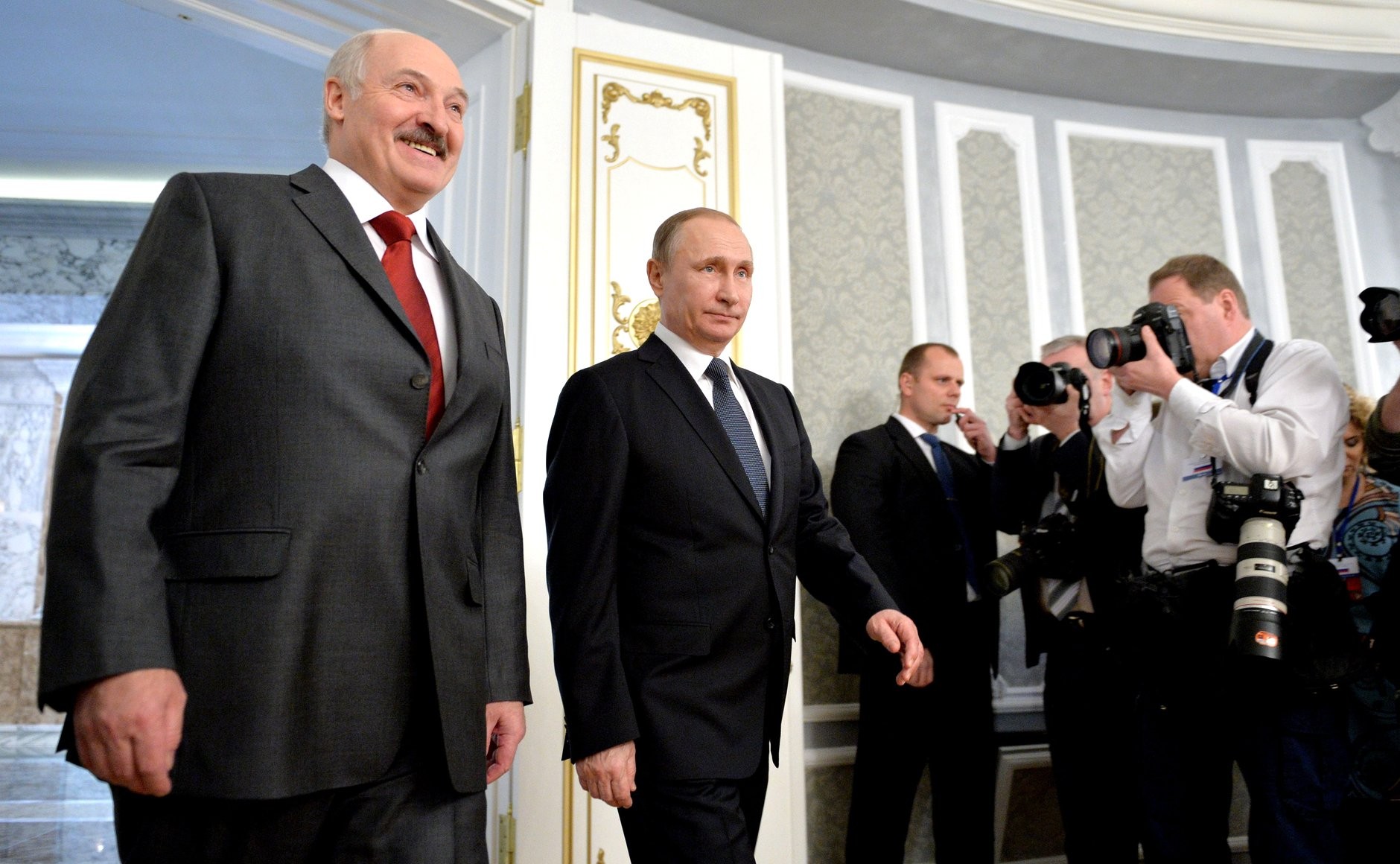
Photo: (CC) en.kremlin.ru

Through this means, Russia directly subsidises Belarus. According to the World Bank, the size of Russia’s oil subsidy in Belarus in 2016 was five per cent of its GDP. In 2015, this subsidy reached 7.6 per cent. The oil “rent” of Belarus has shrunk due to a fall in oil prices. But in 2017 the share of Russian energy subsidies again increased to 4.5 per cent of GDP.

Peretamozhka

Two Belarusian refineries can process nearly 24 million tonnes of oil. However, in accordance with bilateral agreements, in 2017 and 2018, the state-run refineries Naftan and Mozyr Oil will process only 18 million tonnes. Russia agreed to deliver to Belarus the remaining six million tonnes in the form of customs re-clearance (peretamozhka) – in other words, the Belarusian budget will receive the export duties on oil for this volume. This is the result of the abovementioned agreements between Belarus and Russia

Peretamozhka is a good deal for Belarus. Since the export duties on oil are higher than the export duties on petroleum products, this will lead to additional dividends to the Belarusian budget. It is estimated that in 2017 the volume of “re-clearance” of oil in the financial plan for Belarus amounted to 585.2 million US dollars (at an average price of Urals oil at 53.03 dollars per barrel).In addition, Belarus receives the entire amount of export duties on oil products to its own budget: in 2015 this amount was about 1.27 billion dollars, in 2016 it was 550 million dollars, and in 2017 it was more than 600 million dollars.

The 2017 Belarusian budget includes the receipt of 486.5 million dollars of duties on oil products. These figures were calculated by the government based on the price of oil at 43 dollars per barrel. Experts predict an average annual price of oil in 2018 at a rate of 65-70 dollars per barrel. In this case, the amount of “re-clearance” of Russian oil and of export duties on oil products in 2018 may supplement the budget of Belarus with 1.5 billion dollars. In addition, it should be noted that Belarus exports all its own oil (about 1.64 million tonnes per year) to Germany, and directs the duties to its own budget (this is also the subject of agreement with Russia).Thanks to the oil duties, Belarus will pay half of its foreign debt this year (Belarusian state debt in 2018 is estimated to be 3.7 billion dollars), although previously it was intended to repay only about 25 per cent of the external public debt from this source.

This tax manoeuvre, however, is a serious challenge for Belarusian oil refining and the budget. After all, the difference in export duties on oil and oil products has been, and still remains, the driver of growth of oil refining in Belarus and a source of replenishment of the state budget. In late April this year the Russian president, Vladimir Putin, approved the completion of the tax manoeuvre of the oil industry by 2024. This means that in Russia the export duty on oil and oil products will be zero, but at the same time the mineral extraction tax (MET) will be increased, which will lead to an increase in oil prices at the global level. In Russia, they intend to reduce the export duty by five percentage points annually within six years, in order to bring it to zero-level by 2024, commensurately increasing the mineral extraction tax. In this case, the price of oil for Belarus will be as close to the market one as possible (Belarus currently buys oil from Russia at a rate that is about 80 per cent of the global cost). As a result, Belarus will lose Russian oil subsidies, which, according to the estimates of the Belarusian ministry of finance, could lead to a tax shortfall of up to 3.8 per cent of GDP.

Escaping dependence

In order not to go bankrupt with the new conditions, Belarusian refineries have to speed up their modernisation and increase the depth of oil refining before 2024. The government is currently targeting the oil refineries to complete the modernisation by 2019, so that the factories would reach design capacity of processing 24 million tonnes as early as 2020. The cost of the Mozyr refinery modernisation project is estimated to be 1.75 billion dollars and 1.64 billion dollars for the Naftan facility. The degree of their preparedness is estimated to be 85 per cent, and to complete the modernisation each refinery needs to invest another 400 million dollars. The completion of the planned programme will bring Belarusian refineries closer to the technological level of European factories. This means they will be able to process more expensive oil and potentially remain competitive in the global market.

The Belarusian authorities have repeatedly tried to escape from the Russian monopoly on its oil supplies. Such attempts were made every time a conflict broke out between the two countries. In 2006 against the background of worsening relations, the Belarusian president, Alyaksandr Lukashenka, proposed to the president of Azerbaijan, Ilham Aliyev, the possibility of supplying oil to Belarus. The experts noted that an oil supply from Azerbaijan is technically possible in the case of the construction of several “bridges” between the Belarusian sections of the Druzhba Pipeline and the Odesa-Brody Ukrainian pipeline. Interest in this project was also shown by Lithuania, since it connects the oil fields of the Caspian and Black Seas with consumers in the Baltic Sea region.

In 2007 difficulties in the negotiations with Russia regarding the supplies forced the Belarusian leadership to revive the search for alternative sources of oil. Belarus discussed such possibilities with Venezuela, Iran and, again, Azerbaijan. At that time, the possibility of supplying oil from Iran to Belarus through the port at Yuzhny (Ukraine) was examined. The possibility of supplying Venezuelan oil via the Latvian port at Ventspils to Naftan was also considered. However no real steps were taken by the Belarusian side to implement these projects.

In 2010, when the next oil conflict with Russia flared up, the Belarusian authorities, thanks to special relations with Hugo Chavez, were able to quickly organise alternative oil supplies – first Venezuelan, and then, in order to optimise logistics, Azerbaijani (within the swap). And although Belarus announced its plans to receive four million tonnes of alternative oil a year, a little over one million tonnes were supplied to Belarusian refineries. And when the conflict with Russia was extinguished, the alternative oil supply became unnecessary.

In 2016, at the peak of the gas dispute with Russia, Lukashenka again set the task of finding alternative supplies. Nevertheless only two tankers of Iranian oil arrived to Belarus (86,000 tonnes each). Reconciliation with Russia cooled the desire for Belarus to seek an alternative supply. The real need for an alternative supply of oil may appear after Russia completes the abovementioned tax manoeuvre in the oil industry and Belarusian refineries will complete the modernisation and will potentially be able to profitably process oil.

The Russian Railways (RZD) intensified the “struggle” for the export of Belarusian oil products in December 2016, giving those heading to Russian ports a discount of 25 per cent on tariffs. This did not work, however. In March 2017, the discount was increased to 50 per cent, but for Belarusians it did not become an incentive either. In August 2017, the head of Russian Railways, Oleg Belozerov, complained to Putin that the Belarusians use the transit through the ports of the Baltic states, despite deep Russian discounts. Putin reacted unexpectedly harshly: he proposed to make a “package” of the supply of Russian oil to Belarus with the use of the Russian transport and port infrastructure. After that Russian officials negotiated the terms of oil supply with Belarus for 2018 quite tensely, but the Belarusians managed to defend their interests. It was recorded in the minutes of the meeting that “under the condition of positive economic factors, the Belarusian side can provide Ust-Luga (a Russian port) with the delivery of up to one million tonnes of oil products”. But in 2018 this volume is unlikely to be delivered. So far it has been reported that just one consignment of Belarusian oil products has been delivered in the amount of about 50,000 tonnes.

For the moment Moscow is not strongly pressuring its ally in an effort to make it abandon, against economic logic, the usage of the Baltic states’ ports. Yet the way the Kremlin will behave in the future is not known. Until recently, the Belarusian oil industry has called the purchase or lease of an oil terminal in a Riga port strategic. On the one hand, such a decision for Minsk could become an “insurance” against administrative dictates by Russia. On the other hand, it is obvious that the deal would become a very strong irritant for Moscow.

Nuclear power moves

In 2005 the Belarusian authorities announced their decision to build a nuclear power plant without any public consultations. They explained the need for such a large-scale construction due to the catastrophic energy dependence on Russia. The arguments were as follows: Belarus annually buys about 20-22 billion cubic meters of natural gas in Russia and about 95 per cent of Belarusian electricity is generated by gas. Therefore, an increase in the price of natural gas poses a direct threat to the energy security of Belarus. Belarusian scientists noted that the production of electricity via nuclear fuel is two-times cheaper than gas, while a nuclear power plant could replace 4-4.5 billion cubic metres of gas per year.

At that time, Lukashenka declared that a nuclear power plant in Belarus would be built by “the one who wins an international competition”. Possible candidates included the Russian Atomstroyexport, the French-German Areva, and a US-Japanese bid by Westinghouse-Toshiba. Nevertheless it was clear that Belarus would not award this project to anyone other than Russia, especially since no country, except Russia, would be able to offer Minsk a loan for 100 per cent of the construction costs– $10 billion. Belarus would start repaying the loan six months after commissioning the NPP, but no later than April 1st 2021. The repayment will be carried out by 30 equal shares every six months, that is, for 15 years. Thus, the maximum period of use and repayment of the loan in total could be 25 years.

Against the backdrop of the rapid growth of Belarus’s foreign debt, the issue of repaying a Russian loan for a large-scale new construction is very acute. In relation to this, many experts questioned whether Belarus will be able to keep the plant in its ownership. In preparing the feasibility study for the construction of a nuclear power plant, lobbyists for the project proceeded from the assumption that electricity consumption in the country will reach 47 billion kilowatt hours by 2020, which was a significant miscalculation. In recent years, electricity consumption in Belarus has not increased and remains at 36-37 billion kWh.

Nevertheless, two Belarusian nuclear reactors should be completed by the end of 2020. They will initially produce a total of 18 billion kWh. This is about half of the current amount of electricity consumed by the country. The government hopes that by the time power plant is active, the electricity consumption will increase – up to at least 39.9 billion kWh per year (although there is no certainty of this).The construction of a nuclear power plant was also conceived with the notion of exporting electricity. However, there is only one transmission line from which Belarus could transport electricity to Europe and it operates in the direction of Lithuania. Lithuania, meanwhile, categorically refuses to buy electricity from Belarus due to the construction of the nuclear power plant which it considers vastly unsafe. There is no similar power transmission line with Poland – it would have to be built if the Poles agreed to import Belarusian electricity. But Poland has declared it does not see any need to import electricity from Belarus.

Trading for cheap gas

Belarus does have a chance to supply electricity to the Eurasian Economic Union. But this would only be the case if it was possible to reduce the price of Russian gas. For Belarus, the gas supply situation is agreed upon through 2019. According to agreements with Russia, in 2018 Belarus pays for Russian gas regardless of the oil and gas market conditions. By July 1st 2019 Belarus and Russia should prepare a draft agreement to include a formula for determining the price of gas for Belarus for the 2020-2024 period. The Belarusian leadership hopes to bring the price of imported gas to the same price that consumers in the Russian Smolensk region pay. Today, this price difference is nearly double.

The difference in the price of gas in Russia and Belarus is a serious obstacle to the creation of a unified electricity market in the EEU, which is scheduled to go into effect on July 1st 2019. Belarus will not torpedo the creation of a common electricity market, but it may also seek to delay it if it does not get the right price for gas from Russia. Time will tell whether the Belarusian authorities will be able to, once again, achieve a tactical victory on this important issue. At the same time, it is important to note that six years ago the gas transportation system of the country was sold exclusively to the Russian Gazprom, and no alternative options for the supply of natural gas to the country are now available to Minsk.

Translated by Yulia Oreshina

Tatiana Manenok is a journalist and commentator who specialises in energy, the petrochemical industry and privatisation. She is an expert with the online Belrynok portal and often contributes to the Belarusian service of Radio Free Europe/Radio Liberty.

, , ,

Partners

Terms of Use | Cookie policy | Copyryight 2026 Kolegium Europy Wschodniej im. Jana Nowaka-Jeziorańskiego 31-153 Kraków
Agencja digital: hauerpower studio krakow.
We use cookies to personalise content and ads, to provide social media features and to analyse our traffic. We also share information about your use of our site with our social media, advertising and analytics partners. View more
Cookies settings
Accept
Decline
Privacy & Cookie policy
Privacy & Cookies policy
Cookie name Active
Poniższa Polityka Prywatności – klauzule informacyjne dotyczące przetwarzania danych osobowych w związku z korzystaniem z serwisu internetowego https://neweasterneurope.eu/ lub usług dostępnych za jego pośrednictwem Polityka Prywatności zawiera informacje wymagane przez przepisy Rozporządzenia Parlamentu Europejskiego i Rady 2016/679 w sprawie ochrony osób fizycznych w związku z przetwarzaniem danych osobowych i w sprawie swobodnego przepływu takich danych oraz uchylenia dyrektywy 95/46/WE (RODO). Całość do przeczytania pod tym linkiem
Save settings
Cookies settings