
Lost Legacy? Georgia and the Rose Revolution twenty years later
An interview with retired Ambassador Richard Miles, former US ambassador to Georgia. Interviewer: Vazha Tavberidze
VAZHA TAVBERIDZE: Let’s begin with the Rose Revolution as you remember it. From your perspective, what exactly transpired 20 years ago?
RICHARD MILES: Well, it was a very interesting display of – I guess you have to say democracy – because what happened was what the majority of the population wanted. I wouldn't say that it was entirely legal, but I do not think it was exactly illegal either. In fact, the country adapted to the revolutionary changes and the opposition leaders fairly easily. I should point out almost from the start that not all of the opposition leaders were supporting the demonstrations and therefore the Rose Revolution.
VAZHA TAVBERIDZE: Let’s begin with the Rose Revolution as you remember it. From your perspective, what exactly transpired 20 years ago?
RICHARD MILES: Well, it was a very interesting display of – I guess you have to say democracy – because what happened was what the majority of the population wanted. I wouldn't say that it was entirely legal, but I do not think it was exactly illegal either. In fact, the country adapted to the revolutionary changes and the opposition leaders fairly easily. I should point out almost from the start that not all of the opposition leaders were supporting the demonstrations and therefore the Rose Revolution.
February 7, 2024 -
Richard Miles
Vazha Tavberidze
-  InterviewsIssue 1-2 2024Magazine
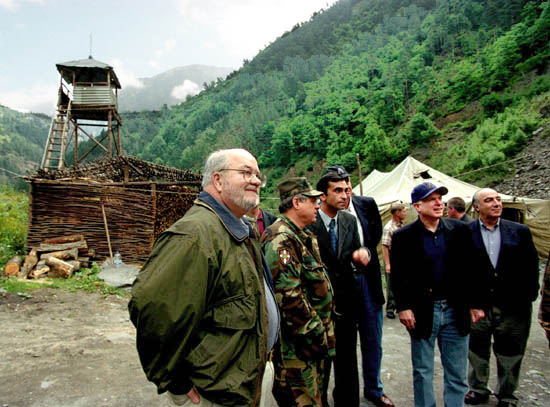
Richard Miles (left) visiting a Georgian border post in the north Caucasus mountains on the border with Russia while US ambassador there. With him is a delegation of Georgian and American officials, including the late Senator John McCain Photo: (CC) US State Department Archive