
Text resize: A A
Change contrast

China’s role as a pro-Russian mediator in ending the Russia-Ukraine war

Debate has grown regarding Beijing’s relations with Russia and its war against Ukraine. While China has offered support to Moscow, it is important to remember that the rising power has other wider interests. Overall, it seems that China will always put its own interests first with regards to the ongoing conflict.

The Russian invasion of Ukraine has sent shockwaves throughout the international community, raising concerns about regional stability, human rights violations and global security. As the world grapples with finding solutions to the invasion, the role of key actors like China has come under scrutiny. Exploring China’s strategic interests, economic ties, role in the balance of power and diplomatic leverage can shed light on the complex dynamics of the invasion. It can also reveal potential paths toward resolving the war and dealing with Russia and its allies.

November 20, 2023 - Arsen Martyshchuk - Hot TopicsIssue 6 2023Magazine

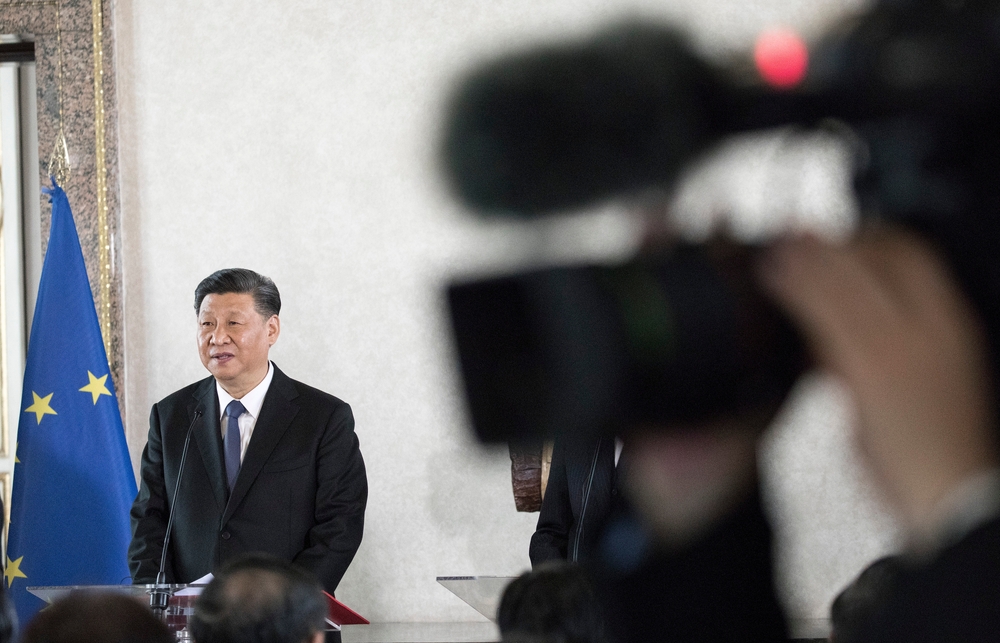
Photo: Alessia Pierdomenico / Shutterstock

China’s strategic interests in the Russian-Ukrainian war are multifaceted and underscored by its desire to expand its global influence and secure its economic interests. China aims to strengthen its position as a major player in international diplomacy and enhance its diplomatic credentials as a global peacemaker by positioning itself as a mediator. However, China’s approach to the war is characterised by cautious pragmatism. While it has not explicitly endorsed Russia’s actions, it has refrained from taking a strong stance against the Russian Federation, opting for a balanced approach that seeks to maintain positive relations with both Russia and western countries critical of Moscow’s actions.

Strategic interests and geopolitics

There are many layers to China’s strategic interests in the Russian-Ukrainian war. At first glance, its “good” intentions look positive in terms of rhetoric and theory, but in practice, we see direct and indirect support for the aggressor. This is especially evident in the information field, where China does everything possible to silence or whitewash the reputation of the Russian military and the Kremlin. According to reports from the New York Times, at the beginning of the Russian invasion of Ukraine, Chinese leader Xi Jinping expressed confidence in the “strong support” for Vladimir Putin among the Russian population. This, in fact, was a sign of Beijing’s continuing support for Moscow, which, according to its interpretation, is fighting not only against Ukraine but also against the entire West.

According to the New York Times report, the turning point was the Wagner Group rebellion, which shook Putin’s authority across the whole world and particularly regarding his “closest ally” China. Xi Jinping and the entire Chinese leadership waited to make any statements while the Wagner head Yevgeny Prigozhin confidently advanced on Moscow, where he was stopped only by deception and pseudo-negotiations with the alleged participation of the Belarusian dictator Alyaksandr Lukashenka. This particular situation once again proves that despite the common interests of Putin and Xi, the Chinese leader is not the kind of ally that the Kremlin will protect at any cost during critical situations. The main guarantee of such a situational alliance is primarily the interests of China itself. This situation also disproves the myths of some western politicians who promote the narrative of a “strong alliance” between Russia and China, which could threaten the security of the countries of the European Union and the United States.

Beijing, unlike Moscow, carefully calculates every step and does not make drastic moves in the international arena until it is convinced of the positive consequences of such a step. Rather, the situational Sino-Russian friendship shows a further deepening of the confrontation between the West and Beijing, which is only likely to grow in the future.

The Russian invasion also set a precedent for a strong power to invade a weaker one. This immediately drew parallels with China and Taiwan. The main factors in the context of China and the West are the sharp reaction to the invasion by Ukraine’s allies which, along with Kyiv’s well-organised armed forces, actually restrained the Russian advance on Ukrainian territory and, most importantly, prevented the capture of the Ukrainian capital. Effective opposition in theory to one of the strongest armies in the world is what deters China from making drastic moves towards Taiwan. This makes sense because in the case of a sanctions regime against China, the already substantial Chinese economic expansion across the world could completely tumble, harming Beijing’s interests.

Economic and energy ties

Despite general support for the Russian Federation in the information space, China is not harsh in its statements and tries not to give priority to either Ukraine or Russia. Such a “wait-and-see” strategy gives China room for manoeuvre when it is needed. For example, China’s economic interests in the region are substantial. It views Ukraine as a potential gateway to Europe and an important part of its Belt and Road Initiative. Ukraine’s agricultural resources, as well as its geographic location, make it an attractive partner for China’s economic expansion.

Moreover, Ukraine’s strategic location as a gateway to Europe is not limited to the initiative alone. It also serves as a potential manufacturing and trade hub for Chinese goods entering European markets. This aligns with China’s broader goal of expanding its economic influence globally. China also sees Ukraine as an emerging market with investment opportunities in various sectors beyond agriculture, such as technology, infrastructure and manufacturing. With all that said, Beijing remains a pro-Russian country in the war against Ukraine, as its geopolitical interests and competition against the US are ultimately more important.

Another important reason why China is so supportive of Russia is that Beijing somehow depends on Russian energy resources, particularly oil and natural gas. Realistically, a prolonged Russian war in Ukraine could disrupt energy supplies, posing a threat to China’s energy security. Due to this, Beijing is doing everything possible to make Russia economically dependent on it, while simultaneously looking for alternative sources of oil and natural gas supplies.

Balance of power and multipolarity

Russia’s aggression in Ukraine has highlighted the evolving global balance of power. China seeks to challenge the dominance of the United States and its western allies in international affairs. By supporting Russia diplomatically, China can promote multipolarity and undermine the unipolar world order. China’s involvement in mediating the conflict allows it to assert itself as a major player on the global stage, promoting its vision of a “more balanced world order”. Western allies very often express an opinion about the People’s Republic of China and Russia as equal partners in a “confrontation with the West”.

Such a delusion arises because of the effectiveness of Russian propaganda in positioning itself as a great geopolitical player. However, we need to consider the example of Chinese leader Xi Jinping’s visit to Moscow six months ago. Before his talks with Putin, the main questions were not about the Kremlin and its position but whether Beijing would continue to provide institutional support to Moscow. Will military aid be provided? Will Xi help Putin fight sanctions?

If so, how much? How much energy will be bought and will it be bought at all? Even from this example, we can state precisely that Russia has ceased to be an independent subject of international relations. For the first time since before the era of the Russian Empire, it is not the Kremlin that decides its fate, but the “elder brother” that does precisely so. For Russia, the People’s Republic of China is the main trading partner that can actually shut down the Russian economy if it has the political will and desire. Technology, industrial equipment and spare parts – all of Russia is mostly provided by China. Beijing itself, in the event of the loss of the Russian Federation as a partner, will hardly suffer in any way, but Moscow will actually lose its economic subjectivity.

Since the beginning of the 21st century, the People’s Republic of China has radically changed its approach to international relations. From a focus on domestic affairs in the 20th century, China became more involved in conflicts around the world. In particular, the rethinking of Beijing’s traditional values of non-interference and respect for state sovereignty intersect with the need to protect its assets under pressure from the West, as well as its economic expansion in the world as a whole. Afghanistan, Mali, Sudan, Myanmar, the Democratic Republic of Congo and South Sudan became countries where China was able to participate in one way or another to help defuse conflict for its own benefit. The primary driver behind China’s involvement in conflict and post-conflict regions is its pursuit of natural resources and improved access to markets, particularly along the route of the Belt and Road Initiative (BRI).

According to data from the Mercator Institute for China Studies, in 2017 alone, the PRC became a mediator in the resolution of seven conflicts, compared to only three such efforts by Beijing in 2012. With Xi Jinping’s rise to power, the country’s peacekeeping efforts have grown exponentially throughout his five years in office. Looking at the statistics up to 2012, we can see that Beijing did not seek to be a mediator and did not make great efforts to win such a title. Returning to analysis of the Belt and Road Initiative (BRI), we can see the tendency of the Chinese Communist Party to ensure the smooth flow of trade and investment through unstable regions, and most importantly, to protect the interests of Chinese citizens. The period from 2016 to 2020 represented an important shift and adoption of a major initiative in the context of mediation.

During the presidency of Donald Trump, the US administration chose a course of isolationism and non-intervention in world conflicts, even with regards to the role of mediator with some exceptions. Such passivity on the part of the United States, which made a sharp change from its role as “world policeman”, gave China the opportunity to seize control in some respects. It also coincided with Beijing’s plans to become a leading power by 2049. Shortly after Trump’s term, the new administration led by Joe Biden once again returned to the principles of the Truman Doctrine and support for democratic states across the whole world and especially regarding allies. It can definitely be argued that such circumstances provided additional time for China to establish itself in the role of one of the main mediators in world conflicts. As a result, competition between Moscow and Beijing regarding their influence in international relations deepened.

Implications for Eastern Europe

So, China’s role as a potential pro-Russian mediator in the ongoing Russian-Ukrainian war is a complex and multifaceted issue. While China has strategically positioned itself as a mediator in international conflicts to expand its global influence and diplomatic credentials, its actual stance and actions regarding the war have been marked by cautious pragmatism.

China’s strategic interests in the region encompass both geopolitical ambitions and economic considerations. Geopolitically, China seeks to challenge the dominance of western powers and promote multipolarity in international affairs. By supporting Russia diplomatically, China can assert itself as a major player on the global stage, projecting an image of a peacemaker and a proponent of a “more balanced world order”. However, China’s approach to the conflict has been characterised by careful calculation, as it strives to maintain positive relations with both Russia and western countries critical of Moscow’s actions.

Economically, China sees Ukraine as an essential component of its Belt and Road Initiative and a potential gateway to Europe. Ukraine’s agricultural resources, geographic location and strategic importance as a trade hub make it an attractive partner for China’s economic expansion. Additionally, China’s dependence on Russian energy resources, particularly oil and natural gas, creates a complex dynamic in its stance towards the conflict, as a prolonged war in Ukraine could disrupt its energy supplies.

China’s diplomatic leverage and experience of mediation have evolved significantly in recent years, with the nation increasingly engaging in war resolution efforts around the world to protect its assets, secure natural resources and improve access to markets. This growing role in mediation aligns with its Belt and Road Initiative and its broader goal of becoming a leading global power.

While China’s support for Russia in the information space may suggest a pro-Russian stance, it is essential to recognise that China’s primary allegiance is to its own interests. The dynamics of the war have demonstrated that China does not hesitate to carefully weigh its options and make pragmatic decisions that serve its goals.

In the context of ending the Russian-Ukrainian war, China’s role as a mediator is a reflection of its evolving global strategy and the pursuit of its own interests. The competition for influence between Moscow and Beijing in international relations is an ongoing process, and the invasion of Ukraine has provided China with an opportunity to solidify its position as a key player in shaping the future of global diplomacy.

Ultimately, China’s involvement in the war highlights the complex interplay of global power politics, economic interests and diplomatic manoeuvring. As the war continues to evolve, China’s role as a mediator and its broader aspirations on the world stage will undoubtedly have a significant impact on the path toward a resolution in Ukraine, as well as the future of international relations as a whole.

Arsen Martyshchuk is an international relations expert and the executive director of the Institute of American Studies.

, , ,

Partners

Terms of Use | Cookie policy | Copyryight 2025 Kolegium Europy Wschodniej im. Jana Nowaka-Jeziorańskiego 31-153 Kraków
Agencja digital: hauerpower studio krakow.
We use cookies to personalise content and ads, to provide social media features and to analyse our traffic. We also share information about your use of our site with our social media, advertising and analytics partners. View more
Cookies settings
Accept
Decline
Privacy & Cookie policy
Privacy & Cookies policy
Cookie name Active
Poniższa Polityka Prywatności – klauzule informacyjne dotyczące przetwarzania danych osobowych w związku z korzystaniem z serwisu internetowego https://neweasterneurope.eu/ lub usług dostępnych za jego pośrednictwem Polityka Prywatności zawiera informacje wymagane przez przepisy Rozporządzenia Parlamentu Europejskiego i Rady 2016/679 w sprawie ochrony osób fizycznych w związku z przetwarzaniem danych osobowych i w sprawie swobodnego przepływu takich danych oraz uchylenia dyrektywy 95/46/WE (RODO). Całość do przeczytania pod tym linkiem
Save settings
Cookies settings