
Text resize: A A
Change contrast

Roma refugees from Ukraine face additional adversity

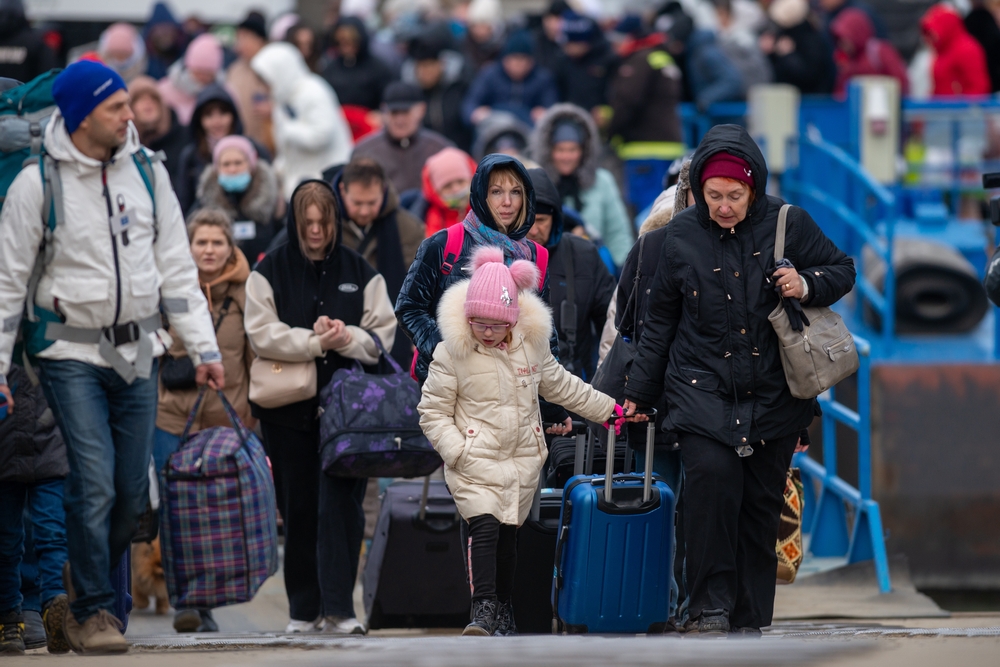
Following Russia’s invasion of Ukraine in February 2022, a large portion of Ukraine’s Roma population escaped as refugees alongside their fellow Ukrainians. However, they were not always met with open arms and many faced additional challenges and discrimination.

In the face of Russia’s war on Ukraine, the subsequent hardships of Ukraine’s Roma population, both as refugees and internally displaced people, has drawn the world’s attention to the double standards refugee host countries hold even in the face of danger and destruction. It is estimated that of the approximate 400,000 Roma living in Ukraine (this rough figure is due to migration and lack of Roma documentation), 25 per cent have fled since the beginning of Russia’s February 2022 invasion. Yet, unlike non-Roma Ukrainians, who have generally felt welcomed when seeking refuge in Ukraine’s neighbouring Eastern European countries, Roma Ukrainians have oftentimes faced prejudice and distrust. This is similar to that which they face in their homeland.

November 19, 2023 - Madeleine Cuckson - Issue 6 2023MagazineStories and ideas

Refugee Ukrainians walk from Ukraine to Isaccea in Romania after crossing the border. Photo: Pazargic Liviu / Shutterstock


From the start of the war, Roma have seemingly had to prove their legitimacy as Ukrainians – demonstrating overt solidarity with their nation. The Ukrainian Roma rights group “Roma and Youth Roma Council”, issued a statement to this effect just days after the start of the full-scale invasion. “Roma have lived on the territory of Ukraine for more than 600 years, and consider it their Motherland!”, the statement declares. They went on to list specific acts of Roma Ukrainian bravery, including when one group “requisitioned a tank of the Russian invaders” and “along with everyone else… stand on the front lines”.

History with oppression

The origins of the Roma people are somewhat uncertain. They are considered an Indo-Aryan ethnic group and it is thought that they migrated to what is now considered to be Eastern Europe from India in the 11th century. In the Romani language “rom” simply means “people” and has, in this century, come to replace “gypsy” in official terminology – a name which was placed upon Roma by non-Roma. Estimates regarding the arrival of Roma in Eastern Europe span a wide timeframe, from the seventh to the 13th centuries. This is due to various groups leaving India and migrating to the region at different points. It is believed that the Roma first began their westward journey from Eastern Europe in the 15th century. Their traditions, language and customs, distinct from those of their host regions, have subjected them to centuries of challenges and oppression.

It is thought that Roma first migrated from the Romanian lands to Ukraine and Russia in the second half of the 19th and beginning of the 20th century. Ukraine’s surrounding countries (Moldova, Romania, Czech Republic, Slovakia and Hungary) all share histories of Roma oppression. In border areas, such as Hungary’s Transcarpathian region, Roma Ukrainians often speak the language of the bordering country in addition to Ukrainian and Russian, as well as holding two passports. This means that some regard Roma Ukrainians as economic migrants rather than refugees. In Hungary, for instance, tens of thousands of Roma possess Hungarian passports, but this status does not necessarily work in their favour as refugees. The Transcarpathian region (which borders Slovakia, Romania and Hungary), with its complex history of changing borders and multiple occupations, now falls within Ukraine’s jurisdiction. In this region, the Roma population, estimated at 30,000 to 40,000, grapples with high poverty levels.

Notably, it was difficult to persuade Roma Ukrainians to speak with me about their experiences – some Roma Ukrainians I spoke with denied they had experienced prejudiced behaviour, despite aid workers telling me directly about their discriminatory cases. Some were concerned about where and for whom the article will be published, while others said they were on the road and had no clear idea when they might be able to establish a secure connection to talk. Around half of those spoken to could not read or write – all interviews were carried out in person and on the phone.

“They are either scared, or don’t know their rights,” said social worker Oleg, who works at the Roma Education Fund in Bucharest. Oleg is from the Republic of Moldova and speaks both Russian and Romanian. From the start of the war, Oleg was stationed in Bucharest’s main train station and noticed marked differences in the treatment of Roma refugees by authorities and volunteers there. “Roma people were sometimes discriminated against even by state social workers or volunteers from various organisations, they were treated with suspicion or more harshly when they tried to access the same services: water, food, clothes or accommodation,” he noted.

It is increasingly difficult to find housing for Roma in Romania, who often arrive with their extended families. Oleg commented that “even a refugee centre organised by a church told me that they do not accommodate Roma.” “Are they Roma?” is now a commonplace question asked by the municipalities working with refugees and aid workers. One church centre has a strict no Roma policy due to apparent previous noise complaints from neighbours.

Personal struggles

Lilia is a 60-year-old Roma Ukrainian woman from Odesa Oblast. She has lived in Bucharest since the outbreak of the war. “All together in my family we are 18 people here, mostly children,” she tells me. “I am trying to find work for my children but it is hard. We can’t seem to find employment.” Due to the size of her family it is difficult to house them all together. Under a now concluded government programme in Romania, in which accommodation for Ukrainians was free, Lilia and her family found an apartment: “it was appealing to the landlord because we are a big family so they got more money.” Now the scheme has ended and Lilia, with her family, is housed in a centre for refugees because they could not afford to rent the apartment.

Oleg often translates at job interviews for Ukrainian Roma refugees in Bucharest and has observed that even for the most willing, there are usually setbacks. “More than once I went with someone to an interview, and as soon as they saw the person’s face, the employer said that they were no longer hiring.” The unemployment rate for Roma stands at two-thirds – meaning, being both Roma and not speaking Romanian makes the chances of finding employment even slimmer.

27-year-old Svitlana has first-hand experience of racial abuse in the workplace. Originally from Ukraine’s Artsyz region, she has three children, speaks some Romanian and moved to Bucharest in August last year due to the war. For a period of time she was employed for some months at a supermarket warehouse. “The manager treated me differently to the others, she shouted at me more, used more vulgar language, swore [at me].” One day, after an inappropriate comment was made by her manager about deceased relatives, Svitlana retaliated, shouting back at her employer. She was fired on the spot. “We are also treated with suspicion in the supermarket. Once my child was accused of trying to steal something, when we were in fact waiting in the line to pay.”

According to statistics, there are around 1.85 million Romanian Roma currently living in Romania, which makes up 8.32 per cent of the whole population. Little is said about Roma slavery, which lasted for hundreds of years during the Ottoman Empire (this took place in what was then Wallachia and Western Moldavia (now Romania) and spanned almost five centuries). Roma slavery was only fully prohibited in 1864 and it undoubtedly seriously stunted integration and perpetuated prejudice.

A common misunderstanding is that Roma are one homogenous group. “Sometimes there is no solidarity and unity between Roma from Ukraine,” Oleg tells me. Indeed, Roma do not always associate with other groups of Roma (based on location, status, etc.) and have nuanced differences when it comes to religion, language and lifestyle. Some have travelling lifestyles, but the majority in Eastern Europe are now sedentary. This disparate grouping of Roma means there is no collective desire for a homeland and never seems to have been. Instead, Roma across the world comprise an amalgamation of heterogeneous groups. In Romania alone there are thought to be over 40 different groups of Roma, some speaking the Romani language, others not. These vast differences have, over time, incited the question of whether the Roma people can be considered one ethnic group.

From what Oleg has observed, for the vast majority of Roma, Romania has served as a transit country to go further west. This is despite “a few successful stories” of integration, due to “the hostility of the authorities here and the intolerant society”. Nationalism and its link to “intolerance” has been a part of Romania since its inception as a nation in the 17th century. However, Romania is currently seeing a new wave of nationalism, confounded by the Alliance for the Union of Romanians (AUR) party, established only a few years ago. Such conservatism does nothing to better attitudes towards Roma. Indeed, one of AUR’s leaders has described Roma as a “social plague”.

Discrimination from day one

Roma political parties have not yet managed to gain widespread recognition on the political stage. The European Roma Rights Centre (ERRC), founded in 1966, was the first large body to combat Roma hatred in Europe. Jonathan Lee is the ERRC’s advocacy and communications director. He says that Roma have faced discrimination since the first days of war – “They were denied exit from the country, given unequal access to aid, profiled and segregated at border crossings, and accommodated in sub-standard and segregated centres in several countries.” 

In Moldova, the ERRC have found segregated Roma accommodation centres and are now working with “local activists and local government to improve conditions inside these centres, but they remain places of ethnic segregation”, according to Lee. There have even been cases of physical violence. “We have taken legal action against those responsible for a pepper spray attack on Romani refugees in one centre in Chișinău.” But bringing anyone to justice remains a challenge as “people are afraid, isolated and frequently unwilling to risk taking legal action against their host countries.”

At the beginning of the war, Romania’s refugee housing centres were disproportionately populated by Roma families, and largely still are. Stefania has been the coordinator of a shelter in Romania’s capital of Bucharest for more than a year. “There were always strong rules against discrimination, we inform all the staff and volunteers about this obligation to have the same attitude towards all.”

Despite training, there were “some volunteers who visibly preferred to help families who are not Roma – those who could not accept our policies on discrimination quit volunteering with us”. Stefania points out that one of the main battles in the centre is prejudice from non-Roma Ukrainians – “When they arrived from Ukraine they asked very publicly and loudly not to share a room with Roma. The Roma Ukrainians seem to be used to this attitude of direct discrimination.”

Most of those staying at the centre Stefania manages are there long term. “Marginalised people or the ones with high risk of marginalisation don’t risk trying other options and they lack contacts, they lack resources. So most of them remain here long term,” she explains. For Stefania, what the centre can do is to arm Roma with knowledge on their rights abroad. “We asked a feminist NGO which fights for Roma rights to inform them about the law against discrimination, instruments to defend themselves at all levels and their rights in Romania as an EU country.”

Integratory and informative programmes are in place across Romania for Roma Ukrainians. Oleg explains that at the Roma Education Fund there is “a training centre where parents with refugee Roma children come to learn Romanian, English, drawing, driving lessons, etc. We also had psychological counselling for adults to help them integrate into Romanian society and a European state”.

Roma people who lack official documentation have found it much more difficult to access help during war time as internally displaced people. Ukrainians without documents or financial means often fall into the “internally displaced people” category. A registered or permanent address is necessary in Ukraine for most governmental help. This therefore makes it tough for some Roma to prove they moved to a city or town because of attacks on their homes. Not to mention they are sometimes not welcome at shelters. Instead, some are redirected to Zakarpattia, where they are told that more appropriate accommodation is available for Roma people.  Zakarpattia Oblast is within the Transcarpathian region of Ukraine, where a large percentage of Roma Ukrainians live and 35 per cent speak Romani as their first language.

Complicated relations

It is certainly not the case that all Roma Ukrainians have negative experiences abroad as refugees. Renata, 33, stays at a free housing centre in Bucharest.  “I haven’t received any bad treatment in Romania – people are kind and we are very grateful to this country,” she tells me. Additionally, “passing” as non-Roma seems to be an uncomfortable way that some avoid prejudice.  Dina, a 30-year-old mother of two, has been living in Bucharest since May last year. Originally from Kyiv, she has a Roma Ukrainian father and Slavic Ukrainian mother. “People don’t see that I’m Roma, so I haven’t had bad experiences here, my children are integrated in schools and I have been offered help from different organisations,” Dina explains.

The Czech Republic has taken the most Ukrainian refugees, per capita, than any other Eastern European country, standing at around 350,000 – with a population of just 10.5 million themselves. In June 2023, a Hungarian Roma man was stabbed to death on a tram by what the police claimed was a Ukrainian man. This has further complicated relations between Ukrainian Roma, Czech Roma and non-Roma Czechs, and only caused uproar amongst Czech Roma, who believe Ukrainians are taking their places in schools and take precedence over them for other vital resources.

One of the more shocking aspects of Czech Roma history is that from 1966 until 2012, the Czechoslovak and then Czech authorities forcibly sterilised Roma women to combat an apparently excessive birth rate. This was a process often coerced during childbirth – a document would often be passed to the woman in the labour room for them to sign, agreeing to sterilisation – despite the disorienting situation and statistically sizeable number of Roma who are illiterate.

Despite Roma history on Ukrainian territory spanning over six centuries, the struggle for recognition and acceptance persists, both at home and abroad. We have witnessed governmental and non-governmental bodies in Eastern Europe grapple with the balance between assimilation and integration, attempting to accommodate Roma refugees while preserving their enduring and diverse traditions within nations where their ethnicity always constitutes a minority. For social worker Oleg, “It’s not about different training for aid workers to be able to work with Roma – it is about understanding their customs, traditions and accepting those differences.”

Madeleine Cuckson is a freelance journalist and full-time humanitarian aid worker. She currently heads a Ukraine aid programme in Bucharest, Romania and covers stories from Russia, Romania and Moldova for various news outlets including the Moscow Times and Universul.net.

, , ,

Partners

Terms of Use | Cookie policy | Copyryight 2025 Kolegium Europy Wschodniej im. Jana Nowaka-Jeziorańskiego 31-153 Kraków
Agencja digital: hauerpower studio krakow.
We use cookies to personalise content and ads, to provide social media features and to analyse our traffic. We also share information about your use of our site with our social media, advertising and analytics partners. View more
Cookies settings
Accept
Decline
Privacy & Cookie policy
Privacy & Cookies policy
Cookie name Active
Poniższa Polityka Prywatności – klauzule informacyjne dotyczące przetwarzania danych osobowych w związku z korzystaniem z serwisu internetowego https://neweasterneurope.eu/ lub usług dostępnych za jego pośrednictwem Polityka Prywatności zawiera informacje wymagane przez przepisy Rozporządzenia Parlamentu Europejskiego i Rady 2016/679 w sprawie ochrony osób fizycznych w związku z przetwarzaniem danych osobowych i w sprawie swobodnego przepływu takich danych oraz uchylenia dyrektywy 95/46/WE (RODO). Całość do przeczytania pod tym linkiem
Save settings
Cookies settings