
Text resize: A A
Change contrast

Society vs the elite: Belarusian post-Soviet experiences

After the collapse of the USSR, opposition groups in the republics found themselves unprepared for the new political and economic reality of independence. The anti-Soviet elites were expected to present a concrete socio-economic programme for the country. This is despite the fact that the group was deprived of earlier political or administrative experience. Its political capital was only limited to a vision of nation-building.

More than anything else, revolutions and social resistance movements in post-Soviet states show the large disconnect between authorities and society. They reflect differences in perceptions of reality as they are experienced by globalising societies and post-Soviet leaders. This disconnect can be explained by the fact that political elites, as well as some of the intellectual elite, are simply out of touch with a civil society that is now made up of a young generation of digital natives. Clearly, they do not understand this generation’s cultural needs or the global technological change that has taken place.

December 1, 2021 - Anton Saifullayeu Maxim Rust - issue 6 2021Magazine

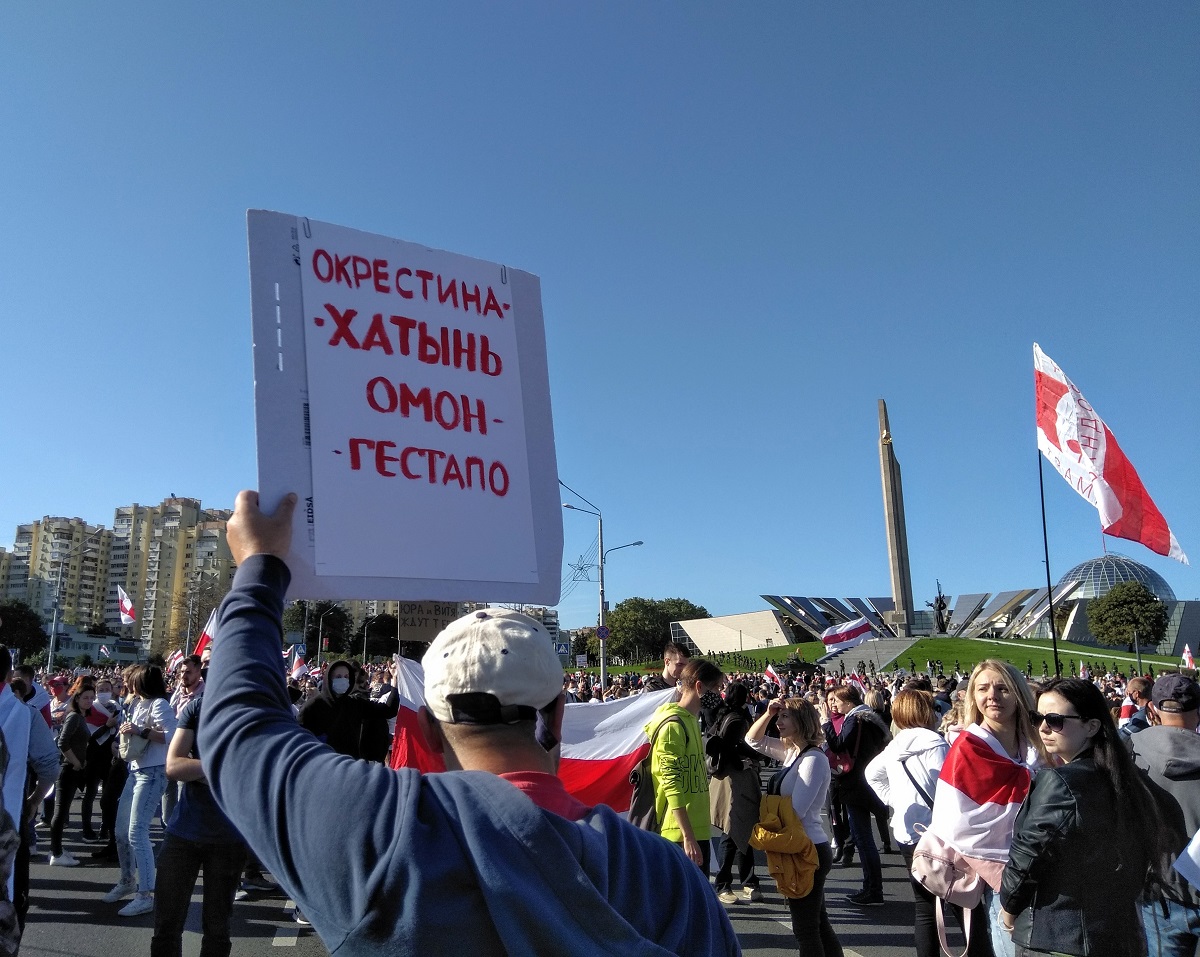
Anti-Lukashenka demonstration in Minsk in September 2020. The events of 2020 showed that a large generational change has taken place within the Belarusian society. Photo: Troshina / Shutterstock


This has brought about a variety of new tools that are also useful for bringing political change. We can observe these processes today in countries such as Kazakhstan and Russia. We can also see similar trends in Ukraine and the Central Asian states. The authorities and representatives of the opposition keep their societies in a kind of a lethargy, or turn them into hostages of a bipolar language of political division.

Making a choice without a choice

Belarus is also an example of such a disconnect, which reached its peak in 2020. Before we look at events surrounding this divide, we would like to point out that our use of the term political elite in the Belarusian context is not limited to the ruling authorities. Our perspective is broader and thus this term refers to both the opposition and those who hold state power. Clearly, none of these groups have yet proved capable of presenting a social programme that would be acceptable to Belarusian society. How and why have these groups both failed? To answer this question, it is worth taking a closer look at the behaviour of the Belarusian political and intellectual elite throughout the post-Soviet transformation.

The Soviet Union was an empire that collapsed in 1991 with all the logical consequences of such an event. However, the empire was already experiencing a serious crisis by the 1980s. At that time, the state’s peripheral areas were increasingly home to “anti-Soviet elites”. These groups were focused on national rights and this was justified at that time. In a highly centralised Soviet state, nationalism was the only way to consolidate opposition in the peripheral republics.

In line with the social science theory of orientalism, this moment should have marked the beginning of the republics’ anti-colonial struggle. Yet, in the USSR things did not turn out this way. Instead, these local national elites were still in the early stages of formation. It would still be several years before such groups would play an important political role following the empire’s collapse. This was also the case in Belarus, where this process was halted by the fall of the Soviet Union.

The anti-colonial movement was necessary for the republics to get out of the centralised Soviet empire. Opposition groups needed this time of consolidation to delegitimise their local centres of power. In Belarus that was the case, just like in the other republics. The initial process of institutionalisation of the anti-Soviet national elites was interrupted by the disappearance of the empire. The Belarusian Popular Front, which emerged in the late 1980s, united the national intelligentsia, which was just beginning to accumulate symbolic capital for future political acceptance by society. That is why in 1991 these unconsolidated elites found themselves unprepared for the new political and economic reality of independence.  Despite the fact that they were deprived of earlier political or administrative experience, they were expected to present a concrete socio-economic programme for the country. Their political capital however was limited to a vision of nation-building.

On the other side of the political spectrum were representatives of the young and part of the old Soviet nomenklatura. Some of them had already been in power before, while others aspired to such positions. For this group, the collapse of the Soviet Union did not mean political marginalisation. On the contrary, by nationalising various assets after independence they were able to keep their pre-1991 positions to a large degree. The political and administrative experience, know-how and connections of its members gave this group an upper hand over the unconsolidated national elite.  

The third, and most important, political player in the early stage of the post-Soviet period was the society. At that time, its position can be described as “having to make a choice without a choice”. Putting aside the fact that most post-Soviet societies (Belarus was no exception) had no prior experience of free media, free elections or political programmes, it is worth noting the various mental and psychological issues faced by the population during the uncertainty of the 1990s. Due to this, it is not surprising that many people who had lost their entire capital and whose life experiences were strongly shaped by the previous system of values and symbols, were influenced by the language and narratives prepared for them by political candidates. Overall, the only thing the society could do is to listen to what the politicians were saying.

Intelligentsia versus the people’s man

The political strategies of the post-Soviet elites were primarily focused on language and image. As such they were geared towards voters who had earlier experienced protectionism of the Soviet state which was much more based on materialism than ideals, including in their private lives. Thus, Lukashenka’s coming to power in 1994 can be explained in a rational way. His promise of immediate stability was widely accepted by Belarusian society, especially in small towns and rural areas. Specifically, the programme of immediate stability was seen as a more attractive offer than the vision of a national enlightened western-style future. At that time, the division between post-Soviet and anti-Soviet was still visible and very clear. However, with time the anti-Soviet elite also became a thoroughly post-Soviet actor, just as much as the old ruling class that increasingly turned its back on the idea of national independence.

The anti-colonial image of the brave intelligentsia vs the (post)Soviet man of the people was diligently strengthened by the authorities after 1994 and shaped the Belarusian political discourse for a long time. However, it was not only the “work” of the authorities. In the post-Soviet context, the anti-colonial nationalism, which served as an ideological foundation for the not yet fully politicised post-Soviet intelligentsia, was a natural reaction. Yet, in the context of the fast disappearance of the empire, it had little chance to succeed.

This setup has been characteristic of much of the political competition in Belarus since 1994. Things changed somewhat during the campaign in 2006. Specifically, this was the first election in which Belarusian millennials were able to vote. At that moment, however, there was still no generational conflict within society or mass confrontations with the authorities. Instead, this election showed the clear disconnect between the power elite and society and a relative political consolidation of the opposition, which was then acting as the only alternative to the authorities. In 2006, the official narrative of a conflict between “treacherous westerners” (the opposition) and “a strong kolkhoz manager” (Lukashenka) began to lose its political charm and became part of the closed ideological concept used by the elite. This change occurred as a result of rapid technological development, as well as the various “colour revolutions” in other post-Soviet states. These developments made it increasingly more difficult for the authorities to censor the socio-economic and cultural discourse of the young generation. This in turn led to a greater ideological divide between the elite and a changing society. Even though the Belarusian counter-elite was experiencing its heyday of consolidation, for the population as a whole, however, the narrative built on the dichotomy of “national democracy” versus “bloody tyrant” became less convincing.

As a result, 2006 was an important year not only for Belarus’s political history. Indeed, it was also a turning point for its social development. It was the first moment in the country’s post-Soviet history when society started to better understand the existential challenges of the outside world than its internal political players. At this time, both the authorities and the counter-elite became tangled in the pro-Soviet versus anti-Soviet rivalry paradigm. Society subsequently chose an apolitical position, which allowed it to distance itself from both sides and which was characteristic for the generation born or coming of age in the post-Soviet period.

Whilst the counter-elite attempted to strengthen its internal unity in 2002, it did not achieve much success in this regard. The Belarusian post-Soviet experiment brought on an actual destruction and near complete marginalisation of the counter-elite by the authorities. From that period on the public sphere was completely controlled by state structures, which in turn determined the development of Belarusian society in the decade to come.         

The next two presidential elections took place in 2010 and 2015. However, they did not generate much interest and went almost unnoticed. The ruling elite, centred around Lukashenka, strengthened its grip on power by repressing any expression of discontent and limiting freedom of expression. The counter-elite did not have any real impact on the country’s social and economic life, as its existence was now dependent on Minsk’s tactic of appeasing the West by showing that there was some political pluralism in the country. This meant that opposition representatives got completely cut off from real life, which only damaged their ability to run effective national political campaigns. This cast-like structure of the counter-elite was to the authorities’ advantage and lasted until 2020.

In-between zone

The society’s response to this change was to enter a kind of in-between zone. The goal was to avoid engagement with either side. This disconnect to a large degree worked to the advantage of the authorities, who continued to control elections by heavily exploiting the image of Lukashenka as a guarantor of stability. Only the repressive tactics that they used to eliminate political rivals hampered their ability to further strengthen their position.

As mentioned above, both the authorities and the opposition operated in their own worlds, while society found its own niche. This feature of the Belarusian reality is also characteristic of many post-Soviet societies. Those who are in power stay there thanks to the logic of “if not us, then who?” At the same time, the opposition turns from being anti-Soviet into simply anti-government.  This disconnect between the society and the elites became visible only in 2020. 

Yet, a few positive changes took place in Belarus prior to 2020. This includes the liberalisation of Belarus’s foreign policy towards the West, which Lukashenka allowed after the 2014 revolution in Ukraine. The potential regional consequences of Ukraine’s Maidan  were likely his biggest nightmare. Equally important was the policy of soft “Belarusianisation”, which the authorities introduced out of fear of Russian influence. Another example was the mass protests against the so-called “parasite law” which were organised throughout the country in 2017. In early 2020, the authorities also did not stop demonstrations in Minsk that were directed against the strengthening of Belarus’s integration with Russia. 

The biggest breakthrough and a new window of opportunity for the counter-elite came with the outbreak of COVID-19. The old opposition regained hope for quick social mobilisation as it became clear that the authorities were simply ignoring this public health issue. At that moment, society was still keeping its distance from both sides. Also, the social mobilisation process that took place then and which was independent of the activities of political players should be regarded as a natural process than something extraordinary. The society, which became “left alone” in its fight with the coronavirus pandemic, was consolidating not because it wanted to manifest its discontent politically, but because of the disconnect that existed between the people, the authorities and the counter-elite.

As a result, no matter what name we use to describe the social mobilisation in Belarus in 2020 – be it a “revolution” or “social uprising” – these protests should first and foremost be viewed as the Belarusian society mobilising on its own.  This process is a consequence of the young generation’s breaking free from the earlier cemented political discourse in Belarus. Indeed, for the first time in Belarus’s post-Soviet history people realised their autonomy and the society became an independent political actor separate from both the authorities and anti-Lukashenka opposition. Initially, this protest mobilisation was used by the new political players.

However, can we really say that Siarhei Tsikhanouski and Viktar Babaryka, who ran against Lukashenka in 2020, were indeed representatives of a new kind of Belarusian politician? If we look more closely, we can see that Tsikhanouski adopted the image of an independent blogger with revolutionary spirit, whilst Babaryka took on the role of a “smart and experienced manager”.  Interestingly, these personas offer a mirror reflection of Lukashenka in the mid-1990s. Back then, Belarus’s current president presented himself as a young counter-revolutionary, a people’s man who wanted to bring an end to corruption and chaos. The similarity between the image of Lukashenka in the 1990s (a strong kolkhoz manager) and the 21st century image of Babaryka (a smart manager) is a perfect illustration of the generational evolution of Belarus’s post-Soviet society.

Not surprisingly, Lukashenka quickly recognised Tsikhanouski and Babaryka’s popularity and jailed them as a preventative measure. The society continued to protest against these and other decisions made by the authorities and by doing so proved its ability to speak up. Tsikhanouski and Babaryka managed to encourage a new social energy that was no longer based on political or ideological preferences, thereby showing that the people were no longer alone in their desires to have their voices heard as loudly as possible. Tsikhanouski and Babaryka managed to spark a large social reaction not because of their political or ideological appeal, but because they were stressing out that the society is not alone in its attempt to speak up.

Again left alone 

The events of 2020 also showed a large generational difference within Belarusian society. This gap is not only measured in time but also in outlooks and ideas. The truth is that while the authorities and the democratic opposition operated in two parallel worlds over the last decade, a new generation came to be and showed its independent power in 2020. This more open-minded social group’s world can be found largely in the digital sphere. In a sense, this group is a product of internal autocracy and external globalisation. Outside factors especially helped the Belarusian people free themselves from both the socially conservative authorities and the equally unrealistic opposition. This fact was not yet recognised by either side. In our view, it is this generation that could possibly bring the biggest social and political change to the country.

This challenge yet remains for the new opposition leaders who emerged in 2020. Today, they are mostly regarded as alternative centres of power. The question that we would like to ask here is whether they will pursue long-term change or fall into the trap of the bipolar division of Belarus’s political life? For the moment, they are naturally very limited in their actions and can only operate from abroad, which is completely understandable and justified. However, it is already quite evident that society is again getting tired with politics and politicians. We can see its increasing disappointment with them and their actions. This is the result of the fact that the new political actors are also losing touch with the changing social dynamics. Unfulfilled promises and increased repressions are also pushing society away from politics. Representatives of the opposition who were forced to flee abroad had no choice but to start co-operating with the old opposition. This may lead them to a dead end and marks a return to political tactics from 30 years ago.

Also, many of the “more modern” leaders of the opposition ended up in prison. Those who are still free are joining the fight against the regime and thereby only deepening the disconnect that exists between the two elite groups and society. This could result in a permanent loss of the social capital that was gained over the last year. As no political system tolerates a vacuum, it is highly likely that a more controlled systemic opposition will emerge after the constitutional referendum planned for next year.

Can we say that since 2020 Belarus has undergone a special post-Soviet experience?  It was not that long ago that western discourse on Belarus stressed the passivity of its society as a feature of its post-Soviet identity. However, the disconnect that this text discusses and which came to light in 2020 shows that these old stereotypes are no longer valid. Despite this, it is clear that Belarus’s political scene is returning to its old tricks following a year of protests. This is mainly but not only the work of Lukashenka’s repressive regime. This dichotomy is also the result of the behaviour and decisions of the new and old counter-elite. As a result, we can talk again about a political scene that is based on the outdated post-Soviet division, with “courageous pro-western supporters of democracy” facing off against a “stable, yet bloody dictator”. The society has yet again been left alone in this remote corner of Europe, with no alternative on the horizon.

Translated by Iwona Reichardt

Anton Saifullayeu is an adjunct professor of Centre for Eastern European Studies at University of Warsaw and the editor in chief of the Białorus2020 portal (https://bialorus2020studium.pl/).

Maxim Rust is a political analyst and researcher of political elites in the post-Soviet space. He has a PhD in Political Science and Administration from the University of Warsaw. He is also a contributing editor with New Eastern Europe and lecturer and researcher at the Centre for East European Studies at the University of Warsaw.

,

Partners

Terms of Use | Cookie policy | Copyryight 2026 Kolegium Europy Wschodniej im. Jana Nowaka-Jeziorańskiego 31-153 Kraków
Agencja digital: hauerpower studio krakow.
We use cookies to personalise content and ads, to provide social media features and to analyse our traffic. We also share information about your use of our site with our social media, advertising and analytics partners. View more
Cookies settings
Accept
Decline
Privacy & Cookie policy
Privacy & Cookies policy
Cookie name Active
Poniższa Polityka Prywatności – klauzule informacyjne dotyczące przetwarzania danych osobowych w związku z korzystaniem z serwisu internetowego https://neweasterneurope.eu/ lub usług dostępnych za jego pośrednictwem Polityka Prywatności zawiera informacje wymagane przez przepisy Rozporządzenia Parlamentu Europejskiego i Rady 2016/679 w sprawie ochrony osób fizycznych w związku z przetwarzaniem danych osobowych i w sprawie swobodnego przepływu takich danych oraz uchylenia dyrektywy 95/46/WE (RODO). Całość do przeczytania pod tym linkiem
Save settings
Cookies settings