
Belarusian language and culture: is the patient more alive than dead?
One of the ways to save the Belarusian language is to maintain courage in preserving and displaying the Belarusian identity. This includes pride in Belarusian history and language, which should be used especially in everyday life. Since it is nearly impossible to do this inside the country, perhaps the best place to start is within the Belarusian diaspora.
The consistent and managed destruction of the Belarusian language and culture has become one of the hallmarks of Alyaksandr Lukashenka’s rule and a distinctive feature of his regime’s activities since 1996 (together with the increase in Russian influence). As a result, in today’s Belarus, people who use the Belarusian language in their everyday life are discriminated against, while representatives of the Belarusian culture are persecuted. Belarusian citizens can be arrested for displaying their Belarusian identity in the streets of Minsk even when they speak Belarusian while offering guided tours, or wear socks with white-red-white stripes.
December 7, 2022 -
Katarzyna Bieliakowa
-
Issue 6 2022MagazineStories and ideas
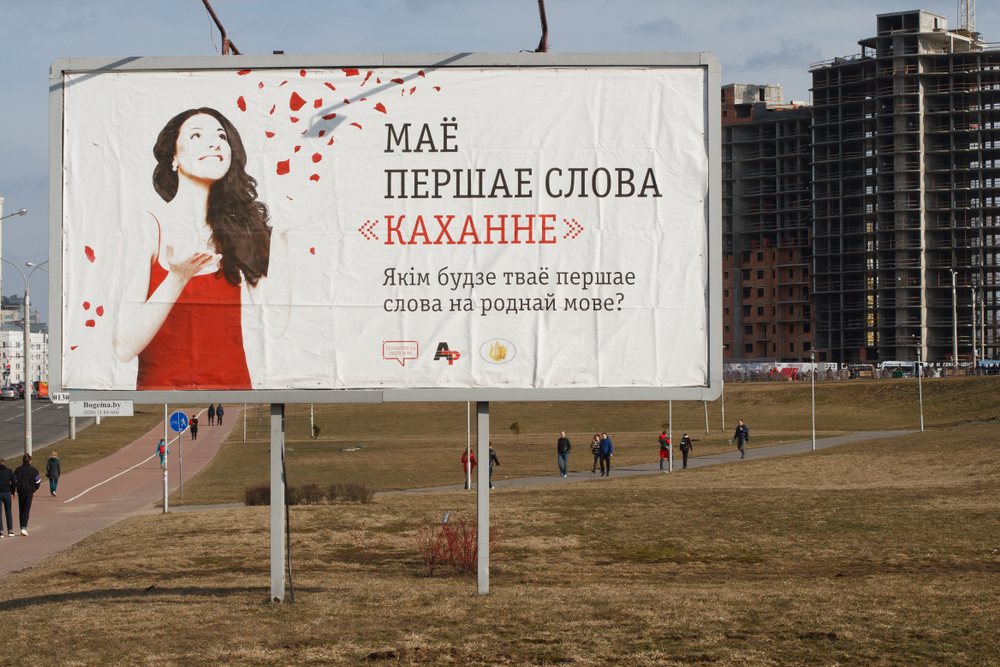
Signboard for the word love in the Belarusian language. Photo from 2019 - losmandarinas / Shutterstock.
This is the Belarusian reality today. Why is this happening and is it possible to stop these processes are questions asked by everyone who cares about the future of a sovereign Belarusian state and the freedom of the Belarusian people.
Short renaissance
Belarus remains one of three post-Soviet countries (together with the Kyrgyz Republic and Kazakhstan) where the Russian language still has an official status. After centuries when (old) Belarusian was the language used on the territory of present-day Belarus under the rule of the Grand Duchy of Lithuania, it was replaced by Russian in the late 18th century when the area was taken over by the Russian Empire.
In more contemporary times, Belarusian became the official state language only in 1990, when the Supreme Soviet of the Belarusian Soviet Socialist Republic passed a law on languages to gradually increase the prestige and use of Belarusian. This was followed by the creation of a National Language Programme to support this endeavour. After the collapse of the Soviet Union and Belarus’s independence, the status of the Belarusian language was further reinforced by the 1994 Constitution (Article 17). This declared it to be the sole official language of the newly independent state, though Russian was given the status of the “language of inter-ethnic communication”. In addition, article 28 of the 1992-94 Law on Language in the Republic of Belarus proposed that the Belarusian language be used in the sphere of culture. Thus, we can say that the early 1990s was an exceptional period for the Belarusian language renaissance but, unfortunately, it proved to be too short.
The controversial 1995 referendum organised by Lukashenka not only altered the system of separation of political power in the country but also introduced an “insignificant” change with regards to language. Namely, as a result of this law Russian became the second official language of Belarus. Since then, the two languages are considered equal, however only in theory. It is indeed quite symbolic that the first referendum which expanded the powers of the president also deprived the Belarusian language of its status as the sole state language. In the same way, the main symbols of Belarus’s independence – the coat of arms (the Pahonia) and white-red-white flag – were replaced with Soviet-era symbols which represent the times of autocracy and repressive ideology.
The Belarusian people, who had no earlier experience of participating in political life, voted for the return of the Russian language largely because the usage of Belarusian was often looked down on in society (it was rather spoken in the villages than by the urban elite). In the same way, they opted for the return of the Soviet-era symbols that were better known to them compared to the old emblems from the times of the Grand Duchy. Evidently, symbols are not just meaningless images – their selection can also offer an insight into social sentiments, in this case Soviet nostalgia. However, we cannot say that in this regard Belarus is alone in reassessing the past. Indeed, it is sufficient to take a look at other countries in the region, including Belarus’s neighbours (specifically Latvia and Lithuania) and their decommunisation attempts.
There is no doubt that the stipulations of the 1995 referendum presented the first serious barriers to the development of the Belarusian language. As a result of this popular vote, Belarusian ceased to be used in legislation, even though it is stated in the law that at least 50 per cent of the state’s legal acts should be written in Belarusian. So far, the republic’s 2006 Code on Culture has been the first and only legislative act written in Belarusian (out of 26 codes) and only eight codes in total had been officially translated into Belarusian by April 2021. Indicatively, the 2006 code emphasises the “priority of development of the Belarusian national culture and recognition of the Belarusian language as one of the factors shaping national mentality”. Practice yet shows that these are empty words, even if the authorities attempt to show some recognition of the importance of the Belarusian language and culture by proposing a list of organisations responsible for its development. These groups include museums, educational institutions, theatres, etc. Yet again, these organisations also use Belarusian very rarely, and this can be noted even by looking at their official webpages.
The challenge of preserving language and culture
The situation in the educational system is very dire. Between 2012 to 2018, as many as 482 Belarusian language schools were closed down. Russian thus remains the primary language of education and is used even to teach courses on Belarusian history. The situation in academia is even worse. In fact, there are only a few places in the whole country where Belarusian is the language of instruction. The majority of them are actually the departments of Belarusian language and culture. Thus, an overwhelming majority of students, even if they obtained secondary education in Belarusian, have no choice but to use Russian at universities, no matter which degree they decide to pursue. Russian is also the language used by the academic staff. All this shows that Belarusian academia still carries the legacy of the Soviet times and does not participate in European structures or models of higher education. Instead, the point of reference is Russia and its academic institutions.
The publishing market also reflects the difficulties faced by speakers of the Belarusian language. A mere 12 per cent of books published in Belarus are in Belarusian. These are mainly school textbooks. Since 2020, publishing companies that printed Belarusian-language books have been shut down. Many owners and workers of private bookshops have been persecuted by the authorities and have been forced to leave the country and re-open their businesses abroad. There is also no state policy on translating books into Belarusian. Thus, in recent years all translations of popular foreign literature into Belarusian have been financed by community collections. This fact also illustrates the divide that exists between civil society and the state regarding the Belarusian language and culture: people are trying to save what is being destroyed by the state.
The preservation of Belarusian art remains another challenge, which can also be explained by economic factors. In other words, many artists know all too well that there are not too many opportunities for them to earn money (in Belarus or abroad) by performing in Belarusian. In this context, it is indeed quite noteworthy that some rock bands still write their songs in the Belarusian language.
Unprecedented political pressure
The political and social processes that have taken place in Belarus since 2020 have demonstrated a growing disconnect between the Belarusian people and the regime. The Belarusian authorities have become more hostile towards everything Belarusian. As a result, there have been unprecedented repressions of prominent artists and educators, who fight to preserve the national idea, national symbols, Belarusian language and overall – freedom.
Despite the fact that because of the repressions the protests ended in the second half of 2020, layoffs of cultural workers have continued to take place, and in the second half of 2021 they intensified. Many employees in cultural institutions were fired for political reasons, although this was done in a very underhanded way. Officially, it was declared that there will be no mass layoffs. Instead, employees were terminating their contracts (in agreement with the employer). Throughout this process, special “attention” was paid to Belarusian-speaking cultural activists.
Other forms of discrimination against cultural representatives include searches, raids, the confiscation of electronic devices, administrative and criminal prosecution, detention in poor pre-trial facilities without access to correspondence and communication with relatives and friends, the creation of a cultural activists “blacklist” (people on such a list cannot organise concerts or any other cultural events), and the removal of anti-regime writers from school curricula. Books by authors who speak and write in Belarusian have also been added to lists of “extremist materials”. Among them is Anatoly Tarasau’s Short Course on the History of Belarus. There are also books about Belarusian symbols on these lists, as well as those authored by writers who were forced to leave the country and publish their books abroad (e.g. Dogs of Europe by Alhierd Bacharevič).
As of October 2022, there are 1,344 political prisoners in Belarus. Many of them are cultural activists, poets, writers, musicians, actors, artists, teachers, dancers, literary scholars, librarians and culture managers. Most of them were sentenced to imprisonment for a period of one to 14 years. In addition, since 2020 we have seen unprecedented pressure put on non-governmental organisations active in the cultural field. Many of these organisations have already been shut down – as of September 2022 at least 77 have suffered this fate. Among them was the respected Francišak Skaryna Belarusian Language Society. It was one of the oldest NGOs in Belarus whose mission was the revival of the Belarusian language.
Invisible occupation
The most recent large wave of repressions began after February 24th 2022, which is the day when the Russian Federation began, also from the territory of Belarus, its full-scale invasion of Ukraine. These repressions were directed against those Belarusian artists, cultural figures and activists who opposed the war in Ukraine and the role Belarus has played in this war. These people recognised that the Russian invasion of Ukraine is actually an implementation of Russian policy against both Ukraine and Belarus. This policy has been made clear, on many occasions, by Vladimir Putin, especially when he stated that Ukraine and Belarus are not “real nations” and as such do not deserve to be independent states. In this viewpoint, Russian language and culture should dominate and replace those of its two neighbours. If we can say that in Ukraine this idea resulted in a war, in Belarus it is taking the form of an invisible occupation, where Russian language and culture are supported by Lukashenka’s regime.
However, since the outbreak of the war more and more Belarusians have started to come to an understanding that they are in the same position as their southern neighbour. Therefore, they are now convinced that it is worth preserving what has not yet been destroyed by the regime and the “big brother”.
In my view, one of the ways to save the Belarusian language is to maintain courage in preserving and displaying the Belarusian identity. This includes pride in Belarusian history and language, which should be used especially in everyday life. An example to follow could be that of the Belarusian diaspora. Its representatives organise concerts but also promote films, performances and TV programmes for children that are in the Belarusian language. They have also opened (or re-opened) Belarusian book shops and publishing houses of Belarusian books abroad, as well as established language clubs. They do this to help preserve and promote the Belarusian culture, but they also do it for themselves.
Naturally, all of the democratic forces should pay special attention to cultural and language issues, which will be of key importance once the country is free again. The rebirth of the Czech language in the 20th century will offer a good example for the new democratic authorities. Once the new Czechoslovak republic was established after the collapse of the Austro-Hungarian Empire, the Czech language returned to the public sphere after centuries of German language domination. This was thanks to the political will of the republic’s political class but also that of Czech society. This example also shows that there can be no “choice” when it comes to what should come first: regaining freedom or preserving the native language and culture. We cannot and should not choose between these three elements. We need them all.
Katarzyna Bieliakowa specialises in theory and history of law. Her research interests are in the field of human rights law, migration law, democratic transformations in Belarus, and legal clinical education. She is a member of Analytical Group “BELARUS-UKRAINE-REGION” established by the Centre for East European Studies of the University of Warsaw.