
Between history and magic
The protesters and Belarusian commentators adopted the role of colonised objects. The scale of the protests surprised everyone. As soon they erupted, the clichéd accounts that the pro-tests represent the birth of the nation were repeated like a mantra. Apparently it emerged sud-denly and Belarusians were formed as a nation in that moment.
A year has passed since the presidential elections in Belarus, which initiated an un-precedented social uprising, often referred to as the Belarusian revolution. Like most revolu-tions, the Belarusian one created its own symbols. Their appearance and dissemination among the protesters had primarily a unifying function. Symbols express the intentions of a revolu-tion. Their interpretation allows us to reconstruct the vision of the future that could emerge on the ruins of the overthrown regime. It raises the following question: one year after the start of protests, how can we describe the symbolism of the Belarusian revolution and can we say it will be an unfulfilled one?
September 12, 2021 -
Paulina Siegień
Wojciech Siegień
-
Hot TopicsIssue 5 2021Magazine
Photo: Vadim Maevskyi / Shutterstock
Women’s revolution?
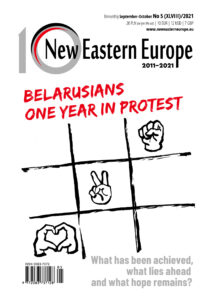
The mass protests in Belarus started as a result of Lukashenka’s rigging of the presidential election. He eliminated his main rivals from the race: Viktar Babaryka, Siarhei Tsikhanouski and Valery Tsapkala. Their removal forced three women, who quickly became a symbol of the entire Belarusian protest, to enter the political game. These were Sviatlana Tsikhanouskaya, Maryia Kalesnikava and Veranika Tsapkala. They formed something that we could call an electoral coalition. Like three female musketeers, they spoke together at rallies and meetings with Belarusians. The visual side of their performance included powerful symbols – each one assigned a characteristic hand gesture symbolising victory, love and fight.
Tsikhanouskaya’s gesture was her fist clenched to fight. And, indeed, it was her, whether she wanted to or not, who ran for the presidency. We can consider her decision a forced fight because both during the campaign and while in exile, she repeated (like a mantra) that she is not a politician or a fighter, but a wife and mother who, by a twist of fate, has become a symbol of the opposition. Kalesnikava was quite different. She showed a real heart for the fight, but put forward the gesture of love. Yet it was her who refused to leave the country; she destroyed her passport and was arrested. Her trial has recently started and it is expected that she will be handed a prison sentence. The third musketeer, Tsapkala, joined her husband abroad and disappeared from the scene.
The Belarusian revolution, as we can see, is a women’s revolution. It was these three women who took to the centre stage after the male candidates were arrested. They became the face of the protests. However, this fact should not be treated as evidence of general progressivism within the opposition. On the contrary, it is rather a confirmation of the traditional gender stereotypes which are characteristic of quasi-conservative post-communist societies. In Belarus, where the myth of the Great Patriotic War is especially strong, the image of women, forced to bear the burden of the struggle to survive, is a repetition of the war and post-war narratives which have been exploited for decades in official historiography.
Female heroism is that of the victim. It is a non-political activity, which is clearly visible in the figure of Tsikhanouskaya, who consistently avoids calling herself a politician. In a recent interview with the Russian television channel Dozhd (TV Rain), she nodded with understanding as the journalist said to her: “People listen to you because you speak from the bottom of your heart. Because you are not a politician and that is so great!”. As paradoxical as it sounds, Tsikhanouskaya’s consent to depoliticise her own role confirms Lukashenka’s campaign statement that Belarus’s political system does not foresee female leadership, and that Tsikhanouskaya is an ordinary housewife who only accidentally found herself as a candidate.
Thus, the Belarusian revolution can be called a female revolution, but in a stereotypical sense. It comes down to a paradigmatic confrontation: on the one hand, the protesters represented by women, are gentle and peaceful, empathetic and immaculate; on the other hand, Lukashenka’s regime is male, aggressive, militaristic, political, physical, dirty and dark. We have iconic images of women’s marches with participants dressed in white, carrying signs with peaceful slogans, handing out flowers to security forces. On the other side we have officers in black balaclavas with guns, brutally pacifying defenceless victims. A year after the protests, when this paradigmatic confrontation was taking place on the streets of Minsk, we can see that the ruthless force has won.
Belarusian revolution – Polish or Russian?
Today, it is not difficult to find entire playlists on Spotify that refer to last year’s events in Belarus. They are dominated by Belarusian performers (both old and young) who were previously involved, if not in political then cultural, opposition to Lukashenka’s Soviet-kolkhoz aesthetics. They played both popular and underground bands. Some of their songs are quite old while others have been created recently, during the wave of protests. However, none of them has become a universally recognised anthem of the revolution. This is something different from the Ukrainian revolutions where hymns of revolution were established.
During the Revolution of Dignity, it was the Belarusian group Lyapis Trubetskoy that, on the Maidan, sang in Russian its protest song “Voiny Sveta”. However, the group’s lead singer, Siarhei Mikhalok was not an important voice of the protest in Minsk. What we saw in Belarus was quite different. Foreign media reported that there were two songs of the revolution: “The walls” by the late Polish singer and guitarist Jacek Kaczmarski and “Peremen” (“Changes”) by the late Soviet and Russian singer, Viktor Tsoi. In fact, Polish and Russian media competed in emphasizing their own national inspirations for the Belarusian protest movement. To them it did not matter that the protesters could well have sung NRM or NIZKIZ songs.
The reaction of the two neighbouring countries, which have been pursuing colonial policies towards Belarus for hundreds of years, shows something else. Namely, to them Belarusians are carte blanche. In other words, they see Belarusians through the prism of colonised people, deprived of their own voice. Hence, it was very easy for Polish and Russian journalists to take patterns of resistance they knew from their own countries and apply them to the protests in Minsk.
Maybe the Belarusian public should have expected a unifying song from one of its biggest stars, the hip-hop performer Max Korzh. However he made the protesters wait until October 2020 before releasing his video clip Her Fault which made references to the summer events. The public, however, interpreted this more as Korzh’s desperate attempt to become part of the movement than genuine support of it. Interestingly, in November 2020 the Russian hip-hop band, Kasta, also released a clip dedicated to Belarusian protests. It was titled “Go for a walk” and its message is incomparably stronger than Korzh’s.
Korzh showed young men in a typical hip-hop setting. They are standing in groups in urban neighbourhoods, swaying to the rhythm of music. This provoked jokes such as: “Ah, all those Belarusian men who did not come out to protest and instead sent their women there. They’re now in Max Korzh’s music video.” The clip of the Russian band tried to recreate the real context of the Belarusian protests, showing tensions in families, beaten faces of protesters and how they were running away from OMON forces. It even includes powerful torture scenes from detention centres. This presents a particular paradox – Russian artists have managed to create a deeper and more compelling picture of the Belarusian revolution.
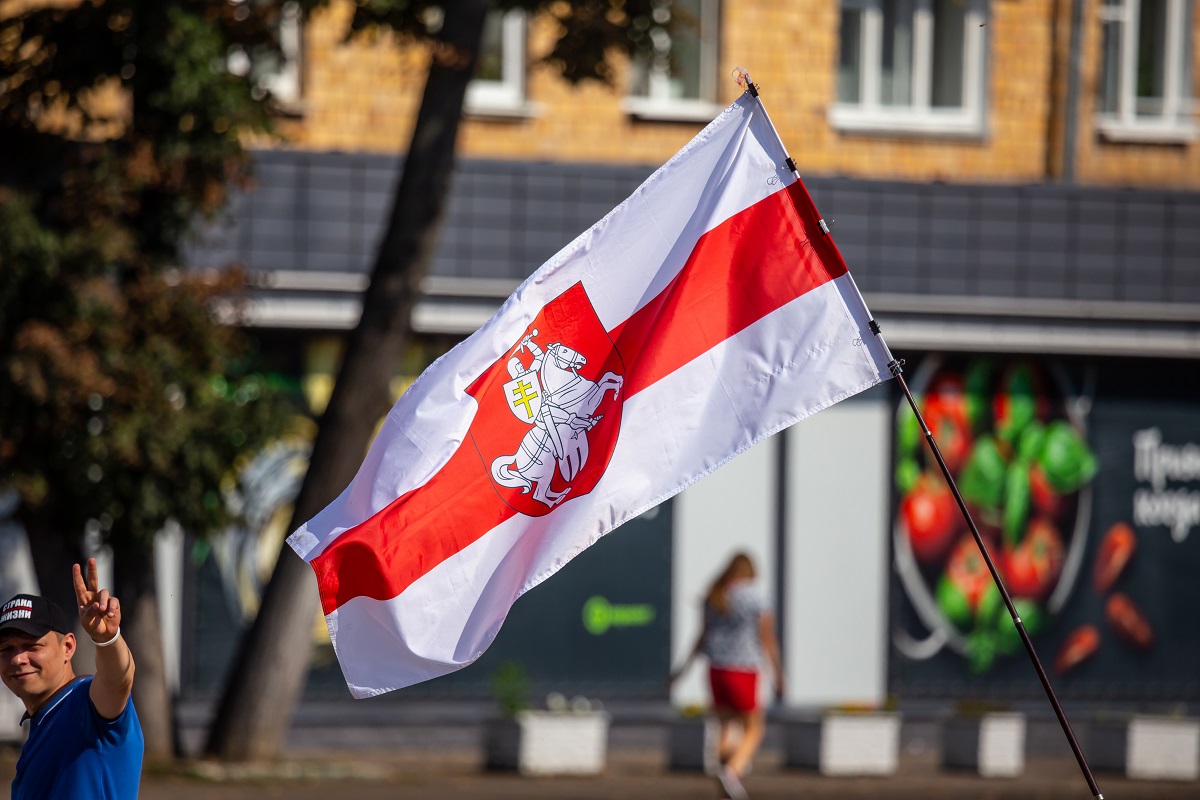
At the same time, it is necessary to emphasise the shock of Russian media when they saw the Belarusian white-red-white colours instead of the red-green post-Soviet flag. These historical Belarusian flags, which were widely displayed during the protests and became its central symbol, turned out to be incomprehensible even for Russian liberal audiences. The journalists of TV Rain had to explain to viewers why the Belarusian crowds marched with this flag. In this sense, the Belarusian protest movement could only be understood from the outside when it was assigned symbols they were familiar with. Consequently, autonomous Belarusian elements, such as the flag or the Pahonia (the coat of arms depicting a charging knight on horseback), turned out to be difficult to decode. Again, it was as if Belarus or Belarusianness were empty labels.

Miracle birth of a nation under a white-red-white flag
In one sense, the protesters and Belarusian commentators adopted the role of colonised objects. Evidently, the scale of the protests surprised everyone. As soon they erupted, clichéd accounts that the protests represent the birth of the nation were repeated like a mantra. It emerged suddenly and Belarusians were formed as a nation in that moment. This apparent fact was not even described as a kind of a national awakening, but as birth. In the abovementioned interview with Tsikhanouskaya, the Russian journalist blissfully claims that Belarusians just woke up as a nation. In response, Tsikhanouskaya corrected her by explaining that maybe it took more than one day, but agreeing that it was something amazing. Naturally, the rhetoric of the miracle birth of a nation is part of protest language, but we should recognise that it also expresses some elements of magical thinking.
This rhetoric of the (re)birth of the Belarusian nation, so often repeated in various commentaries, deserves special attention. Clearly, it results from the scale of the protests and the belief that, this time, they are qualitatively different than previous anti-Lukashenka protests. Commentators repeated the thesis about the emergence of a new opposition, something different from the old one, which was associated with the nationalistically-minded intelligentsia and was seen as detached from reality.
And yet this new protest and the rebirth of the nation did not find any other symbols than the white-red-white flag of the Belarusian People’s Republic and its Pohonia coat of arms. In other words, it used symbols of the old opposition, which was criticised for its overly nationalistic nature when it was stressing the need to use the Belarusian language and national symbols. In this sense, the agenda for the unfinished revolution of 2020 does not differ from previous protests. Its main, and only, postulate is the removal of Lukashenka from power, while the omnipresence of national symbols suggests that, for the protesters, it is important to preserve the sovereignty of the Belarusian state, to which Lukashenka and his multi-level integration game with Russia is a threat.
All these elements – the character of the protest and its female face – found a perfect combination in Nina Baginska, a petite pensioner who walked around Minsk with a large white-red-white flag during the protest. Baginska, who consistently tries to speak Belarusian, is not yet a “child” of this revolution. Neither is she an accidental heroine whose image visually fit the revolution’s visual narrative. She is someone who for decades has been associated with the Belarusian democratic opposition and made her first anti-Lukashenka speech immediately after his rise to power. The fact that the media presented her as a gentle grandma of the revolution corresponds with the dominant magical thinking about the political and social events in Belarus. The apparent sudden and unexpected birth of the nation is accompanied by the expectation that the dream of a new Belarus will come true in an equally sudden and unexpected way.
And yet the symbols of this revolution did not come out of nowhere. They have their historical roots which have been cherished by the Belarusian opposition. Similarly, the behaviour of Belarusian protesters did not emerge unexpectedly. They have their roots in the authoritarian model of the Belarusian state, which has been educating its citizens for several decades.
Strength in unity
In his article titled “What Americans should learn from Belarus” the historian Timothy Snyder points to six Ps – preparation, predominance, protest, peace, persistence and pluralism – as positive features of the Belarusian protest which should ensure its success and may serve as a model for protests elsewhere. The article was published in August 2020, when Snyder could not have known the revolution would not end with instant success and that Lukashenka would remain in power.
Careful observers of the Belarusian reality realised early on that the model behaviour of the protesters can be explained by specific Belarusian character traits based on the self-stereotype of a quiet, peaceful and clean nation. The sterile cleanliness of Belarusian cities has been described many times as the spatial implementation of an authoritarian model. Yet, in the context of the ongoing struggle for freedom, dignity and prosperity and the care for the cleanliness of city benches was not criticised as a reflection of the year’s long educating citizens to live in an authoritarian state. Today, we can reflect that perhaps it was society’s behaviour patterns – which have been shaped by the authoritarian regime – that explains why the Belarusian revolution has not been successful thus far.
Nevertheless, the protests in Minsk and other Belarusian cities have demonstrated that the strength of the nation comes from unity. This may sound obvious, but in the context of previous ineffective attempts, last year’s protests were clearly an unprecedented moment. The white-red-white flags fluttered over the heads of thousands of people and proved that the work of the old opposition was not in vain. Years of struggle to preserve the Belarusian language and national identity have finally brought results.
However, it should also be emphasised that there were not many EU flags at these protests. This marks a difference from Ukraine’s Revolution of Dignity and says a lot about the aspirations of the protesters: while the Ukrainian revolution, from the beginning, was clear about its demands to continue the country’s western integration, the Belarusian leaders stubbornly tried to manoeuvre, repeating clichés about the sovereign Belarusian path. In this way, the Belarusian protests proved to be, in fact, a negative project. It narrowed down without offering a specific vision for the future. And perhaps that is why, on a symbolic level, the Belarusian revolution turned back to history, to symbols and myths rooted in the Great Patriotic War and the velvet revolutions that took place in Central Europe during the late 1980s and early 90s. It thus used second-hand songs.
Overall, neither the protest leaders nor the Belarusian protesters or media collectives, such as NEXTA, have proved able to define and maintain the future trajectory of the movement. When protesters reached the Palace of the Republic in Minsk and tensions were reaching its peak, the demonstration would turn back to disperse shortly afterwards. On the other hand, the satrap, hidden behind the security forces, knew he had nowhere to turn. Therefore, he struck back. As paradoxical as it sounds, in the battle between good and evil, it was the tyrant who played according to the rules of the revolution.
Paulina Siegień is a freelance journalist writing about the Polish-Russian neighbourhood and general Russian developments. Her latest book, Miasto Bajka. Wiele Historii Kaliningradu (City of fairy tales. The many stories of Kaliningrad), will be published later this year.
Wojciech Siegień works at the department of social sciences at the University of Gdańsk. He has researched on the countries of the former Eastern Bloc. He is currently doing research on Donbas in Ukraine. His main interests are educational ideologies and the different processes of militarisation in post-Soviet countries. He is a member of the Belarusian minority in Poland.