
Text resize: A A
Change contrast

International law and the Soviet wild-goose chase

Soviet political proposals from before the war and the legacy of the United Nations established as a result of the Soviet victory over Nazism are often recalled in the Kremlin’s contemporary narratives. Yet, a look at the historical development of the Soviet understanding of international law reveals a chaotic and political, rather than legal, approach.

The 75th anniversary of the end of the Second World War and the proclamation of the United Nations was a topic intensively exploited by Russian diplomacy which attempted to highlight the Soviet input into the triumph over the Nazis and the creation of an international organisation. The Kremlin’s rhetoric was expressed directly by Vladimir Putin twice last year – once thanks to an article published in The National Interest in June and then, via a speech delivered virtually during the annual summit of the United Nations, in September.

February 3, 2021 - Grzegorz Szymborski - History and MemoryIssue 1-2 2021Magazine
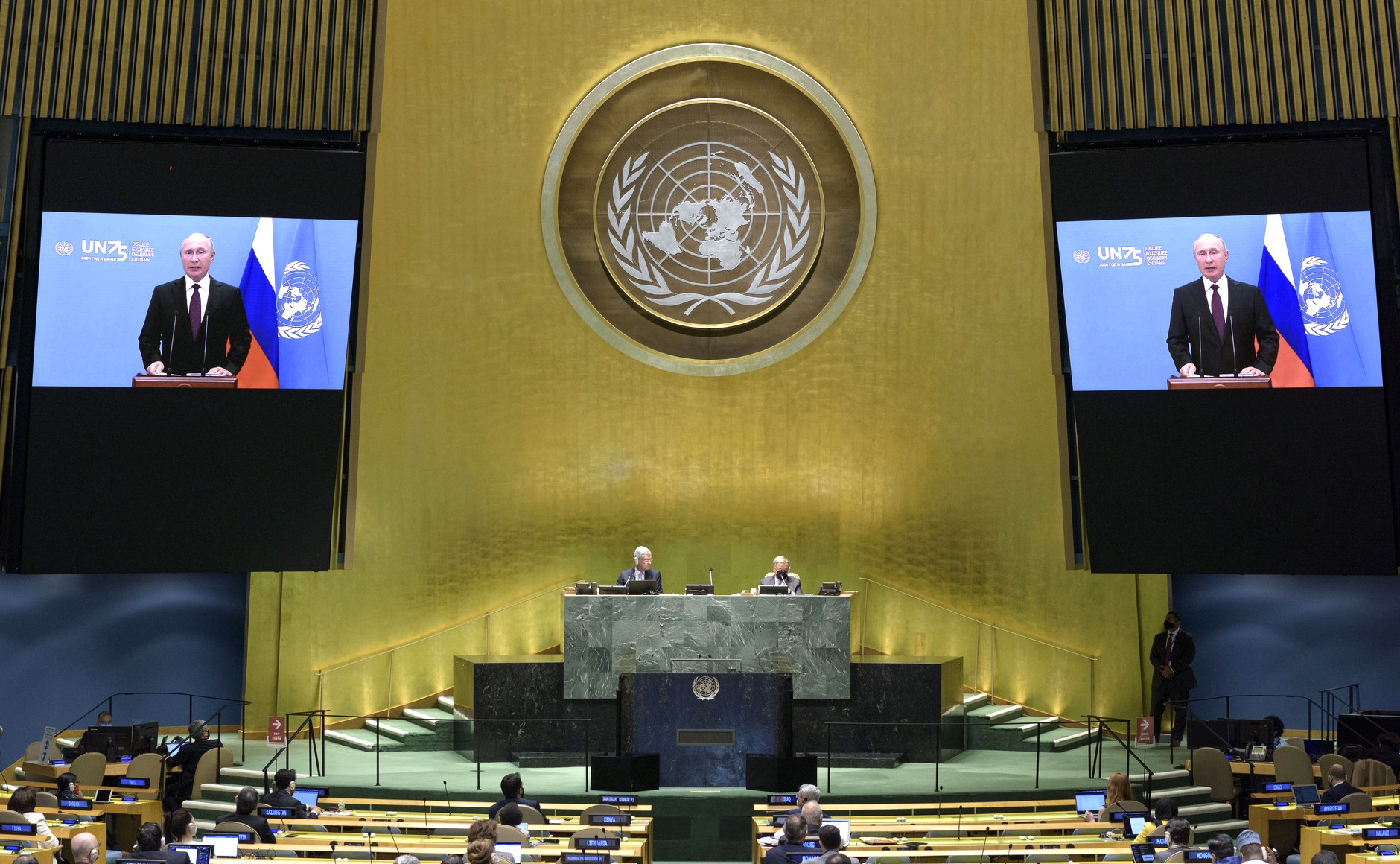
Vladimir Putin delivering an address to the 75th anniversary session of the UN General Assembly. Photo: UN / Manuel Elias (CC) United Nations


During both occasions Putin stressed the significance of the Soviet Union in creating and developing the post-1945 international order, fixed after the failure of the League of Nations (described by Putin as “a cautionary tale”). He noted the decisive role in sentencing war criminals and Russian allegiance to international law, of which the UN Charter appears to be the primary source.

Putin praised the advantage of the veto mechanism within the United Nations and the role of the five main leading powers responsible for protection and execution of international law. He elaborated significantly on co-operation within the organisation, its legal heritage grounded in multilateral conventions and protocols which should be respected. Putin openly accused the world of turning a deaf ear “to the repeated calls of the Soviet Union to establish an equitable collective security system and sign an Eastern European pact and a Pacific pact to prevent aggression”. He wrote that “these proposals were disregarded”.
Rewriting… the history of law?

Soviet political proposals from before the war, and the legacy of the United Nations established as a result of the Soviet victory over Nazism, are often recalled in the Kremlin’s contemporary narratives. From the Russian point of view, they remain one of the greatest and undisputable achievements of the USSR. When examining political facts rooted in the concept of international law and order, this legal grounding appears to be a reasonable (and necessary) starting point for revealing the true intentions behind the mask of rule of law. Indeed, how did the Soviets perceive the League of Nations and international law at that time? Were they so eager to co-operate with the world with the set of common rules? The 75th anniversary of the establishment of the United Nations and Russia’s unfading pride of the Soviet legacy are good reasons to give the floor to Hans Kelsen, a scholar who was able to reveal the weaknesses of the communist approach from the point of view of law and international law in particular.

Kelsen, an Austrian lawyer, may be known to some readers as the author of the idea of constitutional court and co-author of the Austrian constitution. After he fled Europe and moved to the United States, he focused on Bolshevism and contributed some academic works to the rising East-West conflict. In 1955 he published The Communist Theory of Law, a somewhat forgotten volume. The study was not complete at that time since Grigory Tunkin’s most famous and profound book, Theory of International Law,was not released until 1970. Nevertheless, since the 1950s, Kelsen and his work were recognised even by Soviet and other Marxian authors. Reginald Parker, who reviewed the study shortly after its publication, wrote that the Austrian lawyer “spares no effort to show the fallacies and inherent impossibilities in all these pseudo-scientific writings”.

The book itself elaborates on many different authors, including the theory of law and state as expressed by Karl Marx, Friedrich Engels, Vladimir Lenin, and lesser known authors such as Soviet lawyers Pēteris Stučka and Evgeny Pashukanis. Almost a quarter of the volume was dedicated to the issue of international law and the ambiguities of the Soviet jurists which were based on shaky legal understandings.

Kelsen debunked many thoughts on international law, pointing to the internal and ideological incoherence of legal concepts. The Soviet leaders were trapped by their own masters, as Marx and Engels’s understanding of law in general was not easily adoptable to the international context. Their simplified picture of the legal order was presented as an instrument of oppression of one class over another and simultaneously leading to the intensification of the contradictions within society. In fact, law became a tool of domination and exploitation directly connected with the state. For the fathers of communism, it was an expression of the economic reality. As Kelsen points out, that was not the case for international law, completely decentralised, without special organs for the implementation of sanctions. Most of all, the international community remained classless. This is why the Marxian theory of law stood on a minefield.

Apparently, Kelsen also noticed that international law advocated for the value most praised by communists – equality – and the principle of sovereignty of states – as one of the cornerstones of contemporary international law. This was something that could have been useful for a worldwide revolution as every struggle between two capitalist states could have weakened the oppressive government and bourgeoisie, strengthening the proletariat respectively. It was also a good example that international law might not have been perceived as class law, because the internal struggle between dominant and oppressed classes was something incomparable to the duel between two “equal” imperialist states.

Kelsen admitted that the general perception of law through class struggle, however, was not fertile ground for any discussion on international law for the communists. Their dogmatic concept failed rapidly. As he claimed: “just because international law is no class law in any sense of this term, the Soviet government – and, following their government the Soviet legal scientists, finally recognised the existing international law as a normative order binding upon the Soviet Union in its relation to all the other states … Hence there exists an insoluble conflict within the Soviet theory of international law.”

In fact, coming back to Marx himself, international law was not law at all, and the newly created Soviet state had been ignoring international law for the first five years after the October Revolution. Yet, according to Kelsen’s explanation: “political interest forces the Soviet government to recognise this law as a set of legally binding norms regulating its relationships with the other states, and the Soviet legal theorists to make the futile attempt to interpret this set of norms as law in conformity with the Marxian definition”. International law was a real trap for Soviet fundamentalists wriggling among ideology, law and political aims. And this is where the reality and needs challenged the blurred theory.

A hard nut to crack

For the Austrian lawyer, the Soviet legal theorists were unsuccessful in explaining the phenomena. According to Kelsen, Evgeny Korovin, future member of the Permanent Court of Arbitration in The Hague, was the first Soviet scholar to express that “it is impossible to reject international law by simply denying its existence and to dispatch the entire set of international legal norms of the present time as a bourgeois remainder by a stroke of the pen”.

Soviet Commissioner of Justice, Pēteris Stučka, fully accepted the Marxian theory: if law exists, it means we still face social inequality and the division of mankind into classes with one superior over the other. What are the classes within the international community? According to Kelsen, Stučka unintentionally proves there is no “international class unification” as capitalist states team up temporarily, being unable to become a dominant class in a long run. He also claims international law is actually “nothing more than relationships de facto”,whatever that means, surely being far from explaining the phenomena of international law. Sergey Krylov, a Soviet member of the International Court of Justice, introduced a very clumsy definition of this branch of law: “the international or interstate law must therefore be defined as a juridical superstructure set up on the world economy, representing the results of the competition and co-operation of the dominant classes of the various states in the external international relations”.

In 1926 Evgeny Pashukanis attempted to deal with the problem, writing: “international law owes its existence to the fact that the bourgeoisie exercises its domination over the proletariat and the colonies by organising itself in several trusts, separated from one another and in competition with one another”. Yet, he escapes the challenge of a deep discussion on that. Pashukanis shared his thoughts on the effectiveness and the normative character of the international legal order, but did not explain its origins and meaning. Still, Pashukanis delivers an interesting remark on international law, that it is “a form of temporary compromises between two antagonistic class-systems”. For Kelsen such a statement somehow resembles the Marxian concept of “the transition period” – the phase when the Soviets temporarily have to acknowledge some rules, getting ready to strike in the future in order to achieve complete domination.

In 1930 Pashukanis tried to make use of the Marxian understanding of law, but again the concept of international law did not fit into Lenin’s ideas for which it should not have been perceived as law at all. Pashukanis, indeed gave up, claiming: “the problem of international law remains without a solution. Does international law exist? Can we regard it as a real fact in the mutual relationships between the Soviet Union and capitalist encirclement? … All this is subject to further consideration.”But Kelsen took note that the Soviet textbook on international law, issued in 1935, did not determine the class character of international law parallel to the idea of domestic law of the capitalist states.

Pluralistic doctrine of law

The idea of international law and a transition period was developed in 1924 by Evgeny Korovin. The Soviet scholar introduced his own theory on international law claiming there are several different systems co-existing at once. He advocated for a special international law regulating and binding the Soviet Union in its relations with the other states. Korovin maintained that norms of international law based on solidarity of ideas shared by capitalist states cannot be applied to the relationships between bourgeois and socialist states. As for Kelsen, who spent much time researching relations between international and domestic legal orders, Korovin’s statement indicated superiority of the state’s will, justified by its domestic law. Kelsen elaborated on pluralistic theory of law and reached the conclusion that Soviets represented the so-called monistic concept of international law: “The so-called international law can be considered as valid for the state only if recognised as such by the states and, hence, only as part of its national law. There are as many international laws as there are national laws.”Still, Korovin’s concept was really not that “socialist”, as many bourgeoisie jurists shared this point of view.

In spite of ideological issues, the Soviet lawyer acknowledged that there are common topics that shall be the object of international relations. He specified three categories of broader co-operation. The first consisted of “humanitarian interests” free from politics, such as the common struggle against epidemics or the protection of cultural heritage. The second area regarded economic interests of strictly technical origin. Connections via postal service, telegraph, or railway were essential for communists to progress and spread communist values worldwide. Finally, Korovin spoke of some political compromises between capitalist and socialist states.

Like many Soviet scholars, he also advocated for the principle of unlimited sovereignty of the state as a cornerstone in international relations. Korovin perceived the Soviet Union as “the world master of the classical doctrine of sovereignty”.From the very beginning the Bolsheviks declared support for the idea of self-determination, no matter how fake it was in reality. Still, the attachment to declared self-determination was not only broken by the Soviets politically through their interventions in the satellite states, but they invented legal concepts or remarks contradicting the general rule. The Communist lawyer himself claimed in 1946 that under certain circumstances, restrictions upon sovereignty were justifiable.He insisted that only peace-loving states could enjoy the privilege of unlimited sovereignty.

Korovin also tried to prove that the sources of socialist international law were different from the sources of capitalist ones. Contrary to “bourgeoisie law”, he (and then Sergey Krylov) attempted to underestimate the role of custom, indicating treaties as the primary source. Other Soviet jurists did not share such views, claiming the equal footing of treaties and customs. It is therefore worth mentioning that the Soviet lawyer Grigory Tunkin perceived the Brezhnev Doctrine as a local customary law accepted only within the Eastern Bloc. Again, Kelsen counters Korovin’s reservation of custom, claiming that maybe he was afraid of the need of being bound to a custom not necessarily invented in co-operation with the USSR. Taking into account that customs were developing for ages, capitalist international law was superior at this point in its relation to the newly “invented” concept of “socialist international law”.

Korovin also explained the communist approach to the rebus sic stantibus clause which referred to the possibility of switching the conditions of the international agreement under an extraordinary change of circumstances. The Soviets accepted its existence, but exclusively in case of a reversal of the legal order and exchange of basic principles the state was built upon. It was therefore double-tongued as neither Korovin nor other Soviet scholars rejected the state succession between Russia and the Soviet Union. And they maintained that for political purposes. Nevertheless, in respect to succession, Korovin’s Marxian thoughts on who is in charge of the state were completely irrelevant for international law.

Grim warning

Elaborating on Korovin’s idea of a “socialist international law”, Kelsen noticed the main mistake the Soviet scholar made: many concepts did not constitute any sort of new “socialist international law”, but rather an international policy differing from the bourgeois one. The bones of contention were, among others, a Soviet unwillingness to conclude treaties with half-colonial states, the rejection of the majority voting in favour of unanimity in international organisations and tribunals, or the reinterpretation of the rebus sic stantibus mechanism. One of Kelsen’s primary accusations regarding the Marxian theory of law was in fact misleading the law with the theory of law, which is in essence a subjective interpretation.

Austrian lawyer argued that the communists did not invent a new international law but reinterpreted the existing one and that the Soviet study on it was spoiled by politics. Korovin appeared to be quite progressive as he advocated for the acknowledgement of international organisations as the subjects of international law along with states. Of course he did so for political, and not strictly legal, reasons; he mentioned, for instance, vague entities such as the communist international and international associations of workers. At times, the Soviets were trapped by their own contradicting political and ideological goals – Kelsen pointed out that the USSR both accepted the mandate system under the framework of the League of Nations and then UN trusteeship system of which Moscow heavily criticised.

Kelsen summarised his studies claiming the Soviet belief that a socialist international law could have existed independently was based on biased assumptions and the confusion of law and politics, characteristic of Soviet academic discussions on law in general. As he maintained in his conclusions: “The deplorable status of Soviet legal theory, degraded to a handmaid of the Soviet government, should be a grim warning to social scientists that true social science is possible only under the condition that it is independent of politics.” As the reviewer of Kelsen’s book, Reginald Parker, noted: “the present book is valuable, not because it helps in a battle against communism … but rather because it furnishes a tool in what ought to be our ever-lasting war against bemuddled thinking and wishdreams pretending to be reality”.

Putin praised the United Nations for the equality of states, self-determination, the balance of powers, and solutions through compromise within the framework of international law. The same can be said about the Soviet international lawyers, but thanks to Kelsen we know that what they claimed, how they tried to justify their unfortunate findings, what was the ideology behind the political reality, and how incoherent their motives or jurisprudence were.

The next time we hear applause for the Soviet contribution to the international order, I suggest we listen to the echo of the Marxian true colours, and the parallels between Russian contemporary rhetoric and sly Soviet attempts to co-exist in order to achieve their goals. Or, at least, read Kelsen’s book carefully.

Grzegorz Szymborski is a graduate at the College of Europe in Natolin (Poland), a graduate from the Faculty of Law and Administration at the University of Warsaw and author of the books: Wolność niejedno ma imię (2013), Wyprawa Fryderyka Augusta I do Inflant w latach 1700-1701 w świetle wojny domowej na Litwie (2015) and Działania zbrojne w Rzeczypospolitej podczas intwerwencji rosyjskiej 1764 roku (2020).

, , ,

Partners

Terms of Use | Cookie policy | Copyryight 2025 Kolegium Europy Wschodniej im. Jana Nowaka-Jeziorańskiego 31-153 Kraków
Agencja digital: hauerpower studio krakow.
We use cookies to personalise content and ads, to provide social media features and to analyse our traffic. We also share information about your use of our site with our social media, advertising and analytics partners. View more
Cookies settings
Accept
Decline
Privacy & Cookie policy
Privacy & Cookies policy
Cookie name Active
Poniższa Polityka Prywatności – klauzule informacyjne dotyczące przetwarzania danych osobowych w związku z korzystaniem z serwisu internetowego https://neweasterneurope.eu/ lub usług dostępnych za jego pośrednictwem Polityka Prywatności zawiera informacje wymagane przez przepisy Rozporządzenia Parlamentu Europejskiego i Rady 2016/679 w sprawie ochrony osób fizycznych w związku z przetwarzaniem danych osobowych i w sprawie swobodnego przepływu takich danych oraz uchylenia dyrektywy 95/46/WE (RODO). Całość do przeczytania pod tym linkiem
Save settings
Cookies settings