
After Ostpolitik. Perspectives for future relations between Moscow and Berlin
Any normalisation of relations with Russia will only take place once Moscow gives up its imperial ambitions and pays for its crimes. There should be no notion of a new policy towards the Kremlin without change at the top and the complete removal of its threat to European security. We cannot repeat the mistakes of 1991.
Germany’s post-reunification Ostpolitik has ended in a national and European disaster. A policy that was supposed to foster peace, stability and reconciliation has resulted in war and an energy crisis. This is not to say that Germany is to blame for the aggression against Ukraine. The responsibility clearly lies with the criminal policies of Vladimir Putin and his regime. Nevertheless, Berlin needs to accept that post-reunification Ostpolitik, especially in the last 15 years, helped to enable the Kremlin to pursue its attacks on neighbours.
December 8, 2022 -
Jan Claas Behrends
-
Hot TopicsIssue 6 2022Magazine
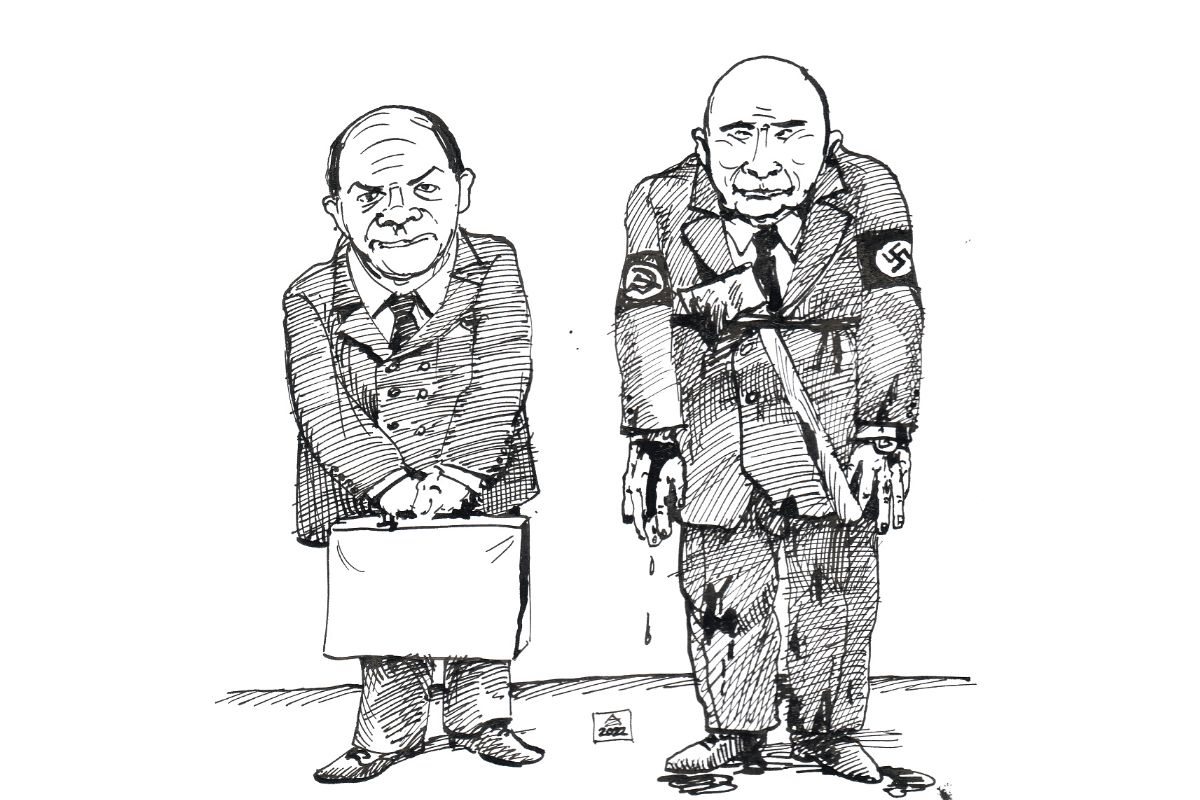
Illustration by Andrzej Zaręba
A whole cascade of strategic mistakes by successive German governments helped to destabilise the situation in Eastern Europe and embolden Putin, who could perceive Germany as weak and indecisive.
German political elites were probably amongst the staunchest believers in the proverbial “end of history”. For the first time in modern history the country seemed to be surrounded by friends. The mainstream of German politics believed that – at least in Europe – geopolitical competition was over. A post-Cold War order would allow the country to focus on internal unification, foreign trade and the expansion of the European Union. Questions of security and strategy could be outsourced to the United States and NATO. For a long time, they hardly played a role in political discussions or campaigns.
Painful lessons
Building on the myth that Ostpolitik and détente had ended the Cold War, Berlin sought to engage with Putin’s Russia through trade and accommodation. For the most part the official Berlin chose to ignore Putin’s crimes in Chechnya. The veto against the further expansion of NATO in 2008, as well as the decisions surrounding the two Nord Stream pipelines, were at the heart of these policies. Although noted by German experts, our Eastern neighbours and the United States, Berlin chose to ignore the radicalisation of Putin’s regime and Moscow’s use of military force in the post-Soviet realm and Syria. These policies of catering to Russian aggression reached their apex in the two Minsk agreements, deals that provided Kyiv with crucial time but also undermined Ukrainian sovereignty and legitimised the Russian invasion of the Donbas.
Even former supporters of Chancellor Angela Merkel recognise today that Germany should have changed course in 2014. But until February 24th 2022 Berlin structurally supported Putin’s anti-Ukrainian policies by backing the failed Minsk deals, buying large amounts of Russian oil and gas and failing to provide Ukraine with military aid. The prehistory of Olaf Scholz’s Zeitenwende (turning point) is the failure of Ostpolitik. The processes of recognising the mistaken decisions of the past and critically reassessing German appeasement of Russia have just begun. Amongst others, I have supported the idea of setting up an independent commission to investigate the failures of our Russia policies, as well as clandestine Russian influence.
This process will be important in order not to repeat the mistakes made towards Russia and in Germany’s relations with China. Looking back is also necessary in order to rebuild trust with our neighbours in Central and Eastern Europe and with Ukraine – countries that have been deeply disappointed by Berlin’s negligence. It will be a long and painful process because many politicians in Berlin were involved or have supported our failed Russia policies. Despite all evidence, the myth of Ostpolitik and of Germany as a beacon of peace and stability still looms large: many now claim they were just “tricked” by Putin. These dangerous new narratives need to be firmly rejected. We need to learn more about the personal responsibilities of those who held the highest offices of state over the last 15 years.
Still, Germany and the West must also think about the present and the future. While the war is continuing, it is paramount to support the Ukrainian war effort. Ukraine fights for Europe, for our shared freedom. Russia is not only breaking international law. Legal experts agree that the Kremlin is conducting genocide in the middle of Europe. Not since 1945 has Europe seen war crimes on this scale. The majority in Germany realises that there can be no revival of the special relationship between Berlin and Moscow that emerged after 1991. As long as Vladimir Putin stays in power, any attempt at normalising relations is out of the question. Putin and his entourage have to be held accountable for their crimes. Even after Putin, the actions of the Russian political class will demand consequences. Instead of bilateral relations, any future German Russia policy should be embedded in European efforts to contain Moscow’s power. Therefore, not only Germany, but the entire western alliance must agree on strict conditions for any normalisation of relations with a future Russian regime.
Preparing for what comes next
At the moment it is impossible to foresee how Russia’s war of aggression against Ukraine will end. But we can look back at Russian history and ask ourselves what would have to change in order to stabilise the situation in Eastern Europe in the long term. It is essential that the collective West starts to think about a post-war order. When Russia lost wars – like the Crimean War of 1856, the disastrous war against Japan of 1905, the First World War or the Afghan War (1979–89) – this always meant radical changes in domestic politics. Defeat was often followed by short periods of liberalisation. While we do not know what will come after Putin, we can assume that turning away from an aggressive foreign policy and repressive domestic policy is a plausible possibility. The Russian hawks have nothing to offer – neither abroad nor at home. Their aggression has had catastrophic consequences for all parties.

The rapid collapse of the Soviet Union at the end of 1991 took the West by surprise. The Americans and the Europeans quickly sided with the winner of Russia’s internal struggle and supported Boris Yeltsin, who described himself as a democrat. Western governments deliberately overlooked the fact that large parts of the Soviet repressive apparatus continued to exist. In particular, the domestic secret service FSB – standing in the tradition of the Soviet KGB – regained power and influence in Russia as early as the mid-1990s. Putin was chosen as Yeltsin’s successor because of his KGB background. Once in office, Putin had a free hand to expand the power of the secret services even further. From the 2000s they have dominated the state as well as the economy and subjugated a weak civil society.
At the moment, Russia has become an international pariah because of the attack on Ukraine and as a result of western sanctions. However, the day could come when another Russian ruler will once again try to re-establish relations with the West. Russia needs western technology in order to fend off the threat of becoming a Chinese colony. Historically, modern Russia has moved away from the West time and time again, only to reconnect later. It can be assumed that this will remain the case. We just do not know when the next moment of rapprochement will come.

Before normalisation
If there were to be a new regime in Russia, the West should set clear conditions before broken relations are normalised. Normally, western influence on Russia is weak – but it is the strongest when Russia is in crisis and needs assistance. This will be the case at the end of this war. The West should not miss this window of opportunity. In my view, the West should set six key points as a pre-condition for any normalisation in our relationship with Moscow.
First, the full withdrawal of the Russian Federation from all occupied territories in Ukraine, including Crimea. Moscow must also withdraw from Georgia, Moldova, Belarus and Syria and recognise the 1991 borders. Second, Russia must pay comprehensive reparations to Ukraine and other states like Georgia that have suffered from Russian aggression. Third, there must be a comprehensive disarmament of the Russian army and nuclear forces in exchange for western security guarantees. Moscow should no longer pose a threat to Europe. Fourth, Russian war criminals need to face the International Criminal Court. Fifth, free elections should take place in Russia together with the restoration of the political rights of Russian citizens. And sixth, the destruction of the criminal Russian secret services that have formed the basis of the Russian regime in recent years must also be pursued.
Realistically speaking, the West will hardly be able to achieve all six points. Nevertheless, we should try. These six points are worth pursuing – otherwise our children will still live under the Russian threat. We must not repeat the mistakes of 1991. Additionally, Germany needs to renew its commitment to the West and development a strategic culture in order to overcome the idleness and naïveté of the decades after reunification. Berlin has to realise that it must take responsibility for the failure of our policies. Germany must work hard to regain the trust of our partners in the Baltics, Central Europe and Ukraine. Together we must work out a new policy which will contain a future Russian threat.
Jan Claas Behrends is a historian of Eastern Europe. He is head of the international research network “Legacies of communism” at the Leibniz Centre for Contemporary History in Potsdam and teaches at Viadrina University in Frankfurt on Oder.