
EU-Armenia co-operation at a crossroads
The launch of the Eastern Partnership in 2009 became strategically important for Armenia as it gave a chance for alternatives and a diversification of its partners in the West. The programme not only provided financial assistance to Armenia, but it also enriched the narrative on EU-Armenia relations.
Armenia’s relations with the European Union, within the Eastern Partnership (EaP) programme, have seen many positive developments accompanied by certain setbacks. Thanks to the EaP, the EU has become an important strategic partner for Armenia, introducing a democratic agenda and guidelines for democratic development. Since the EaP began 11 years ago, it has included the signing of significant documents with the EU. Yet due to deviations from the democratic path, Armenian authorities, at times, also backed off on co-operation. The 2018 Velvet Revolution in Armenia showed there is a desire in the country for democracy. Yet despite these changes, Armenia’s foreign policy has not changed, making it difficult to observe tangible results in the advancement of the EU-Armenian relations.
September 4, 2020 -
Hasmik Grigoryan
-
AnalysisIssue 5 2020Magazine
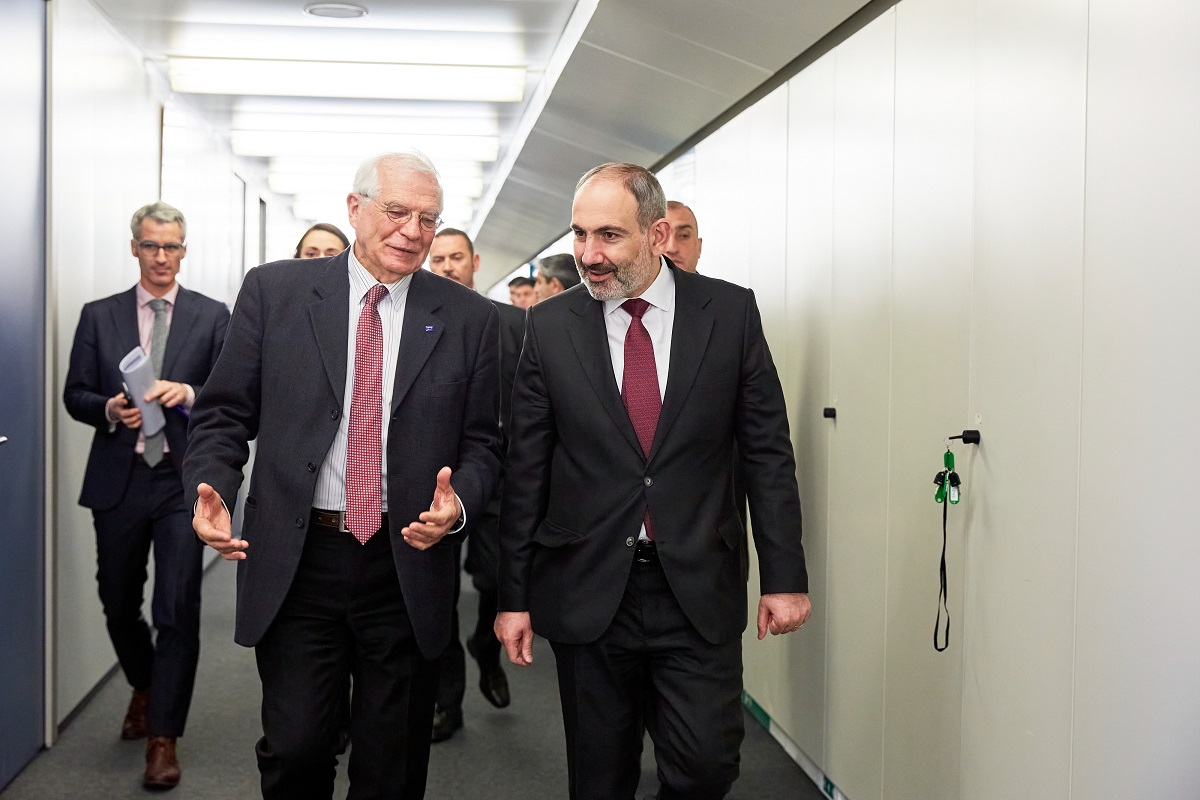
Nikol Pashinyan, Josep Borrell Fontelles. Photo: European Commission
If the EU had a stronger position on democratic values in Armenia, more emphasis on civil society and less focus on official channels, it could be the start of strengthening co-operation in the Eastern Partnership.
Diversification
If EU-Armenia relations under the Eastern Partnership were measured in terms of democracy assistance, then we could say that the progress of democratisation on the official level has been very slow. However in the case of observing EU-Armenia relations in the realm of strategic co-operation, there is no doubt for Armenia that the Eastern Partnership has been an important political programme.
To understand the role of the Eastern Partnership in Armenia, it is important to analyse Armenia’s foreign policy over the last several years. Since the early 1990s, Armenia’s foreign policy has been dominated by its military and political partnership with Russia, whereas the partnership with the European Union was mostly on an economic and humanitarian level. Future orientation towards the EU and the West was never prioritised, especially considering the Nagorno-Karabakh conflict remained in the background. The military co-operation vacuum in the region for Armenia has been filled via co-operation with Russia, and under these conditions it was difficult to imagine that Armenia would make any abrupt changes in that regard.
Relations with Russia expanded in the early 2000s and part of Armenia’s sovereignty was handed to the Russian Federation. This was visible in the “assets-for-debt” agreement, which gave key state resources, such as electricity, gas and railway networks, to Russia, in return for reducing Armenia’s debts owed to Russia. In 2010 Armenia also agreed to extend Russia’s military presence until 2049. In December 2013, Armenia transferred the remaining 20 per cent share of its gas distribution network to the Russian-owned company, Gazprom.
Nevertheless, the launch of the Eastern Partnership in 2009 became strategically important for Armenia as it gave a chance for alternatives and a diversification of its partners in the West. The programme not only provided financial assistance to Armenia, it also enriched the narrative on EU-Armenia relations. In the framework of the Eastern Partnership, Armenia gained an opportunity to negotiate its Association Agreement and the Deep and Comprehensive Free Trade Area (DCFTA). In terms of successful reforms, Armenians would also get a chance to gain visa-free travel to the EU. As engagement with the EaP and negotiations with EU partner countries increased, Armenia could feel the political presence of the EU grow.
The Eastern Partnership also raised the importance of democratic values in Armenia. Such tools as EaP co-operation subcommittees on justice, freedom and security – or panels on migration and asylum, the fight against corruption, and integrated border management – introduced important values to the country while serving as guidelines for the democratic reforms process. Many Armenian state institutions benefitted from EU assistance via legislative reforms, an emphasis on good governance, training and capacity support. The EU also assisted Armenia in the harmonisation of its laws with the standards and requirements of the European Council. The EU implemented specific programmes on water management, environment and agriculture, and raising the image of the EU in Armenia.
Lack of political commitment
During the last 11 years Armenia has signed three key documents with the EU. In 2012 Armenia and the EU signed the Agreement on Facilitation of the Issuance of Visas, which was followed in 2013 by the signing of the Readmission Agreement. The political partnership between the two sides was reinforced by the Comprehensive and Enhanced Partnership Agreement (CEPA), signed in 2017.
While Armenia and the Eastern Partnership registered important success, co-operation between the EU and Armenia has also had some setbacks, largely due to the lack of political commitment by the Armenian authorities. The partnership did not reach its initially planned Association Agreement and DCFTA. The sudden refusal to sign the Association Agreement in September of 2013 was a dishonest move from the side of the Armenian government. After a long process of negotiations with the EU starting in 2010 and initialling of the agreement in the summer of 2013, Armenia unexpectedly reversed its decision and refused to sign the agreement in the fall ahead of the Eastern Partnership Summit in Vilnius. The refusal became a clear sign that there is a lack of political commitment from Armenia to push EU-Armenia relations forward.
The developments in 2013, while disappointing, should not have come as a total surprise as there were many indicators that the Armenian authorities had been deviating from its progress on the democratic reforms. The parliamentary and presidential elections of 2012 and 2013 were organised with mass violations and were followed by civil protests. Furthermore, it could be argued that during these years the Armenian authorities were promising the EU to sign the Association Agreement, in order to receive less condemnation about the conduct of the election. What complicated EU-Armenia relations even more was that right after the refusal to sign the Association Agreement, Armenia started the process of accession to the Russia-led Eurasian Customs Union, which later became the Eurasian Economic Union.
In light of these events, the European Union needs to develop a stronger position regarding development in the Eastern Partnership countries. The approach of “more for more” is an important tool, however it should be tailored to the development of democratic standards. More support should be provided if a country demonstrates clear commitment to democratic principles, while support should be decreased if the authorities deviate from these reforms. The EU could have reduced its financial support, for example, when Armenia refused to sign agreement.
This is not to say that EU-Armenia relations have had no success since then. Despite the slow process, Armenia has made some visible progress. The Eastern Partnership continues to serve as an alternative platform for Armenia – in 2017 the authorities signed a new Comprehensive and Enhanced Partnership Agreement. Although the CEPA differs from the Association Agreement, it certainly is an enhanced and much improved legal basis for positive reforms. The importance of civil society was also acknowledged in the CEPA and was institutionalised as a participant in official relations between the two sides.
Certain dilemma
During the Eastern Partnership Summit in June this year, Armenia and the EU began its co-operation with a certain deadlock for a couple of reasons. First, since the 2018 Velvet Revolution, Armenia has not made any abrupt foreign policy changes towards the West; and, second, due to the slow implementation of the existing agreements with the EU. In June 2019 the new government of Armenia signed a roadmap on the implementation of the CEPA. The reform agenda includes extensive and important steps including judicial reform, an increase in the number of judges, the creation of a commission on anti-corruption, the development of national strategies in the fight against corruption, the protection of human rights, and the adoption of amendments in the electoral code. Moreover, in February of 2020, Prime Minister Nikol Pashinyan signed an agreement to set up a professional commission on constitutional reform.
Here, the main issue is whether the roadmap will be implemented efficiently and in a timely manner. The process has been very slow from the Armenian side. This can be explained by the lack of experience of the newly formed post-revolutionary government, the difficult legacy it inherited from the previous corrupt regime, limited economic networks and of course the threat of COVID-19.
Within the six EaP countries, the CEPA is certainly a positive document. However, it is noteworthy that post-revolutionary Armenia has demonstrated little advancement in its relations with the EU: it has not endeavoured to design a new, more advanced, partnership – in fact, it continues to implement the document that was signed by the previous regime.
In this regard, Armenia faces a certain dilemma. On the one hand, the 2018 revolution was not related to its foreign policy. The newly formed government does not mention any plans for future EU membership. On the other hand, the revolution that was driven by various democratic layers of society, and under Pashinyan’s leadership, had clear intentions of ending authoritarianism and corruption. This illustrates that moving towards greater partnership with the EU would help achieve the goals of the revolution.

In light of these developments, the EU should also adapt its approach towards Armenia in the Eastern Partnership. Co-operation over the last 11 years has largely focused on official developments and less on civil society. Even when working with civil society, the EU has always supported civil society organisations that closely work with the national government. This policy should be changed, as support of the EU is important for further developing the NGO sector and for preserving diverse actors in the country. The revolution has demonstrated that the Armenian public desires democratic reform.
Certain steps have already been taken place by the EU to support the private sector in Armenia. In 2019 the EU supported private companies in the development of solar energy and energy efficiency as well as tourism. More support should now be given to the democratic civil society organisations that work independently and strive to increase democratic values and monitor policies implemented by the government. The EU should also increase its presence in Armenia by opening European institutions, or democratic centres that would assist the reforms.
Hasmik Grigoryan is a senior research fellow at the Yerevan-based Analytical Centre on Globalization and Regional Cooperation (ACGRC).