
Moldova (re)balancing its foreign policy
For the time being, Machiavellian principles dominate Moldova’s foreign policy. With pressure from the European Union targeting the rule of law and the need to find material benefits, the current Moldovan ruling elite is heading to the widest doors.
Since the first days of independence in 1991, the political class in Moldova has chosen to tie the country’s foreign policy to a bifurcated East-West orientation. This is reflected in the state’s governance as leaders constantly search for quick fixes from the outside. Thus, this geopolitical oscillation has become a modern Moldovan political tradition with the foreign policy dichotomy as a sort of “trademark” used to quickly interpret, not always accurately, public perceptions or the conduct of the political parties by observers both at home and abroad.
April 6, 2020 -
Denis Cenusa
-
AnalysisIssue 3 2020Magazine
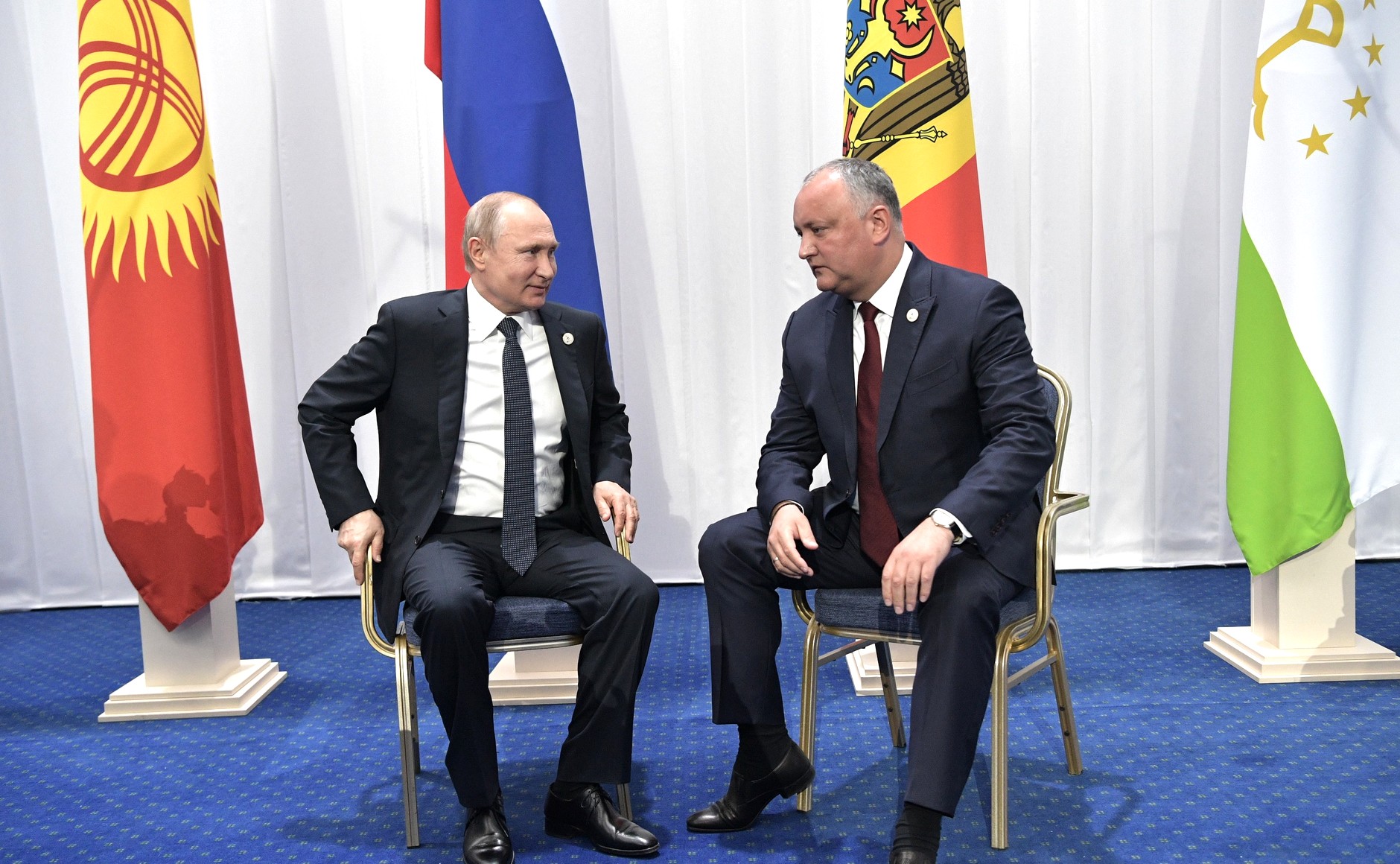
Moldovan president, Igor Dodon, in a 2019 meeting with the Russian president Vladimir Putin. Dodon has invested considerable political capital in building a strategic dialogue with Russia. Photo: President of Russia (CC) http://en.kremlin.ru/events/president/news/60598/photos
Since the enlargement of the European Union in 2004-2007, integration with Europe was seen as the only choice available by many states in Eastern Europe. The pro-EU inclination dominated the foreign policy agenda when the Association Agreement and visa regime with the EU came into force in 2014. However, its effect on influencing the ruling elite towards maintaining this vector was not so obvious.
Russia first
The termination of the oligarchic regime, followed by the eviction of the pro-reform government towards the end of last year, and the installing of a Russian-friendly Socialist-led coalition, illustrates how the elite view foreign policy. The oligarchic regime imitated the pro-EU leaning from 2015 until 2019, exploiting in parallel the confrontation with Russia. During the short five months of her time running the government (between June and November 2019), Maia Sandu, who led among others the pro-reform ACUM bloc, restored trust in the EU-Moldova weakened dialogue, but also allowed for an opening in relations with Russia. When the Socialists took control over the legislative and executive bodies in November that year, the rebalancing of foreign policy turned into a major political priority of the new government of Ion Chicu.
In context of 2020 the new government has less of an appetite for geopolitical multi-polarity. According to its approach, Russia, first and foremost, is to enjoy a special place in the constellation of Moldova’s foreign policy. Second, European integration should be selective, but not entirely removed, due to the high volume of Moldovan goods heading to the EU and the fact that over 50 per cent of the public still support the EU. Finally, any bilateral relations, starting with its neighbours, must favour Moldovan statehood even at the cost of Russia’s increasing influence.Worryingly, the three principles can contradict each other. As a result of this schizophrenic approach to foreign policy, any authentic democratisation process or cross-cutting principles of good governance are losing ground.
In terms of economic and institutional deficiencies, the elite have often felt it necessary to exhibit different types of dependency on powerful regional actors (in most cases it is the EU and Russia). Interest in NATO as a defence community for the state remains low with less than 30 per cent public support. Efforts to add a neutrality status into Moldova’s constitution have been instrumental in convincing the public against any notion of NATO membership. Russia, too, has explicitly expressed that solving the frozen conflict on Moldova’s territory would require an unalterable neutrality status.
What is more, some social segments in Moldova increasingly link the idea of NATO membership with the unification with Romania. This scenario, according to the latest polls, has less than 30 per cent public support. Yet, the worsening demographics, poor governance, and no improvement in everyday living conditions, have put the sustainability of Moldovan statehood into question. But the low level of political mobilisation around “unification” keeps it out of mainstream thinking across the country. At the same time, the Romanian government approaches its relations with Moldova via a separate department within the government responsible for it, while being in line with the EU’s strict reform conditionality.
Genuine reforms vs expressive pro-Russianness
It does not take a great deal of time and resources to sweet-talk Russia or the EU. The two players, nevertheless, have begun to take notice of the chameleonic approach of Moldovan politicians. The EU, for instance, has become more cautious and less impressed by pro-EU discourse without action. With a lack of genuine reform, the EU has refused to renew financial support to the central authorities in 2020. In one of her last speeches as the EU’s High Representative, Federica Mogherini regarded “genuine reforms” by the new government as a prerequisite for securing support in the future. The EU Delegation to Chișinău, Peter Michalko, frequently notes that “justice and anti-corruption reforms” remain crucial in establishing whether Moldova fulfils its commitments or not. Preferring values over geopolitical loyalty, the EU has decided to gauge whether Moldova is transformable and seriously willing to align with the EU.
Russia, on the other hand, appreciates a combination of praise and unilateral political-diplomatic actions that emanate subordination and respect. This can explain the risky actions of the Moldovan president, Igor Dodon, to please Russian officials. One of his boldest moves was bringing Moldova closer to the Russian-led Eurasian Economic Union in 2018, by becoming an “observer” country. By doing so, Dodon overstepped his constitutional authorities, bypassing parliament. Dodon is well known for lauding Russia in the highest international forums. During the UN General Assembly in September 2019, he praised Russia for agreeing to destroy weapons stored in the Transdniestria region instead of avoiding a request for their immediate withdrawal. Earlier this year, he emphasised the role of the Russian language in inter-ethnic communication in Moldova. More recently, Dodon advertised the celebration of the 75th anniversary of the Soviet victory in the Second World War. The predilection for a conservation of Soviet memories has a strong presence on the Socialists’ political agenda. In 2019 Dodon closed down the Museum of Soviet Occupation, established in 2015 during a brief time of de-Sovietisation. Amid the commemorations, the Socialist mayor, Ion Ceban, elected during the 2019 local elections and bringing a left-wing mayor to the capital for the first time since independence, announced a new museum that will feature the story of the Leningrad blockade.
Engineering friendships
The mid-2019 political transition was supported by the United States, together with Russia and the EU. The attempt of the previous oligarchic regime to seduce Washington with the relocation of the Moldovan embassy to Jerusalem fell flat. A qualitative change came with Maia Sandu’s government, which prioritised two significant aspects in relations with the US. First, the “immobilisation” of fugitive oligarchs came into place and included a strong will to introduce individual sanctions. Second was an exploration of financial assistance which could include Moldova’s eligibility to return to the US-run “Compact” aid programme, dedicated to underdeveloped countries and that was operational in Moldova until 2004. Nevertheless, only the first goal materialised – the US introduced visa restrictions on the oligarch Vladimir Plahotniuc and members of his family. The US did not drop the reform agenda towards Moldova, despite the fact that the Socialists Party shut down the pro-reform government of Maia Sandu. On the contrary, the bilateral dialogue on justice and anti-corruption reforms accelerated. That makes the US slightly different from the EU: Brussels shows more reluctance, and “waiting and watching” using strict conditionality.
While the EU keeps a firm hand on strict conditionality, the tenacity of diversifying the sources of Moldova’s external dependency has become even more visible. While the government vows full compliance with its commitments with the EU, the unconvincing reforms in critical areas, such as justice, reinforce the impression that European integration is reaching a point of political fatigue with the Socialists.
The Moldovan government, incapable of earning the trust of the West, has decided to build friendships with other regional powerhouses. Both Russia and Turkey enjoy the openness and respectfulness of the Moldovan ruling political forces towards their authoritarian tendencies. The treatments though display distinguishing traits. The Socialists and the president have invested considerable political capital in building a strategic dialogue with Russia. With that came electoral visibility, political relevance, but also permanent and unpleasant distrust from the public and the West. Both Vladimir Putin and Dodon understand that bilateral relations can offer reciprocal rewards, though massively disproportional ones. Thus the Kremlin is regularly consulted regarding matters of Moldovan national interest. In return, Dodon is invited for high-level talks giving the impression of an elevated status for the country. Such relations rely on personal contact, which is harming formal institutional structures. Therefore, Dodon’s unconditional loyalty to Putin, who appears to be manoeuvring to stay in power well beyond 2024, can ultimately jeopardise Moldova-Russia relations.
In many cases, the superficial appearances are outweighing the de facto accomplishments. For instance, the decrease in gas price in 2020 – from 240 US dollars to 173 dollars per 1000 cubic metres – is related largely to market fluctuations. Yet, Prime Minister Chicu and President Dodon both portrayed this as a sign of Putin’s goodwill. Even if Dodon has been playing the Russian card for a long time, Russia’s embargoes – engineered since 2013 against the pro-EU advancement of the country – were only slightly softened. That has not discouraged the Moldovan leadership from looking for other benefits from Russia, such as a credit line worth 300 million dollars. This money has a practical meaning, namely, fuelling Dodon’s promise to repair the nation’s poor road infrastructure ahead of the next presidential election.
The search for allies abroad has also influenced the dynamism of contact with Turkey. The launching of the Turkey-Moldova Security Co-operation Council in late 2019 significantly advanced the political dialogue. The Council includes the objective of expanding the sectoral interaction in some vulnerable areas like the functioning of law enforcement bodies.
As a matter of fact, Turkey is already trying to instrumentalise the strategic partnership in order to seize control of Turkish cultural entities operating in Moldova. The Turkish president, Recep Tayyip Erdoğan, sees the “Orizont” lyceums (in Moldova since 1993) as an extension of the much hunted Gulen movement. Under partial international isolation in 2018, the previous regime abducted and extradited seven Turkish teachers who worked for the “Orizont” lyceums, just before Erdoğan’s visit to Moldova. After the launch of the bilateral Security Council, Turkey demanded the transfer of the “Orizont” lyceums to the state-controlled foundation Mariff. For the moment, Dodon has claimed to be powerless since the targeted lyceums belong to undisclosed private entities from Romania.
Predilection for “strong men”
In order to have a real stake in this autumn’s presidential election, Dodon needs to put aside the controversial issues that can likely re-surface later. Instead, he has diversified trade and investment and avoided the pressure coming from western partners. The prioritisation of relations with Turkey is quickly bringing results. For instance, a leading Turkish company in the scrap metal business, Șahinler, entered the Moldovan market early this year. Another Turkish holding, Yuksel Yildirim, is manifesting a pronounced interest in the country’s only international port, situated in Giurgiulesti, opening Moldova to maritime routes in the Black Sea.
So far the engagement with assertive regional autocracies like Russia and Turkey has not created any conflict. That gives more leverage to Dodon. On the one hand, it helps him counterbalance the principled approach of the EU and the pressure from its conditionality policy. The reduced dependence on western aid will be an important development. On the other hand, following the autocratic verticals of power is increasing voters’ preference for a “strong man” style of leadership.
An opposition victory in the presidential election in the autumn of this year would bring radical change to the presidential institution – energising more contact with the West and depersonalising relations with the East. Dialogue with Eurasian institutions would be downgraded to correspond with the constitutional procedures and the strategic objectives of European integration. The presidency could then potentially convert into the main fortress of European integration. If Dodon succeeds, however, the Machiavellian principles currently being promoted would become unstoppable, at least until the next parliamentary elections.
Denis Cenusa is a PhD candidate and researcher at the Institute of Political Science at the Giessen University in Germany. He is an associate expert at the “Expert-Grup” think tank in Moldova and a contributor at IPN News Agency in Moldova since 2015.