
A writer and war. Karahasan, the rebel
Dževad Karahazan’s rebellion was the result of his refusal to live imprisoned in a world of absolute truths, which are fed on the fear of others. He was not an idealist. He experienced real evil. He chose the life of a writer who diligently collected the remains of the wisdom of bridge builders.
When I learnt about the passing of the Bosnian writer, essayist and philosopher Dževad Karahasan, I could immediately feel the taste and smell of the Bosnian meat stew dagara. In our lives there are meetings that leave permanent marks on us. Regardless of when and where they take place, they come back to us as if they were real again.
February 7, 2024 -
Krzysztof Czyżewski
-
Issue 1-2 2024MagazineStories and ideas
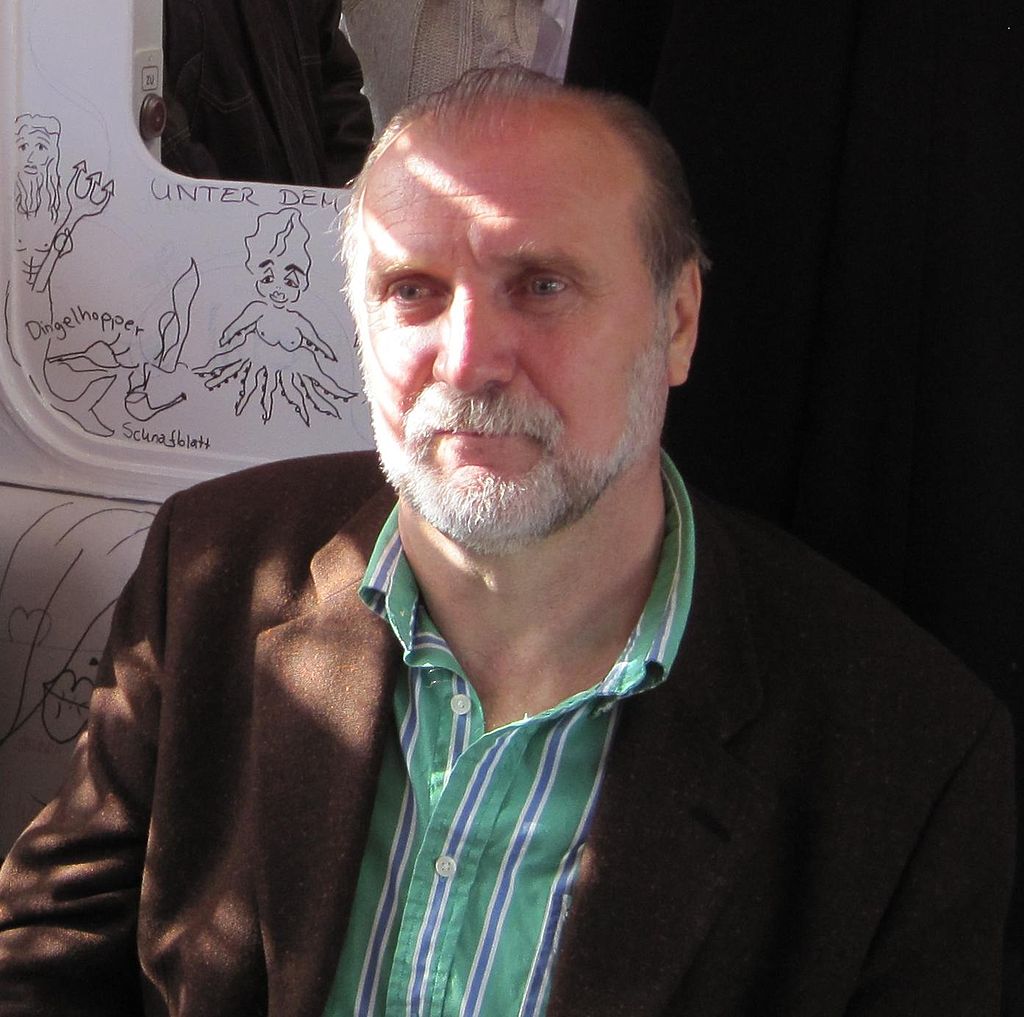
Dževad Karahasan died on May 19 2023. Photo: Stefan Flöper (CC) commons.wikimedia.org
I was Karahasan’s neighbour for half a year. We both resided in the famous clock tower (Uhrturm) at the Castle Mountain, which is now a public park, in Graz, Austria. At this place the city of Graz offers literary residencies to writers and writers in exile. There, we could also smell the dagara that one of our neighbours, Mrs Šarić, was cooking. Šarić’s husband was a former prisoner of the Serbian concentration camp in Omarska. His look was that of a man who had gone silent forever. Karahasan could yet read from his eyes and write. He became the voice of the pain-torn and misunderstood Bosnia.
Dark and bright at the same time
Šarić’s silence would be broken, even by the strong taste of coffee that Karahasan was brewing in his cezve, a small copper pot he had brought from Sarajevo. Thinking about this coffee I can still taste its bitterness, perfectly balanced by the sweetness of the Turkish delight that we would place on our tongues when taking our first sip and which would actually burn our mouths. When consumed separately, these two are actually difficult to digest. They are extreme in their distinctiveness, just like everything in Bosnia and also in the whole Karahasan family. When describing his parents, Dževad would say that his father was a “religious communist”, while his mother a devout Muslim. His own spiritual development was influenced by the Franciscan order from Duvno, his hometown, now called Tomislavgrad. Bosnian coffee matched the tone of our conversations, which were dark and bright at the same time. They were flavoured with both humour and bitterness.
During our residencies, the Yugoslav Wars were still ongoing and so was the siege of Sarajevo. I came to Graz straight from Mostar, Tuzla and other cities in Bosnia and Herzegovina that I had visited together with Poland’s former prime minister, Tadeusz Mazowiecki. At that time, Mazowiecki was the Special Rapporteur for the UN Commission on Human Rights. He was commissioned to prepare a report on evidence of ethnic cleansing in former Yugoslavia.
When I had shared my testimonies of Serbian crimes, Karahasan responded to me with a story about a Serbian woman who lost her life after having offered shelter to Muslims. It was his wife’s mother. Dževad left Sarajevo in February 1993, almost a year after the shooting of Suada Dilberović and Olga Sučić, the first two victims of the Bosnian Serbs’ Democratic Party militia. Their murder was later recognized as the beginning of the genocidal siege of the city. A few months later, Dževad was joined in exile by his wife.
Karahazan needed a long time to write novels. It was as if he was waiting for his protagonists to leave him and start lives all on their own. He started writing his last novel, Introduction to Floating (Uvod u lebdenje), back in 1998, only to later shuffle its manuscript in the drawers of his desk. Three years ago, Karahazan was diagnosed with cancer. It seemed that he beat the beast after intense chemotherapy. A sudden wave of strength and close contact with death, which he had befriended a long time ago, allowed him to finish the novel before the first symptoms of the illness returned.
Introduction to Floating tells the story of Peter Hurd, a specialist in ancient literature and mythology, who had come to present a lecture in Sarajevo before the outbreak of the war. There his drama started. It took the form of a sudden, unexpected and counterintuitive decision to follow his internal voice and stay in war-torn Bosnia. He did this despite having had his return ticket already purchased, despite a life in peace and comfort being available to him.
It would seem that the experience of love and suffering somewhere else can make us who we are: “I would never trade with anyone in the world,” says beautiful Aida in another Karahazan book titled Sarajevo, Exodus of a City. “Trust me, I would not trade with any of these people.”
“These people” included, among others, an American who in a conversation with Dževad and Aida could not stop being surprised that “we were not going to agree with the division of Bosnia and Herzegovina, if this was the condition for peace.” He could not overcome his surprise, not noticing that his own hiding place when the Serbs were shelling the city was Dževad’s basement in Marindvor, a neighbourhood in Sarajevo where only one out of ten married couples was of the same nationality. “I realized this just now, at this moment,” Dževad added to make us understand that before the war that nobody bothered with ethnic issues. To stay in a country at war is what Ukrainians today express with the words “Я тут. Ми тут” (I am here. We are here).
Unlocking the mystery
Karahasan’s protagonists experience war not only because – like Peter Hurd – they renounce their tickets to paradise at the very last moment. They decide to go to war, equally unexpectedly, thereby causing distress to their loved ones who earlier thought of them as pacifists. Additionally, their wills include a mystery that will disturb their children and grandchildren. One of these characters was Max Löwenfeld from Karahasan’s short story Letters from 1993. Max was a young doctor who joined a Bosnian regiment during the First World War to improve his medical knowledge and skills. Similar decisions were made by Joseph Roth and Joseph Wittlin, two writers who studied in Vienna and who, despite being pacifists, joined the same Austrian army and went to the frontline. In 1920 they all moved to Paris. In France’s capital Max made a fortune and a name for himself and even built a wonderful family. He left it all behind in 1937 and moved to Spain, where he joined the International Brigades of the republican army. In a year he was among the fallen. His wife wanted to believe that he joined the army driven by his medical mission. This conviction was not shared by other members of his family, who knew his personality quite well.
One of the leads to solving such a mystery can be found in Karahasan’s Letters from 1993. It is to be found in a letter penned by Moritz, Max’s grandson who could not come to terms with the alienation of his father, who as a result of the Second World War, a tragedy that his grandfather wanted to prevent, became a Jew. This was despite the fact that only a few generations prior his family had adopted Christianity. “He had to understand that while it remains unclear what a Christian looks like, it is very clear what a Jew looks like; matter-of-factly an average Jew looks exactly like him.”
When I am re-reading these letters today, I feel the bittersweet taste of Dževad’s coffee. Moritz’s grandfather Max indeed left Bosnia. He was convinced that it was impossible to live in a place with such strong cultural divisions and people who were only encouraging them. However, his own son, who was born and lived in Paris, where life was meant to be easier and more beautiful, also discovered the terrors of his times. He was not allowed to be like others and was humiliated by the need to hide from other “more real” Christians. As a result, he discovered that under the slogan of “us” is a hidden layer of “others” who are persecuted. Moritz also remembered that at the time of the Algerian War his father was calling the French authorities as “them”, while calling the Algerians “us”.
Hatred’s hideous power
Karahasan’s short story is like an identity “palimpsest” of his protagonists. It takes us to the depth of the dramatic experiences of the people who live in borderlands, and which take place in the face of subsequent wars. In his Reports from the Dark World, we can read another letter, this time one that Moritz found in his home archives. His grandfather wrote it in German to his old friend from Sarajevo. The letter was penned shortly before Max’s departure to Spain. For me, this piece is one of the most touching out of all of Karahasan’s writings. It echoes some of the conversations we had together during his stay with us in Sejny (in northern Poland) and when I visited him in Sarajevo. In these talks, Dževad was constantly referring to Ivo Andrić’s Letter from 1920. Written soon after the Second World War, this short story depicts the world’s darker side, one which is ruled by hatred and fear. And because the latter is here seen as the consequence of a lack of confidence and knowledge, the truth about what is evil in human beings is hidden in hatred. The heart of the dark side of the world can indeed be found in Bosnia.
Karahasan knew the whole of Letter from 1920 by heart. He was reading this text as if Andrić (who, matter-of-factly also lived and worked in Graz) wrote it for him and sent it to his residence in Graz, addressing it to a “refugee” from Bosnia. He could feel that in this text there was something extremely poignant, something that we are too fearful to utter and put into words. At the same time, this something is not the full truth, not about Bosnia or the world. Andrić was correct in recognising that hatred’s hideous power comes from it being transparent to those who bear it or from them repressing it from their consciousness. That is why hatred also needs to be brought into the light and addressed in a way a doctor addresses an illness.
Andrić made hatred eternal by linking it with borders and darkness, which irreversibly are part of a human condition. This fatalism of the old master yet generated a need for rebellion in Karahasan. He felt that he had to respond to Andrić’s text and thereby enter into a dispute about the essence of the world, the meaning of literature, about who is who and what is “the fight” all about. Responding to the Letter from 1920 took him the rest of his life. Following Andrić’s footsteps he entered into its darkness. However, his interpretation of it was different.
Karahasan’s collection of short stories, Letters from 1993, was an intentional continuation of the correspondence which originated in Andrić’s short story. Yet, his Max Löwenfeld was 17 years older. He had already lived in an Italy that was then celebrating its unification, as well as in France which had been united for long enough that nobody questioned it. He admitted to his old friend from Bosnia that these experiences did not give him a single argument for the superiority of uniformity over diversity. When wondering what would happen to his neighbours in Paris, who also all live in different worlds, he concluded: “It would only blur differences between us, our awareness of these differences and our self-awareness, as it is the differences between our private calendars that make me a doctor, my patient a future corpse and his son joy to the eyes.”
Max’s escape from Bosnia ended in Spain, in a hospital bombed by fascists. If it was an escape from hatred, it was in vain. A high price for the value of uniformity was also paid by his son who lived in occupied France during the Second World War. As important as all these are they are not enough to face the fatalism of Andrić’s story, one that hangs over Bosnia, Karahasan and all the people who stayed in a war-affected country or have visited such a place.
In a letter from 1937, Max also did not give any final answers. By then he had been enriched by the experiences that allowed him to go beyond the uniformity versus diversity debate. This led him to the conclusion that he was not wrong in noticing the potential for hatred in Bosnia’s nourishing of differences, but also admitted “that it was not enough of a reason to give up on the city and leave it. Real care for diversity means getting interested in one another and becoming important to one another”. Max admitted that escape from Bosnia had an impact on his decision to join the International Brigades in Spain. His openness in admitting that there are no answers to all questions and problems was something that Karahasan shared. That is why despite visible traces of the search to find answers to Andrić’s Letter from 1920, which we can see in many of Karahasan’s texts, they never include the author’s temptation to give superiority to his own views. Instead, there are more open questions and the reader is encouraged to continue the journey.
Temptation to escape
When finishing his Reports from the Dark World, Karahasan asks a question about whether it is possible to understand the fate that binds a man with the place and the people who live in that place, just like his fate bound him with Bosnia: “I don’t know and I will probably never know. I can only secretly hope that we will be able to understand or sense at least some truth.”
The same can be said about Karahasan’s escape from Bosnia. Evidently, he never left it. He lived in Graz and Sarajevo at the same time. The problem lied in something else: it was his temptation to escape from the world of darkness. He continues to be haunted by the question of why he could not mentally leave Bosnia and was constantly writing about it. Why, as the opponent of the war, could he not turn his back on his homeland and enjoy peace elsewhere?
To better understand Karahasan, it is wise to analyze the moment when Max Löwenfeld decided to leave Bosnia. Specifically, what Moritz remembered from the story about his grandfather and his escape from the world where people guard their differences so jealously that an “unexperienced eye may notice mutual hatred in them”. The point here is not the mutual hatred but the “inexperienced eye”, which allows us to see this hatred in other people. It means we find hatred where it is not yet to be found. Just like there does not need to be hatred in places where life is full of tensions, conflicts, contradictions, burning passions and borders, which are protected as if they were something sacred.
Yet, unable to tame these discrepancies, feeling uprooted from the traditions that can cultivate them and see beauty in them, we start to fear them. We start to distance ourselves from them and let hatred take the lead. In this case, hatred is not the essence of the world but a reflection of our worldview. Human pessimism can easily be fed here. Thankfully, we are not doomed to live in hatred and we can still do something. For example, we can change what we see with our eyes.
Karahasan believed that our eyes and perception can be made sharper by the differences which exist between us and the darkness which we need to get through. Hence, it is best to stay in the place from which fear and hatred would like to push us out and take complete control over us. Our recognition of hatred and bringing it into the daylight only makes it weaker.
Hatred wants to be invisible and it manages to be so when we see it only in others. It also succeeds when we blur borderlines, especially those that mark out oppressors from the victims. Good from evil. Our morality is born from differences. By blurring them we stop knowing who we are. Not only with regards to our gender or national identity but our morality. In this way, the border is the voice of our conscience. And that is why we are the people of the borderland. We see its overcoming but never blur it.
Wars, which make the enemy more recognisable, also make the borders of identity stronger. As a result, winners can draw political maps as they wish, taking control of the borders that had been fought over and gained with blood, which only reinforces them. A dictator who gains and keeps power as a result of war does not need to send people to prison or remote labour camps. It is enough that he forces us to put on the lenses of relativism. We could even help him achieve that. It does not matter that our understanding of moral relativism will be different than his and that unlike him we have our own morality. What matters is that the war that he had started takes control of our relativism and our ability to see borders.
From indifference to evil
War, together with the immense suffering that it brings on, can indeed make people insensitive to physical pain and mental suffering. This happened to Max Löwenfeld during the First World War. He had become indifferent to good and evil before he noticed that hatred was at the foundation of the multicultural Sarajevo and before he decided to escape from Bosnia. This huge change in Max’s personality was noticed by his old friend, the narrator in Andrić’s story. They knew each other from middle school in Sarajevo. They spent days browsing through the rich library of the Löwenfelds. They read books in their original language, which allowed them to learn German and Italian. They were also discussing philosophical matters and reciting literature. Yet the war separated the two friends. They tried to tell each other about it when they met at the train station in Slavonski Brod, where they were waiting for a train that would take them on a journey to a better world – the West.
Yet, when they talked, his friend did not talk about poetry or books. Their conversation was summed up in the following way: “[Max] talked a bit about the war in general and with great bitterness, but rather in the tone of his voice than with the words and which was not intended to be noticed.” From the letters mentioned during the 1993 siege of Sarajevo by the protagonists of Reports from the Dark World, Max Löwenfeld is a man who diagnoses himself and his surroundings with a fatal disease, which deprives him of the skill of separating the wheat from the chaff. That is why to comprehend Karahasan’s writings it is important to understand the indifference to evil. Max suffered from it since the First World War onwards. His indifference to pain took the form of a mental inertia. This is how you capitulate in front of a real enemy and escape from having to recognize who is the criminal and who is the victim. The very same disease befell Andrea from Sarajevo, Exodus of a City, when she could not accept the position of the UN workers who were turning their backs on those who supported one of the sides to the point that they would even see wounded children as taking sides in the conflict.
Indicatively, right after Russia started its full-scale invasion of Ukraine, people from former Yugoslavia started to warn Ukrainians of the danger of forging a war reality by relativizing good and evil, and blurring the border between black and white. Just like the Russian propaganda called the residents of Kyiv fascists, pro-Serbian propaganda called the residents of the besieged Sarajevo Muslim mujahideen. The Austrian writer, Peter Handke, accused the victims, including women from Bosnia, of inflicting wounds on themselves in order to generate pity in front of the cameras. “These lies were more painful than hunger, coldness and death,” wrote a Sarajevo-based journalist, Aida Cerkez, in her letter to Kyiv residents.
An escape from taking responsibility for the victims is the soft belly of the liberal West, which is skilfully abused by dictatorships like Russia and effectively used in their propaganda. As a result, the wars that these countries engage in often end with rotten compromises which take away a chance for victory. This more optimistic concept of believing in victory was only brought back to the world by the Ukrainians who put their faith in peremoha (victory in Ukrainian) in their fight for freedom and justice.

Be capable of more
In Sarajevo nobody talked about victory. That is why Karahasan called the 1995 Dayton peace treaty “a security vest” which only maintained the existing schizophrenic tribal divisions. As a recipient of many prestigious European awards, he could not forgive Europeans for their inability to understand and defend the ethos of the Sarajlije (Sarajevans), meaning those of the city’s residents who wanted to be a part of a shared and diverse polis. He was very bitter in his interpretation of the Dayton constitution, which made Bosnia the only country in the world where there are no citizens. Instead, there are only Bosniaks, Serbs and Croats.
Europe’s failure in the Yugoslav Wars did not free Karahasan from his continuous fight. He became even more rebellious. The price of his victory was to leave the dark land. That is why a more adequate explanation of his struggles with the world is related to the meaning of the Ukrainian term for victory: it is not as much the act of achieving victory, as it derives from its Latin root, victoria. For Karahasan, the process of overcoming evil was the most important thing. And here the original meaning of the Ukrainian peremoha proves better again: peremohty means to be capable of more. Thus, for Karahasan, statements such as “We can do as much as we can afford” or “You won’t be able to overcome” were expressions of capitulation that only allowed people to get used to living in the dark lands, where there is no exit. To be capable of more, in turn, is a challenge to overcome oneself, and aim at getting better. To enter this path, we need the bravery of our hearts and the readiness to follow our internal imperatives, to go against evil.
For Karahasan, it was clear that the side to support is that of the victim. That we need to stand by the Sarajlije, who were faithful to their diverse city. By opting for one side, he did not capitulate in front of evil but he also did not support any homogeneity or one-sidedness. In fact, it is just the opposite, as the bright side for him was diverse, complex and with multiple voices. On this side, the greatest art was that of the neimar, meaning bridge builder. Among these people the great master was Mimar Hajrudin, who combined beauty with goodness by building the famous Old Bridge in Mostar.
On Karahasan’s bright side were also people of dialogue – those who were capable of critical thinking, self-criticism and who would not treat their own convictions as final and absolute. They could listen, have a sense of humour and self-irony. That is why, when I talked about the prosecuted Bosnian Muslims, he responded with a story about a Serbian woman who paid the price of her life for offering members of that group shelter. That is why he did not agree with those who would deprive Putin-like dictators of their humanity. The aim is not to free them from their guilt but to understand that evil is present in the world through other human beings. Finally, his bright side allows for moral relativism but not one that serves totalitarian regimes. Instead, it is one that can be found in the power of free people who recognize the relativity of their own moral judgements and are driven by the ethics of caring for the “Other”.
Permanent wanderer
I do not know whether Karahasan felt that he achieved a peremoha in his life. I did not talk to him about it, nor do I find any definite traces of it in his books. I think that the innate distance he felt in relation to his ability to have a final say made me believe that it is more correct to perceive him as a permanent wanderer, who had experienced both the bright and dark sides of life. I am aware that these words do not depict the full truth about Karahasan. That there is some kind of a paradox in them which shows the inherently Bosnian unity of contradictions. Thus, one more time, I read the Bosnian Discourse on the Method, which is one of the chapters in Sarajevo, Exodus of a City. When reading it at the time of the war in former Yugoslavia, I discovered that Bosnia represents the world not only because of the richness of its diversity but also because of the crisis of the multicultural community that it experienced. Back then, diversity was regarded as a problem of the periphery, while now it is, as we expected, a global challenge. When reading this text today, I can see that it was written by a victor. Maybe because it talks about Karahasan’s failed meeting with a guest from the West.
The meeting in question took place in 1992. Its failure was even more painful because the guest was friendly and understanding. He was also hosted and showered with gratefulness for coming to Sarajevo at a time of war. He only wanted, in his best intention, for his interlocutor from the besieged city to admit that he had been suffering beyond human endurance; that he is a victim of a pointless war; and that without accepting the terms of the militarily stronger aggressor he had no future ahead of him. Karahasan, who never pitied himself and who was determined to go through hell alone, managed to find what was good, constructive and empowering in life. Thus, when asked about the lack of water and heating in his flat, as well as his hunger, he would answer that it was possible to survive, that he had only lost five kilogrammes and that there were others who had it much worse. More than anything else he was trying to get the attention of his interlocutor on what, in his view, were more pressing problems. He did not want to respond to chauvinism with chauvinism and hoped to stop the spread of the global fear of cultural pluralism, which “directed its weapons against those who wanted to live together, enjoying their differences”. It was all in vain, unfortunately.
Our failed encounters with the Other are failures which have negative effects on us and generate a sense of guilt in us. If not overcome, they will turn us into victims of fear and shadow. In response to this threat, a discussion on method is born. Karahasan called it Bosnian because the job of the neimar is to find the resources to rebuild a bridge in the world in which it was destroyed. Karahasan found inspiration for the description of this method in a hospital where, in the early stage of the siege, he worked as a volunteer. This is where he heard the Sarajevo sevdalinka – a song that is popularly known as a Bosnian song, but its music was composed by an Austrian composer while the lyrics were written by Heinrich Heine. And yet in Sarajevo it is still treated as “local”. A similar trend could be seen in the city’s architecture, where the pseudo-oriental villas that Austrians built in Sarajevo and Mostar have elements of local Bosnian culture. As a result, Karahasan discovered that the “openness of Bosnian culture to ‘the views of others’ does not come from the lack of identity or its weak recognition, but from the readiness to admit relativism and the right of existence to others.”
People wage wars to impose their narratives and their own truth on others, often with the use of tanks. Their power on the battlefield is often superficial and can collapse like a house of cards, even though before that it can take many lives. Karahazan’s rebellion was the result of his refusal to live imprisoned in a world of absolute truths that feed on the fear of others. He was not an idealist. He experienced real evil. He chose the life of a writer who diligently collected the remains of the wisdom of bridge builders. He left behind priceless notes of a rebel, which together make one Book of Exodus. They became useful to the next generation of refugees leaving the dark lands. He left us with a path. Against everything, he remained a citizen of Bosnia. And Bosnia is the world.

Krzysztof Czyżewski is a Polish public intellectual and essayist. He is the founder and director of the Borderland of Arts, Cultures and Nations Centre in Sejny (Poland).