
Text resize: A A
Change contrast

A forgotten tale of violence from Romania’s recent past

The story of violent clashes that broke out in Sibiu in Romania during late December 1989 is one that many have forgotten since the revolution and regime change. Tudor Giurgiu’s latest film Libertate revisits that turbulent event in Romania. The film not only acts as a reminder of the ruthless terror and chaos of the time but also as a chance for Romanians to reassess their own history.

When Nicolae Ceaușescu’s brutal regime collapsed in Romania 34 years ago, Tudor Giurgiu was 18 years old, living in his home city of Cluj-Napoca, in central Transylvania. “For many days and weeks, the country was directionless,” the 51-year-old Romanian film director explains from central Sarajevo, Bosnia, where he is showcasing his latest film Libertate. “People were not talking normally, they were going nuts and there was a lot of shouting, paranoia, and violence.”

November 16, 2023 - JP O'Malley - Issue 6 2023MagazineStories and ideas

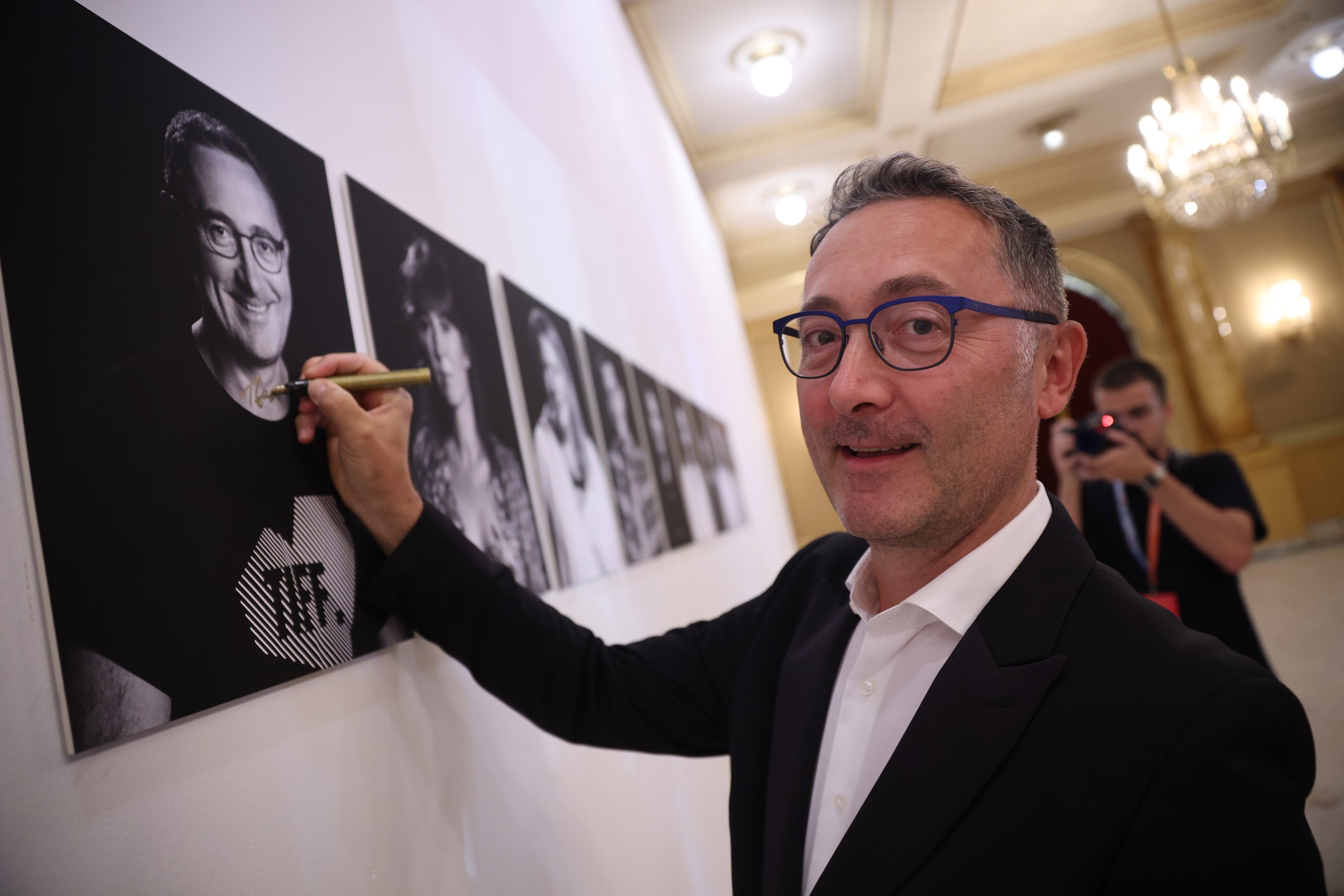
Romanian director Tudor Giurgiu at the Sarajevo Film Festival. His latest film Libertate is based on events which took place in December 1989. Giurgiu says the research for the film took some time: “For more than two years, I was transforming myself into an investigative journalist.” Photo: 29th Sarajevo Film Festival 2023 (C) Obala Art Centar


The revolt against Ceaușescu began in mid-December 1989, in Timișoara, western Romania. Dissent then spread across the country and hundreds of thousands of citizens began demonstrating in Bucharest against the government. On December 26th 1989, the dead body of Ceaușescu was shown on Romanian television. The broadcast came a day after the leader, 71, and his wife, Elena, 72, were tried by a secret military tribunal and executed by a firing squad. They were the closest any communist regime in Central and Eastern Europe had to Louis XVI and Marie Antoinette. The provisional government claimed Ceaușescu was responsible for numerous crimes, including genocide.

Power game

Today, this controversial history continues to be contested in Romania. Some claim the people were joined by the army and a popular revolt occurred against an evil dictator. Others are convinced, however, that Ion Iliescu, who succeeded Ceausescu (and served as president of Romania for three terms between 1990 and 2004) staged a coup d’état masquerading as a popular uprising. “The coup d’état was accompanying the popular revolt, but that is another story,” says Giurgiu, who is currently the president of the Transylvania International Film Festival (TIFF), and founder of the production company Libra Films.

The Romanian director recalls feeling relieved, and even elated, when he first learned that Ceaușescu had been shot. Today, he takes a more measured and nuanced view. “I now look at the killing of Ceaușescu, and see that he was shot like a dog, without a proper trial, just because the new apparatchiks wanted to keep him silent,” Giurgiu says. “It was all part of a power game. It became clear to me, later on, that if you get rid of the ‘Big Daddy’, then the people will react like sheep without a shepherd. That is what happened in Romania, it was callous.”

The assassination of Ceaușescu is referenced several times in Libertate, which was released in Romanian cinemas on October 6th. The film tells another story though. Based on real historical events, it is set in Sibiu during late December 1989, when the Transylvanian city became the scene of a violent assault on a police unit. It rapidly escalated into a violent and bloody confrontation between soldiers, policemen, civilian protestors and representatives of the Securitate – Romania’s infamous and ruthless secret police, known for torturing and killing political opponents. Overall, 102 people died and 300 were wounded as a result of the politically related violence that led to the bloodbath in Sibiu. Numerous buildings in the city were also destroyed. Many were attacked with heavy military equipment, under the accusation that they were hiding terrorists.

A Romanian-Hungarian co-production, the film premiered at this year’s TIFF, where it won the Public Choice award. In August, Libertate was shown at the Sarajevo Film Festival, where it won the Award of the International Confederation of Art Cinemas (CICAE). The film is produced by Libra Films and Mythberg Films and distributed in Romania by Transylvania Film. The London-based company Reason8 has also acquired the film for international distribution. “Most Romanians will not have heard of this story, where two million rounds of ammunition were fired in just a couple of days [in Sibiu], so I think the film is going to surprise and shock people when it is released,” says Giurgiu, whose previous films include Love Sick (2006), Of Snails and Men (2012), Why Me? (2015) and Parking (2019).

Ruthless machinery

The film’s central protagonist is a police captain named Viorel Stanese, played by Alex Calangiu. He is captured by the army and made a prisoner in an empty swimming pool in Sibiu. Along with hundreds of other prisoners – including suspected Securitate operatives and their contacts – Viorel is accused by the new regime of being a terrorist. Several conspiracy theories then surface. The army accuse the so-called terrorists of poisoning water, digging tunnels and preparing counter-revolutionary attacks against them.

 “It was tricky and challenging to have a police officer as the main character in this film,” Giurgiu says. “As most ordinary people in Romania at that time were generally scared by the police. But I thought it would be interesting to make them the main focus of the story.”

The director points out that the ruthless machinery of the Ceaușescu regime was not just the work of one man. It was held together by thousands of individuals working for the army, the police and the Securitate. “These people considered themselves to be just turning up for work every day and respecting order,” he says. “But in the end, it was their combined effort that contributed to the dictatorship and created all of this terror, which was all over Romania back then.”

Giurgiu notes that when the Romanian revolution kicked off in December 1989, a breakdown in army discipline “led to many innocent civilians being killed and to many soldiers being killed by their own peers”. This is something we witness in the opening scenes of Libertate, which involve confusion, paranoia and random bullets being fired amid panic and distrust. The first half is mostly filmed on a shaky handheld camera, giving the viewer a claustrophobic feeling that they are witnessing both the breakdown of law and order and a bloodbath in real time. “I wanted to show the perspective of a country in chaos,” the director explains.

“When I was thinking about the aesthetics for this film, I was inspired by Paul Greengrass’s Bloody Sunday (2002),” Giurgiu adds. “I kept saying to my production team, this is a film we have to try and [emulate]. I also looked at a lot of documentary footage of the Romanian revolution, too.”

In the second half of the film, the pace slows down. There is less action and more contemplation. We witness hundreds of prisoners coming to terms with the grim reality of life under internment, in the empty swimming pool in Sibiu. Some individuals appear to be on the verge of a mental breakdown. Others use comradery, humour and even games as a coping mechanism.

“There is one moment where the captured prisoners invent a crazy football game. I think simple events like this often define us as human beings,” Giurgiu explains. “It doesn’t matter if one person is a villain, and the other person is a hero. They are all trying to find a way together to live with their mistakes and just stay sane and normal.”

A difficult process

Giurgiu says undertaking research for this film at times felt like assembling together pieces of a puzzle. “For more than two years, I was transforming myself into an investigative journalist,” the director explains. The main problem was trying to decipher what was true and what was false from historical records. They contained their own personal and political biases. “If I read something by a police officer, it was respecting the police narrative,” says Giurgiu. “So it was so difficult to navigate through the evidence. It was also essential to speak to civilians from that time too.”

The director says conducting these interviews for research was very emotional. “I met a man whose son was shot in a car [by mistake] during all of the chaotic violence. This scene appears in the film,” Giurgiu explains. “Stories like this made me feel responsible for reopening [old] wounds in Sibiu.”

Shooting the film also brought its own practical difficulties. “When I arrived on the set to shoot the film, the hardest task was dealing with so many actors and so many extras,” says Giurgiu. “Every morning I thought, oh my God, I’m going to go into this empty swimming pool and I’m going to have to explain to 30 actors, 150 extras, what to do and try to explain to them this cobweb of relationships between all of the characters.”

Giurgiu co-wrote the screenplay with the Romanian author and journalist Cecilia Ștefănescu. “It was great working with a female script writer because she was fighting a lot to give a woman’s perspective,” he says. Some viewers may come away from the film with a different perspective though. It is very much a male driven narrative, with most of the story focusing on male rage and violence. Women play a passive role in the film. “Yes, well Romanian society was very patriarchal back then,” Giurgiu explains. “The male energy and power was very dominant.”

The film ends on an ambivalent note. There is the suggestion that despite the hardship, violence and suffering, Romania has been freed of its evil tyrant, and the people and the revolution have triumphed. But the viewer also gets the sense that the director is subtly mocking the new party line. To paraphrase the Swiss writer, Jacques Mallet du Pan, “Like Saturn, the Revolution usually devours its children.”

Limitations

“One of the sub themes of the film is that revolutions, despite their popular energy, and idealism, often come from a place of manipulation,” says Giurgiu. “During revolutions many people are killed by mistake. Civilians are supposedly let free. But at the same time, they are totally confused and are unable to tackle this freedom.”

Giurgiu believes it is important that “Romanian people continue to reassess their own recent history.” But art has its limitations, he insists. “If you asked me 15 years ago whether a film like this might begin a new conversation in Romania about our own history and have the ability to change things, I might have been more optimistic,” says Giurgiu. “But now I understand that while documentaries sometimes have the power to create lasting social or political change, fiction films cannot play this role.”

They can, however, help younger Romanians to come to terms with a violent history that many of them have very little knowledge about, the director insists. “I’m pretty sure this kind of film will be seen, maybe in 50 years, as a document about how those moments of revolution were taking place,” Giurgiu concludes. “That is very important: we need to open up this story and make people understand that we did not end this search for truth. We will not be healthy as a society if we do not assess the [past] properly and do justice to the people who were suffering a lot back then.”

JP O’ Malley is a freelance journalist and critic.

, , ,

Partners

Terms of Use | Cookie policy | Copyryight 2025 Kolegium Europy Wschodniej im. Jana Nowaka-Jeziorańskiego 31-153 Kraków
Agencja digital: hauerpower studio krakow.
We use cookies to personalise content and ads, to provide social media features and to analyse our traffic. We also share information about your use of our site with our social media, advertising and analytics partners. View more
Cookies settings
Accept
Decline
Privacy & Cookie policy
Privacy & Cookies policy
Cookie name Active
Poniższa Polityka Prywatności – klauzule informacyjne dotyczące przetwarzania danych osobowych w związku z korzystaniem z serwisu internetowego https://neweasterneurope.eu/ lub usług dostępnych za jego pośrednictwem Polityka Prywatności zawiera informacje wymagane przez przepisy Rozporządzenia Parlamentu Europejskiego i Rady 2016/679 w sprawie ochrony osób fizycznych w związku z przetwarzaniem danych osobowych i w sprawie swobodnego przepływu takich danych oraz uchylenia dyrektywy 95/46/WE (RODO). Całość do przeczytania pod tym linkiem
Save settings
Cookies settings