
The Holocaust in Romania turns 80, with antisemitism back in political vogue
Eighty years after the dawn of the Romanian Holocaust, a new force on the far right has emerged that closely mirrors the fascist organisation that wrought havoc on Bucharest’s Jewish community in 1941. This political party, the AUR, denies any connection to the past, but with national education on Romania’s role in the Holocaust historically limited, connecting the dots is not always a simple feat.
On January 21st this year, Jewish Romanian actress Maia Morgenstern performed a monologue online in which she attempted to portray the fear and anxiety felt by the Jewish community in Romania 80 years ago. The occasion marked a dark chapter in the country’s history: the anniversary of Romania’s first pogrom during the Second World War, constituting three days of sudden and brutal violence, as it ushered in its participation in the extermination of Europe’s Jews. In her performances, broadcast over one week, Morgenstern and the State Jewish Theatre shed light on the morbid events that took place during that bleak period in Romania, a country that has historically struggled to come to terms with its role in the Holocaust and the murder of around 400,000 Romanian Jews. The commemorations, however, came just weeks after Romania’s parliamentary elections, which saw the ultra-nationalist Alliance for the Unity of Romanians (AUR) party take nearly ten per cent of the overall vote, winning 47 seats in parliament. It was a meteoric rise that stunned many observers, and alarmed several more.
June 23, 2021 -
David M. Shoup
-
History and MemoryIssue 4 2021Magazine
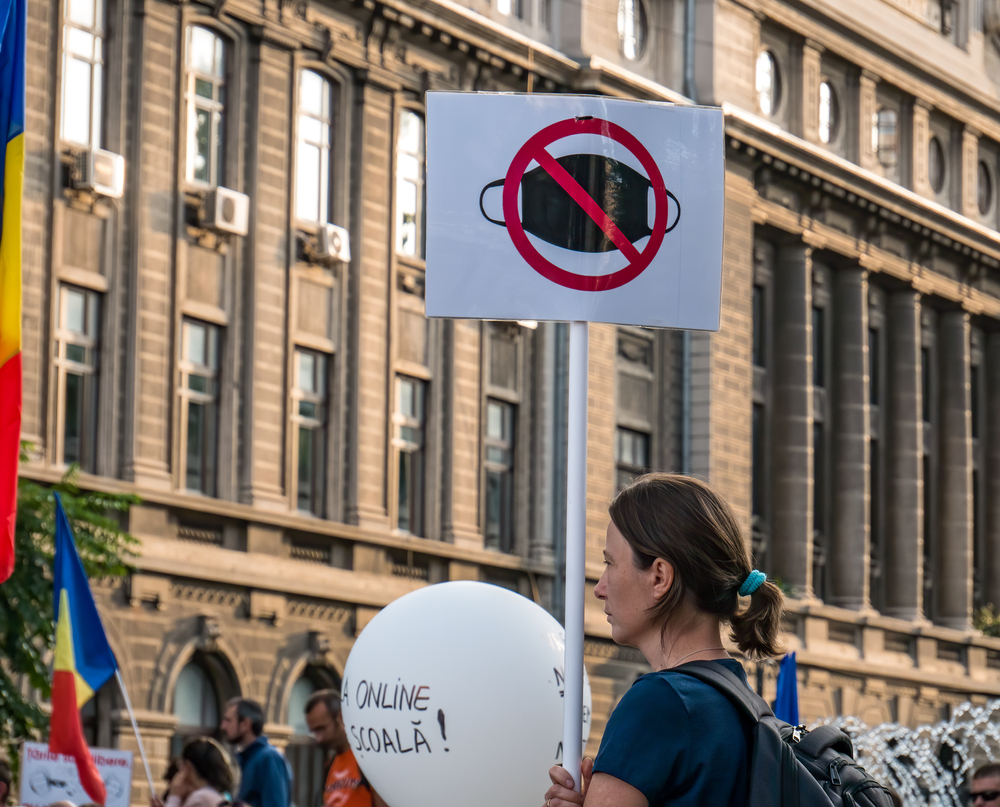
oman holding a sign board with the picture of a face mask in a red circle - no more facemasks.. Protest in the University square against wearing face masks. Photo: Cristi Croitoru / Shutterstock
“What worries me is the polarisation of speech and the lack of shame that we are starting to see in public declarations,” says Radu Magdin, a Bucharest-based political analyst, who added that the pandemic crisis “is golden for parties who are in opposition and who do not necessarily have a very complex offer.”
Troubling signs
AUR’s leaders, George Simion and Claudiu Tarziu, have expressed admiration for the belligerents behind the Romanian Holocaust. Calls by the AUR in recent months to protest against pandemic restrictions have already led to some concerning incidents. A recent march in the western city of Timisoara, home of the 1989 revolution, saw protesters gather outside the home of the city’s ethnic German Mayor, Dominic Fritz, where they chanted slogans calling for him to leave the country. After the incident, Fritz responded that demonstrators are “being pushed from behind by some extremists who publicly declare that they want freedom for all, but at the same time, promote a violent, xenophobic and anti-European discourse,” and later said similar protests across the country had “been hijacked towards nationalism, xenophobia, and antisemitism”.
Romanian President Klaus Iohannis also expressed concerns over antisemitism. There have been more troubling signs that AUR, while not overtly espousing racist or xenophobic messages, does provide an ethnic nationalist platform to its followers. Only a few months after Morgenstern’s commemorative Holocaust performances, and the AUR’s electoral success, the Jewish actress received antisemitic death threats via email – signed on behalf of the AUR. Simion publicly denounced the letter. The culprit was later tracked down by the authorities and was reportedly suffering with mental health issues. He was released within 24 hours and has not been charged.
Maximillian Marco Katz, founding director of the Centre for Monitoring and Combatting Antisemitism in Romania, followed the incident closely. “I wrote a letter to the General Prosecutor of Romania asking to know what is happening with these threats,” Katz said. “I did not yet get any answer.” Addressing parliament on March 31st after the Morgenstern incident, Jewish Deputy Silviu Vexler, who represents the single-seat Federation of Jewish Communities of Romania in parliament, said: “Sometimes I have the feeling that I came back to the 1930s.” He also noted that the Iron Guard’s headquarters, adorned with antisemitic and Nazi symbolism, stands a mere five minutes from parliament. Nevertheless, he remains resolute. “We won’t give in. We will not be intimidated, we will not be threatened by anyone and we will not live our lives as citizens of Romania in fear,” Vexler said.
The terror Bucharest’s Jews faced in 1941 is well preserved in Jewish collective memory, but dark – and even illegal – reminders remain on public display. Less than 500 metres away from a former Jewish neighbourhood targeted in the pogrom is the Mircea Vulcanescu school – named after a war criminal convicted for his role in the Holocaust. Local media have identified two dozen such locations across the country named after war criminals with connections to the Iron Guard and former Marshal Ion Antonescu, who ruled the country alongside the legionnaires before eliminating the group during its attempted seizure of power and simultaneous Bucharest pogrom in 1941.
One of the pogrom’s victims was Katz’s uncle, Isidor Katz. “They threw him in a truck together with 90 other Jews. They took them to Jilava, to Fort 13. They kept them there one night, all naked. They continued to torture them. The next day they took them out to the forest and shot them in the head – this is the way my uncle died,” Katz said.
Katz’s organisation has criticised official Holocaust commemorations by the Romanian government that attempt to honour both perpetrators and victims. “They are recognised as friends of the Jewish community and on the other hand they commemorate those that killed the Jews,” Katz said. “So I think the truth is that, in their minds, they cannot make the difference and do not understand what that Holocaust was about.”
Resisting the truth
These concerns were exemplified in a debate in March when an AUR deputy and a deputy state secretary criticised recent legal provisions to exclude prisoners of the communist regime and their families from receiving government benefits if they were convicted of crimes against humanity. Such former prisoners of the post-war communist regime include Vulcanescu, after whom the Bucharest high school is named, despite an explicit 2002 law banning the naming of schools, streets, or other monuments after war criminals.
“Romanians did not vote to praise legionnaires and the high officials of the Antonescu regime who participated in the extermination of the Jewish community in Romania,” said Deputy Alexandru Muraru of the National Liberal Party. “No, Romanians did not vote to turn the country back decades.” Leader of the opposition Social Democratic Party, Marcel Ciolacu, added that the debate and recent incidents demonstrate that “the scourge of antisemitism has never been completely defeated.”
After suggesting that many early communist-era officials were of Jewish origin, Octav Bjoza, the deputy state secretary, was fired by Prime Minister Florin Citu. Bjoza continues to claim his statement was misinterpreted. However, he further suggested, on March 16th, that he and the organisation he represents, the Association of Former Political Prisoners, may take issue with “the size” of the Holocaust.
For Katz, this is nothing new. “Romania, today, has institutions that, in my opinion, are not focused on really combatting antisemitism and Holocaust denial but controlling whatever is said about it,” he said. “There is a resistance to the idea that in Romania there was a Holocaust – I’m talking about a majority of people resisting the idea.” Deputies from three out of Romania’s four largest parties have denounced the latest spate of antisemitic incidents, with many placing blame squarely on the AUR. Deputy Prime Minister Dan Barna expressed his concerns over antisemitism being treated for too long as a secondary issue that does not impact Romanian society, stating “that’s how monsters are born,” before turning his ire to the AUR, whose Deputy, Sorin Lavric, praised far-right politician Mircea Vulcănescu as a martyr during communist rule.
Less than two years after the AUR’s inception, the party now holds roughly one in ten seats in parliament. The party message asserts that Romania is a Christian nation under threat from globalist forces that have anti-family and anti-church sentiments. Its co-founder, Tarziu, said after the election that the AUR is the only Romanian party to support then-President Donald Trump. As the rhetoric of Trump and his supporters descended into violence and five deaths on January 6th in Washington, DC, Timisoara Mayor Fritz warns that “verbal violence to physical violence is a short distance”. The analyst Magdin suggests that such a descent could also prove detrimental to the AUR’s political trajectory. “Other manifestations, like physical violence, is what gets me worried – there will be a price that the AUR will pay in the future if they are not careful,” he said.
During scores of AUR-supported anti-restriction protests, many demonstrators have brandished Orthodox icons and national flags as part of their push to return to regular church services – the type of simplistic policy agendas that Magdin identifies as a characteristic of recent populist movements worldwide. He predicts that the AUR could reach close to 20 per cent in the polls by the end of the year.
By 1937, the Iron Guard, led by the charismatic Corneliu Codreanu, held onto roughly 20 per cent of seats in parliament and used its relative popularity as a mandate for using death squads against their critics. It was not long before Jews became their targets. Underscoring the connection between the movement and Orthodoxy, Codreanu and several of his co-legionnaires, assassinated by King Carol II’s secret police in 1938, were later sainted by senior leaders of the Romanian Orthodox Church. As the fantasy of a global Zionist conspiracy guided the ideology of the Iron Guard legionnaires, another new globalist ploy dominates the AUR party platform and the minds of its voters. Today, the threat they perceive is the lack of access to local churches and a ruse surrounding mask mandates and the origins of COVID-19.
Thing of the past?
But not everyone shares concerns about AUR. Cezar Victor Nastase, a 33-year-old architect, believes that the far-right party represents the least corrupt option for conservative Christian voters, and that any overlaps with the legionnaires are not reflective of the party’s aims. “I think there might be voters that have those tendencies or sympathies,” Nastase said. “But I think that legionnaires and the Iron Guard are a thing of the past. The reality is now different and the AUR is more of a conservative national party and does not share the Iron Guard’s beliefs.” Nevertheless, Nastase says that one of the issues concerning him, as a voter, is the perceived threats to Christianity in Romania. On April 25th, Muraru, who was recently appointed Romania’s Special Envoy for Fighting Antisemitism, Xenophobia and Promoting the Memory of the Holocaust, publicly demanded Nastase’s arrest for hate speech after the AUR supporter reportedly published a Facebook post listing 35 prominent intellectuals and politicians and calling for their execution.
Christianity identified as being under threat from multicultural and globalist forces is an idea featured prominently in Codreanu’s manifesto, a Mein Kampf for Romanian fascism that warns of Jewish tradition and Bolshevism squeezing out Romania’s Christian values. Codreanu chillingly noted in the manifesto that one of Romania’s three primary pillars for the future must be “resolving the Jewish problem”. Romania’s Jewish population today is fewer than 2,000 – most are now elderly – compared to roughly 790,000 in 1936, the year Codreanu’s manifesto was published.
“Romania is not an antisemitic country, but there is a lot of antisemitism here and there is a lot of it underground, and this is coming out especially when we speak about the Holocaust,” Katz said. Disagreement between the ministry of education and several Jewish advocacy groups, including Katz’s antisemitism watchdog, over the removal of a proposed textbook’s references to Antonescu and Romania in the Holocaust resulted in a high school course on the Holocaust being made optional, rather than obligatory. According to the US State Department’s 2021 report on Romania, less than two per cent of high school students took the course in the 2019-2020 school year.
Last year Katz, who is an advocate for Holocaust education, returned to the site of his uncle’s murder. Like the recent Morgenstern death threats, it served as a reminder of the horrors experienced by his community, which he says can take an increasingly dark turn in turbulent times. “Many Jews, including me, believe that whatever happened could happen again,” he said.
David M. Shoup is a freelance journalist based in Bucharest.