
Ukrainian refugees fleeing war battle with French bureaucracy
Ukrainian refugees who arrive to France face the daunting task of not only coming to a new country where they do not speak the language but also of trying to understand the complicated bureaucracy. In many cases, additional help from volunteers and online community groups is the only way to fully navigate the process.
When Olena Kondratova arrived in Paris in August 2022 after having fled the Russian invasion, she found shelter in temporary accommodation provided by French social services. The small apartment, where she lived with two other Ukrainian women, was two hours away from her new university, but it meant safety from the bombs raining down on her native city of Kharkiv in eastern Ukraine.
July 4, 2023 -
Cristina Coellen
-
Issue 3-4 2023MagazineStories and ideas
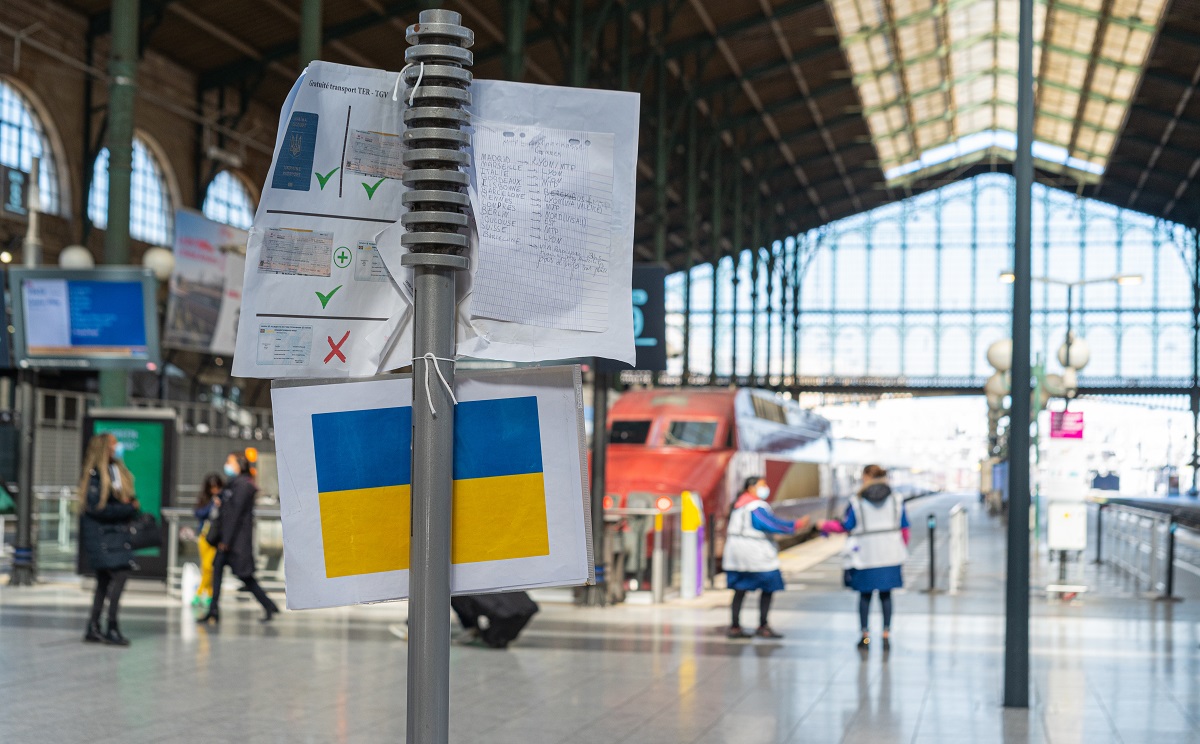
A scene from 2022, with volunteers helping Ukrainian refugees at the railway station in Paris. Ukrainians rely on the volunteers not only for housing but also to navigate the complicated bureaucracy. Photo: BooFamily / Shutterstock
Yet, a few months later, when a necessary trip back to Ukraine for administrative reasons took longer than expected, she was told that she could not come back to her accommodation in France. Social services told her that she was in fact only allowed to be absent from it for a week at a time.
“They forced me to move out. I don’t know if they were allowed to do this or not”, she says. She was then brought to an emergency refugee accommodation which she described as essentially a “big tent with around 20 beds inside”, until she finally found an apartment in Paris where she could stay for longer. This experience is only one among a whole list of administrative problems that she has experienced as a Ukrainian refugee in France.
Language barrier
More than a year after Russia’s full-scale invasion of Ukraine, almost six million Ukrainian refugees who fled the war remain spread across countries of the European Union, according to the UN Refugee Agency. In France, around 100,000 Ukrainians are currently registered as temporary residents or refugees. From applying for health insurance, opening bank accounts, finding a job to sending children to school, France’s administrative system already represents obstacles for its own citizens. Yet it becomes even more challenging for the Ukrainian refugees, who do not always have French contacts and face language barriers.
“Overall, we really appreciate the help and the possibility to stay here”, Kondratova adds, but “there are a lot of questions that we want to ask the French government”.
Not – yet – speaking French has only made the situation worse for many Ukrainians. For Kondratova, this language barrier has complicated much of her life in France, including accessing healthcare. “To help you in hospital, they will say that ‘Ok you do not speak French, I will not help you until you come with a French-speaking guy or girl’. And I said that ‘Ok, I do not know French-speaking people here, what do I do?’ and they did not want to communicate via Translate”, she says, referring to the Google translation service.
Natalia Kotok, who studies at the business school ESSCA with Kondratova, agrees with the picture painted by her friend of their new life in France. “The biggest problem is the lack of clear explanations and help in case of difficulties”, Kotok says, who is also still struggling with the French language.
The OFII, the French Office of Immigration and Integration, is the central institution organising the first steps of most Ukrainian refugees in France. Its tasks notably include providing a first place to stay if required by the respective person – such was the case for Kondratova – and also offering language courses. While the language courses proposed are adapted to each learner’s level, many of the refugees cannot progress fast enough to achieve the linguistic skills that are required to sort out their administrative problems.
Unexpected help
Not everyone has struggled this much. Alina Prokopenko, a 22-year-old pastry artist, is enjoying her new life in Paris after having fled Kyiv over a year ago: “I found work by myself through Instagram”, she says. Her Instagram page of pastry creations, which more often resemble art pieces than food, has tapped into the taste of a Parisian culinary audience. Banana and dark chocolate tarts mimicking the supremacist artwork of Malevich or matcha and raspberry pastries inspired by Monet’s water lilies have allowed her to start out in the French capital relatively easily. She first participated in a Ukrainian cooking pop-up in the restaurant La Bourse et la Vie in central Paris before becoming a resident pastry chef at the gallery-doubling-as-an-artistic-restaurant Mater.
For housing, Alina also found her bearings quickly through some unexpected help: “For the apartment, I wrote to a girl who lives in Paris and studies history of art at the Sorbonne. I just asked her about a possibility to continue my education and she was like: ‘Oh, I already found an apartment for you for two months’”, she says.
The French owner of the apartment then also helped Prokopenko out when it came to understanding the rent contract and getting documents ready. The pastry artist is still deeply grateful to her landlady, calling her “the best in the world”.
While Alina managed to avoid the struggles that Kondratova and Kotok experienced with immigration institutions, she highlights that she could not have done so without the help she received, both from French citizens and Ukrainian self-help groups on Telegram and Facebook.
Indeed, faced with the daunting prospect of coming to a new country where they do not speak the language and might not have anyone to rely on, many Ukrainians have taken the initiative in informing each other and helping others online navigate French bureaucracy. Groups such as “Bizhentsi” (Refugees) or “Ukrainians in France” on Telegram have several thousand members and allow newcomers to ask questions about any issue from how to get a “pass Navigo”, the Paris region transport card, to applying for a social security number.
Private citizen support
Another important helping hand comes from French citizens, such as Prokopenko’s landlady. The French government estimates that around 11,000 Ukrainians are currently hosted privately by French citizens who have volunteered to take them in after arrival. Many of these volunteers are not only providing shelter, but also accompanying the refugees in their administrative journey in France.
This help has been crucial, as especially long-term housing options are not necessarily available to every Ukrainian immediately. Although there are no collective data for all of France, several cases of Ukrainian refugees waiting for long-term housing for months or even over a year as it was the case in the city of Lyon in eastern France have been recorded. Kondratova and Kotok spent several months waiting for it, too. This comes despite France taking in a relatively low number of Ukrainian refugees in a European context: in Poland and Germany, two million and over one million refugees, respectively, were registered in the first year of the invasion, ten times the number of refugees registered in France.
Yet, even for the French citizens well versed in the intricacies of French bureaucracy, hosting Ukrainians and helping them find their bearings can be a struggle. Frenchwoman Jany Mouillaud from Pessac, a suburb of Bordeaux in south-western France, has been hosting between three and five refugees at her home since the start of the invasion. The Ukrainian couple and their daughter currently still staying with her are trying their best to integrate themselves into French society, she says: “The little seven-year-old girl is now bilingual and perfectly integrated”.
As for the girl’s parents, who are working as an architect and a civil engineer, they have already held a so-called CDD, a limited-time work contract, but are currently unable to find a CDI, an unlimited French work contract which provides more stability and increases their chances when it comes to finding an apartment to rent. For Mouillaud as a host, this situation is just as frustrating as for the Ukrainian couple: “They don’t speak French perfectly, but they’re well on the way to autonomy.”
To support the refugees living with her in their struggles for housing and jobs, she has contacted every government department, non-governmental organisation and social agencies imaginable and even met with the deputy of her constituency. With little help resulting from this process according to her, she has mostly been turning to a Facebook group dedicated to helping and supporting Ukrainians in France for advice.
Mouillaud is also still waiting for a one-time financial aid of 150 euros, which was put in place for citizens hosting Ukrainian refugees privately in October 2022. “The civil service is not coping with the number of applications [for financial aid]”, Mouillaud says. “It’s a real year-long struggle”, she adds, about her hosting experience. “I think that the government’s idea to put in place a hosting system by citizens is not working.”
For the refugees themselves, most of their administrative struggles have been solved – for now. But after fleeing airstrikes and invading troops, their experience of settling down in France has been “painful”, as Olena terms it.
Cristina Coellen is a freelance journalist from Austria specialising in Eastern European affairs and international conflicts. She is currently studying for a Master’s degree in journalism and international security at SciencesPo Paris. Besides her freelance work, she is an analyst for the Geneva-based geopolitical information project Confluences Internationales, for which she covers Eastern Europe and Central Asia.