Ukraine, Mayday
While Russia’s war in Ukraine has become a regular story in European and world media, its physical connections with the wider world have become severely restricted. Now reliant on railways and roads to transport both people and goods, the war-torn nation now dreams of a future in which airplanes will no longer bring destruction and death.
My last visit to Kyiv was on February 16th, 2022. It was the day that American intelligence determined to be the day of Russia’s invasion of Ukraine. In Kyiv and other Ukrainian cities an initiative called “Reconciliation” was held on that day as well. It was meant to “strengthen the consolidation of the Ukrainian society, increase its resilience when faced with growing hybrid and propaganda threats as well as the psychological pressure that was being put on the Ukrainian society”, as stated by the president’s decree “On urgent means to consolidate the Ukrainian society”’ issued two days prior.
July 4, 2023 -
Nikodem Szczygłowski
-
Issue 3-4 2023MagazineStories and ideas
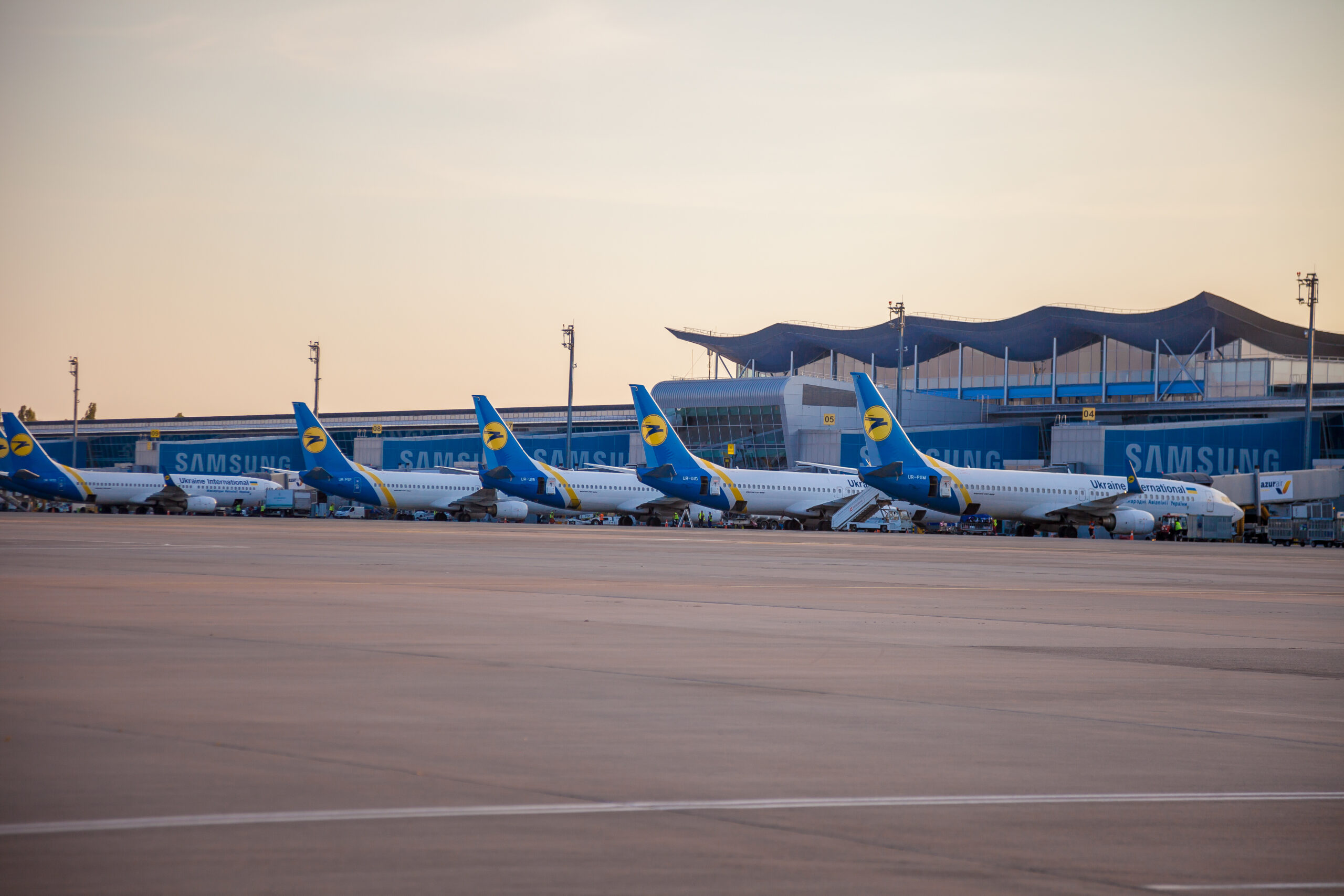
Before the Russian invasion: Boeing 737 passenger planes from the fleet of Ukraine's International Airlines stand on the platform near the runway at Kyiv’s Boryspil Airport. Since February 2022 no civilian aviation has taken place. Photo: Real_life_photo / Shutterstock
The atmosphere was already quite tense. From conversations overheard in cafés one could hear forced laughter among mentions of the threat of an invasion. One week later, Kyiv was bombarded for the first time. My flight departed from Boryspil Airport, located near Kyiv. This is the largest airport in Ukraine and an important hub for domestic and international flights. Just a few years ago it was paralysed by the COVID-19 pandemic. Kyiv was in fact a popular transfer point for passengers heading, with Ukrainian or foreign airlines, to such destinations as the South Caucasus, Central Asia, and the Middle East.
Things yet started to change already in 2014, when the Russian Federation annexed Crimea and started an undeclared war in the eastern parts of Ukraine. This year marked a watershed in the history of Ukrainian aviation, mainly because before both the number of flights and passengers between Ukraine and the Russian Federation clearly exceeded other destinations. This was specifically true regarding flights between Kyiv and Moscow, with journeys operated by both Ukrainian and Russian air carriers taking place almost on an hourly basis.
MH17 and its consequences
Undoubtedly, one of the most dramatic turning points that took place in 2014 after the start of the war in Donbas was the downing of Flight MH17 operated by Malaysian Airlines. Evidence shows that the crash took place in Ukrainian airspace and was the result of military activities. It took place on July 17th, 2014, in Donetsk Oblast, near the village of Hrabove in the vicinity of the city of Torez (Chystiakove). The debris from the plane landed on Ukrainian soil, around 40 kilometres from the Russian border. The investigation that followed the crash showed that the plane was hit with a BUK M1 surface-to-air missile, which was shot by the 53rd Rocket Anti-Air Brigade of the Russian army. All passengers and crew members lost their lives: 298 people in total. Since the crash, the airspace over eastern Ukraine has remained closed to air traffic. This in turn pushed foreign carriers to re-direct their routes to avoid the risky parts of Ukrainian airspace.
In addition, in autumn 2015 the National Security Council of Ukraine imposed sanctions on some Russian airlines, while on September 25th of the same year the Ukrainian government banned Russian flights to the country. The list of sanctioned carriers included Russia’s largest airlines: Aeroflot, Utair, Transaero and S7. The ban went into force on October 25th that year. The rationale for this decision was that some Russian airlines had continued to use Ukrainian airspace to fly to Crimea, disregarding the 2014 Eurocontrol ban on all flights to Sevastopol and Simferopol. Although Ukraine’s state aviation administration financially punished some carriers for breaching Ukrainian airspace, Russian carriers continued to ignore the ban, claiming that both airports belonged to Russia, even though they were not internationally recognised as such. That is why all global ticketing systems showed these destinations as belonging to Ukraine.
In response, the Russian authorities banned Ukrainian airlines from using their own airspace. Consequently, not only were all air connections between the two countries stopped but Ukrainian airlines also encountered difficulties with their flights to Asia and the South Caucasus. For example, any flight from Kyiv to Tbilisi became one hour longer because the route required avoiding the airspace over Crimea, the Russian part of the Azov Sea and Kuban (this is the shortest route that was used earlier). Thus, planes from Kyiv to Georgia flying over the Black Sea had to enter Romanian airspace and then turn east along the Turkish coast. For the same reason, flights from Kyiv to Baku, Yerevan, Almaty, Tel Aviv, Tehran, Beijing, New Delhi and other eastern destinations became longer. This caused a crisis in Ukrainian aviation but at the same time brought about new business opportunities, especially with regards to expanding flights to westwards.


Shift to the West
Early 2020 brought another tragic event in the history of Ukrainian aviation. On January 8th, 2020, a Ukrainian International Airlines (UIA) plane (Flight PS752) destined for Kyiv was shot down shortly after take-off in Tehran by the Islamic Revolutionary Guard Corps. All passengers and crew members lost their lives. At first, the Iranian authorities denied shooting down the plane. It was thanks to different western investigative agencies and the pressure of the Iranian public opinion that information confirming the plane was shot down by two Iranian surface-to-air missiles was released. On January 11th, 2020, the Iranian government admitted that the IRGC had targeted the Ukrainian flight after erroneously identifying it as an American missile.
At Boryspil airport a farewell ceremony was held to commemorate the victims. Terminal D was decorated with their photos, candles were lit, and flower wreath arrangements laid out. I remember a note with “PS752 – Mayday” written on it. Only later did it turn out that this grieving for the victims was a forecast of what was to come two years later.
In late May 2020 another turning point took place in the region’s airspace. This time something unexpected happened over the territory of Belarus. On May 23rd, 2020, Ryanair Flight FR 4978, operated by the Polish branch of Buzz Airlines, was on its regular route from Athens to Vilnius. However, once the airplane had entered the airspace of the Republic of Belarus, it was redirected, upon the request of the Belarusian authorities, to land at the airport in Minsk. There, two of its passengers, the opposition journalist Roman Protasevich and his girlfriend, Sofia Sapega, were arrested by the Belarusian authorities.
This act of air terrorism, carried out by the Lukashenka regime, which used legal means but abused all safety procedures, was something that Europe had not seen in decades. As such, it was condemned by the European Union, NATO, the United Kingdom, and the United States, as well as the civil aviation organisations of many other states. The European Commission and the EU aviation safety agency issued directives forbidding European airlines from flying through Belarusian airspace. Ukrainian airlines followed suit. As a result, all flights from Kyiv to Baltic or Scandinavian states were to avoid, from now on, the territory of Belarus. This, again, meant longer flights.

In a way, it can be said that a certain restructuring of the Ukrainian airline market took place as a result of these aforementioned events. Overall, they forced it to depart from its earlier close ties with Russia, which was the number one destination for Ukrainian flights and passengers, as well as a transit point for flights from Ukraine to Asia and the South Caucasus. Gradually, the Ukrainian aviation market almost entirely redirected its offers towards flights to the West. As a result, before the full-scale invasion, the majority of the airline connections offered in Ukraine were to EU countries. This change was possible thanks to the liberalisation of the airline market, which allowed airlines such as Ryanair to offer flights between Ukrainian and EU cities.
Rapid development
Changes also took place in the domestic Ukrainian airline market. Specifically, prior to 2014 the most frequented routes were those from Kyiv to Donetsk and Simferopol in Crimea. In the case of the first route, the situation changed after Donetsk airport was completely destroyed by the Russians and so-called “separatists” in January 2015. The airport in Simferopol, in turn, is now a part of annexed Crimea, which means it has lost all connections outside Russia. All this explains why the most popular connections within Ukraine prior to the full-scale invasion were Kyiv to Lviv and Kyiv to Odesa.
In just a few years, the airport in Lviv became the third largest regional airport in Ukraine. It was only bested by two airports in Kyiv: Boryspil and Zhuliany. While describing this new trend two years ago, at the time of the COVID-19 pandemic, Tetiana Romanovska, the director of Lviv Airport, told me that “In 2019 we reached 2.3 million passengers. This means that we have exceeded the symbolic threshold of two million passengers per year, which is a certain indicator in the development of the regional airport. For us this is an even greater achievement considering that we were starting from a very low position – for example ten years ago we had only half a million passengers per year and incomparably fewer connections. Now (in 2020 – author’s note) we are the leading regional airport in Ukraine, and when it comes to the number of passengers only two airports in Kyiv are ahead of us. However, we are already coming very close to Zhuliany and hope to pass it in 2020.”
A larger number of flights to EU countries made Ukraine a more popular destination for both tourists and business travellers. Poland, for example, started offering flights to Ukraine from large cities such as Warsaw, Modlin (which also counts as a Warsaw airport – editor’s note), Kraków, Katowice, Gdańsk, Bydgoszcz, Wrocław, Poznań and Lublin. These flights were bound for the main Ukrainian cities such as Kyiv, Lviv, Odesa and Kharkiv. In summer 2021 there were even plans announced for flights to Zaporizhzhia (on the Ukrainian side) and Szczecin (on the Polish side). In 2022 flights from Kyiv to Łódź started to operate, as well as from Lviv to Olsztyn. In terms of the number of passengers, Ukraine was one of the main destinations for passengers flying from Poland and Lithuania.
Overall, from 2018 to 2020 the Ukrainian airline market was among the most rapidly developing in Europe. Not only were Ukrainian passengers offered many new connections, but also low-budget airlines, such as Wizzair and Ryanair, began to set up bases in Kyiv and Lviv. All this made Ukraine a destination for more and more flights. Even during the COVID-19 pandemic new connections were offered, such as the airBaltic flight from Vilnius to Kyiv or the Wizzair flight from Szczecin to Lviv.
The majority of Ukrainian airports were bombarded by the Russians in the first stage of the full-scale war. To some degree, all the airports were damaged (or became temporarily dysfunctional), including Kyiv’s Boryspil and Zhuliany. On the second day of the full-scale war, the airport in Ivano-Frankivsk was bombarded, while the infrastructure of airports in Kharkiv and Kherson was destroyed as a result of almost constant shelling. The airports in Odesa, Mykolaiv and Zaporizhzhia were also seriously damaged. Among the larger airports, only Lviv was almost untouched. While among the smaller ones, no damage was done to the airports in Uzhhorod and Chernivtsi. They are all located in western Ukraine.
There are also different, but not less tragic, people’s stories that are related to Ukrainian aviation. When on February 16th, 2022, I was walking through the departure hall in Boryspil, I had no clue that in just a few days it will not be available to any civilian passengers. My friend, Bohdan, who always smiles and can solve just about any problem, worked as a passenger service manager at this airport. In January 2022 he joined a territorial defence unit and was seriously wounded while defending his homeland. He was sent for long-term treatment and rehabilitation in Latvia. Olena, who had worked at Zhuliany, was in Finland on the first day of the invasion. She was there representing her airport at an international aviation conference. Now she works at an airport in Modlin, near Warsaw. Similarly, many Ukrainian flight attendants are now working for Polish and other airlines in the neighbouring states. Some of the employees of Lviv Airport found employment at the Rzeszów-Jasionka airport, which has now become a hub for the shipment of military equipment to Ukraine.
Iron diplomacy
At the time of the shooting down of the Ukrainian plane in Tehran, I was heading from Budapest to Ukrainian Zakarpattia. Early in the morning I left the beautiful Budapest train station, Keleti, and my train headed eastward. Once we passed Debrecen and Nyíregyháza, my compartment became almost empty. Behind the window I could only see the snowy scenery of eastern Hungary’s landscape. I left the train at a small station in Záhony, located right next to the Ukrainian border. Here, I transferred to a small three-wagon MÁV train, which slowly crossed the bridge over the Tisa River. After a journey of half an hour I found myself in a spacious yet empty hall at the train station in Chop, which is the first city on the Ukrainian side. This place used to be the largest, after Brest in Belarus, Soviet railway gate to the West. There, my passport was stamped with the new – just introduced – Ukrainian border stamp. It resembled EU stamps, finally replacing the old Soviet-style ones that looked more like those from Russia and Belarus. At that moment, I could not even imagine that after February 2022 these stamps obtained at railway and pedestrian crossings would outnumber the earlier stamps I had obtained at the airports in Kyiv or Lviv.
Throughout 2022, after the initial chaos of the first weeks of the full-scale invasion, the Ukrainian railways established dozens of new connections to western states. To the Polish city of Przemyśl there are many daily trains from Lviv, Kyiv, Kharkiv, Zaporizhzhia and Odesa. The aforementioned Chop is also a transfer station for many trains heading to Budapest or Vienna. They depart from cities such as Lviv, Kyiv or Mukachevo. At the same time, trains from Zakarpattia to Romania that were for a long time not operating were quickly re-established and resumed regular operations. There are now connections available from Rakhiv to Valea Vișeului, Uzhhorod to Sighet Marmației, and Chernivtsi to Suceava. The express train from Kyiv to Chișinău allows passengers to make connections to Bucharest through Iași.
Railways play an important role both in war-torn Ukraine and – even more – trans-border transport and communication. Thanks to the Ukrainian railways, hundreds of thousands of Ukrainians managed to escape from dangerous areas to safer locations in western Ukraine or abroad. The Ukrainian railways also reacted effectively during Ukrainian counter-offensives and de-occupations, first of the northern parts of Ukraine in spring 2022, then the Kharkiv region in September, and finally Kherson in November. All these places that saw the return of Ukrainian administration, and also saw the return of Ukrainian trains.
Interestingly, Ukrainian trains transport around 40 per cent of goods that are transported in Ukraine, which is a high number, given that in neighbouring Poland railway transport accounts for around only ten per cent of goods. Thus, it seems very reasonable to connect both railway systems, which are responsible for the majority of the trade exchange taking place between these two states. Recognising this potential, the Ukrainian railways have already announced an ambitious plan to build new narrow lines, which are compatible with European standards. They have also declared plans to build the first European railway from Lviv to Rava-Ruska/Hrebenne (a border crossing with Poland) by the end of this year. Plans have also been made to build a similar line from Lviv to Medyka, (a border crossing with Poland next to Przemyśl) and in the north from Kovel to Dorohusk.
Not surprisingly, with the closing of Ukraine’s skies, railway travel became the choice of the absolute majority – if not all – of the official delegations that wish to visit Ukraine. We can see this in the photos of many European state leaders and members of the European Commission, who now arrive in Kyiv by train. The same mode of transportation was taken by Turkish President Recep Tayyip Erdoğan and the foreign minister of Saudi Arabia, Prince Faisal bin Farhan Al Saud. US President Joe Biden, who made a highly anticipated visit to Kyiv since the beginning of the full-scale war, also took this form of transport. For the same reasons, railway transport is the choice (at least to the Polish border) of the Ukrainian delegations that are now travelling abroad.
The majority of these trips start (and end) at the railway station in Przemyśl, where Platform 5 has a separate “wide” rail that is used by Ukrainian trains, as well as the special VIP trains used by government officials and other delegations. The popularity of rail travel has allowed the Ukrainian railways to declare that they are pursuing “iron diplomacy”. This witty statement contains some truth indeed.
Lastly, Ukraine is connected to Europe by thousands of bus connections, which are offered from the majority of Ukrainian cities, as well as the pedestrian border crossing in Medyka (Shehyni on the Ukrainian side), which is located near Przemyśl. From these places, travellers can take Flixbus to Vienna, Berlin, Amsterdam, Prague, or Brussels. In addition, there are also Polish, Czech, Austrian, and Hungarian trains and buses which offer options for travellers to and from Ukraine.
Ukraine – close and far away
While waiting for my train at Przemyśl train station, after having come from Ukraine through the pedestrian border crossing in Medyka where I got another stamp from the Ukrainian authorities, I observe passengers arriving from Ukraine. I am listening to the stories that they are sharing, together with the information about their travel destinations. This rather small train station, which is located 12 kilometres from the state border, has become an important stop in many people’s journeys to other places in Europe and throughout the world. It shows the way of travel that is used by many refugees, who are running away from the continued shelling, which takes place even in the de-occupied cities and villages. It also shows the route used by many journalists (both Ukrainian and foreign), doctors, volunteers, members of international missions and official delegations, ministers, and presidents. This place is thus used by people who are travelling to a country where the sky, instead of civilian airplanes, is full of Russian rockets. They return from it in the very same way.
Since the Second World War, there has not been such a large country in Europe that has gone without airline connection for such a long period of time. Even besieged Sarajevo (1991-96) had an operating airport for the running of so-called “airbridges” which allowed for the provision of food to the besieged city and the transport of people.
All this makes me think about many things. First that since its beginning, aviation was aimed at making the world smaller and bringing people closer together. However, also since the very same beginning, airplanes were used to inflict pain and suffering and bring death to people. This was the case during both world wars. Lastly, with the growing popularity of aviation in the last decades, it is clear that we have become the true inhabitants of a global village. As a result, Ukraine too became closer to us. Now, it is again drifting further away, as the only transportation channel we have with it is through its border crossings with Poland, Slovakia, Hungary, Romania and Moldova. Instead of taking a flight from Warsaw to Kyiv, which takes around an hour and a half, people now have no choice but to spend long hours travelling to and from Ukraine. For example, the shortest trip between Kraków and Lviv requires at least six hours, while prior to the full-scale invasion it lasted less than sixty minutes.
Looking at the passengers in Przemyśl as they are catching trains to Kraków, Wrocław, Warsaw, Prague, Vienna, and Berlin, I ask myself how many of them had earlier used the airports in Kyiv, Lviv, Odesa or Kharkiv. I imagine them now with their empty halls and corridors and damaged runways. More than anything else, however, I think about the people whom I met when I was working with the Ukrainian aviation industry. The absolute majority of them had to stop their professional careers (I do not even want to think about those who could have possibly lost their lives). Now many of them live somewhere else because they had no choice but to abandon their homes that were under enemy shelling. Not all will be able to return home.
Even worse, while some people lost everything they had owned, others lost their loved ones. Among them are also those who have been fighting for their home and those who are doing their best to support the Ukrainian defenders, keeping the hope that one day, normal life will return to Ukraine, which also means a return to regular civilian air connections. One day, the sound of an airplane will no longer bring associations of destruction and death.
I am also thinking about the piece of paper with “PS752 – Mayday” written on it that I spotted at Boryspil airport in January 2022. “Mayday” is a term used by pilots to warn others about the dangers that occur during flight. Its creator was Frederick Stanley Mockford, who worked as a radio connection officer at Croydon airport in England in the 1920s. He was tasked with coining a phrase that would indicate danger and be understood by all pilots and land personnel during an emergency. As at that time the majority of air traffic took place between Croydon and Le Bourget Airport in Paris, Mockford suggested the term “Mayday”. This new English word was phonetically identical to the French term m’aidez (“help me”) or m’aider (the short form for venez m’aider or “come help me”).
Now, over 100 years later, a large European state has been sending its “Mayday” message for over a year, warning that almost every day its inhabitants are experiencing death coming from the sky.
Nikodem Szczygłowski is a writer, essayist, translator, and traveller. He is fluent in English, Lithuanian, Slovenian, Ukrainian, and others. He is the recipient of the award for achievements in journalism from the ministry of culture of the Republic of Lithuania and a graduate of Mediterranean Archaeology at the University of Łódź as well as MBA in Central European Management Institute in Prague.