
Text resize: A A
Change contrast

Lost in the labyrinth of possibilities

Soon after the news of the assassination plot against Archduke Franz Ferdinand reached Vienna, shock gave way to reflection. The would-be-king and next emperor was now dead, a gruesome fact that created a political vacuum and opened the gates for new opportunities.

The murdered Archduke Franz Ferdinand was not a person without flaws. His social talents were less than average, and he could not compare himself with an actual emperor like Franz Joseph I. The ruling monarch had come to power amidst the stormy circumstances of a people’s revolution and the previous Ferdinand’s forced abdication.

July 4, 2023 - Andrzej Zaręba - History and MemoryIssue 3-4 2023Magazine
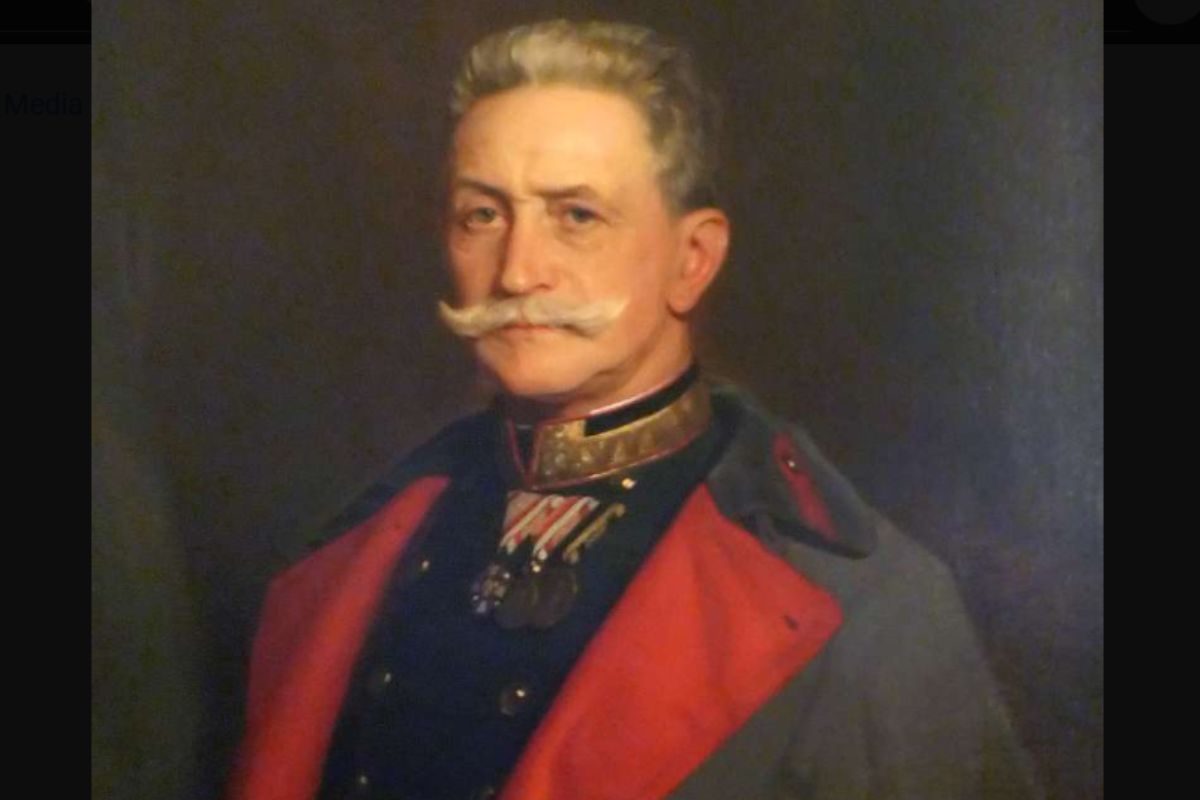
Franz Graf Conrad von Hötzendorf, Austro-Hungarian general, Chief of the General Staff of the Austro-Hungarian Army. Photo: Heeresgeschichtliches Museum (public domain)


Franz Joseph I held a great love for the masses. This is despite his solemnity and elitism, which were presented fully in all possible ways. Yet in contrast to the liberal intellectuals, who perceived the emperor as a metaphorical dam against new fashions and trends, the lower classes appreciated his simple gestures of obedience to duty. They viewed him as an omnipotent imperial and royal father of many nations and tribes, who lived peacefully under his caring watch.

Franz Ferdinand, on the other hand, not only violated his marriage obligations – his wife was chosen for romantic reasons and not for the crown’s interests – but he also had a dangerous taste for various political novelties. These included the federalisation of the state, which was a key downside of Hungarian equality with Austria.

Revolution of the railway

The assassination in Sarajevo gave hawks in the Viennese political circles the much needed pretext to pacify the Balkans once and for all. One of the key figures in this group was Franz Conrad von Hoetzendorf, the Austro-Hungarian chief of staff – in other words, the army’s real boss. Franz Conrad was a man of many talents and he was well respected in both civilian and military circles. Many years before such dramatic events, he devoted himself to the theoretical analysis of future wars. Being a modern man with up-to-date beliefs, Franz Conrad treated life as a constant fight for survival. His concept of philosophy was based on the theory of Charles Darwin, adapted to the circumstances of the dual monarchy. As an intellectual, Franz Conrad tended to overcomplicate even the simplest tasks, which for onlookers might have been seen as a sign of sophistication and deep thought.

After he first took office in 1906, Franz Conrad advocated for military action as the only practical solution to political problems. Meticulously planned military assaults were proposed by him at almost every meeting with the political bodies of the monarchy. The crisis of the annexation of Bosnia and Herzegovina in 1908 marked the 60th anniversary of Franz Joseph’s reign. It also almost ended in bloodshed, which was only avoided through the careful work undertaken by the foreign ministries of the European powers. Franz Conrad warned his political superiors that the best moment for an invasion of Serbia had thus been lost. He was then sacked, only to return to office when his plans were truly ready. Fully aware of the weaknesses of the Austro-Hungarian war machine, he thought he had found a real game changer. The key to success lied in the railways.

Helmuth von Moltke the Elder – a German marshal and the real mastermind behind France’s defeat in the Franco-Prussian War – is believed to have whispered on his deathbed the following words: “Don’t erect more fortresses, invest in railways instead.” This anecdote gives us insight into the dilemma faced by most military planners at the end of the 19th century – whether to spend money on static defence or support the new network of fast transport.

Railways do not necessarily interconnect with military budgets. However, they may be crucial in times of war. They gave the victors an initial advantage during the Franco-Prussian War and also became a key part of operations during the American Civil War. Overall, these conflicts offered a blueprint for the coming future of war.

Franz Conrad never had enough money to pay for the development of his artillery, his ramparts, new uniforms for the cavalry, the motorisation of field trains, the army air service, or the spy network he needed to control the enemy’s movements. Austro-Hungarian military spending was regularly cut by the treasury and what precious little was left was partially taken by the Hungarian part of the state. Meanwhile, the iron network of railways was only partially funded by the state budget, as private money provided an important part as well. Thus, this spending was a bonus for the military system, as transport can be used as part of defence.

Completely surrounded

The plan conceived by Franz Conrad was both simple and complicated. Although he saw enemies even among allies – he warned that sooner or later the empire would have to attack Triple Alliance partner Italy, and for sure preventively invade Romania – he was still mostly sympathetic towards the Habsburg monarchy. One key part of his outlook was Serbia, which changed rulers in 1903 following a palace coup. The Obrenović dynasty was replaced by the House of Karađorđević with full backing from Russia. As Russia was now the guarantor of Serbia’s independence, Franz Conrad viewed the monarchy as being completely surrounded by enemies.

Thus, the military planners had to decide on which enemy to attack first. At the beginning of July 1914, political circles tended towards the old options, which were presented by Franz Conrad. He believed that Serbia must be punished and that a punitive expedition was now finally going to happen. The so-called “Echelon-B” plan, which involved enough troops to invade Serbia, included 282,000 infantry, 10,000 cavalry and 744 artillery guns.

Military strategists usually advise the attacker to use overwhelming numbers against a defender, preferably three to one, the more the better. Although defence is seen in military circles as inferior to attack, numbers still often favour the defender. Was Serbia so weak that it needed to be attacked with almost 300,000 men?

Indeed, the Serbian forces were able to mobilise almost 250,000 soldiers with 528 artillery pieces. At first glance, it was apparent that something in Franz Conrad’s plan was fundamentally off. Moreover, the proof was already available. In April 1914, a simulated invasion of Serbia conducted by the high ranking officers of the Habsburg General Staff ended in victory for the Serbian defenders.

Yet Franz Conrad would have lost face if he had withdrawn from his decades-old obsession with attacking his political enemies. He stayed silent when asked if he could guarantee a quick campaign in Serbia. Years of struggle against his Balkan enemies and his obsession with incorporating the restless Serbia into the stable monarchy, just like before with Bosnia-Herzegovina, gave Conrad no option but to stand firm behind his own recommendations. He had to believe that even if the defenders’ numbers were nearly equal to the attackers, the imperial troops were still better equipped, better trained and disciplined. What then could go wrong?

There was nevertheless one thing that went unnoticed by the empire’s chief of staff. This was namely Russia, which now possessed a new statist attitude towards politics. Following reforms in the armed forces, there was a clear feeling of strength between 1905 and 1914.

Long before Sarajevo, it was clear that there might come a time of war with this real and dangerous enemy, whose sudden backing of Serbia came as a shock for these “poker players” of 1914.

There were plans put in place in case Russia decided to attack the northern boundaries of the monarchy. The so-called “Plan-R” assumed that Russia would mobilise its troops and violate the northern borders of the empire. Franz Conrad’s underpaid spy network closely cooperated with Polish revolutionaries, who were quite fervently preparing volunteers for the future. Yet political circles chose to believe that Russia would let Serbian independence be violated. Politics usually has no other proof than practice – being not a fully rational process like maths or chemistry. Russia let itself be humiliated during the annexation of 1908, so why not this time?

Change of plans

Franz Conrad’s ambitions, however, did not go according to plan. The sophisticated schedule of military transport by rail did not take into account several drawbacks, which were omitted while drawing up the plans. First of all, no one expected Franz Conrad to implement a simultaneous war on two fronts – with Serbia and Russia. No one predicted that Russia would mobilise and concentrate its armed forces in such a quick time – less than two weeks. The reserve forces of Conrad simply did not have “bilocation” abilities, as the railways did not have enough locomotive engines, even if cars were standing at the ready at platforms. The real time needed for concentrating the forces of the dual monarchy was much longer than what Franz Conrad guaranteed. Instead of being fully ready for hostilities, the army could have reached full readiness only after August 4th. By then, the Serbian front became secondary. Russia with its full might had entered the scene.

Despite this, Franz Conrad let his colleagues keep one more corps (the one from Prague) to engage Serbia, adding the Budapest VI Corps to be used there. Thus, the reserve forces so desperately needed in the north were seriously depleted by almost half before the main battle.

After full preparedness, both Russia and Austria had comparable strength of force. On August 17th the Russians concentrated 35 divisions of infantry and 12.5 divisions of cavalry. After the joyride from the north to the south and back again, Austria augmented its storm forces, which were supposed to be used offensively (again, the recommended proportion is three to one) with almost 37 infantry and ten cavalry divisions. After several days, the Russians would move more than 53 infantry divisions with 18 cavalry units.

Thus, before commencing hostilities, Conrad, in his sneaky way, announced that he would not rely on aggressive moves and attack anymore, choosing an operational defence on the Vistula and Dniester rivers. While combining and interfering with his own plans, mixing previous schedules and leaving worn-out troops hungry and thirsty in trains, Franz Conrad suddenly came to the conclusion that his soldiers would eventually engage the enemy. The Russian front divisions had to disembark in Western Galicia. They then marched in the heat and dust towards destiny. When the battle finally commenced, the dual monarchy’s men were almost completely worn out, as if the all-so-precious railways never existed.

Andrzej Zaręba is the illustrator for New Eastern Europe.

, ,

Partners

Terms of Use | Cookie policy | Copyryight 2026 Kolegium Europy Wschodniej im. Jana Nowaka-Jeziorańskiego 31-153 Kraków
Agencja digital: hauerpower studio krakow.
We use cookies to personalise content and ads, to provide social media features and to analyse our traffic. We also share information about your use of our site with our social media, advertising and analytics partners. View more
Cookies settings
Accept
Decline
Privacy & Cookie policy
Privacy & Cookies policy
Cookie name Active
Poniższa Polityka Prywatności – klauzule informacyjne dotyczące przetwarzania danych osobowych w związku z korzystaniem z serwisu internetowego https://neweasterneurope.eu/ lub usług dostępnych za jego pośrednictwem Polityka Prywatności zawiera informacje wymagane przez przepisy Rozporządzenia Parlamentu Europejskiego i Rady 2016/679 w sprawie ochrony osób fizycznych w związku z przetwarzaniem danych osobowych i w sprawie swobodnego przepływu takich danych oraz uchylenia dyrektywy 95/46/WE (RODO). Całość do przeczytania pod tym linkiem
Save settings
Cookies settings