
Text resize: A A
Change contrast

Central European sensitivity towards Ukraine

After Russia’s aggression in Ukraine, people who live in Central and Eastern Europe were able to quickly assess the situation and express their empathy for Ukrainians. They felt a sense of connection with them and started to help them straight away.

We have always had difficulty when trying to explain what it means when we say “Europe”. Indeed, this concept is dynamic and has undergone many changes over time. That is why in his “Letters to the European Deputies” (Lettres aux députés européens), a Swiss writer and promoter of European federalism in the 1950s, Denis de Rougemont, wrote that it was difficult to place Europe in one space and time. Clearly, the Europe which is seen from nearby, from within or on the periphery, is different from the Europe that is seen from afar. For example, from a remote continent.

July 14, 2022 - Kinga Gajda - Hot TopicsIssue 4 2022Magazine

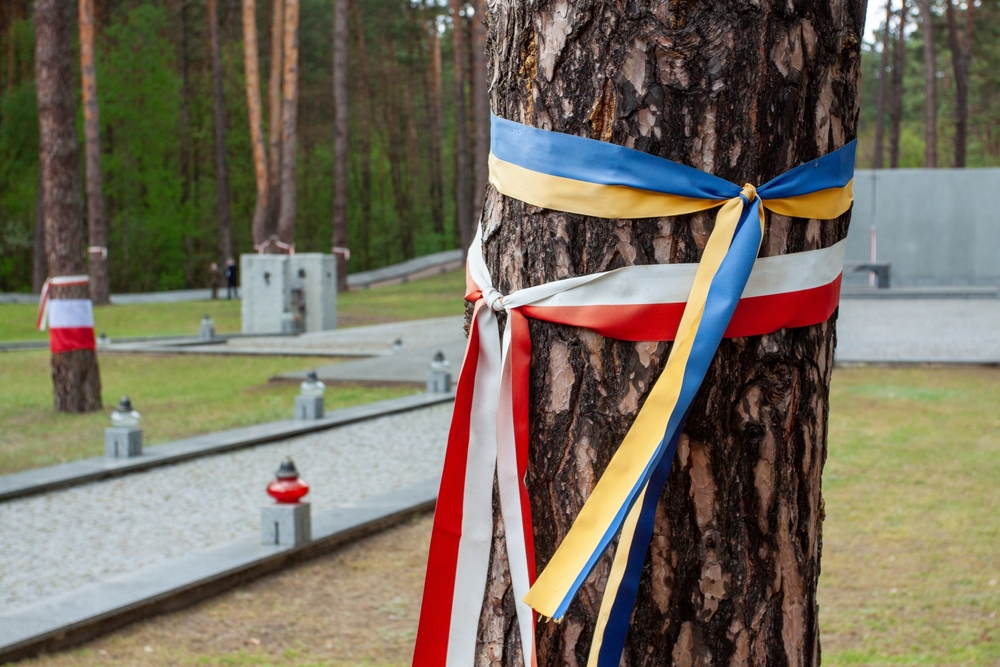
Photo: Alexander Ishchenko / Shutterstock

Thus, it is never easy to define Europe within geographic boundaries. Such an attempt always brings more questions than answers. Can we limit Europe solely to the continent’s borders? If yes, would that mean then that a quarter of Russia, including Moscow, which is located on the European continent, can also be called Europe? Can we thus decide on the Russian Federation’s belonging to Europe? In light of today’s war in Ukraine, which was deliberately started by the Kremlin, we are clearly far away from identifying Russia with what we call Europe.

Should we then talk about Europe as an area which falls within EU borders? If yes, would this mean that after Brexit we should stop calling the United Kingdom a European state? What if we limit our understanding of Europe to European states and their colonies? Can we then claim that the French Antilles belongs to a European rather than Caribbean culture? These kinds of questions continue; while the answer to what Europe is, has become increasingly more and more difficult.

Heritage and belonging

To define Europe and European identity we should look at Europeans and their sense of belonging to European culture. Above all, Europe is a cultural fact. That is why it seems more rational to put aside the less useful geographic definitions and attempt to describe Europe through the prism of cultural sources and the values that its people hold dear. These sources, as the French essayist Paul Valéry rightly noted, include the heritage of ancient Greece and Rome, as well as Christianity. In addition, there is the heritage of the French Revolution, with human rights at the centre and treated as an absolute value.

The idea of Europe is thus based, or maybe we would like it to be based on, such values as freedom, democracy, dignity, equality, rule of law and human rights. More than anything else, these values are said to distinguish Europe from “non-Europe”. They also determine whether we belong (or not) to the European community. Today, at the time of Russia’s war against Ukraine, they are – on the one hand – what we are trying to defend and – on the other hand – what motivates us to move forward.

Faced with the brutality of Russia’s aggression we have also seen a return of the justified question about Europe’s limits and how to overcome them. Even though we know that many of our borders cannot be called natural – just like the Berlin Wall was never a natural border and erected for purely ideological reasons – we now see that some borders have again become imfportant, mainly for security reasons. This also explains why the old division between Western and Eastern Europe has not only become central to many recent discussions but has also gained more exposure than we have seen in years.

Europe’s internal border, rightly criticised, shows that there are still large mental differences between different parts of Europe. As a result, there are differences in the senses of threat and shock that are experienced by people who live in them. The point of stressing these differences is, however, not to eliminate Europe’s East (or centre) from a civilised, progressive and democratic West. Neither is it to embrace a discourse of exclusion. The point of understanding these two different sensitivities that characterise the East and the West is rather to stress the fact that the internal border that divided Europe after the Second World War has had a long-term effect on the whole region that was once behind the Iron Curtain. Indeed, the area is still freeing itself from this burden.

The existence of this clearly political border explains why in the 1990s countries such as Poland, Hungary, Bulgaria, Romania and others were seen as different from those located in Western Europe. It also explains why the term “Eastern Europe” was used to collectively describe a region that was in fact made up of different countries, ethnic groups, languages and histories. Not all of them would even like to use the term “Eastern” to describe themselves.

S: Memory and experiences

The concept of “Central Europe”, put forward by Milan Kundera in 1984, was popularised by Polish, Czech and Hungarian intelligentsia. It was meant to serve as an antidote to the derogatory term “Eastern Europe”. This term – as it was believed – denied the inhabitants of our region a sense of belonging to Europe. Central Europe’s “return” was manifested with German reunification in 1991 and the EU enlargement of 2004. However, even after these two breakthrough moments for European integration, the East-West division remained, at least in discourse. It became a label to which Central and Eastern Europeans always had to make reference, regardless of whether they wanted to or not. The term can be offensive, but it cannot be ignored.

Since February, this emblem, or uniform to use Hannah Arendt’s words, has once again been publically put on by Central and Eastern Europeans. In other words, it has become the lining of the Western European suit. The fabric of this Eastern European uniform is made of the experience of socialism and communism, but also the memory of the lack of sovereignty, Stalin’s repressions, and the knowledge of persecution and propaganda.

It was because of these experiences that Czesław Miłosz wrote about Homo Sovieticus. This victim of the totalitarian regime later – after the collapse of the Soviet Union – turned into a Homo Post-Sovieticus. Analysing these two sociological and political categories in New Eastern Europe, Professor Venelin I. Ganev wrote that what connects Homo Sovieticus and Homo Post-Sovieticus is an “interpretative template” that people in post-communist countries use to analyse the world that surrounds them. That is why right after Russia’s aggression in Ukraine people who live in Central and Eastern Europe were able to quickly assess the situation and express their empathy for Ukrainians. They felt a sense of connection with them (we can call it brother or sisterhood). They began to help straight away; unconditionally and en masse. They also did it because collectively they share the memory of the brutality of the Soviet regime and the times when their countries were victims of Russia’s crimes. This and the information about the threats that Vladimir Putin and Sergei Lavrov have been directing at other post-Soviet republics have generated a sense of threat, fear or even panic.

Recognising these emotions, we should not be surprised that the voices calling on NATO to send weapons to Ukraine and close Ukraine’s skies come mostly from this region. Also, characteristically, people from this part of Europe seemed less shocked when they heard about the Russian army breaking international legal norms or deliberately killing or hurting innocent civilians. Unfortunately, the experience of torture and imprisonment is widely present in our history. The earlier experience of Soviet propaganda explains why in Central Europe we are more conscious of widespread Russian propaganda.

All said, we can now see that our thinking about security, which has clearly been shaped by these experiences and the sense of threat that accompanied them, is evidence of a certain distinctiveness. This is despite our attempts to wipe out this feature of being non-western. As a result, the memory of the past has turned out to be a living and non-erased experience.

Most importantly, however, the war that has been taking place since February right at the EU and NATO’s borders, as well as the world’s reaction to the violations of human rights and international law committed by the Russian army, have brought to light differences between what can be called European and what is not in accordance with European norms and values. Consequently, the conflict has made it clear that we need to define anew what we mean by Europe.

Europe’s bulwark

Undoubtedly, creating a new border between Europe and non-Europe will amount to condemning what is beyond it as unacceptable. It will also have consequences for our discourse, as clearly a new border would mark a division between what we see as familiar and what is foreign to us. Indeed, since the 17th century everything that was East to Europe, or its core, was described as primitive, pre-modern, semi-civilised, traditional, despotic, barbarian and backward. It was contrasted with the progressive, democratic and dynamically developing western part of the continent. In this way, Western Europe managed to determine its positions of power as well as dependencies and subordination. It also determined who is to be called aggressive and who is benevolent; who is fast and who is slow; who is brave and who is fearful; open to the future or stuck in the past; controlling and controlled.

Culturally speaking, on the first day of the war’s outbreak, Ukraine has become Europe’s bulwark. We understand its importance for the security and future of the European community, even though we know that formally Ukraine is not a member of the EU. Yet, we admire Ukrainians who fight also for our values and thus ask ourselves whether our understanding of Europe should also embrace other countries that are not necessarily a part of the EU. We should also think about states that are not located on the European continent and even those that do not belong to what is popularly called the “West”. And yet many of these countries, as it turns out, are now on “our” side. These countries have developed what we like to call modern statehoods, are willing to cooperate (and not fight) with other states and respect others’ sovereignty (even if in the past they had conflict with other states).

Thus, a wider marking of European borders would not necessarily be limited to formal divisions of territories, but rather reflect our shared values and their protection in the face of future challenges. We should also remember that because of varied adherence to the aforementioned value system, Europe’s Eastern border was never permanently set in one place. Research on axiological preferences in the region shows that it actually has been moving further and further to the East. Until not that long ago Europe was said to end in Poland, while Ukraine was believed to be the beginning of the East. For Ukrainians, in turn, it is in Ukraine that Europe was to end, at least since the time of the Orange Revolution, while the East was believed to start in Russia.

The only question is how far can the border move? Clearly the current discourse points to a division between Russia and the West. Yet, it should also be noted that this West is also joined by what we consider non-western states, such as Japan. As a result, it is probably better to place the current division between states that are for and against Putin (it is surely difficult to find neutral ones). Possibly, this division over the war in Ukraine will overlap with US President Joe Biden’s theory that the world is now divided between democratic and authoritarian systems.

Translated by Iwona Reichardt

Kinga Anna Gajda is an associate professor at the Institute of European Studies of the Jagiellonian University in Kraków.

, , ,

Partners

Terms of Use | Cookie policy | Copyryight 2025 Kolegium Europy Wschodniej im. Jana Nowaka-Jeziorańskiego 31-153 Kraków
Agencja digital: hauerpower studio krakow.
We use cookies to personalise content and ads, to provide social media features and to analyse our traffic. We also share information about your use of our site with our social media, advertising and analytics partners. View more
Cookies settings
Accept
Decline
Privacy & Cookie policy
Privacy & Cookies policy
Cookie name Active
Poniższa Polityka Prywatności – klauzule informacyjne dotyczące przetwarzania danych osobowych w związku z korzystaniem z serwisu internetowego https://neweasterneurope.eu/ lub usług dostępnych za jego pośrednictwem Polityka Prywatności zawiera informacje wymagane przez przepisy Rozporządzenia Parlamentu Europejskiego i Rady 2016/679 w sprawie ochrony osób fizycznych w związku z przetwarzaniem danych osobowych i w sprawie swobodnego przepływu takich danych oraz uchylenia dyrektywy 95/46/WE (RODO). Całość do przeczytania pod tym linkiem
Save settings
Cookies settings