
Russians in Estonia. We are not “them”, we are “us”
Access to good education, healthcare, social welfare and general public services has all contributed to the often difficult process of better integrating mostly older generations of Russian-speakers into Estonian society. The relative ease of conducting everyday life, the security of state support and the prospect of a European future for their children have bound Russians with Estonia over the last three decades.
Estonia’s Russian-speaking community became irritated by a recent speech of the Estonian president, Kersti Kaljulaid, on Estonia’s Independence Day on February 24th, where she emphatically called on fellow citizens “with a different cultural and linguistic background” to understand “(us), Estonians”. The way she chose to address Russian-speakers and other non-ethnic Estonians living in the country – paraphrased as “you, who are different, need to understand us, Estonians” – signifies the lack of understanding in the president’s office of the sensitivities of “the Russian question” from the perspective of Russian-speakers.
April 11, 2021 -
Kristina Kallas
-
Hot TopicsIssue 3 2021Magazine
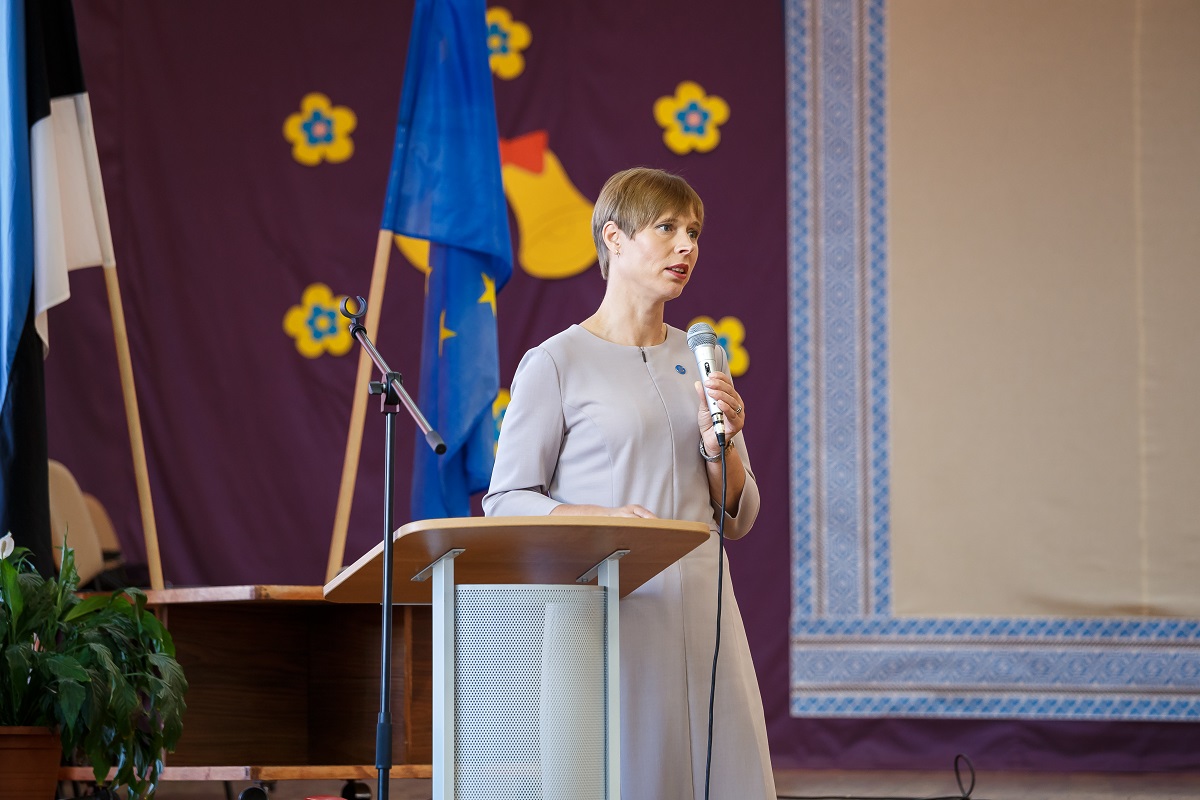
Estonian president Kersti Kaljulaid visiting the Keeltelutseum - Russian school in Narva on the first day of the school year in 2018. Photo: Zoja Hussainova / Shutterstock
However, even more significant is that the mishap of the president’s address revealed a shift in self-understanding of Estonian Russians which has happened since Kaljulaid took office in 2016. What has changed with the self-perceptions of Russians in Estonia over the past five years?
To put it simply, they no longer appreciate it if they are addressed as “them”. As journalist Ilya Sundelevich commented on the Russian-speaking national broadcasting programme, it is offensive to be treated as an outsider who is not capable of understanding the cultural and linguistic concerns of ethnic Estonians. The reaction of the Russian-speaking audience strongly indicated that they prefer to be not addressed separately from “us, Estonians”. And this is a significant change. It is a change from three decades ago when Russian-speakers were barely addressed in Independence Day speeches and their existence in the country was silently tolerated. Then, about a decade ago, a special reference was started to be made to “Russian-speaking compatriots” which generated applauses of long-awaited attention.
More like us
When Kersti Kaljulaid became president and chose to reside for a couple of weeks in the Russian-speaking border city Narva, the special attention she gave to the uniqueness of the place and its residents was appreciated by the local community. However, it is fair to note that her attention was translated as “she is here because we are all the same Estonia” rather than “she is here, because we are different”. Being singled out as somebody different, with a dissimilar cultural and linguistic background, has not become appreciated by the Russian-speakers and it is significant.
The change came with the annexation of Crimea in 2014. At the time when events in Ukraine unfolded with extraordinary speed and caused unprecedented abruptions, the analysts looking at the events used the knowledge to extract the potential conflict spill-over to other post-Soviet territories with significant Russian-speaking resident populations. Back then the belief was that Russian-speaking populations in Estonia and Latvia have long-term, overdue grievances towards their governments and that the Russian Federation’s regime has applied a rather aggressive compatriots’ policy to utilise this grievance. Adding to this, the act of Narva residents demanding linguistic and political autonomy through a 1993 referendum was often treated as a sign of separatism, which could lead one to conclude that events in Crimea and Donbas could be replayed in Estonia and Latvia, if Russia so chooses.
Yet, the reaction of Narva Russians to the annexation of Crimea – or, more accurately, the lack of reaction – surprised everybody. International journalists who travelled to Narva found a community that did not like the idea of being associated with the Russians in Crimea, and did not like questions about their loyalties to Estonia or their relations towards Russia. They did not want to talk because it would mean drawing attention to a group in need of special attention. They wanted to be left alone, to continue working and raising their families. The message they sent was clear: “Leave us alone. Estonia is not Ukraine, Narva is not Crimea and we are not like Russians in Russia”.
Thirty-year search of identity
The process of self-identification as Estonian Russians, different from Russians in Russia or Ukraine, has been a bumpy ride. The collapse of the Soviet Union plunged the Russian-speaking residents of Estonia into a profound identity crisis. One late summer day in 1991, the country they identified with the most – the Union of Soviet Socialist Republics, a non-national centralised ideological empire spanning from the Baltic sea of Northern Europe to the Pacific coast of Asia – no longer existed. Instead, they woke up to the realities of an aspiring small nation-state, whose political, cultural and social outlook were foreign to them. Overnight they went from being the dominant class to unwanted migrants, a minority group with no social, political or cultural status.
The loss of rights and privileges caused a rebellion against the independent Estonian nation-state, especially among the technocratic and political elites of the Russian-speaking community. Narva and Sillamäe, the most Russian-concentrated and most industrial Moscow-connected cities, conducted referenda in 1993 to declare special status zones in cities where the Russian language would continue to hold primary status. This was the last attempt to hold on to the status quo. The political power shifted quickly from the hands of the old Soviet ruling class to the new Estonian elite, backed by the western powers and not heavily resisted by Boris Yeltsin. Russians in Estonia had to choose their adaptation strategies: to resign and leave; to stay and resist, but risk marginalisation; to stay and try to get by; or, perhaps, to stay and to integrate.
All four strategies were tried. An estimated 100,000 Russian-speakers left Estonia in the early 1990s, including Soviet army personnel and family members. At the same time, many tried to integrate – they passed language tests and acquired Estonian citizenship. Estonian language skills have been slowly but steadily improving among Russian-speakers and, together with this, a better understanding of Estonian history and culture.
Demand for integration
Identity formation is a prolonged process influenced by a myriad of factors. The most significant factor in the adaptation of Russians in Estonia (and equally so in Latvia), has been economic growth and the delivery of public services. Access to good education, healthcare, social welfare and general public services have all contributed to the difficult process of integration and association with Estonia. The ease of conducting everyday life, social security, and the prospect of a European future for their children have bound Russians more with Estonia than Russia over the last three decades. This is the major difference between Estonia and Ukraine: the state delivers relatively good quality public services in return for the taxes that citizens pay.
Soviet-era generations, while not fully content with the situation they were thrown into, have nevertheless adapted fairly well. Even if there are still significant inequalities in terms of income, access to top jobs and opportunities in politics, the life which most Russians have built in Estonia and Latvia is stable. They have a lot to lose from sudden disruptions of the regime. There lies the reason behind the lack of response to events in Crimea – Russians have as much as Estonians to lose from rocking the boat. Their children, born in independent Estonia, identify themselves almost exclusively with Estonia – its social, political and civic realities and its everyday practices. There are still cultural and linguistic dividing lines – partly inherited from the essentialist approach to nationality from the Soviet era, and partly caused by the linguistically separate schooling. The plea not to be considered as outsiders is a view loudly represented by younger generations of Russian speakers and the reaction to the president’s mishap reflects this clearly.
Pal Kolstoe, a researcher of post-Soviet Russia and surrounding states, forecasted back in 1996 that the development of a “new cultural self-understanding” of Russians in post-Soviet countries is the most probable trajectory. This trajectory is most evident in the democracies of Estonia and Latvia. While Kolstoe did not dare predict which form this cultural self-understanding would take, observations from Estonia and Latvia allow me to claim that the self-understanding of Estonian and Latvian Russians, rooted in their respective countries, integrated into the mainstream national cultures and societies is taking shape with younger generations. Having said all that, it is important to note that structural inequalities and citizenship issues remain unresolved. It is also important to note that Russia continues to have leverage on the identity formation of Russian-speakers via language and cultural projects, especially via informational operations using Russian-language social media and television. This leverage nevertheless weakens with each passing decade.
Kristina Kallas is a political scientist and leader of the liberal political party Eesti 200.