
New president, old authorities
Kazakhstan’s presidential election on June 9th was a breakthrough. It was the first election in the history of the young country where the main candidate was not Nursultan Nazarbayev, who had ruled Kazakhstan for almost 30 years. The country’s new president is Qasym-Jomart Toqaev, a long-time diplomat and confidant of Nazarbayev.
“I have made a difficult decision for myself – to resign from the powers of the President of the Republic of Kazakhstan.” It was a historic moment when Nursultan Nazarbayev announced his resignation live on TV on March 19th 2019. He made an unusual decision for a region where presidents tend to die in office rather than resign. This step came by surprise for many at that time but had been in preparation for years.
November 13, 2019 -
Othmara Glas
-
AnalysisIssue 6 2019Magazine
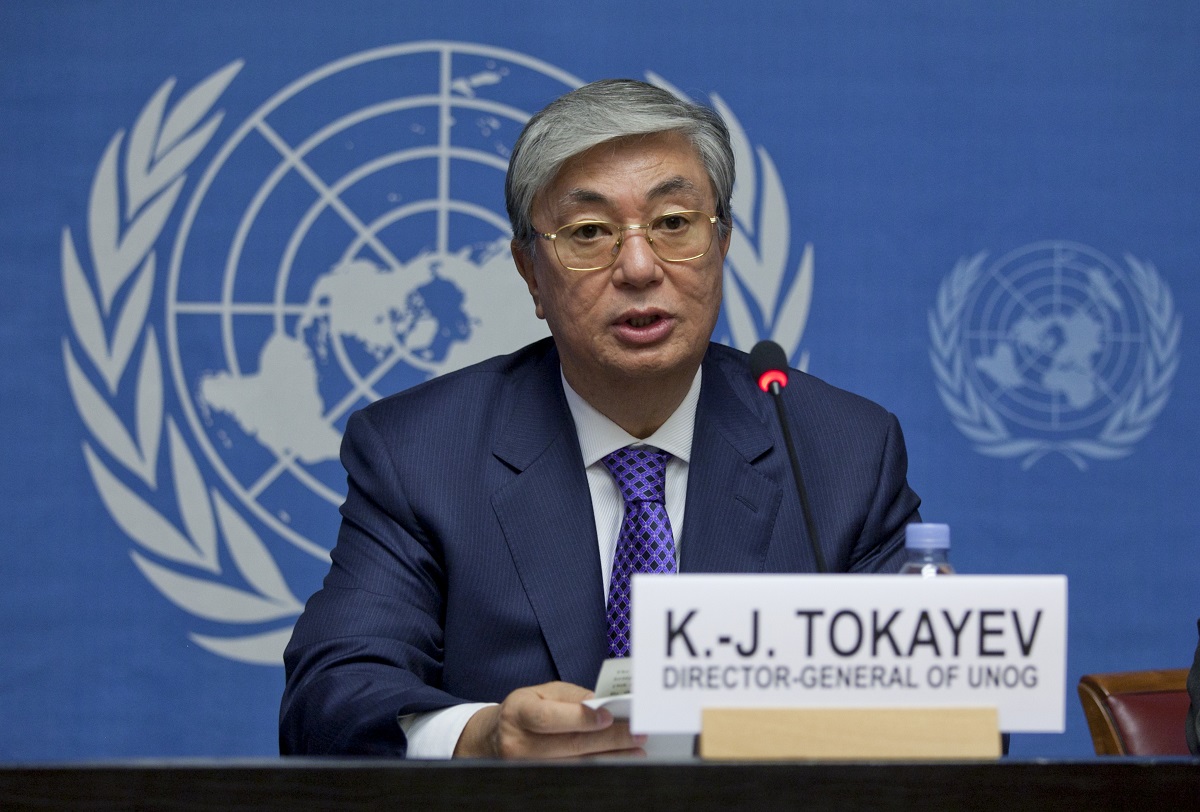
Qasym-Jomart Toqaev Nazarbayev’s successor in Kazakhstan. Photo (CC): commons.wikimedia.org
As the head of the senate – and according to the constitution, first in line to replace the president – Qasym-Jomart Toqaev became Nazarbayev’s successor. Toqaev, a career politician and diplomat, has been working with him since the beginning of Kazakhstan’s independence in 1991. During his resignation address, Nazarbayev introduced the new president: “I know him well. He is an honest, responsible and indispensable person … I believe that Toqaev is the person we can entrust with the governance of Kazakhstan.”
After only a few weeks in office as acting president, Toqaev announced snap elections for June 9th. Parties and organisations had two months to nominate their candidates, collect money and signatures and prepare a campaign. For weeks, people went on the streets to call for free and fair elections. The demonstrations were quashed and access to news outlets and social media in the weeks leading up to the election were blocked. As expected, Toqaev won the election with nearly 71 per cent of the vote. However, the protests continued, and he soon had to deal with more social unrest.
Why did Nazarbayev step down?
Nursultan Nazarbayev ruled Kazakhstan for almost 30 years, first as the First Secretary of the Communist Party of the Kazakh SSR and then as the president of Kazakhstan after April 1990. He managed the country’s politics following the break-up of the Soviet Union and during the years of economic decline that saw a mass exodus of hundred thousands of people. Economically, Nazarbayev built the country on resource-rich soil. Politically, he found a balance between the neighbouring political giants Russia and China. Looking at certain indices, like the Human Development Index, Kazakhstan has been performing well compared to other post-Soviet countries. Yet, at the same time, Nazarbayev has built an authoritarian system with barely any opposition. He won the presidential election in 2015 with 97.7 per cent of the votes.
Nazarbayev’s resignation in March of 2019 was preceded by social unrest and economic decline. Social allowances are small, the education system and resource-based economy need reform, and corruption is widespread. In 2018 GDP growth was a respectable 4.1 per cent but not high enough to escape the middle-income trap – a situation, in which a country gets stuck at a certain income level. The value of the national currency, the tenge, has been falling for years.
Earlier this year, the United States-run Radio Free Europe/Radio Liberty reported on mothers who renounced their “Hero Mother” status. These are women who have seven or more children and get a golden ring and a monthly state stipend of 40 dollars per month. The Kazakhstani government is encouraging people to have many children but fails to support families in an adequate way. In February, five girls, aged between three months and 13, died in a fire in the capital Astana. The parents had to leave their children alone during the night to go to work but could not afford child care. A malfunctioning heating system caused the fire to break out.
Following these events, at the end of February, Nazarbayev sacked his entire cabinet, stating that social issues have not been resolved because of “the inefficiency of the government … to work with the population, to listen to people’s problems and to inform them of the work undertaken and the policies carried out”. Nazarbayev’s resignation came at a time when people were so upset that they were ready to go to the streets to protest for greater rights. He clearly wanted to avoid a situation like the one in neighbouring Kyrgyzstan in 2010 when then-president Kurmanbek Bakiyev was ousted by protesters in Bishkek. Some observers believe that he was also influenced by the events in Algeria where mass demonstrations in March ousted the president, Abdelaziz Bouteflika, who had served since 1999.
Who is the new president?
One day after Nazarbayev’s resignation, Qasym-Jomart Toqaev was inaugurated as acting president. Since 2013 he was the head of the senate and, according to the constitution, first in line to replace the president. Toqaev was born in 1953 in Almaty. His father, Kemel Toqaev was a well-known Kazakh writer and veteran of the Second World War. At the age of 17 he entered the Moscow State Institute of International Relations. In 1975 Toqaev joined the Soviet foreign ministry and was posted to Soviet embassies in Singapore and Beijing. After the collapse of the Soviet Union Tokaev was appointed as deputy foreign minister of Kazakhstan and later promoted to first deputy foreign minister. In 1994 he became the minister of foreign affairs and from 1999 to 2002 served as deputy prime minister. He was also the Director-General of the United Nations office in Geneva between 2011 and 2013.
While Nazarbayev’s resignation caught many people by surprise, it was not so unexpected for those who followed Kazakhstan’s politics and could observe preparations for a power transition. In 2010 Nazarbayev was bestowed the official title of ‘Elbasy’ (leader). In 2018 the security council, which implements national security policy, became a constitutional body that is led by the Elbasy. In this way, the now 79-year-old Nazarbayev remains at the top of the security council and can remain there until the end of his life. Furthermore, Nazarbayev is still the chairman of the ruling party, Nur Otan, and a member of the constitutional council. As Toqaev became president, Nazarbayev’s daughter, Dariga Nazarbayeva, took over as chair of the senate. This means that if Toqaev was to step down, she would become the acting president. Some experts have speculated that the actual plan is a power transfer within the Nazarbayev family.
Civil society awakens
Nazarbayev’s resignation gave new momentum to Kazakhstan’s civil society. Young people, in particular, who had not known any other president, rejoiced with posts on social media: “We declare March 19th a holiday!” However, the first wave of euphoria for change after Nazarbayev’s declaration quickly rescinded when Toqaev was sworn in as the new president. His first decision in office was to rename the capital from Astana (“capital” in Kazakh) to Nur-Sultan (Nazarbayev’s first name). A few days later, during the Nauryz spring festival – one of the most important holidays in Kazakhstan – the first protesters gathered against the renaming. An online petition was signed by around 40,000 people within a few hours.
On April 26th two activists held a banner during the Almaty Marathon which read: “You cannot run away from the truth.” They were arrested and detained for 15 days – the maximum possible sentence. Soon after, an artist, who hung a banner on a bridge in Almaty quoting the constitution, was also arrested. In the following days, more banners popped up around the country. The authority’s high level of insecurity was especially evident in the case of a young man in the western city of Uralsk, who held a blank sheet of paper just to prove that he would get arrested for holding a blank sign with no slogan at all (and he was).
“I have a choice! You cannot run away from the truth!” was heard on the streets of Kazakhstan during the weeks before the election. It seemed that a window of opportunity for the civil society had opened for the first time. Hundreds of people gathered in the bigger cities on May 1st, officially called the “Day of Unity”, to call for free and fair elections, the release of political prisoners and the final withdrawal of Nazarbayev from politics. In Almaty, the meeting went on for several hours as a peaceful demonstration before the police intervened and arrested dozens of people. Further protests were announced for Victory Day celebrations on May 9th. In response, the authorities began to block social media and messenger services like Facebook, Instagram and WhatsApp. Websites of news outlets that reported on the protests, including Radio Free Europe/Radio Liberty, were also inaccessible. While the authorities had taken such actions in the past, the scale of this digital blockade was unprecedented.
The election
Originally, the next presidential elections were scheduled for 2020. Yet, on April 9th, Toqaev unexpectedly announced snap elections for June 9th. Seven candidates, the highest in the history of Kazakhstan, competed for presidential office. Among them was Daniya Yespayeva (Ak Zhol party), the first female candidate ever to run for president. While most candidates could be called loyal to the regime, Amirzhan Qosanov (Ult Tagdyry party) was widely seen as the opposition candidate. The former journalist worked in the government under Nazarbayev but was jailed twice for organising unauthorised rallies; most notably one to support the victims of the 2011 Zhanaozen massacre.
Almost 12 million voters were registered. Visiting polling stations, the transparent ballot boxes were remarkable. Voters did not take care to fold their ballots correctly and everyone could see their vote. As expected, Toqaev won with 70.96 per cent of the votes. Qosanov received 16.23 per cent. Voter turnout was announced at 77.5 per cent.
Local and international election observers have raised suspicions about these numbers. In its preliminary report, the OSCE noted “significant irregularities observed on election day, including cases of ballot box stuffing and a disregard of counting procedures meant that an honest count could not be guaranteed … there were widespread detentions of peaceful protesters on election day in major cities.” In the days after the election, more demonstrations against the results took place. According to official statements around 1,000 people were detained. Nevertheless, Toqaev’s second inauguration took place on June 12th.
Challenges ahead
Although Toqaev is now the officially elected president of Kazakhstan, Nazarbayev remains in control. His first months as acting president were marked by an insecurity of authorities. Young people saw a window of opportunity and went on the streets to call for democracy. Police officers and judges who were not yet familiar with Toqaev’s wishes (over)reacted with detentions and sentenced people to the maximum penalties. The election in June gave more stability to the current regime. However, on September 18th, his 100th day in office, Toqaev announced a reshuffle among top officials. Krymbek Kusherbayev, presidential chief of staff and a confidant of Nazarbayev, was dismissed. Whether it is Nazarbayev or Toqaev behind the decision remains unclear because Kusherbayev has caused hard feelings among the authorities.
The second president has many issues to solve. In addition to the existing socio-economic problems, the protests continue. In June an ammunitions depot exploded in the small town of Arys. Three people were killed and some 45,000 inhabitants evacuated. Left without alternative accommodations, videos depicted an angry group of protesters in front of the local branch of the Nur Otan party. In the beginning of September mass protests against Chinese expansion took place after plans became public that China wants to transfer factories and workers to the western region of Mangystau, where the country’s oil and gas reserves are exploited. For years, demonstrations have been taking place against the working conditions and the betterment of foreign workers compared to Kazakhs. Kazakhstan has its bids on a key role in the Belt and Road Initiative and counts on investments from China. Toqaev, who reportedly speaks Chinese, needs to now find a balance between growing economic dependence on its neighbouring country and further unrest.
Othmara Glas is a freelance journalist based in Kazakhstan.
Listen for more: Check out the Talk Eastern Europe podcast Episode 18 – Kazakhstan’s managed transfer of power.