
Multiplying civil society’s voice in the Eastern Partnership, a challenging task
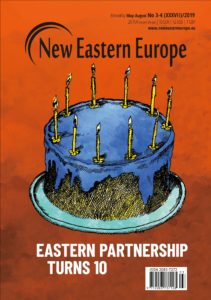
The Eastern Partnership Civil Society Forum was established to facilitate civil society’s engagement in Eastern Partnership policy and promote dialogue among civil society organisations and the authorities. One might think that one decade is enough time to develop co-operation where officials learn to value civil society’s expertise and willingness to help. Unfortunately, that has not been the case.
When asked to look into the past ten years of the Eastern Partnership Civil Society Forum (EaP SCF) I did not envision how difficult it would be. I found myself divided between my professional passion for the Eastern Partnership (EaP) region and the frustration that accumulated over the years of working on it. I have enormous admiration for civil society in the region whose actors, despite personal risk, tirelessly defend human rights, seek to instil democracy and the rule of law and create a safe and engaging environment. But I also cannot ignore the limitations.
May 2, 2019 -
Dovilė Šukytė
-
Hot TopicsIssue 3-4 2019Magazine
Photo: European Commission (CC)
As a former co-chair and member of the forum’s steering committee, I faced situations when country-related realities, cultural differences and even personal egos hindered our work. Some members deceive themselves about competences they do not possess, and prevented themselves from meeting the expectations of the EU (the forum’s main supporter) and giving EaP country governments a reason to ignore civil society when it becomes uncomfortable.
The Civil Society Forum is a unique tool for facilitating civil society engagement within the EU’s EaP policy implementation process, notably the achievement of the 20 Deliverables for 2020, as set by the European Commission and the European External Action Service. It unites over 800 civil society organisations with their own areas of expertise and capacities. Their abilities are on different levels and it is among the forum’s tasks to foster exchange of experience and co-operation among the members. In order to assess the results of the forum’s decade of work, it is important to understand the environment in which the EaP civil society functions, to look at the impact of the EaP policy on civil society and the transformations it had to undergo in order to have a say in national reform processes.
Promoting dialogue
The Eastern Partnership policy was launched to bring six Eastern partners closer to the EU. However, EaP related discussions tend to sideline the societal elements and instead focus on the geopolitical leanings of the EaP member states and their political stamina to implement reforms. A majority of EaP experts and critics have never worked on the actual implementation of the reforms and have no connection with civil society. Furthermore, much of their analysis is dominated by hard security concerns, while ignoring the social changes. To illustrate this point, the post-Velvet Revolution of Armenia is still being analysed primarily through the prism of its security dependence on Russia, even though the Armenians themselves do not overemphasise this fact – an overwhelming majority (88 per cent) support the intensification of Armenia-EU relations. Such ignorance of the role that society plays is surprising, especially when the EaP region is coloured with civil society-run revolutions. As soon as the street revolution is over and the baton is given to the new government, the role of civil society is downgraded to reform monitoring. Another option for civic activists is to enter politics, which might strengthen the ranks of decision makers, but it bleeds society of its talents.
The EaP CSF was established to facilitate civil society’s engagement in EaP policy and to promote dialogue among civil society organisations and public authorities. One might think that one decade is enough time to develop co-operation where officials learn to value civil society’s expertise and willingness to help. Unfortunately, that is not the case. Civic actors, who are working on the ground and possess a practice-based know-how, are treated with the same respect as experts whose advice is based more on academic theories. A young social entrepreneur from the mountainous areas of Armenia might not offer extensive market analyses, but she can provide successful models on creating workplaces for vulnerable groups and strengthening local communities.[1]
The extent of civil society’s inclusion in the reform processes varies in all six EaP member states. The Georgian parliament, for example, has given civil society organisations premises within its buildings, while in Belarus the engagement between government and civil society is limited to cases when the EU insists on the presence of civil society at meetings.
The forum unites civil society organisations from six EaP member states and the EU. Forum participants are divided into members and delegates. Members belong to one of the six EaP member state platforms (organisations from EU member states have no such opportunity). The forum sets minimal standards for the national platforms, for example, insisting that they follow its code of ethical conduct. Most other matters, including the selection of members, are under the jurisdiction of each national platform. It would be a mistake to assume that the size of platforms is correlated with the size of the Eastern Partner state or their openness to civic activism. Currently the largest platform is that of Armenia, with 260 members. The Georgian platform unites 185 member organisations, while Ukraine has 130. The Moldovan and Belarusian platforms have around 80 members each, while the smallest – Azerbaijan – has 63 members.
The platform facilitates coordination of local activities, provides learning opportunities and easier access to decision makers. Platform membership is a precondition for any EaP member state organisation wishing to become a delegate to the Annual Assembly of the forum. Out of the 800 members, only 120 (20 per country) attend the Annual Assembly in a given year; an additional 30 seats are allocated to civil society organisations from EU member states.
Bring the bottom to the top
The Annual Assembly is more of a networking event where prominent civil society actors gather to share results of their joint work and discuss co-operation initiatives. It is also an opportunity to deepen dialogue with EaP decision-makers and EU representatives. Since the assembly is financially and politically embraced by the EU, civil society groups uses the event to pressure their national governments to take more action when implementing pro-EU reforms, and in simply respecting basic human rights. Conversely, the participation of high-ranking EU officials (including the Commissioner for Enlargement and European Neighbourhood Policy) is an opportunity for civil society groups to pinpoint troubling issues (including the wrongdoings of EaP member state governments) and to ask the EU for help in solving them. The forum has no legal authority, thus it needs to be creative and use any opportunity to voice concerns regarding the failing of human rights, superficial government commitment to reforms, election irregularities, the abuse of public resources and other issues.
Delegate engagement is not limited to the two days of the assembly. During the term they work in five working groups. Four of them mirror the priority areas (thematic platforms) of the Eastern Partnership: strengthening institutions and good governance; economic development and market opportunities; connectivity, energy efficiency, environment and climate change; and mobility and people-to-people contacts. The fifth one focuses on social dialogue. While it lacks an equivalent within the EaP structure, its topics – social policy, employment, labour rights, etc. – are still considerably relevant. When applying for the Annual Assembly, potential delegates need to highlight their competences and select a working group. The largest working group is the first one, as it covers human rights issues.
The aim is to organise the forum’s work in a structure that is similar to the EaP’s thematic platforms in order to ensure appropriate civil society involvement and contribution to the EaP agenda. When working on the ground in their communities, delegates are free to set their own goals. However, at working group meetings they need to ensure their work is of value to EaP policy. Furthermore, when attending EaP platform meetings – where they find themselves among policy makers – they need to provide valuable input. As one frustrated Moldovan public servant stressed to me, criticising is easy, but working towards solutions is what is actually needed.
Thus the forum, via its secretariat in Brussels, works to select the most qualified members to attend these and other meetings, and to present recommendations carefully developed in co-operation with colleagues from all six EaP member states. However, this is not an easy task. First of all, the preparation for such recommendations requires skills that many organisations do not possess. They are more used to working on the ground with people than writing policy briefs. The forum has prominent EaP think tanks among its members, but not all of them specialise in, for example, agrarian, educational or environmental issues. In addition to expertise-related weaknesses, the forum has limited resources. Most of the resources are allocated to the Annual Assembly, working group meetings, re-granting and the maintenance of the secretariat. Accordingly, all contributions are made on a pro-bono basis. Recently two forum representatives took part in the EaP Ministerial Meeting on Environment and Climate Change – covering all six EaP member states, not only their own. Preparation included consultations with their counterparts in the other EaP member states, taking several days. The final result – a thorough presentation of problems and ways to manage them – reconfirmed the value and importance of having civil society actors in the room. One of the representatives assured that she would do it again even if it meant working without pay and putting aside actual work commitments.
New leaders and initiatives
In order to boost its members’ co-operation and expertise, the forum has a re-granting scheme. Every year each working group formulates priorities which must be in line with EaP policy and the 20 Deliverables for 2020. For 2019, some 270,000 euros have been allocated; these funds will be divided among 13 awarded projects (they will receive approximately 20,000 euros each). To ensure broad co-operation, the project team has to contain three partners from the different EaP member states. As recently as a few years ago, there was a tendency to assign EU-based civil society organisations as lead partners with administrative responsibilities. Due to persecutions and limitations on receiving funding, organisations in Armenia, Azerbaijan and Belarus would not embark on leadership roles.
Current data shows that EaP civil society organisations have taken over project management competences from their EU counterparts and are running all 13 re-granting projects: five are led by Georgian organisations, three by Ukrainian, two each by organisations from Armenia and Moldova, and one by an Azerbaijani organisation. Belarusian and Azerbaijani organisations still face difficulties in obtaining funds from abroad and this makes the forum, as well as the EU, look for local approaches on how to support civil society without putting its members at risk.
Due to re-granting and additional fundraising, forum members have launched many successful initiatives. Among the first was the Media Landscape of EaP member states, an index of EaP media freedom. Each year the forum also produces the Eastern Partnership Index which measures and compares EaP member states’ progress on democratic reform, sustainable development, and European integration. The flagship event of the working group on mobility and people-to-people contacts is the annual EaP Youth Forum which serves as a platform for youth co-operation. In 2017, members launched the EaP Think Tank Forum aimed to integrate EaP think tanks into the European network. One of the EaP Think Tank Forum’s products included a set of recommendations for the 2017 EaP Brussels Summit. In 2016 the forum launched monitoring missions on the civil society, media and human rights situations. Their aim is to evaluate the working environment for civil society and independent media after abuses of power arise, as well as providing recommendations to the government of the assessed state, to the EU and other intergovernmental and nongovernmental organisations. The first monitoring mission took place in Armenia after the seizure of a police station in Yerevan and the wave of public protests it ignited. The second mission the following year in Belarus happened after the arrest of demonstrators protesting against the so-called social parasite law.
Responsibility and relations
When asked about the main advantages of being a part of the forum, EaP civil society members usually cite the following: through the direct influence of the EU, their participation in the decision-making processes significantly increased (especially for Armenian and Belarusian respondents), leading to improved outreach to national decision-makers; the network of EaP and EU civil society organisations led to an exchange of expertise, the transfer of best practices, and co-operation on joint initiatives; the focuses of civil society organisations broadened; the forum’s secretariat in Brussels became the platform for events presenting civil society organisation’s agenda and work results to a Brussels audience; also, via the forum’s activities, its members became more familiar with the work of EU institutions. One respondent insightfully noted that civil society organisations took upon the shared regional responsibility in order to bring their governmental institutions closer to the EU and its structures.
The harshest criticism was expressed by a long-time member who noticed that during the past number of years the forum and its members have lost their identity as they try to meet the expectations of EU institutions and, in some cases, national governments (irrespective of how fair they are). Relations with the European Commission and the European External Action Service are adopting the logic of a donor-grantee relationship, which has never been the purpose of the forum. Civil society organisations receive funding via projects and continue to apply for what is available. The majority of the EU’s funding opportunities are to provide support in a concrete area of EaP policy; thus organisations have less chance to contribute their project ideas and instead change their expertise in accordance to the EU calls for proposals. These risks diverting EaP civil society organisations away from what they do best – protecting human rights and democracy – and to turn them into another service contractors of the EU.
The EaP civil society organisations are doing what it takes to survive, to partake in the policy-making processes and support reforms that would bring their countries closer to the EU. The forum has served as a support network for them to share challenges, to learn from each other and to co-operate. In the words of a very determined EaP colleague of mine: the Eastern Partnership Civil Society Forum is one of the best demonstrations of partnership.
Dovilė Šukytė is a policy analyst with the Eastern Europe Studies Centre in Vilnius. She served as a Steering Committee Member of the Eastern Partnership Civil Society Forum between 2015 and 2017.
[1] Among the most inspiring initiatives is Goris Handmade in Shinuhayr village, Armenia. From local sheep wool, which often is considered waste, economically disadvantaged women produce a variety of natural wool products – including toys for kids and personal accessories – thereby securing a sustainable income.