
From Putin’s Russia to a non-Putin’s Russia
An interview with Gleb Pavlovsky, a Russian political scientist. Interviewer: Maxim Rust
MAXIM RUST: In your social media posts and comments you often use the hashtag #sistemaRF (system of the Russian Federation). What is this system like today and what is its essence?
GLEB PAVLOVSKY: I use this concept because I wrote several articles where I describe the regime in Russia which does not fit classical categories as a political system or a state. These are disputable issues indeed. What is the Russian regime like, what kind of state is Russia, etc.? The regime is bad but that does not mean anything, because if we make comparisons between today’s Russia and other systems, it means we put Russia in a certain order which may mean that we will lose the key to understanding its essence. This essence is what I am searching for. That is why I use this hashtag to describe the Russian system as a unique aggregation of behaviour and power norms. This system is exceptionally flexible, which is important.
April 26, 2018 -
Maxim Rust
-
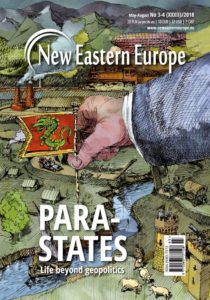
Hot TopicsIssue 3-4 2018Magazine
Photo: Mikhail Afonin
If the Kremlin regime – as it is often called – was solely limited to a resource-based economy or conservative bureaucracy, it would have collapsed a long time ago. But it is not collapsing and nothing indicates that it is going to. This is because it was built on the ruins of the Soviet Union. It was created by people whose goal was to survive and make money. We can now say that Russia is governed by a group of survival experts. This does not mean, however, that they are professional in other areas. They have no managerial skills, they are no experts on economic development or state-building. But using the old, typically Russian, idiosyncrasy – that is, a lack of a border between the authorities and society – they built a model that Nassim Taleb, the Lebanese-American scholar, would call “anti-fragile”. However, Taleb coined the term in reference to developed economies, while in Russia we have an “anti-fragile” political system, which assumes using deceit and deception as well as chaos and fear. The essence of our system lies in that it was born out of extraordinary situations and has always been creating such situations. That is why such a system dwells on chaos, crises and catastrophes.
Would you say that the Russian system suffers from the besieged fortress syndrome?
This is one of its elements. But what is an important feature of the Russian system is that it can be adjusted and you can easily change its patterns of behaviour. Tomorrow, Russia can open itself to the world with a wide smile on its face and to do so it does not have to change absolutely anything. Overall, the Kremlin needs extraordinary situations to have a mandate to govern. To understand our economy and management system – here I am often using metaphors of the work of humanitarian aid institutions – you have to think in terms of a disaster and its effects as well as people who can offer solutions to avoid further catastrophe. Such persons are perceived as saviours and their authority is indisputable. That is why our authorities need disasters or a spectre of a catastrophe. These disasters and catastrophes can also be created by the authorities. Then they can defend the people against them. This is an old mechanism, one that goes back to Stalin times. The paradox is that society which just yesterday was cursing the authorities because of a disaster now sees a saviour in them.
You mention the saviour, so let us talk about the last election. Do the official results, which show Vladimir Putin with almost 77 per cent of the vote, reflect the real support of Russian society?
In Russia there is no such thing as an independent society and that is why, in our situation, this question is absurd. It is more justified to reflect on whether there were so many ballot sheets with an approval for this candidate, and how many votes were forged. With this in mind, I think the numbers are credible. We have regions, such as Kemerovo or Chechnya. I call them areas of artificial voting because over there you cannot make a count of anything and these are the regions that generate 90 per cent support. They are also, like Putin’s support, an indicator of the lack of alternatives. In fact, what people really experience is the lack of any alternative. This does not mean that they have no other ways to express their political support. For example, Aman Tuleev, who was the governor of the Kemerovo oblast, got over 90 per cent of the voters’ support. Last March he was recalled after the tragic fire in Kemerovo’s shopping mall, even though there were no demonstrations. The question is: where are the 90 per cent who voted for him? I think that there is a similar situation with regards to our president. Putin is the biggest symbol of Russia. Just like in Soviet times, people were voting for “Lenin’s state” even though nobody, of course, was expecting that Lenin will rise from the mausoleum and lead the nation to a brighter future.

Does this mean that #sistemaRF will not end any time soon and that Putin will remain its symbol even when he is no longer president?
It is difficult to say whether it will last long or not. Eighteen years ago there was no such thing as Putin’s Russia, even though there was a Putin’s majority. I coined this term “Putin’s majority” as a campaign slogan, not as a real measuring unit. During Putin’s first term, there was still an alternative, but since the mid-2000s a massive unification and de-politicisation has taken place. I also participated in that, as it was a well thought-out policy. That is why if someone says that things have always been like this in Russia, it is rubbish. Things were not this way. And it does not mean that they will always be like this. As a rule, these are short cycles in the history of a state, but this one will be remembered for a long time. Russia became Putin’s for the people and by the people. However, in reality, there is nothing of Putin here. And that is why I think the current presidency will be a transition term, from Putin’s Russia to a non-Putin’s Russia. This is regardless of how Putin himself is looking at these matters.
In one of your recent analyses, you mentioned that this election marks the beginning of the post-Putin Russia. Are you convinced that this is indeed Putin’s last term?
I am not a prophet. This term may actually turn out to be shorter than six years. But I also cannot exclude that in certain political circumstances and in the situation created by his closest circle, which is really ruling Russia, Putin will stay even after 2024. This is because Putin’s closest circle needs him more than he needs them. Putin would certainly like to leave nicely and in a comfortable way, but the people in his circle want to keep their positions and the same influence and privileges that they are enjoying now. The problem is that these people hold their positions only because Putin is a part of the system.
Will the post-Putin Russia be different from today’s Russia?
Russia is already different. It is hard to see this from the outside. But living here I can see many changes related to social media that, in some way, shows where political life is budding. However, I am cautious to not overestimate the importance of social media. In Russia they make so much noise which does not really say who is in power, who redistributes goods, etc. It rather resembles a masquerade more than anything else. That is why, today, it is difficult to notice Russia’s real face. Putin himself does not see the full picture of Russia, as he too watches Russian television. In a sense, censorship returned to the Kremlin. Their reality is seen as it is depicted in the media even though they themselves order this narrative. But this is also one of the reasons behind the degradation of the strategy in Kremlin’s external and internal politics.
Let us return to Putin’s circle. You mentioned that the fight within the political elite over influence has already begun. Is the Russian elite no longer a monolith and do you think it will change into a proverbial jar of spiders in the near future?
Every community is a proverbial jar of spiders. Today’s Kremlin is not consolidated. It is very difficult for them to reach an agreement with regards to Russia’s future and its power structure. Putin’s power is, in its essence, informal. He has not built any rational bureaucracy that would allow him to be replaced by somebody else after he leaves. Under the current situation it would be a difficult operation. At the time, when we were developing the project of Yeltsin’s successor, the office of the president had much fewer competences than it has today. But it was clear already back then that one person would not change the state of affairs – the problem lies in the system. When the authorities allow real elections, this is an expression of their power. This is very relevant today. The authorities should allow free elections. I am talking about not just allowing representatives of the opposition to participate, but also candidates from within the power circle.
That means from Putin’s circle…
Yes. Overall, I think that this is from where the real opposition will eventually emerge. Where else could it come from? This is the reason why the authorities do not let anyone from within the circle to run. No governor, no minister, no head of industry would dare mention that he or she would like to become president. And this is stupid, as it will be someone from the establishment who will have real experience of governing Russia. I doubt that such a candidate will come from some of the groups that spend most of the time demonstrating on the streets and who have no policy proposals apart from their fond memories of Yeltsin times.
This brings me to the question about the alternative. Can we treat today’s opposition as a real alternative? Is there anybody whom we can call the new rising star of Russia’s politics? Somebody who can replace Putin one day?
First of all, you should be looking at the sharks within the Russian political elite. The Russian political market does not offer alternatives. There is Alexei Navalny who is a very important figure. He is important because he reminds us of what politics is all about and this is something we have not had for the last 15 years. That is not a very long time, but during these years people started to get used to this state of affairs and started believing the myth that everything is decided by Putin and nothing can change that – which, of course, is not true. Navalny reminded us that politics starts with concrete activities, and not because somebody within the Kremlin willed it. But in the current environment, he is not an alternative. Navalny will play an important role in open politics when it comes back to Russia. The leaders of large regions will play an important role then, but it is difficult to point to anyone specific today. Ramzan Kadyrov should also be looked at very carefully. Sergey Sobyanin, the mayor of Moscow, could also become a player, as long as he does not make any mistakes on the last leg of Putin’s system. Sobyanin is a very talented and powerful politician who created himself (a rarity in Russia), and this is something we tend to forget.
Is the West waiting for a change in relations with Russia?
Russia’s problem is that it is doomed for functioning on the global stage. Russia cannot isolate itself from the world and manoeuvre all the time. It may seem like a paradox but Russia’s system is dependent on world politics. The Kremlin goals are also conditioned by global affairs. Should the authorities become strictly focused on domestic matters, they would become very parochial and not able to retain power. Putin is perfectly aware of that. Here the question is: Can the existing world order integrate Russia? I will not be going into all of our problems, starting with perestroika, but I will say that we owe the current system to ourselves. The truth is that Russia, in its current form, is not capable of being integrated with the rest of the world. At the same time, it cannot be isolated, or cease being a global player. This is what causes many problems and tensions on the international stage.
How will the Putin regime manage this? I do not know. Usually regimes solve these kind of problems by escalating tension and waiting for the opponent to let go. But when our opponent is Donald Trump, that is Putin’s American equivalent, the situation becomes more dangerous. I think that here we need a détente, but not a Soviet-style one. Something different. Otherwise these two guys may get too far.
Also, I cannot say anything comforting regarding our relations with the West. To make matters worse, for a long time our system has not had any checks and balances, even compared to those that existed during the Soviet Union. I know that it can sound quite bizarre but this is how things are. Had Putin publically said in the totalitarian Soviet Union, “Why would we need the world, if Russia ceased to exist?” he would have been kicked out of the communist party and chased out of the KGB. At that time, the official ideology was to promote peace around the world and not allow a third world war to erupt. That is why this kind of thinking was forbidden. Today, nobody wants a third world war, but where are the mechanisms to stop it from happening? Where is there an understanding of the risks? Unfortunately, right now the situation is very tense and that is why it is dangerous. I think that within a year we will be forced to find a solution.
Given that Russia will become neither an autocracy nor get integrated with the West, I gather it will continue to manoeuvre…
Of course. Putin will say – and he will be partially right – that 15 years ago he made a proposal to somehow integrate Russia with NATO and to create an alliance with the European Union, but it was the West who did not want that. It was Dmitry Medvedev in 2008 who proposed a new European security architecture, yet nothing came out of it. I do not want to go deeply into the reasons why that happened, but I do not believe there is such a thing as a permanent “geopolitical crack” between Europe and Russia. Today, we cannot see any signs of Russia’s integration with the West. Thus, even after Putin, the West will have to deal with a Putin regime. Such a regime may be even more Putinist (or ultra-Putnist, if you like) even without Putin being there.
What can we expect in the region? I am not only asking about Ukraine, but also about Belarus and Kazakhstan. Kazakhstan – at least recently – has been increasingly demonstrating that it wants to distance itself from Russia.
Unfortunately in each situation we are dealing with an unpredictable player without any specific strategy. Since Russia is such a player, we can expect an escalation. An escalation could come as a surprise even for those who are the most involved. For example, a month before Yanukovych’s escape from Ukraine, Russia did not even think about the annexation of Crimea, and it did not assume such a course of events would occur. That is why it is so difficult to predict developments in the region. The problem is that the post-Soviet space turned into a space of absence, a symbolic vacuum. And the responsibility for this symbolic vacuum lies on Moscow. There was no request for it from any side. Moscow has yet no plans for the region; it has nothing to offer to it. If Russia had a real strategy for Ukraine, it would use the revolutionary situation in Kyiv. And offer it something. This was an ideal moment for introducing some kind of a strategy, had there been one… Instead a mechanism of escalation was used in order to get out of the situation. The same can happen in other places.
Today, the Kremlin is making more calculations, as it has gained experience in recent years. Yet these experiences do not translate into alternative solutions. There is still an illusionary sense of responsibility for the post-Soviet space which has turned into – as we say here – a suitcase without a handle, meaning it has a symbolic value but no one knows what to do it with it. If we look at Kazakhstan, what will happen when there is no Nazarbayev? The Kremlin will feel obligated to do something, but China might also have plans for such a situation. If we are to analyse Moscow’s offer to different countries of the region, we will see that there are almost no concrete offers. Maybe there was some kind of offer for Armenia, but even this would not have passed without problems.
So who do we have an offer for? We do not even have an offer for Moldova or Belarus. That is why, unfortunately, in our region we need to be ready to improvise. But let us remember that unpredictable improvisations, without any rules, are usually dangerous.
Translated by Maxim Rust and Iwona Reichardt
Gleb Pavlovsky is a Russian political scientist. He is president of the Russia Institute and the Foundation for Effective Politics in Moscow. He was a political advisor to the Kremlin until 2011.
Maxim Rust is a contributing editor with New Eastern Europe and a fellow at the Centre for East European Studies at the University of Warsaw.