
The spirit of Estonia’s tradition of song
The Estonian song festival, Laulupidu, has taken place every five years for over 150 years. It is one of the largest choral events in the world and involves almost all of Estonia. The festival embraces the power of singing, which has become a national symbol for Estonia, especially in the most troubling of times.
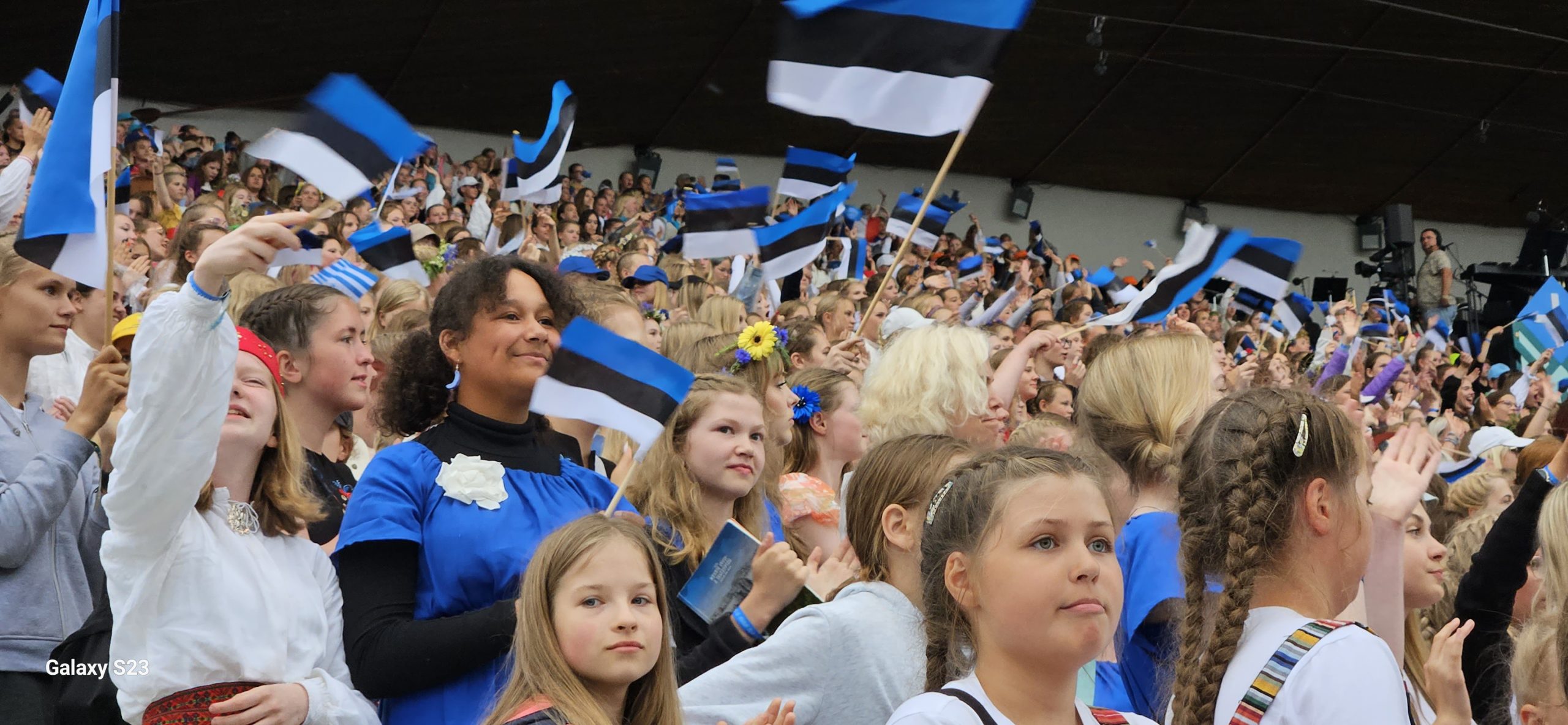
That recent stormy night in Europe’s eastern frontier still reverberates for a 19-year-old student and much of her country. It happened during the closing hour of Laulupidu, Estonia’s biggest national gathering, a quinquennial choral event that had helped Estonia free itself from communism. Under pouring rain that July 2nd, before a crowd, Hanna Grete Rebane stood in a choir of 23,000 young Estonians singing poetic verses about yearning for one’s homeland despite hardships. As darkness began to settle, the audience began to sway with the singers; people held hands and wept, waving the Estonia flag.
September 11, 2023 -
Isabelle de Pommereau
-
Issue 5 2023MagazineStories and ideas
Photo: Isabelle de Pommereau
Thousands of mobile phones lit the night sky, turning singers and listeners into an illuminated sea of song and rain. Rebane thought of her parents and grandparents, who had kept their flags hidden until 1988, when they came out en masse to sing, leaving the Soviet army powerless.
Chills ran up Rebane’s spine, one year after a worldwide pandemic and in the midst of a war launched by Russia, the imposing neighbour to the east. She felt the power of singing to inspire and unify. She felt the boundaries blur, those between the crowd and the singers, the past and the present, her country’s rural villages and its digital-minded cities.
“It was the most beautiful thing I’ve ever seen,” Rebane said. “You see an endless sea of stars, the sea in the background, the people, the trees and the sky; and you sing songs that were sung many years before I was born.” She added that “We are such a small country. We need to hold together if we want to survive.”
The power of singing
That night, Rebane helped carry on an almost uninterrupted tradition dating back 154 years, testifying once again to the power of singing as Estonia’s main unifying force. Every five years since 1869, Estonians have gathered around song and dance in one of the world’s largest choral events. Born out of a national awakening to resist Russian domination, Laulupidu – which alternates between a “general” and a “youth” format – was a force when Estonia won independence from tsarist Russia in 1918, and then from communism during the “Singing Revolution” of the late 1980s. It has become a collective ritual, where Estonians celebrate what they treasure most: their identity, culture and language, all of which successive waves of occupiers tried, but failed, to extinguish.
For more than 500 years (except between 1920 and 1940), this tiny forested country on Europe’s north-eastern frontier, south of Finland and west of Russia, was up for grabs: Denmark, Sweden, Germany, Russia and the Soviet Union all staked their claim. But singing helped them keep their language alive. Singing took on revolutionary powers when journalist Johann Voldemar Jannsen orchestrated the first national Estonian song festival in 1869, which featured not only songs for the tsar but also folk songs praising the Estonian fatherland. Set to music, a poem by Jannsen’s daughter Lydia Koidula called Mu isamaa on minu arm” (“My Fatherland Is My Love”) fostered a yearning for self-determination that culminated in 1918 with Estonia’s first period of independence.
Independence was short-lived, however. Following the Molotov-Ribbentrop Pact between Hitler and Stalin in 1939, the Soviets invaded Estonia, only to be chased out by the German Wehrmacht in 1940. Four years later, the Soviets “liberated” Estonia from Nazi Germany and occupied Estonia for another 50 years. During that time, the Soviets sent a tenth of the Estonian population to Siberian camps. They confiscated Estonian farms, churches and limited freedom of speech. They tried to instrumentalise Laulupidu to spread their ideology. But, in the summer of 1988, 300,000 Estonians – roughly a quarter of the population – gathered to sing Koidula’s “My Fatherland is My Love,” reset to music by conductor and national hero Gustav Ernesaks in 1944. The Singing Revolution defied Soviet control and paved the way for Estonia and its Baltic sisters, Latvia and Lithuania, to become independent.
Today, Laulupidu is “about cleaning your heart, taking with you the love for your country and its traditions, for the soil you come from, for your friends and family,” says Heli Jürgenson, conductor of the Estonian Philharmonic Chamber Choir. “Thankfully, Estonia is not in a war right now, though we are indeed close and it is a scary position, but should there be a time when Estonia needs to be defended, then it is Laulupidu that has created the foundation for people being motivated to do so.”
Flying to the beehive
The 13th Youth Song Festival was the culmination of more than two years of rehearsals and competitive auditions. On that July 2nd morning, singers – 778 ensembles, 23,139 choristers and orchestra musicians, plus 657 conductors and 8,000 dancers – had paraded over five kilometres from the historic old town of Estonia’s capital, to a gigantic open stage along the Baltic Sea. Dressed in the vivid traditional costumes of their villages, unfurling the blue, black and white colours of the Estonian flag, they had formed one great blaze of colour. People cheered on as though they were national celebrities in the opening parade of the Olympics.
Assembled in a giant oyster-shaped arch, they had sung 44 mostly traditional songs in different choral constellations, and were applauded like rock stars. The songs consisted of new tunes, poetry woven into music, and cheerful lyrics speaking of Estonian’s landscape and daily life. Others included ancient folk songs, those expressing a special bond with nature that had existed before religious crusaders invaded their country in the 13th century, and songs, banned but nevertheless sung, from the darkest hours of Soviet occupation, such as “My Fatherland is My Love.” There was raucous cheering and tears and, in between, a minute of silence for Ukraine.
“Ta lendab mesipuu poole” (“flying to the beehive”), a song based on lyrics by the famous 19th poet Juhan Liiv, was perhaps this year’s emotional climax. After the song the crowd of young singers erupted into wild applause, cheering conductor Taavi Esko. The cheering intensified when the crowd’s enthusiastic demand for an encore was granted despite thundering and rainy skies.
For veteran conductor Esko, 72, who had sung the forbidden “My Fatherland is My Love” in 1969 and during the Singing Revolution, the experience of conducting “Homing Bee” for the entire choir twice, and under torrential rain, and feeling the audience sing and sway along, was “one of the highlights of my life.”
With its words focused on Estonians’ ongoing longing for their homeland in spite of hardships, the “Homing Bee” song is particularly beloved and yearned among Estonians. This year, with the war in Ukraine a reminder of the vulnerability of the Estonian nation, it resonated with particular poignancy.
“Seeing so many young people means so much: it is a very positive expression of our nation, our country, our roots,” Estonian Prime Minister Kaja Kallas, seated in the front row, says in between songs. Kallas, whose mother had been deported to Siberia by the Stalinist regime as a six-month-old baby, adds “we kept things alive,” referring to the singing tradition. She turns to me and points to the crowd behind her and then to the giant choir in front of her, an estimated one-third of all Estonians attend Laulupidu, either by participating or watching it. This, she says, “shows we are together, literally. In light of this historical context, it is very powerful. We are a small country, but we are big.”
For much of the world, Kallas embodies the fierce resistance to Russian aggression of eastern EU members. At nearly three per cent of the country’s GDP, Estonia’s defence budget by GDP is larger than most EU countries, and Estonians have been joining the voluntary defence league in droves. Yet, on the day of Laulupidu, wrapped in a raincoat to brave the downpour, surrounded by family, conductors, two former Estonian presidents and the current one, Kallas, sometimes dubbed the new “Iron Lady”, embodies her country’s other bloodless weapon: singing.
Tallinn resident Aiki Haug came to the event because “the singers and conductors are really heroes – they made Estonian free.” During the massive singing in 1988 she saw a “gentleman on a bike carrying a flag in one hand, and the Soviets wanted to take the flag down but didn’t because they were afraid of all this crowd of people all singing here,” she recalls. “We never thought that singing could be such a powerful weapon against the regime.”
Aleksei Kelli travelled from the north-eastern hamlet of Metsanurga to cheer on his 17-year-old daughter, to an event he deems both “political and personal”. “Laulupidu has deep political meaning: it is part of what gave us our independence: what could be more political?” says Kelli, a professor of intellectual property law at Tartu University. He, too, invokes the milestone events of the late 1980s, when “singing happened everywhere as a form of protest, but for the Soviets it was a problem: what could they do? People started singing, could they put people in prison for singing?”
But Laulupidu is more: it is part of the DNA of Estonian culture: “something stable, a collective way to find ourselves in united singing. It is defining your core values, who you are, what your identity is,” Kelli says. It has also meant many one-hour trips to choir rehearsals almost every day, for months, often braving icy, snow-capped roads. For his wife Merike, it has meant spending almost one year stitching an elaborate outfit of linen and wool with the blue, red and yellow colours of her village.
“When there are disturbances, people get more emotional,” says Kelli, “but young people don’t always think about the Ukrainian war: they just want to sing and be part of this event.”
Paying tribute to singing masters of the past
It is 9:30 pm on July 1st, the eve of Laulupidu. A group of conductors, composers and lyricists are getting ready for a special trip, to pay a tribute to their past singing masters. It is a tradition. As the bus heads out of the capital the sun gleams red along the Baltic Sea. The forests of Finland lie ahead. Fifteen minutes later, the bus enters a deep, dark pine forest, and the artists disembark. There is something eerily fascinating about Estonia’s spacious graveyards, but Metsakalmistu’s, in Kloostrimetsa, dubbed “the forest cemetery”, is particularly special. It is the home of Estonia’s most celebrated political and cultural figures, including the conductors, composers and poets who, in one way or another, helped the tiny country safeguard its most cherished treasures: its identity, its independence.
Konstantin Päts is buried here. He is one of three people who signed the first declaration of Estonian independence in 1918, and ended up being deported to Siberia, where he died in 1956. Alongside him is Lennart Meri, the writer and film director who became Estonia’s president when the country became independent again in 1991, after five decades of Soviet occupation.
One by one, slowly, the 25 or so artists make their way to the gravestones engraved with treble clef symbols, lighting candles in the silent forest. There is a feeling of piety. Conductor Raul Talmar of the academic women’s choir of the Tallinn University of Technology kneels before a simple stone, its epitaph reads “Gustav Ernesaks, 1908-1993”. Ernesaks was the master, the father of Estonia’s singing festivals, the man who kept the tradition of song shining under Soviet occupation with “My Fatherland is My Love.”
“I come here to say thanks to the people who have been before us,” Talmar says. “We have to acknowledge where we come from; it is an important impulse for the future.”
Set in a sprawling forest, the Metsakalmistu Cemetery has no monumental gravestones, no borders to separate the grave sites. Only simple stones taken from the field and blending into nature. Lydia Rahula, eyes shining, lowers herself in front of Heino Kaljuste’s gravestone. Heino Kaljuste, another national hero, founded the famous children’s choir Ellerhein.
“He was my teacher,” Rahula, who conducts the Tallinn Boys’ Choir, says. “Such a charismatic conductor.” Kaljuste’s son Tonu, a conducting legend, founded the Grammy-award-winning Estonian Philharmonic Chamber Choir.
The procession moves on. The younger composer, Pärt Uusberg, artistic director of a song festival whose motto this year was “Holy is the Land,” stops before a simply-marked grave. “Lydia Koidula: 1843-1886”. Koidula is the voice of Estonian nationalism, the poet whose “My Homeland is My Love” lyrics, set to music when Estonia was still a province of tsarist Russia, gave rise to Estonia’s call for independence.
Aarne Saluveer, the conductor of the ETV television girls’ choir, stops before a rectangular memorial for national icon Veljo Tormis, who died in 2017. Tormis is the one who brought Estonians’ ancient folk song tradition, the Regilaul runic song which alternates between a soloist and a group, back to life. Along with Arvo Pärt’s more spiritual music, his Religaul is generally considered to be one of the two spiritual pillars of Estonian choral singing. “Laulupidu is a holy moment among us,” Saluveer says. “It’s a place where all generations meet, where singers tell a story for the next generations.”
A force and the heart of a thriving music industry
After the Iron Curtain fell, Estonia embraced western institutions and rebuilt itself as a high-tech society. It gave the world Skype, the first cyber army and the e-residency programme – a way to fend off the influence of its imposing neighbour to the east. And so has it been with singing. Tiny Estonia has the world’s largest repertoire of folk songs. With more than 40,000 Estonians singing in choirs, it has more choral singers per capita than most countries. Most Estonian singers are children and teenagers.
Laulupidu, which was added to the UNESCO list of oral and intangible heritage in 2003, is what makes singing a part of the thriving cultural and music industry. It keeps the country’s singing repertoire alive and is an important motor of musical creation. But concerns have risen over how to keep the Laulupidu tradition alive in the context of globalisation, among Estonians born into freedom. The question had nagged conductor Heli Jürgenson in the years preceding Laulupidu’s 150th anniversary. When she was in her 20s, in Estonia’s “emotionally-loaded” post-communist years, “there was no bread or shampoo on sale, but we had our fantastic night song festivals.” Her spiritual mentors had been Laulupidu conductors. But the number of conducting students was decreasing and the average age of conductors was creeping up. Estonians, including young creative musical talent, were leaving for better paying jobs elsewhere.
Laulupidu organisers reacted by picking then 24-year-old composer Rasmus Puur to orchestrate the 2017 youth singing event. With “I’ll Stay” as its motto, Puur turned Laulupidu into a sort of wake-up call for young musicians. “Many of our conductors are getting old, and we don’t want to be in a situation where all the old ones cannot do it and the new ones do not know how to do it,” Puur said. Dozens of conductors and other musicians, many in their 20s, have debuted at Laulupidu since. Music and arts student Hanna Greta Rebane represents Laulupidu’s young face at 19. With her lyrics making it to the Laulupidu repertoire, set to music and sung by a choir of 9,000 children on July 2nd, Rebane became the youngest composer ever in Laulupidu’s history. “Joy has filled the land,” about the “joy of singing”, is her way to pass on what she had experienced early on. “There is a special feeling that comes from Laulupidu, it is the time when you really understand the core of being Estonian,” she says.
When Estonia’s nationalist Conservative People’s Party (EKRE) started making big headway after the 2015 refugee crisis, some worried about the far right hijacking of the Laulupidu spirit. But that did not happen. While, initially, EKRE’s call for a more insular Estonia played on old anti-Russian resentment, the party started to win the hearts of conservative Russian-speakers by endorsing themes shared by most far-right groups, including Euroscepticism and anti-gay and climate-denialist stances.
“EKRE has one major problem though, Russia. Its stance is ambivalent and that’s where their growth hits the ceiling,” says Maris Hellrand, a Tallinn politician and Laulupidu organiser. “It is quite clear that the whole choir network is actually very resilient to this.”
These have been tough years for Estonia with both COVID-19 and the war in Ukraine taking a toll – and, at times, a polarised society (the pandemic forced the event festival to be postponed for one year). And yet, Laulupidu remains largely unspoilt. It acts as a sort of “shield against this politics of hatred,” says Maris Hellrand. Others argue it tends to enjoy more trust than national politicians. It is “very pure energy, nothing negative,” says Allan Kaldoja of the Vaba Laba theatres in Tallinn and Narva. “It is a ritual, a pilgrimage that connects the whole nation, purifies your mind and brings back what is important and not important in your life. It is not like “you are better than others,” or “there are right Estonians and the others.””
Revolutionary power
The Laulupidu singing model – and its equivalent traditions in Latvia, which this summer celebrated their 150th anniversary, and Lithuania – represents a “beacon of light for all non-political movements of the future,” says Guntis Šmidchens of the Baltic studies department at the University of Washington in Seattle, who authored The Power of Song: Nonviolent National Cultures in the Baltic Singing Revolution.
“Estonia has more than 30 years of vibrant, sometimes chaotic, but very stable democracy, and it emerged from the Singing Revolution,” says Šmidchens. Having “many singers with very different voices, people who have never met before, working together to build something big, something very beautiful,” he says, is “a great metaphor for how democracy should work.”
“All Estonian children singing the same songs, all knowing that everybody, in every choir and every village does the same, is a very strong thing that brings us together,” says composer Rasmus Puur, who describes the process of zigzagging across the country to conduct some 75 rehearsals during the last youth Laulupidu “healthy” and “mind-broadening.” “Everywhere you go has its own spirit, temperature and energy,” Puur says. “It is beautiful to feel that, yes, there are different problems, and yet Laulupidu means so much for all the kids.”
“And when you stand in front of the children, you’re not just conducting. You have to talk to them – about the culture, the spirit of Laulupidu, the background and the history of the pieces,” he adds.
Twelve-year-old Robin Hosman, who lives in Türi, a village one hour south of Tallinn, is passionate about soccer. He says Laulupidu was “big.”
“It’s a really big part of our culture: we need singing, we will be free in the future if you sing,” he says. Laulupidu is part of Robin’s upbringing. Triin Toom-Hosman, his mother, said she “grew with the emotions of Laulupidu”, including those of holding hands with strangers during the “Baltic Way”, when two million Estonians, Latvians and Lithuanians held hands to demand their independence on August 23rd 1989.
Thirteen-year-old Emili Parts came from Narva, in Estonia’s most eastern tip, on the border with Russia. Laulupidu‘s emotions had been so strong she cried that entire July 2nd night. “You felt so connected,” she says. “The rain really united people. We sat in a big tent and we sang together.”
Most residents living in Narva, Estonia’s third biggest city, speak Russian at home. Their families came during Soviet times. When Emili’s mother was a child, “people knew about Laulupidu but the ideology was different,” said Teele Parts. “There were lots of Soviet flags.” To her, she adds, “what was important was the friendship, singing together.”
After Estonia regained its independence in 1991, many Narva residents felt like an unwanted minority. The war in Ukraine has revived simmering tensions between Estonia’s Russian and Estonian speakers and within Russian-speaking families. “Laulupidu is not as important for Narva locals, at least as long as they have not participated,” says Teele Parts. “Then the relationship gets deeper.”
That happened to Olga Bortsova, who attended Laulupidu for the first time with Narva’s two-year-old “integration choir”. “I had tears in my eyes and I told my son, “next time we all go together,”” she says. “I didn’t know it creates such feelings: Laulupidu made me feel like I’m Russian and I am part of Estonia.”
Time to say goodbye
“My Joy knows no Bound”, the final song, is about saying goodbye, until next time. Conductor Aarne Saluveer, 64, is the star. Raucous cheers ring out when the composer and soloist, Silver Sepp, 37, runs up to the conductor’s podium. Pärt Uusberg, 36, who did the orchestral arrangement, joins them. The three musicians embrace each other under pouring rain. In Estonia, the national heroes are their composers, conductors and lyricists. They have shaped not only Estonia’s musical landscape but also the country’s history.
When conductor Niina Esko had sung in the 1988 singing revolution as a young mother, “people didn’t know what the outcome would be, but then people sang old songs and we were not afraid,” she said. Laulupidu is a “holy moment among us,” said Saluveer, who in Soviet times led a famous rock band. “It’s a place where all generations meet, where singers tell a story for the next generations.”
On that July 2nd as the rain poured over the Baltic Sea and Russia launched bombs against Ukraine, the tune of “Joy Filled the Land” – the song written by young Hanna Grete Rebane – rang out. “The song”, she says, means that “we are singing away the rain and the weather, no matter what happens, we sing.”
“Laulupidu is holy for Estonians, like an oak tree that grows its branches, and that holiness cannot be broken, nobody can take it from us,” says Niina Esko. “Perhaps that’s the message to Putin: We are small but strong in spirit.”
Isabelle de Pommereau is a journalist and reporter. Originally from France, she is based in Frankfurt and works as a correspondent for the Christian Science Monitor and Alternatives Economiques.