
No school for the children of Izium
Ukraine’s newly liberated territories still show the scars of war. Critical infrastructure often remains damaged and life remains anything but ordinary. This is particularly true in the case of schools, with the education system in the town of Izium simply unable to provide for the country’s youngest citizens.
Almost a year after its liberation, Izium, a town in Kharkiv Oblast, bears the visible scars of the Russian aggression. Heavily damaged by the Russian bombing and having at least temporarily lost the majority of its population, Izium still remains an unsafe place to live. It will take a long time for the town to rise again.
September 11, 2023 -
Kateryna Pryshchepa
-
Issue 5 2023MagazineStories and ideas
The community centre in Izium after a Russian attack. Photo: Kateryna Pryshchepa
I arrive in Izium at midday on a summer Saturday, accompanying the international project team “Mapping the Russian aggression against Ukraine: Damage to cultural heritage and environment”. This group is documenting the damages of the war in Kharkiv Oblast. For the team, Izium is a particularly busy spot. Upon our arrival, however, we see an optimistic sign. There is a christening in the Orthodox Assumption Cathedral.
Signs of normality, signs of devastation
Like almost every building in the old part of Izium, the cathedral had been damaged by shrapnel. There is plywood covering the holes left in the stained glass close to the main dome of the building and some shrapnel marks on the outer church wall. But luckily the cathedral has not sustained major damage and services continue there. We see a small group of parents, godparents, a family friend and a sister of a baby boy who had gathered for the christening. The happy group takes a photo at the steps of the cathedral and leaves.
There are other signs of normality. There is a beggar at the church entrance, a scene which strangely gives a sense of reassurance. At a bus stop across the road several women get into a bus going in the direction of Kharkiv. The pharmacy next to the bus stop is open and offers its customers all the usual list of medicines one can request in any pharmacy anywhere in Ukraine. The grocery store next to it is open and looks well furnished with goods. But as the team goes about its work along the plan set for Izium, we see the signs of devastation everywhere in the town.
We began our work with a short visit to the cemetery in the forest just outside of the town, where last September a mass grave of civilians and military personnel was uncovered. By design or just due to a lack of time, the graves had been left uncovered after the exhumation works finished in autumn last year. The primitive crosses made of wooden planks with hand-written information about the person who once was buried in the grave are now put in the open pits, from where the bodies had been exhumed. In some open graves there are open coffins, left there after the bodies had been taken away by forensic teams. Not more than three metres away from the last row of provisional graves there are still the pits where the Russian tanks used to be stationed. The whole place is quiet and solemn and it would seem that if it was conserved in its present state it would be a powerful memorial to the victims of Russian aggression.
The centre of the city also carries signs of devastation. Most of the buildings on Izium’s main street, many of which were built in the 18th and 19th centuries, have been damaged or destroyed. The city hall, the main health clinic, bank and post offices in the city centre still have broken windows and burned and damaged walls. But the team concentrates on Izium’s schools, most of which had been badly damaged or completely destroyed. Of the nine schools in Izium only two had not been damaged or totally destroyed over the last year and a half. Some buildings had been hit by Russian forces on the days before they occupied the town. Some of the schools, such as Lyceum No. 2, had been hit by Ukrainian strikes during the Russian occupation of the town. The Russian troops and the Russian field hospital had been stationed there and the school subsequently became a target for an attack.
Some buildings had been hit by the Russians only recently. School No. 6 was hit by Shahed drones in May this year. Olena, the school’s facility manager, says at least five drones had hit the school premises in different spots. The attack destroyed the class rooms on the top floor, the sports hall and the library located in the different wings of the building. The hit had also caused a fire on the top floor. It is likely the school became a target because the Russians thought it could host Ukrainian rescue workers. Olena says that some days before the attack a strange man came to the school asking if it was true that some soldiers or demining engineers had been living in there.
Even if the school had remained intact, it was highly unlikely the students would have been able to return to classes there. Olena explains that “Our school does not have a basement which could be used as an air raid shelter, so we would go online anyways.”
On a bright and new playground some dozen metres from the school building we talk to two boys, who initiate the conversation by asking a colleague if she is a traveller and came from far away. The boys say they are nine and they did not go to the school this year because their mothers would not let them. “They were afraid of the sirens,” one of the boys explains.
Red kalyna
Our route then takes us to Lyceum No. 2, used as a base by the Russian troops and heavily damaged by Ukrainian artillery strikes. On the top of a pile of rubble there is a bright red barrel with the Lukoil company logo on it. The markings on the barrel indicate that its contents were produced in Russia, suggesting Russian troops had brought it there. Behind the school there is a crater left by an artillery shell and just next to one of the walls outside is a pit where a Russian tank used to be covered.
Ironically, the school premises had just been renovated months before the Russian invasion in 2022. The plaques next to its entrance say the renovation was done under the president’s renovation programme and financed with the support of a subsidy from the German government. The plaques on the sports equipment outside the school say they were paid for by the Coca-Cola and Klitschko foundations.
The school guard, who happens to be on site, lets us in and the team walks around the less damaged parts of the building. We enter the sports hall, where the concrete roof had fallen in onto the floor. In the corridor leading to the sports hall, one of the team members identifies a room that has clearly been used by the Russian troops as yet another illegal prison. Metal bars had been installed at the entrance to the windowless room and inside it an additional bar had been installed on the wall, which the prison guards had deemed to be too weak and easy to break.
The guard, Mykola, asks if we smoke and if we could give him some cigarettes. I offer him some from a package bought with this sort of request in mind. The man takes some and thanks me: “I only got the ones without the filter.” He says he remained in Izium during the occupation and was lucky not to get taken to one of the Russian prisons established in the town.
The mapping work takes the team to the Izium Palace of Culture which is a community centre in the town. The building was erected in 1929 in the style imitating an aristocratic palace or villa which had also been used as a base by the Russian forces during the occupation. Unlike most of the schools in Izium, it was not damaged substantially, although its interior has been devastated. All the valuable equipment had been stolen, the windows were broken and the floors damaged.
A group of teenagers is sitting under the big chestnut tree behind the building. They are sitting on benches taken from the community centre’s concert hall, smoking cigarettes and singing (rather shouting) along to a song by the Ukrainian band Medovyi Polyn. The song “Liokha ty separatyst” (You are a separatist, Liokha) presents the view that only unintelligent people with vested interests and connections to the Soviet communist past would want to have closer ties with Russia. The next song to be played is “Chervona Kalyna”, a song made famous way beyond Ukraine in March 2022 when Ukrainian pop singer Andrii Khlyvniuk filmed himself singing it in the deserted Kyiv streets. Later that year he recorded a cover together with members of Pink Floyd.
It seems that the kids are trying to sing even louder when they see us, so we start a conversation. Most of the kids in the group had remained in Izium throughout the occupation and want to share their experience. One of the girls tells us how a group of armed soldiers from the so-called “Donetsk People’s Republic” came to her home and demanded the family leave because they would need the house for themselves. “I began shouting at them that I would not go away,” says the girl, who seems smaller than most of her peers, “and they decided to go away, probably because they did not dare to hurt a child”.
One of the boys who spent some months abroad with his mother – first in Poland and then in Germany – says they returned home as soon as they could because he wanted to and asked his mum about this. While they were away, his father remained in Izium and had been arrested and tortured by the Russian occupation forces because he was in the territorial defence and someone denounced him. The man survived thanks to the speed of Ukrainian operations last September. The Russians did not have time to kill him.
I ask the kids if they know what are the prospects of them having in-person school in the upcoming school year. They begin their deliberations. They say that of the two schools still in condition to hold classes only one has a basement/shelter. It is hard to say if it will be able to host all the students who remain in the city.
One of the group started a vocational school last year, as it has proper premises where they had in-person classes twice a week. But his ultimate goal he says is to go to Kharkiv, enroll in the military lyceum and join the army. He is smiling and tells us about his brother who is now serving in one of Ukraine’s airborne brigades and was among the troops that liberated Izium last autumn. His friend says that he will be going to Kharkiv or Kyiv when the new school year starts. He has family in both places and would be able to stay with them and attend in-person classes. The rest of the group do not have plans yet but agree that going away seems to be a reasonable idea.
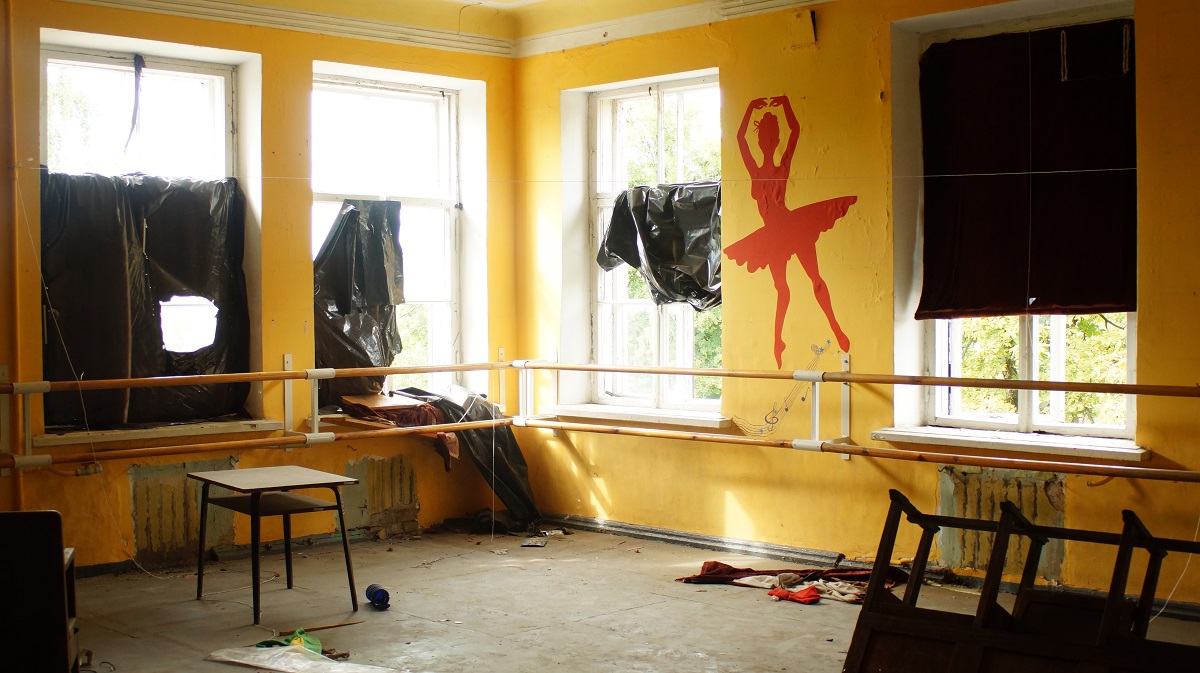
Due to the risk of the artillery shelling and air raids the education ministry announced that in the 2023/2024 school year, only the schools with the proper shelter facilities will be able to conduct in person and/or hybrid classes (partially online and partially in person). The decisions regarding what form classes should take will be made on a case-by-case basis after the inspection of potential school shelters and their refurbishment and renovation, if and when possible. In the beginning of August the state authorities in Kharkiv oblast announced that only 11 schools in the region would be authorised to hold classes in a hybrid format. There were no Izium schools on the list. Most extracurricular activities for the children in Izium have also been put on hold. The community centre where we talk used to host art and sport classes. One of the boys tells us he used to go here for dance classes.
I remember the conversation I had with Vitor, an Izium resident, in September last year just ten days after the town had been liberated. His biggest wish, he told me back then, was to have his three children – all of whom were under ten – back in school. “You cannot imagine how hard it had been for us to keep the children safe and entertained under the occupation. They had spent most of their time inside. I just wish they could have a more normal life now,” he told me. It seems his wish will not be granted just yet.
The danger of the mines
When I ask one of the group if I could see his playlist, he shows me his phone screen and says: “You may have difficulties reading it. The screen is damaged a bit. The shrapnel piece had hit it when the mine blew up.” And it becomes clear that the fresh scars the boy has got on his forehead and on one of his legs must have come from the explosion. “Yes”, he says, “I stood between the explosion and the girl in our group so she was not hit.” He says that a small anti-personnel mine, called peliustka (“petal”), had blown up when one of his friends had thrown a stone on it. Seven of them had been injured by the shrapnel as a result of the incident this February. “We were lucky,” the boy admits. He knows that it could have been much worse. Last autumn one of his friends stepped on a “petal” mine and had his leg amputated just below the knee.
On the day of our visit to Izium, we also learn that a local woman had stepped on a petal mine the same day. She decided to walk over a patch of grass near her house in the town and did not notice the mine. Her leg was severely injured with the prospect of amputation. The next day we visit Izium and meet the newly-appointed director of the local history museum. She warns us not to step in the high grass. There are still mines there.
The local news report on mine-related incidents in Izium and the neighbouring villages on a regular basis. At least 45 local residents have been injured as a result of them after liberation. The incidents continue despite the demining works carried out in the area. Due to a lack of resources, priority is given to the territories around critical infrastructure sights and public facilities.
Thinking about that conversation on the train back from Kharkiv to Kyiv a few days later, I remember the stories my grandfather would tell me of his wartime childhood. When his native village in Donbas was liberated by the Soviet army in 1943 he was just a teenager, the same age as the boys I spoke with in Izium. He and his friends, my grandad told me, would try to dismantle the unexploded shells they would find in the fields surrounding the village, with no tools and obviously no supervision.
During this visit to Izium, I meet several people who fled the Russian occupation of the town but came back after its liberation. However, it seems that the majority of people living in Izium now are the ones who remained there during the occupation. People with children and young adults are not yet reassured enough to come back. Izium’s population before the Russian occupation was estimated at 45,000 people. At the time of liberation, it was believed to have been close to 15,000. In spring this year city authorities had reported that some of the residents had returned home and that the city population was estimated at around 22,000-23,000 people. However, it is unlikely that the number of residents will reach pre-invasion levels anytime soon.
Kateryna Pryshchepa is a Ukrainian journalist and a contributing editor with New Eastern Europe.