
Behind the steppes: How Mongolia has responded to Russia’s war against Ukraine
As one of the only democracies in Central Asia, Mongolia remains a relatively small country surrounded by two geopolitical behemoths. Yet, the Russian invasion of Ukraine has shown Mongolia that nothing can be predicted and that it must be ready to face any situation. The support it provides to Buryats and others fleeing Russia indicates that it does not see eye-to-eye with Moscow’s aggression.
Former Mongolian President Tsakhiagiin Elbegdorj spoke out on September 23rd 2022 about Russia’s invasion of Ukraine, calling on Vladimir Putin to end the war. Elbegdorj condemned the “killings” and “senseless destruction” caused by the conflict. His statement does not represent the official position of the Mongolian government, which is more restrained in its condemnation of Russia. However, the comments highlight the complexity of Mongolian-Russian relations and the conflicting voices within the country.
July 4, 2023 -
Joseph Roche
-
AnalysisIssue 3-4 2023Magazine
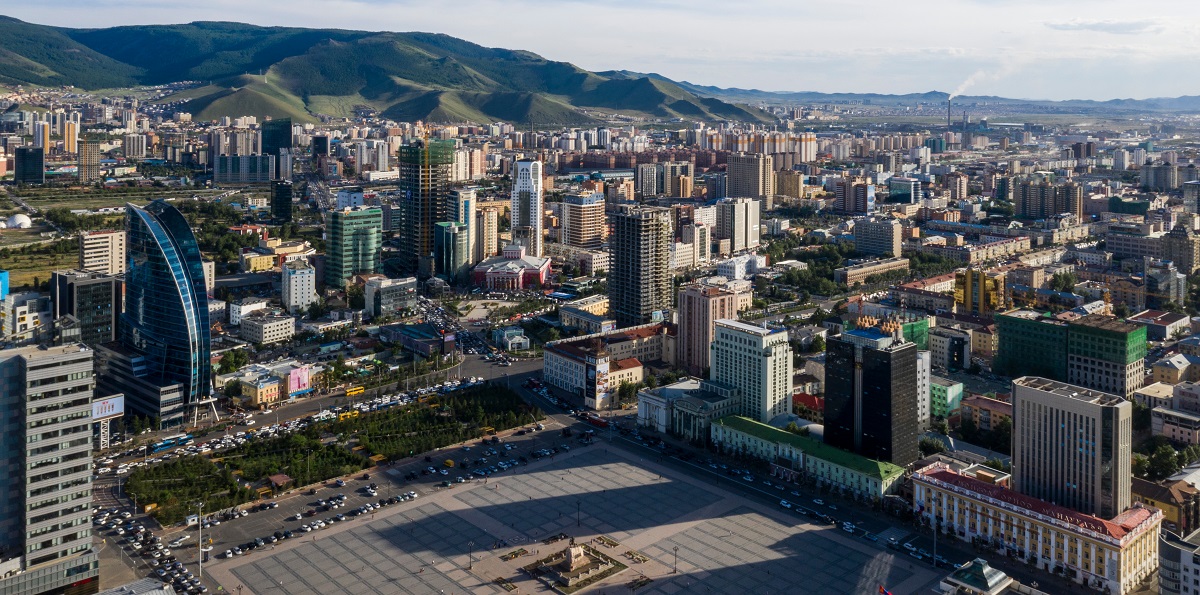
Aerial view of the Sukhbaatar Square, the main square of Ulaanbaatar, the capital of Mongolia Photo: Travel Stock / Shutterstock
Despite the Mongolian government’s current policy of neutrality, civil society in Mongolia is increasingly voicing opposition to Russia’s actions. Notably, the Mongolian population has expressed solidarity with the Buryat ethnic minority, a group with a Mongolic language and culture that primarily resides in Russia and has been heavily recruited into the military since the beginning of Russia’s full-scale war. The Buryats’ plight has garnered attention and sympathy from the Mongolian population, leading to a growing anti-Russia sentiment among Mongolian civil society.
Why are so many Buryats in the Russian army?
Estimating the number of Buryat fighters and casualties on the front is challenging. However, the French think tank Le Grand Continent has noted that soldiers from southern and eastern regions of Russia are overrepresented on the front lines of Moscow’s war against Ukraine. Several factors contribute to this mass recruitment, including the difficult economic and social conditions in Buryatia.
In her remarks for New Eastern Europe, the Buryat activist and founder of the Free Buryatia Foundation Alexandra Garmazhapova explained that Buryat soldiers primarily join the Russian army for economic reasons. “Unfortunately, they joined the army because Buryatia is a poor region,” she says. “You only have a good life in St. Petersburg and Moscow. That’s all. And in many other regions like Buryatia, Yakutia and Chechnya, people, because of corruption and the absence of opportunities, are not having a good life. That is why so many young men (even before the full-scale invasion) either joined the army, to have a good salary, or emigrated to the United States, Moscow, St. Petersburg and South Korea.”
Researcher Ksenia Pimenova points out that the Republic of Buryatia, located in a remote corner of Siberia, faces high levels of unemployment, constant wage instability and low income. Wars reveal the links between recruitment rates in the army, ethnic categories and poverty. While the Russian army does not provide recruitment figures by region, the proportion of victims suggests that there has been mass conscription in Russia’s poor regions and its so-called “ethnic” republics.
According to official data from Rosstat (the Russian Federal Statistics Service), the Trans-Baikal region, including the Republic of Buryatia, has an unemployment rate two to five times higher than the national average of 5.2 per cent. Another factor at play is a policy of militarisation that has been implemented in “ethnic” republics for several years. This policy aims to prepare non-Russian teenagers for regular military service and entices them to pursue a military career. Furthermore, among the Mongolic populations of Russia, “the ideals of masculinity promoted by the military align with traditional “manly games” such as wrestling, horse racing, and archery,” Pimenova writes.
Purve Dambiev, a former history teacher from Ulan-Ude, the capital of the Republic of Buryatia, and a Buryat who fled to Mongolia during the full-scale war, is speaking out against the widespread militarisation of Russian society. Dambiev is currently volunteering at the Buryat Centre in Mongolia’s capital, Ulaanbaatar, which provides refuge to Buryat people who have fled Russia. In his comments for New Eastern Europe, Dambiev shed light on how the Russian government has been promoting militarism to people from a very young age, starting with kindergarten and primary school.
He recalled participating in military games, such as Zarnitsa, where students were taught how to throw dummy grenades in physical education classes, and how to disassemble and assemble a machine gun in life skills classes. Military personnel often visited schools as guests, and marching was a part of everyday life. “In school, the history lessons were dominated by stories of wars in which Russia was always victorious, creating a pervasive sense of militarisation,” Dambiev says.
Finally, one should note the importance of work in defining a person’s social status in Russia. “Work is not just a means of earning a living, but it also constitutes one’s honour,” Dambiev says.
Ksenia Pimenova stated that “work is every man’s dream, and unemployment is his worst nightmare. It is only when one has a job that they can start a family and provide for their loved ones.” However, Dambiev emphasised that those who are sent to Ukraine today have no choice and are afraid to go. They would rather return wounded than disobey orders and compromise their future.
Growing reluctance
After a year of war, with Russia entangled in Ukraine, the Buryat minority has grown increasingly hesitant to join the front lines. Many opted to flee the forced mobilisation, while others deserted to neighbouring countries such as Kazakhstan and Mongolia. According to Garmazhapova, the defection of Buryat soldiers can be attributed to the disproportionately high number of deaths among their ranks. “While the exact number is difficult to ascertain, the Free Buryatia Foundation estimated that around 700 soldiers have died in combat according to open sources,” she says.
Additionally, due to their history and geography, Buryats are less susceptible to Russian propaganda regarding Ukraine. For instance, the concept of “denazification” leaves them perplexed. However, Garmazhapova points out that the psychological impact remains significant. “If a Buryat dies in Ukraine, the family may not want to accept that their loved one died only for Putin’s ambitions,” she says. “Instead, they may prefer to believe that their child is a hero fighting against Nazism. This is a more comfortable belief.”
Garmazhapova notes that one of the most significant issues with Russian citizens is their reluctance to take responsibility for their own lives. “In Buryatia, this mentality is also prevalent, and propaganda on Viber (which is more popular than Telegram in the region) only reinforces it,” she says.
However, Purve Dambiev recalls the first days of the war: “I remember how shocked everyone was in February 2022, regardless of their political views. Spontaneous protest actions, the burning of Z and V symbols (symbols of this military campaign), comments on the internet, arson against military enlistment offices – all of this indicates that the society does not approve of the government’s actions. That is why emergency repressive laws on military censorship were hastily adopted, a series of fines were put in place and demonstrative court cases were held against pacifists.”
Finally, as a minority in Russia, the Buryats face daily racism and discrimination from ethnic Russians. “We often hear phrases like “go back home,” and when you explain to them that you are Russian and that you have a Russian passport, they say that you bought it and ask how much you paid to get Russian citizenship,” she says.
This everyday racism also affects how the Russian army is organised. “When I went to Kazakhstan last September,” says Garmazhapova, “I met Russian soldiers who fled, and most of them were of Buryat origin. When I asked them where are the ethnic Russians, one guy told me that Buryats are always the first ones to be sent to the front lines … He told me a story about one of his friends who is of Buryat origin but has a Russian name and was not sent to war. The recruiter thought he was Russian. If a Buryat has a Buryat name and surname, he will have a higher chance of being sent to war.”
According to Dambiev, the war was a wake-up call for many Buryats. “I want to separately note that Russia discriminates against the languages and culture of indigenous peoples. Any Asian person often faces racism and xenophobia in Russia. We are often denied apartments, some companies do not hire non-Russians and federal media and media do not include Asians,” he says.
With the sudden declaration of war for the “Russian world”, using non-Russians and prisoners as expendable resources, the national issue has become increasingly critical. Over the last year, the Buryat people have made remarkable progress as a political nation, marked by the emergence of public associations such as Free Buryatia, supporters of independence like Tushgar Buryad, and a thorough re-evaluation of culture and history through a decolonial lens. This stands in stark contrast to the non-existent progress made in 2021.
Russia, Mongolia and the Buryats
All of these reasons combined with Russia’s successive failures in Ukraine may explain the gradual defection of soldiers of Buryat origin, both to Kazakhstan and Mongolia. In his address on September 23rd, Tsakhiagiin Elbegdorj also promised asylum to all Russian soldiers, especially Buryats, who wished to flee Russia. This decision must be understood in the context of significant support from the Mongolian population since the start of the war.
For now, the government has not officially announced this policy, but it has been well-received by the Mongolian people and civil society. This deep divide between the Mongolian government and the war against Ukraine can be highlighted. On the one hand, the Mongolian government is aware that it must take into account the economic, geostrategic and geopolitical realities imposed by its geography. Mongolia, the only democracy in Central Asia and free economy since 1992, remains a relatively small country surrounded by two geopolitical behemoths, Russia and China. But above all, Mongolia is deeply dependent on Russia for its gas and electricity supply. In addition, these closer ties are facilitated by a pro-Russian Mongolian elite, who speak Russian and many of whom have studied in the former Soviet Union, as reported by Foreign Policy.
On the other hand, the Mongolian government must contend with a strong and organised civil society that is challenging its inaction in the face of Russia’s aggression against Ukraine. At the beginning of the war, for example, Mongolian youth deeply criticised Mongolian Foreign Minister Battsetseg Batmunkh for waiting until March 2nd to speak out on the war and not condemning Moscow, only calling for a “peaceful resolution”. This popular opposition to Russia is reflected in significant support from the Mongolian population for Russian deserters in general and Buryats in particular, with whom they share cultural, religious and linguistic affinities.
According to Dambiev, who himself fled to Mongolia at the beginning of the invasion: “Several tens of thousands of people left for Mongolia … a large number settled here, learnt the language, went to school and found work. We are a Mongolic people, even if we were forcibly Russified. The Mongolians welcomed us as their own, and that was the most touching moment of my life. We did not expect such a warm reception, sympathy and solidarity,” he says.
Strong in spirit
Nevertheless, it is unlikely that Mongolia will change its foreign policy toward Russia profoundly for now. However, it is important to note that, even if cautious in its declarations towards Moscow, the Mongolian government has sent humanitarian aid to Ukraine and abstained from voting in favour of a UN resolution demanding the withdrawal of Russian troops. This is instead of voting against the resolution in the context of Russia’s complete control over its resources.
Above all, the invasion of Ukraine by Russia has shown Mongolia, which has invested very little in its defence over the past 30 years, that nothing can be predicted and that Mongolia must be ready to face any situation. Thus, on July 10th last year the Mongolian government organised probably the largest annual military parade in 30 years, and it is expected that the government will drastically increase its defence budget.
As the only democracy in Central Asia, Mongolians cannot help but feel solidarity with the Ukrainian struggle. However, they are aware that they must juggle their relationships with their two neighbours and learn to coexist with them peacefully. As Dambiev admits, “Mongolians are strong in spirit, and our bitter experience is indicative that trampling on freedoms guarantees many disasters. Mongolians are ready for decisive action and protect their values. I believe in Mongolian society, it is much healthier than the Russian one, much more united and active.”
As Russia’s war against Ukraine continues, Mongolia is faced with the challenge of making tough decisions that may appear paradoxical or even contradictory. Despite these challenges, one thing is certain: Mongolia will remain a sanctuary for deserters from the Russian army, with the government unlikely to take any action against them. The Buryats, Russians and others who seek refuge in Mongolia will continue to do so, finding shelter in a nation that has historically been a crossroads for many cultures and peoples.
Joseph Roche is an independent French journalist and geopolitical analyst who covers the war in Ukraine for various outlets.