
The best story: The Ukrainian past in Zelenskyy’s words and the eyes of the public
In the current Russian war in Ukraine, history and the historical narratives underpinning the conflict are featuring front and centre. The Ukrainian president, Volodymyr Zelenskyy, has been very effective in his use of historical references, especially when addressing international audiences.
Russia’s invasion of Ukraine and the subsequent fighting in that country have been accompanied by an avalanche of historical rhetoric from both sides, underlining just how important narratives about the past are for this conflict. As Joseph Nye reminds us: “Conventional wisdom has always held that the state with the largest military prevails, but in the information age it may be the state (or non-states) with the best story that wins.”
December 7, 2022 -
Félix Krawatzek
George Soroka
-
History and MemoryIssue 6 2022Magazine
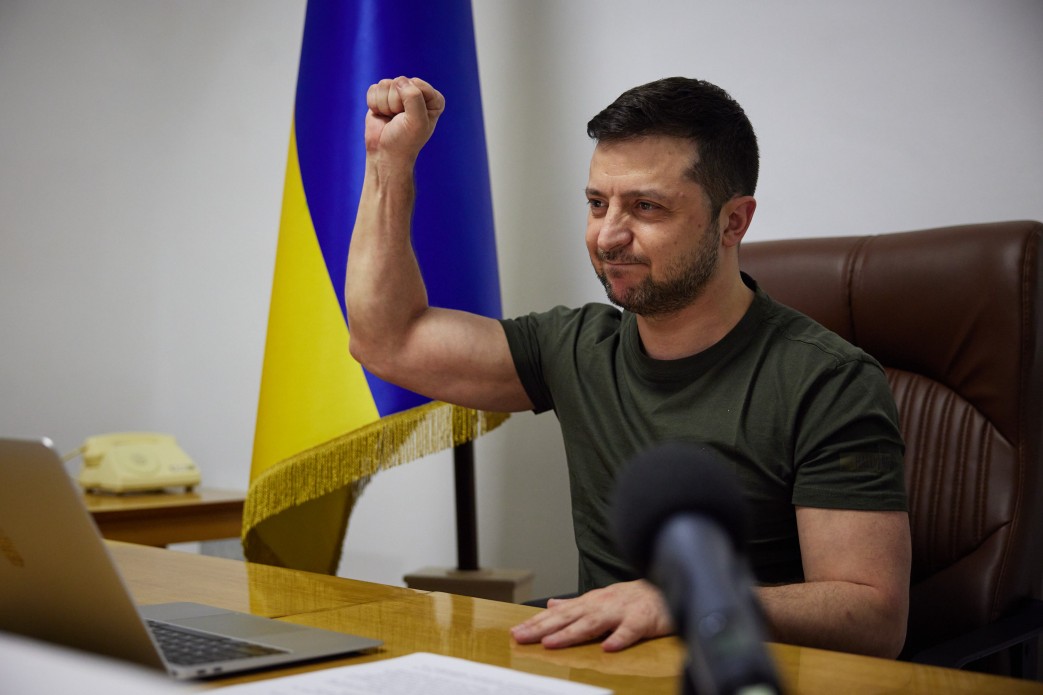
Ukraine's president Volodymyr Zelesnky addresses the Parliament of the United Kingdom in March 2022. Photo: president.gov.ua
In this regard, references to a shared history are particularly effective in crafting stories of national belonging and mission, grounding an individual’s membership in a wider community and linking that community to a mental geography and a coherent temporal trajectory.
Ukrainian President Volodymyr Zelenskyy has proven especially adept at not only deploying historical analogies, but also carefully targeting them when addressing diverse audiences. Drawing liberally on the lessons of the past, Zelenskyy has framed Ukrainian efforts to repel Russia’s incursion in terms of defending Europe’s post-1945 achievements in protecting human rights and promoting peaceful co-existence between states. Indeed, the Ukrainian president’s background as a Jew who lost family in the Shoah has only made his challenge to the civilised world to make good on its promise of “never again” all the more poignant. This has allowed him to exert moral pressure on western countries to deliver weapons to Ukraine and impose far-reaching sanctions on Russia.
Between freedom and slavery
When addressing Ukrainian audiences, Zelenskyy often invokes memories of the Second World War, calling for the mobilisation of popular resistance to Russian aggression and encouraging his compatriots to “win this patriotic war of ours”. Unsurprisingly, the historical narrative he presents to Ukrainians at home vehemently counters Vladimir Putin’s claim that Ukraine is an illegitimate state, with Zelenskyy stressing Ukraine’s innate Europeanness. This claim is only strengthened by his emphasis on the desire Ukrainians today exhibit for joining the European Union and NATO, support for which has risen dramatically across the country since February 2022.
However, Zelenskyy’s most striking use of historical rhetoric occurs in the international arena. In this context, Ukraine’s president leverages a kaleidoscope of historical analogies, ones calculated to resonate with specific audiences and ensure that they empathise with the violence that Ukraine is currently suffering. In this respect, Zelenskyy’s attempt to forge a shared bond between Ukraine and foreign audiences stands in stark contrast to the largely ineffective response that followed the 2014 annexation of Crimea.
German politicians and society are among the most complex audiences with which to connect on the basis of a shared historical worldview. This is due to their country’s fraught past and ongoing domestic debates over how to relate to Russia and the post-communist countries of Central and Eastern Europe more generally. When addressing the Bundestag on March 17th 2022, Zelenskyy drew on two specific aspects of the historical arsenal available to him. First, he stressed the successful overcoming of Germany’s East-West divide and tied it to Ukraine’s own internal divisions. Second, he emphasised Berlin’s continuing responsibility to be a moral beacon to the world in light of the crimes of Nazism. Referencing Germany’s own struggle for unity and self-determination, Zelenskyy stated that “It’s as if you are behind a wall again. Not the Berlin Wall, but one in the middle of Europe. Between freedom and bondage. And this wall grows stronger with every bomb that falls on our land, on Ukraine. With every decision that is not made for the sake of peace.”
Drawing further on Germany’s historical consciousness, Zelenskyy invoked Ronald Reagan’s famous June 1987 “Berlin Wall” speech. Echoing the American president, who exhorted Mikhail Gorbachev, the USSR’s last leader, to “tear down this wall”, Zelenskyy metaphorically asked the same of Olaf Scholz. Such references to brighter moments in German history permitted Zelenskyy to challenge Germany’s politicians to unequivocally support Ukraine, while exhorting them to help overcome the geographic and political divisions that still exist on the European continent.
Simultaneously, we find the Ukrainian president mentioning the Second World War and the extreme violence suffered on the territory of what became independent Ukraine in 1991. In this same speech Zelenskyy recalled the 2021 visit of German President Frank-Walter Steinmeier to Babyn Yar, a ravine on the outskirts of Kyiv where more than 33,000 Jews (among others) were executed during the Nazi occupation and where a Russian missile strike in early March 2022 reportedly damaged parts of the Holocaust memorial complex. Germany, like other western countries, has adopted a cosmopolitan memory norm. This demands that the extreme violence of the Second World War, centred on the Holocaust, is to “never again” be repeated. And this was exactly the chord that the Ukrainian president struck in the Bundestag: “I appeal to you on behalf of everyone who has heard politicians say: ‘Never again.’ And who saw that these words are worthless. Because again in Europe they are trying to destroy a whole nation. Destroy everything we live by and live for.”
In Germany these words have a particularly strong moral bearing and serve to polarise political debate. Zelenskyy continued by emphasising the return of violence to places destroyed during the Second World War: “It is difficult to survive without the help of the world, without your help. It is difficult to defend Ukraine, Europe without what you can do to ensure that we are not looking backwards once again after this war. After the destruction of Kharkiv… For the second time in 80 years. After the bombings of Chernihiv, Sumy, and Donbas for the second time in 80 years. After thousands of people have been tortured and killed, for the second time in 80 years. After all, what then is historical responsibility; what happened 80 years ago has not yet been atoned for before the Ukrainian people.”
Connecting with history
When addressing audiences in the formerly communist countries of Europe, Zelenskyy emphasised their importance to the European Union. This appeal resonates on multiple levels. For example, it grants countries such as Poland or the Baltic states the acknowledgement of their history as integral to the history of Europe as a whole and recognises them as being “properly European”, a recognition they have been striving for since their accession to the Union in 2004. Speaking before the Polish parliament (Sejm) on March 11th 2022, Zelenskyy charmed his Polish audience by stressing Poland’s crucial place in the history of European integration. He likewise referenced Polish heroism in protecting Europe, echoing how Poles portray key moments of the Second World War, such as the Warsaw Uprising, in their national narrative. Zelenskyy, moreover, glossed over the history of shared violence between Ukraine and Poland and symbolically united the two countries in extolling their significance for all of Europe: “We can do everything together. And this is the historical mission, the historical mission of Poland, the historical mission of Ukraine to be leaders who together will pull Europe out of this abyss, save it from this threat, stop the transformation of Europe into a victim.”
In the Baltic states the tone Zelenskyy sets is similar, with great stress placed on the importance of each of these countries’ histories for Europe. On April 12th 2022, the Ukrainian president thanked the Lithuanian parliament for having been among the first to support Ukraine after the Russian invasion, stating that such support is proof of “the values that underlie the unification of nations on the European continent after the Second World War”. In his speech Lithuania also became a stand-in for European values more generally: “Of course, if everyone in Europe were as principled and respected the values of Europe as you do in Lithuania, and we are proud of you, I am sure that the Russian leadership would not expect that they would go unpunished. Probably, this war would not have begun. They would not have dared to make the decision to start it.”
Meanwhile, speaking to Lithuania’s own suffering at the hands of the Soviet Union, Zelenskyy emphasised that the Lithuanian people, “like no other understand how the occupiers can destroy freedom and at what cost independence must then be rebuilt, which you have done in an exemplary fashion”. According to him, it is because of these historical experiences that Lithuania is in a particularly strong position to provide the moral leadership Europe requires to “truly save and uphold common values”. More broadly, Zelenskyy argued that the post-communist countries are today proving that “the common values of freedom, human rights, respect for state borders and prevention of a war of invasion are in fact alive, not something outdated and only worthy of a museum”.
Even in instances where there exist fewer obvious historical parallels, Zelenskyy and his speech-writing team have managed to identify events that can be used to build a rhetorical bridge between Ukraine and the target audience. For example, on April 21st Zelenskyy addressed the Portuguese parliament, just a few days before the anniversary of the 1974 Carnation Revolution, which saw the overthrow of the Estado Novo regime. He used this anniversary to link the shared experience of dictatorial rule endured by Portugal and Ukraine: “The Carnation Revolution … freed you from dictatorship, you clearly understand our feelings. You understand exactly the feelings of all other nations in our region that seek freedom. What does Russia bring to Ukraine? Death and dictatorship.” This constituted a particularly meaningful reference as the Carnation Revolution heralded the start of the so-called “Third Wave” of democratic transitions that eventually brought about the collapse of the Soviet system and communism in Europe.
Similarly, when addressing the British House of Commons on March 8th, Zelenskyy appealed to British heroism and exceptionalism, themes readily invoked in debates prior to Britain’s 2016 referendum on EU membership. Particularly noteworthy in this regard was Zelenskyy’s paraphrase of Winston Churchill’s famous 1940 “We shall fight on the beaches” speech, which the British prime minister delivered after the Wehrmacht forced Allied troops to evacuate from Northern France. In attempting to rally the public, a defiant Churchill stressed that Britain would never give up: “We shall go on to the end. We shall fight in France, we shall fight on the seas and oceans, we shall fight with growing confidence and growing strength in the air, we shall defend our island, whatever the cost may be. We shall fight on the beaches, we shall fight on the landing grounds, we shall fight in the fields and in the streets, we shall fight in the hills; we shall never surrender.” It is no accident that Zelenskyy adopted this same tone when he stated that “We will not give up, and we will not lose. We will fight until the end, at sea, in the air. We will continue fighting for our land whatever the cost. We will fight in the forests, in the fields, on the shores, in the streets.”
Contentious Holocaust comparisons
Despite the overall effectiveness of Zelenskyy’s appeals, his historical analogies have not gone unchallenged. For example, in his address to the Israeli Knesset on March 20th, Zelenskyy drew direct parallels between the extermination of Jews and Russia’s war against Ukraine: “Listen to what the Kremlin says … When the Nazi party raided Europe and wanted to destroy everything … [t]hey called it ‘the final solution to the Jewish issue’. You remember that. And I’m sure you will never forget! But listen to what is being heard now in Moscow. Hear how these words are said again: ‘Final solution’. But already in relation, so to speak, to us, to the ‘Ukrainian issue’.” Furthermore, along with claiming an equal status as victims, Zelenskyy argued that “Ukrainians have made their choice. 80 years ago. They rescued Jews.” In response, Israeli politicians strongly condemned the drawing of comparisons between Moscow’s incursion into Ukraine and the Holocaust, as well as the perceived whitewashing of Ukrainian crimes against Jews.
Comparisons to the Holocaust are never trivial and they are deeply offensive to those who stress the uniqueness of the planned extermination of European Jews. Moreover, Israel has a sizeable Russian-born population and many dual citizens living in the country. Disapproval of Zelenskyy’s comments was voiced by Bezalel Smotrich, leader of the Religious Zionist Party, who stated that “His criticism of Israel was legitimate, as was his raising expectations of us, but not his infuriating and ridiculous comparison to the Holocaust and his attempt to rewrite history and to erase the role of the Ukrainian people in the attempts to exterminate the Jewish people.”
In bringing up the issue of complicity in Nazi violence, a complicated topic of controversy in Ukraine as elsewhere, Smotrich challenged the very foundation of Zelenskyy’s historical narrative. Along similar lines, Yuval Steinitz, a member of Israel’s Likud Party, pointed out the issue of comparing “a regular war, as difficult as it is, and the extermination of millions of Jews in gas chambers in the framework of the Final Solution”. He dismissed any attempt to do so as “a complete distortion of history”.
Unity in fragmentation?
Historical narratives are only as effective as the extent to which they appear socially grounded and legitimate. Zelenskyy’s narratives concerning history would not be nearly as persuasive on either the domestic or international stage if they were not at least minimally congruent with broader attitudes in Ukraine. In this regard, although Ukrainian collective memory is still far from unified, societal views on the past have changed quite rapidly since the 2013-14 Maidan protests, with interpretations of history rooted in the Soviet era increasingly giving way to more national ways of remembering.
In January 2021 we were able to conduct a survey on historical attitudes in Ukraine, which provides an important pre-invasion baseline, even if the implication it carries for today’s situation can only be speculated about. Our results illustrated that, on average, there was a fair degree of congruence between how elites utilise history and the views of the past actually held by ordinary Ukrainians. This is despite the persistence of very noticeable differences based on the respondent’s region of residence, their age and whether the survey was taken in Russian or Ukrainian. Nevertheless, as other research has demonstrated, regional differences in how the past is understood are gradually becoming less prominent, although nationalist views continue to be most dominant in Western Ukraine.
An intriguing point of comparison between respondents in Ukraine and Russia, where we ran an equivalent survey in the same timeframe, concerns markedly differing attitudes towards the Soviet era between the time of Stalin’s death and before Gorbachev came to power. Provided with a set of five positive associations and an equal number of negative ones, more Ukrainians than Russians cited the negative associations, especially the lack of political choice and the surveillance of personal life. Conversely, Russians outnumbered Ukrainians in referencing positive associations, being particularly likely to mention social justice, friendship with neighbouring countries and economic stability. These findings highlight that Ukrainian respondents contrast post-Soviet developments with Soviet-era shortcomings, whereas Russian respondents find themselves contrasting post-Soviet failures and uncertainties with a perceived period of past stability.

The topic of the 1932-33 famine in Ukraine, known as the Holodomor, has also become a key topic of political discourse. Former President Viktor Yushchenko, in office from 2005 to 2010, sought to make the Holodomor the fundamental historical experience on which to base Ukrainian identity, introducing in 2006 a law recognising the famine as a Soviet-orchestrated genocide. While at the time this was a controversial position, acceptance of this narrative has increased noticeably since the overthrow of Viktor Yanukovych’s pro-Kremlin government in February 2014. As of January 2021, 55 per cent of Ukrainian respondents affirm that they think the Holodomor is best described as an artificial famine and genocide that deliberately targeted the Ukrainian nation. Meanwhile, 36 per cent of respondents—primarily those living in Eastern Ukraine—embrace the perspective that the Holodomor constituted a common tragedy of the Soviet people, be it as an artificial famine or the result of natural conditions. In contrast, in Russia more than 60 per cent of those surveyed agree with this second characterisation.

Attitudes displayed across Ukraine also diverged profoundly from those in Russia when we posed the question of which state was most responsible for the outbreak of the Second World War. In Ukraine, a plurality replied that it was Nazi Germany alongside the Soviet Union which bore responsibility for the start of this war. The viewpoint corresponds to an EU resolution from September 2019, which assigned co-responsibility for the war’s inception to Hitler and Stalin. In contrast, 80 per cent of respondents in Russia ascribed blame to Germany alone.

Complementing questions about guilt for the start of the Second World War are those relating to who made the largest contribution to ending it. Ukrainian respondents are most likely to mention that it was the Soviet Union alongside the Allied Forces that played this role (whereas 39 per cent cite the USSR alone). In contrast, 70 per cent of Russians believe it was solely the Soviet Union. These divergent views illustrate the complexity of articulating European views on history. By way of comparison, a plurality of 44 per cent of respondents in Germany (where we also conducted our survey) stated the largest contribution was made by the Allied Forces and 34 per cent mentioned the Soviet Union alongside the Allies. These findings reflect the diverse post-war historical reality and convey the challenges associated with “Europeanising” the contradictory 20th century.

While it may surprise some that history is featuring front and centre in this war, who controls the historical narratives underpinning this conflict – and thus shapes the hearts and minds of the outside world – is every bit as important as which side dominates on the battlefield. Zelenskyy has made ample and very effective use of historical references, especially when addressing international audiences. His claims appear authentic because he mirrors a Ukrainian reality that is increasingly at odds with Russians’ perceptions of the past. Despite mnemonic divisions within Ukraine remaining regionalised when our survey was conducted in 2021, Ukrainian history has, to a meaningful extent, already been folded into a wider European worldview. This comes with all the challenges implied for other post-communist states that have tried to navigate and integrate the historical substrate underpinning European integration.
Félix Krawatzek is a Senior Researcher at the Centre for East European and International Studies (ZOiS) in Berlin as well as an Associate Member of Nuffield College (University of Oxford). He is also the PI on the ERC-funded research project “Moving Russia(ns): Intergenerational Transmission of Memories Abroad and at Home” (MoveMeRU). Previously he held a British Academy Postdoctoral Fellowship at the University of Oxford’s Department of Politics and International Relations.
George Soroka is a lecturer in the Department of Government at Harvard University, where he is also affiliated with the Davis Center for Russian and Eurasian Studies, the Harvard Ukrainian Research Institute, the Minda de Gunzburg Center for European Studies, and the Institute for Quantitative Social Science.