
Can the Three Seas bring a new balance to European politics?
The Three Seas Initiative has evolved into a geopolitical and geo-economic grouping of primarily post-communist EU member states. Despite their diversity and differences in policies towards Russia, the members are showing certain common interests.
The Three Seas Initiative was originally developed as a geopolitical alliance of NATO/EU member states of “New Europe”: from Estonia to Croatia, connecting the Baltic and Adriatic Seas. The initiative was officially launched in 2015 as the Adriatic-Baltic Sea Initiative by Croatian President Kolinda Grabar-Kitarović and has been referred to as the ABC (Adriatic, Baltic, and Black Sea) Initiative, first designated by Polish President Andrzej Duda. It has also been referred to as “the vertical”, considering the north-to-south direction of the bloc of countries which make up the initiative.
March 5, 2019 -
Petar Kurecic
-
AnalysisIssue 2 2019Magazine
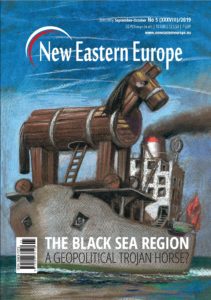
Illustration by Andrzej Zaręba
With the inclusion of Bulgaria and Romania, the initiative effectively became widely referred to as the Three Seas. The members of the project include 12 states – all members of the EU and geographically located in Central and Eastern Europe.
Even by its name, the project resembles the geopolitical idea of Intermarium, which was envisioned after the First World War as a federation of independent Central and Eastern European states. Today, the member states of the Three Seas, with the exception of Austria, share common features such as being post-communist states, NATO members and newer members of the European Union. The initiative also has a geopolitical role to contain the influence of Russia and, perhaps, even draw the states in the post-Soviet space out of the Russian sphere of influence.
East-West divide
One way to perceive the Three Seas Initiative is like an enlarged Visegrad Group (the V4 states include Poland, Hungary, the Czech Republic and Slovakia). The V4 states are in fact the main proponents of the EU as a community of national states, as opposed to the idea of establishing greater political integration. This East-West divide is further strengthened by the support of US President Donald Trump, who attended the Three Seas Summit in Warsaw in 2017. The Trump administration’s support for the project may be interpreted as an opportunity to divide Europe (it is no secret that Trump has been very critical of the EU) on an East-West axis. Trump has also proclaimed the economic potential of the bloc as a market for US oil and gas.
Yet on the other hand, the continuous downgrading of multilateralism – and, consequently, the role of NATO in Europe – by the US administration, does not necessarily favour the security of the initiative’s members. Good political and economic relations between some of the initiative’s members and Russia, as well as a shift towards “illiberal democracy”, cannot be ignored. This is particularly true when it comes to Russian President Vladimir Putin and Hungarian Prime Minister Viktor Orbán.
Hungary has clear economic interests in co-operation with Russia, as it imports Russian gas and Russia is constructing a second bloc of Soviet-style nuclear power plants in Paks. Already in 2008, before the events in Georgia and Ukraine, Hungary was the only NATO member from “New Europe” that opposed NATO opening the door to these states. Beyond Hungary, states like Slovakia, Austria and, to some extent, the Czech Republic have a certain level of pragmatic relations with Russia. Despite their unanimity in support for sanctions against Russia, their support for NATO’s role in Europe and their more or less expressed compliance with US foreign policy since the 1990s, these states illustrate the lack of unity in the project when it comes to relations with Russia.
Regarding Russia, two informal groups within the Three Seas can be identified. Poland, Estonia, Latvia, Lithuania, Romania and Croatia (up to a point, due to a shift in its policy since 2015) make up the group of “New Cold warriors”. Austria, Bulgaria, Hungary, Slovakia and Slovenia can be regarded as the “pragmatics”. The Czech Republic is somewhere in between. This dichotomy reveals the fact that policy towards Russia is a dividing factor, not a binding one. Yet, there is some room to create stronger ties on a series of issues, particularly hard security and energy, which could play a role in better harmonising relations with the Kremlin and the more “pragmatic” Three Seas members.
Hard security
Most members of the Three Seas have not significantly increased their military spending since the outbreak of the conflict in Ukraine, the Russian annexation of Crimea and its assertive military policy in the Baltic and Black Sea regions. The only exceptions are Estonia and Lithuania, which have increased their armed forces by about 10 and 30 per cent, respectively. In 2015 the total number of armed forces in the 11 NATO/EU member states (that are also members of the Three Seas) was about 522,000 (Poland and Romania contributed to that number, with about 323,000). In 2015, Russia’s armed forces totalled roughly 1.5 million, so the ratio between the 11 NATO members of the initiative and Russia was about 1:3 (without considering Russia’s dominance in terms of armoured vehicles and aircraft and not to mention its procession of nuclear weapons).
Therefore, NATO represents an indispensable security guarantor for the member states of Central and South-Eastern Europe, particularly those located in the possible Baltic and Black Sea theatres of war. The smaller Central European NATO members states which share a border with Ukraine (i.e. Slovakia and Hungary) are also exposed, but to a lesser degree – due to their geographical location and pragmatic policy towards Russia (for example, they do not host anti-ballistic missile systems like those found in Poland, the Czech Republic, and Romania).
Defence expenditure as percentage of GDP has showed that only two of the Three Seas member states (Poland and Estonia) complied with the NATO recommendation of two percent of GDP. Due to the small size of Estonia, only Poland can be considered a member with a military force that currently complies with NATO’s recommendation, since it has a modernised weapons system. Poland feels most exposed due its shared border with Russia to the north (Kaliningrad) and the Suwalki Gap – an 80 kilometre stretch which could become a bridge for ground troop transport between Belarus and Kaliningrad. Additionally, the activities of the Russian Baltic Fleet and Russian air force illustrate a renewed presence and assertiveness of Russia on the sea and in the air.
Energy and infrastructure
In terms of energy and infrastructure, the Three Seas has a chance to play a role to balance the geopolitical and geo-economic situation. The initiative has declared two large infrastructure projects as its main goals. First, the North-South Highway, called Via Carpathia, will be a corridor between two important harbours: Klaipėda in Lithuania and Thessaloniki in Greece. The second project is the planned gas pipeline that would connect two future liquefied natural gas (LNG) terminals, one in Poland (Świnoujście) and the other on the Croatian island of Krk. The pipeline between the Adriatic and Baltic Seas could play a significant role in the diversification of energy suppliers to this region. What is more, the United States has shown particular interest in supporting the pipeline project, highlighted by President Trump’s visit to the July 2017 summit in Warsaw. During the summit, Trump promoted US natural gas and coal exports as the US has become a net exporter of natural gas thanks to the growth of shale gas extraction via fracking. Beyond the Three Seas member states, Ukraine, with its heavy industry and dependency on energy, seeks to import more coal and the US could be a potential supplier.
Due to the US interest in exporting more gas to Central and Eastern Europe, obstructing the construction of the Nord Stream 2 pipeline – which would deliver gas directly from Russia to Germany – remains a key American objective. Its main ally, Poland, supports these efforts along with the construction of the LNG terminal on the Croatian island of Krk, and the building of gas pipeline interconnectors in the region. However, the interest in buying the capacities in the planned LNG Terminal in Croatia has been much lower than expected, therefore seriously jeopardising the realisation of the project.
Attempts to halt the construction of the Nord Stream 2 pipeline have not been successful, despite the threat of sanctions and the complaints made by most of the Three Seas member states that the pipeline is against the interests of the EU. Ukraine, being a transit state for Russian gas, also stands to lose significantly should the pipeline go ahead (a final decision is expected sometime later this year). One further step in an attempt to prolong Russian and German dependence on transit countries (like Belarus, Ukraine and Poland) is a law that was passed by US Congress in July 2017. While it makes it more difficult for the president to end sanctions against Russia, it also targets the Nord Stream 2 project, which would significantly reduce or, de facto end, the dependence of Germany and Russia on transit countries.
The Nord Stream 2 gas pipeline would significantly lower the geo-economic significance of Poland because its territory would no longer be used to partially block the delivery of gas from Russia to Germany. Meanwhile, Germany and Austria have criticised the new US sanctions on Russia, describing them as an illegal threat to EU energy security.
Common interests
The Three Seas Initiative has evolved into a geopolitical and geo-economic grouping of primarily post-communist NATO/EU member states. Despite their diversity and some differences in their policies towards Russia, members of the initiative are showing common interests, such as a heavy reliance on NATO as a protector (de facto the US security umbrella), a determination to lower dependence on Russian gas, a desire to develop new transit corridors and gas pipelines, and a willingness to act jointly as a barrier towards a possible renewed German-French-Benelux vision of Europe, which focuses on tighter integration of the political aspects of the EU.
The Visegrad Group, therefore, has emerged as a primary opponent of a federalised Europe, with Poland as its logical forerunner. The influence and objective importance of the Baltic states (as well as Croatia) in the EU mean those states have to continue working together – they cannot act as “game changers” alone. These states have connected with the Visegrad Group in an effort to increase their bargaining power, while at the same time strengthening the presence of American interest in this part of Europe.
Petar Kurecic is an associate professor of political science and an assistant professor of geography at the University North in Croatia.