
Text resize: A A
Change contrast

Education reform put to the test

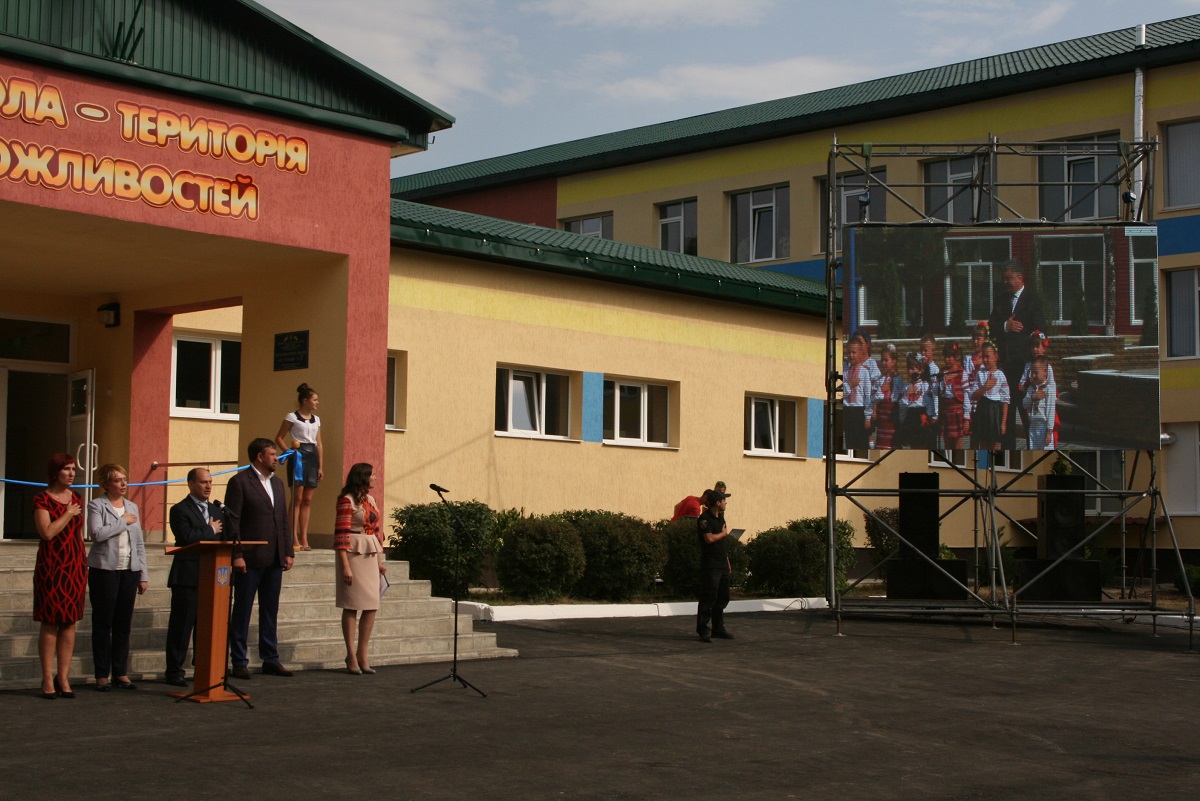
Druzhkivka, a small industrial town in eastern Ukraine, is one of the testing grounds for the new system of schooling recently introduced in the country. The ceremony marking the beginning of the school year in a Druzhkivka school, which is now part of a wider network of base schools, was attended by Lilia Hrynevych, the education minister. It was also watched via live stream by Petro Poroshenko who, at the same time, was opening a new base school in Pokrovsks.

Druzhkivka is a small town in eastern Ukraine with a population of around 58,000. The city is the second to last railway stop on the Donbas-Kyiv route. Located just 18 kilometres from Kramatorsk, it can be easily reached by the local bus service, which is a popular way for the residents of Druzhkivka to commute. Between April and June 2014 the city was under the control of pro-Russian separatist forces. Even though tensions were not as strong as they were in the nearby Sloviansk, the town had its share of victims, with an Orthodox priest among them.

January 2, 2018 - Kateryna Pryshchepa - Hot TopicsIssue 1 2018Magazine

The base school in Druzhkivka was officially inaugurated on August 28th 2017 by Lilia Hrynevych, Ukraine’s education minister. Photo by Kateryna Pryshchepa


Four years since the Revolution of Dignity, the town still exhibits traits of the old regime. Its unchanged elite continue to keep its grip on power. The local residents display a very low level of civic engagement and only a few have any confidence in the government in Kyiv. However, it would be unfair to say that nothing has changed as the ferment of civil activism has somewhat reached Druzhkivka.

How much change?

After the brief period of separatism, the city of Druzhkivka began implementing the decentralisation reform with the same mayor – Valeriy Hnatenko. Despite local civic activists’ claims about his direct involvement with the pro-Russian separatists and support for the Donetsk People’s Republic referendum, Hnatenko has managed to persevere. Political commentators claimed that Hnatenko’s strong connections with the regional law enforcement structures are the main reason for his longevity. This was illustrated best when Hnatenko sued Iryna Kirikova, a civic activist who publicly accused him of supporting separatist activities, accusing her of defamation. The court case unfolded over several tense months. Kirikova received legal support from a local NGO and she introduced video material to support her claims. The scandal caught the attention of the national press yet it brought no results.

Local activists claim that Hnatenko treats Druzhkivka as a source of his personal income. Before being elected to office in 2006, he held numerous positions in local tax offices. In Soviet times, he was a policeman. Despite the fact Hnatenko has been employed in the public sector his whole life, he can afford a lavish lifestyle like a wealthy CEO. What is more, since the moment he became city mayor, Hnatenko has never faced any problems with the city council – his policy proposals always pass with little objection.

The political changes that took place in Ukraine, initiated in the distant Kyiv, have also resonated here, generating a need for a new city identity. In this process, the authorities turned to the history records and found that Druzhkivka was one of the settlements established by Cossacks in the vast Ukrainian steppe, which was first mentioned in the late 18th century. According to legend, the town’s name comes from the name Druzhko, which was the name of a Cossack who apparently settled there. This legend, however, is almost identical to that propagated by Kharkiv that says it was named after the Cossack Kharko. In Druzhkivka, however, this legend has found a new official backing. As a result, an official statue of Druzhko was erected in 2008 during the tenure of President Viktor Yushchenko, who had been a staunch promoter of Ukraine’s national identity. The inscription reads (in Russian) that the statue was built upon the mayor’s initiative.

Starting in the late 19th century and the first quarter of the 20th century, Druzhkivka, like many other towns in Donbas, was transformed into an industrial centre. This transformation was largely sponsored by Belgian and French resources. Yet, today there are no signs that memorialise the town’s Belgian history. The old industrial sites that were built in the beginning of the 20th century are now referred to by their Soviet names. Likewise, the largest church in Druzhkivka, initially built as a Catholic church, now belongs to the Ukrainian Orthodox Church of the Moscow Patriarchate. The most authentic evidence of a European presence in town is to be found in the ruins of the cemetery, which the locals call the French cemetery.

New law

In September 2017 the Verkhovna Rada, Ukraine’s parliament, passed a new law on education. The legislation established important changes in the country’s education system. One of the most contentious stipulations is a requirement that all school students are obliged to have classes in Ukrainian (in addition to their mother tongue, if it is not Ukrainian). The law further restricts instruction in Russian, declaring that it can only be taught as a foreign language.

When asked about this provision, officials with the Ukrainian ministry of education point out that the restrictions towards Russian language introduced by law did not come from the ministry but was an amendment introduced in parliament. Making Ukrainian compulsory is not the only big change. The drafters of this legislation hope to build on other reforms that are being implemented in Ukraine, starting with administrative and decentralisation reforms. The latter reform aims to make local governance more financially effective. According to the reform, budgets of the small localities are eligible for greater resources. The ministry of education expects decentralisation to be one of the main steps to bolster the education reform. For the first time, localities are expected to keep more of their own revenue and in some cases receive more cash from the state’s coffers to invest in road infrastructure and ensure that children can travel to school every day. The new law envisions that local councils will be responsible for ensuring student transportation to schools.

The law also states that the responsibility for the management of schools will be fully entrusted to the local government which, in turn, is recognised as the school benefactor. Therefore, it is also expected that from now on the localities– and not the central government in Kyiv–will be investing most of the resources into school infrastructure at the local level. The local agencies will also be involved in overseeing the educational processes in schools and local residents should play a greater role by participating on supervisory boards, which will be better empowered to make decisions related to education in their localities.

Base schools

Another major element created with the reform is the new base school system. The purpose of this system is to increase the quality of education given to students who live in small rural communities. Starting after primary school, children in small villages will now commute to schools in nearby towns. This change is meant to ensure that rural children are given the opportunity to access better quality education. These schools will be called base schools. Village primary schools, where students are taught until the fifth grade, will become official affiliates or subsidiaries of the base schools. The base schools will not be limited solely to students who are bussed from smaller communities but will also include students from the nearby towns.

Since the base school system is one of the flagship projects for the education ministry, the choice of their location is an important one. So far in many areas the base schools have been converted from the more prestigious local schools. This means that these schools are already well equipped and have a good track record.

The base schools are guaranteed investments from the central government which includes infrastructure and renovation of the school properties. Hence, the choice of a base school can be decisive for a school’s prestige. The principal of the base school is also entitled to dispose the funding for both the school and all of its affiliates, namely primary schools in the villages. The base school system is to be introduced gradually. At the moment, the decision to open new schools is closely supervised by the ministry of education, which ensures that funding is appropriated properly. According to statistics from November 2017, there are already 450 base schools and 900 affiliate schools operating throughout Ukraine. The oblast, an administrative region in Ukraine, with the largest number of base schools is the rural Kirovohrad oblast in central Ukraine; it has 66 schools opened so far. The second most popular location, in terms of numbers, is the Lviv oblast: it has opened 38 base schools.

In Donetsk, only eight base schools have been opened, while in the Luhansk oblast the number is seven. Thus, the newly opened base school in Druzhkivka will, in many ways, be a testing ground for the new system. So far the experiment has brought about mixed results. Evidently, in this small town in the eastern part of the country, local politicians still have a large impact on the implementation of the school reform.

No questions, no principal

The Druzhkivka base school was established through the transformation of local school number 17. The transformation was already decided in the spring 2016 as a part of the ministry of education base schools pilot project. It was officially opened in its new capacity on August 28th 2017 even before the law on education was passed by the parliament. The ceremony took place simultaneously with the opening of the two other base schools in the Donetsk oblast – in Pokrovsk and Chasiv Yar. The school in Druzhkivka was officially inaugurated by Lilia Hrynevych, Ukraine’s education minister, and the one in Pokrovsk by Petro Poroshenko, Ukraine’s president, who was accompanied by the head of the Donetsk oblast administration. The one in Chasiv Yar was opened by Deputy Prime Minister Hennadiy Zubko. The events were live streamed online. The public gathered into the three school yards to watch the ceremonies of the other two schools.

The ceremony in Druzhkivka was held in good, old Soviet fashion. First, the pupils welcomed the minister by reciting poems and presenting a dance performance. Those who gathered at the ceremony in front of the school building had to wait about two hours for the event to commence. The minister arrived late for the ceremony, but as she arrived, it was further delayed since Poroshenko had not yet made it to the school in Pokrovsk – the ceremonies had to be held simultaneously.

Preparing for the minister’s visit, the Druzhkivka city authorities did not want to take any risks. It was ensured that no one would be asking uncomfortable or awkward questions. Uniformed policemen secured the location and one was even filming every step of a local activist named Pavlo Ostrovskyi, who was present at the ceremony. It later turned out that, in addition to the officer with the camera, there was also a non-uniformed agent tasked to ensure Ostrovskyi would keep his distance from the minister.

Even though the opening ceremony was an important event, the school’s director, Vadym Yelagin, did not attend due to an apparent illness. Yelagin was the school’s principal before it was transformed into a base school. He hoped to keep his position, but the city authorities had someone else in mind for the job. Minister Hrynevych was thus welcomed by the chairman of the city’s department of education and the city mayor. When talking with local journalists, she admitted that she was aware of some controversies surrounding the appointment of the new school principal. She claimed to have asked the regional state administration to oversee the selection process and ensure that the new principal is selected in an orderly and transparent manner.

Scandal and conflict

The base school in Druzhkivka has been plagued by scandal practically from the moment its new status was announced. According to a local NGO called “Civic Control”, the contract for renovating the school was awarded to a company tied to Druzhkivka’s mayor. There were no transparent procedures in place for awarding the contract and, what is worse, the school was poorly upgraded and the contractor refused to fix any problems. When the school was officially opened on August 28th 2017 – two days before the start of the school year in Ukraine – many construction problems remained unresolved.

In the meantime, a fierce row about who would be the new principal of the base school continued to unfold. Local pro-Ukrainian activists opposed the nominations as they believed the candidates would be connected to pro-Russian separatists. Until mid-November 2017, the position had still officially been held by Yelagin, who claims that numerous attempts were made to remove him. In a video shared in November 2017, Yelagin said he had submitted an application for the role of principal in the new school but was advised by local authorities to pass additional medical tests to prove he was fit for the job.

Among the two candidates for the position who were proposed by the city authorities one was Iryna Prus, who represents the party Nash Krai (Our land) in the city council. The party was formed in 2014 by former members of the Party of Regions (the party of the ousted president, Viktor Yanukovych). A profile of Prus can be found on the Kyiv-based website Myrotvorets, where pro-Ukrainian activists collect information and evidence against individuals who they believe support separatist activities in Ukraine. On the website are photos portraying Prus at a meeting where attendees claim that Kyiv “doesn’t want to hear the voice of Donbas” and calls for Russia to send a “peacekeeping military mission” to Ukraine. The meeting was organised by Prus’s sister, Valentyna Lugova, who used to be a principal at another local school. After some protests, as well as a campaign organised in the media by pro-Ukrainian activists, Prus’s candidature was withdrawn. Yelagin’s main competitor for the post then became Zhanna Vasylenko, who was in charge of school number 11 and who also served as a chairwoman of a committee under the Druzhkivka city council. Activists from the Civic Control NGO are also against her candidature, arguing that there are simply no reasons to change the principals at all.

The final round of the selection process took place on November 16th 2017. However, no principal was selected. There were only two candidates for the post: Vasylenko and Yelagin. Yelagin was reported ill, however, and the selection committee could only interview Vasylenko. A few days later, Yelagin received notice of his official dismissal. He announced his intent to appeal the decision in court. Nevertheless, by the beginning of December 2017 Vasylenko was officially appointed as the principal of base school number 17.

Kateryna Pryshchepa is a PhD candidate at the Institute of Political Studies of the Polish Academy of Sciences. She previously worked as a journalist in Ukraine.

,

Partners

Terms of Use | Cookie policy | Copyryight 2026 Kolegium Europy Wschodniej im. Jana Nowaka-Jeziorańskiego 31-153 Kraków
Agencja digital: hauerpower studio krakow.
We use cookies to personalise content and ads, to provide social media features and to analyse our traffic. We also share information about your use of our site with our social media, advertising and analytics partners. View more
Cookies settings
Accept
Decline
Privacy & Cookie policy
Privacy & Cookies policy
Cookie name Active
Poniższa Polityka Prywatności – klauzule informacyjne dotyczące przetwarzania danych osobowych w związku z korzystaniem z serwisu internetowego https://neweasterneurope.eu/ lub usług dostępnych za jego pośrednictwem Polityka Prywatności zawiera informacje wymagane przez przepisy Rozporządzenia Parlamentu Europejskiego i Rady 2016/679 w sprawie ochrony osób fizycznych w związku z przetwarzaniem danych osobowych i w sprawie swobodnego przepływu takich danych oraz uchylenia dyrektywy 95/46/WE (RODO). Całość do przeczytania pod tym linkiem
Save settings
Cookies settings